Chipa Guasú
"The big chipa" in Guaraní, and the summer counterpart to sopa paraguaya — fresh choclo instead of dry corn flour. The kernels are pulsed coarse, never puréed, because rupturing every cell releases water that weeps out of the custard as it bakes.
- Prep
- 25 min
- Cook
- 45 min
- Serves
- 8 servings, one 23 × 33 cm / 9 × 13 in dish
- Difficulty
- Easy
Researched · Kitchen testing pending
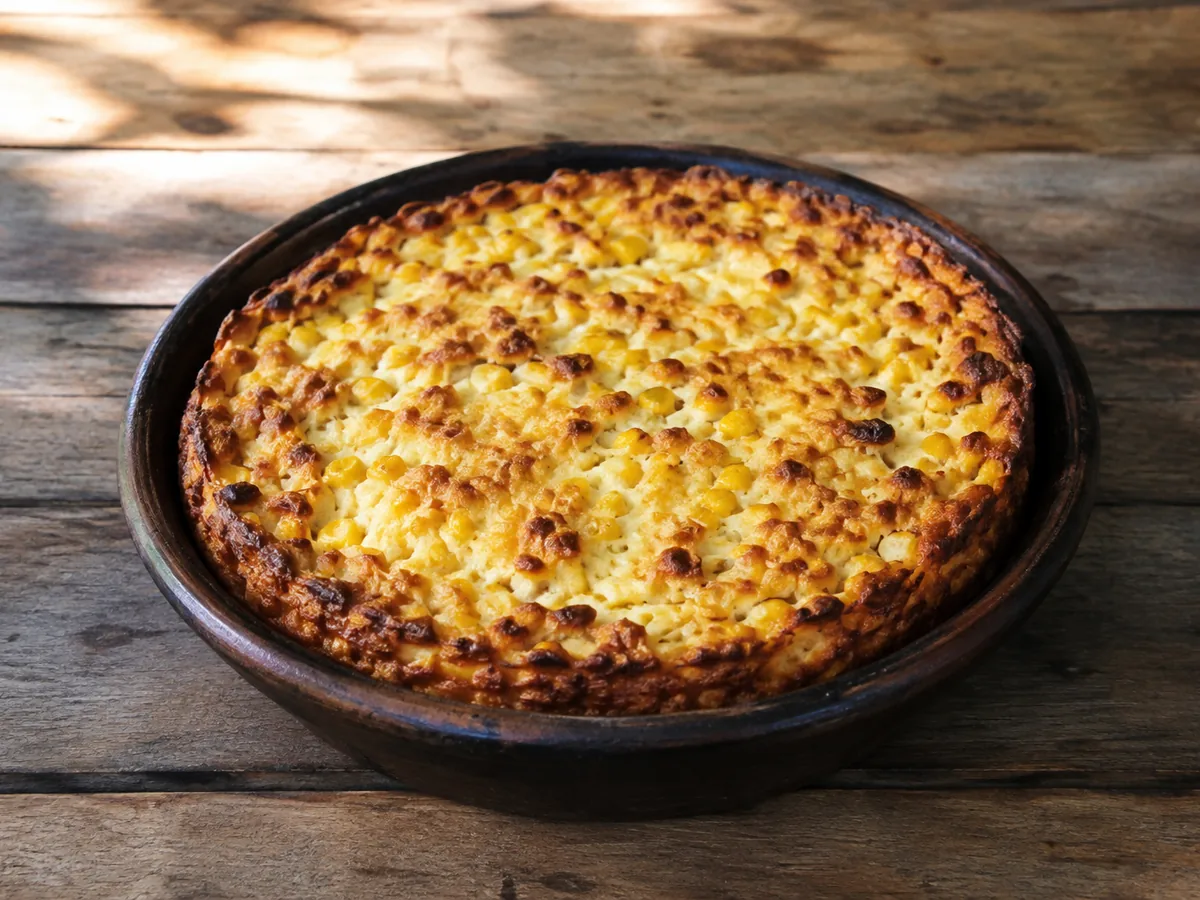
In Guaraní, chipa guasú means “the big chipa”. Where sopa paraguaya is built on dry toasted corn flour, this one celebrates the milky summer harvest of fresh sweet corn.
Kernels are stripped from the cob and crushed into a coarse, juicy batter with sweated onions, eggs, whole milk and crumbled Queso Paraguay. Baked hot until golden and bubbling, it comes out custardy and almost soufflé-like inside, with blistered caramelised edges.
Sweet, savoury, and full of molten cheese pockets — Paraguay’s comfort gratin.
The custard
- 1.2 kg6 cups kernelsFresh sweet yellow corn (choclo), cut from 6 to 7 large ears with the cobs scraped for their milk
- 500 g3 largeYellow onions, peeled and cut into fine 3 mm brunoise
- 120 ml½ cupRendered pork lard, or unsalted European butter
- 6 large6 largeEggs, at room temperature
- 200 mlscant 1 cupWhole milk
- 450 g3.5 cupsQueso Paraguay, or fresh farmer's cheese, crumbled coarse
- 12 g2 tspFine sea salt
- 2 g½ tspFreshly ground white pepper
- 15 ml1 TbspLard or butter, for the dish
Pulse, never purée
Fresh choclo holds living liquid endosperm — fructose, sucrose and ungelatinised starch. Coarse grinding ruptures the cell walls without liquefying them, which keeps the rustic texture. Blend it smooth and every cell releases its water, which then weeps out of the custard in the oven.
How it sets
Whisked with whole eggs and milk, the ovalbumin and ovotransferrin form a heat-set matrix. Past 75 °C the egg proteins coagulate around the corn starch while the milk fat and melting curds trap steam, and above 160 °C the surface sugars caramelise into the bronzed crust.
200 °C, not hotter
Above about 220 °C the top burns before the egg-and-corn custard inside has set. Hold 200 °C and let it take the full 45 minutes.
Drain canned corn hard
Canning brine dilutes the custard. If you must use canned, drain it thoroughly and pat it dry; frozen kernels want the same treatment.
Passive time, counted separately
The onions cool to lukewarm before meeting the eggs, and the baked dish rests 10 minutes. Neither is active work and both sit outside the times quoted above.
The five tastes on this plate
Salt is sea salt through the corn batter and the briny curds. Fat is rendered lard, whole milk and egg yolk making the custard mouthfeel. Acid is mellow, balanced by the lactic tang of fresh cheese. Heat is sweated onion and clean white pepper against the corn's sweetness. Umami is fresh corn, caramelised onion sugar and melted aged cheese.
Equipment
- Skillet
- Sharp chef's knife
- Food processor or blender
- Large mixing bowl
- 23 × 33 cm ceramic or Pyrex dish
- Instant-read thermometer
Traditionally heavy clay fuentes de barro preheated in a wood-fired tatakuá at about 220 °C. A 23 × 33 cm ceramic or glass dish works in a modern kitchen — ceramic insulates the sides so the custard in the middle cooks through gently instead of curdling at the edges.
Method
Sweat the onions12 min
Heat the 120 ml lard in a skillet over medium and add the diced onions with the 12 g salt.
Cook gently 10 to 12 minutes until completely soft, translucent and sweet, without browning. Cool to lukewarm.
Heat 120 ml lard over medium; add onions and 12 g salt. Cook gently 10–12 minutes until completely soft and translucent without browning. Cool to lukewarm before adding to eggs.
Strip and grind the corn10 min
Stand the shucked cobs upright in a bowl and slice down to strip the kernels, then scrape the bare cobs with the knife spine for the thick corn milk.
Into a processor with the milk, and pulse 6 to 8 times only — a coarse, juicy mash with distinct kernel pieces, not a purée.
Strip kernels into a bowl; scrape the cobs with the knife spine for their corn milk. Pulse in a processor with the milk just 6–8 times to a coarse, juicy mash, never smooth. Drain and dry canned or frozen corn thoroughly.
Whisk the custard base3 min
Beat the 6 whole eggs with the white pepper 2 minutes until frothy and pale.
Whisk in the 200 ml milk and the cooled onions with all their fat.
Beat the 6 whole eggs with the white pepper 2 minutes until frothy and pale.
Whisk in the 200 ml milk and the cooled onions with all their fat.
Assemble4 min
Stir the ground corn thoroughly through the egg mixture.
Crumble the cheese by hand into irregular bite-sized chunks and fold it in so pockets stay scattered.
Stir the ground corn thoroughly through the egg mixture.
Crumble the cheese by hand into irregular bite-sized chunks and fold it in so pockets stay scattered.
Bake to a gratin40–45 min
Preheat to 200 °C / 400 °F and grease the dish generously.
Pour in the batter, level it, and bake on the middle rack 40 to 45 minutes until deeply golden-amber, puffed and firm through the centre — 88–90 °C / 190–194 °F.
Heat oven to 200 °C / 400 °F; grease the dish generously. Pour in and level the batter. Bake on the middle rack 40–45 minutes until deep golden-amber, puffed and firm at the centre, reaching 88–90 °C / 190–194 °F.
Rest and serve
Rest 10 minutes before slicing into squares. The custard firms a little as it cools while staying unctuously moist.
Rest 10 minutes before slicing into squares. The custard firms a little as it cools while staying unctuously moist.
Sensory cues of doneness
- Visual: blistered deep golden-brown cheese spots across the top, and a centre that is puffed and set with a gentle custardy wobble.
- Auditory: quiet active bubbling around the edges of the dish as the fats separate and sizzle.
- Olfactory: roasted sweet corn, browned butter, sweated onion and toasted country cheese.
Look for blistered golden-brown cheese spots and a puffed, set centre with a gentle custardy wobble. Expect quiet bubbling at the edges and aromas of roasted corn, browned butter, soft onion and toasted cheese.
Storing it
It freezes well baked. Slice into squares, wrap in foil and freeze up to 2 months, then reheat at 180 °C / 350 °F for 15 minutes.
Troubleshooting
- A watery, separated custard.
The corn was blended smooth. Pulse it coarsely so the cells stay largely intact.
- A burnt top over a raw centre.
The oven was too hot. Above 220 °C the surface sets long before the custard does — hold 200 °C.
- A thin, diluted set.
Canned corn went in with its brine. Drain thoroughly and pat dry.
Substitutions
One-to-one global substitutions, with the technique adjustment each one requires.
Ingredient substitutions
| Ingredient | Replace with | Culinary impact and technique adjustment |
|---|---|---|
| Fresh choclo | Frozen sweet corn kernels, thawed and drained | One-to-one, and nearly identical in flavour and body |
| Queso Paraguay | Fresh mozzarella with crumbled queso blanco | One-to-one. Balances melting stretch against curd tang |
| Rendered pork lard | Unsalted European butter, or neutral corn oil | One-to-one. Butter gives a richer pastry aroma |
Scaling
Half, for 4 servings
Halve everything into a 20 cm square dish and bake 35 minutes at 200 °C.
Double, for 16 servings
Double everything across two 23 × 33 cm dishes baked side by side, rotating them front to back halfway.
What to serve it with
- Asado paraguayo — the classic partner, cutting through char and smoke
- Ensalada rusa — cold diced potato, carrot and pea in mayonnaise
- An ice-cold lager, or tereré
Questions
Can I use frozen sweet corn?
Yes. Thaw 1.2 kg completely, drain on paper towels to shed the excess water, and pulse coarsely as directed.
How is this different from sopa paraguaya?
Sopa paraguaya uses dry, finely milled corn flour and whipped egg whites, giving a firmer, bready sponge. Chipa guasú uses fresh sweet corn and whole eggs, giving a softer, moist custard.
Can I freeze leftovers?
Yes. Slice into squares, wrap in foil, freeze up to 2 months, and reheat at 180 °C / 350 °F for 15 minutes.