Sopa Paraguaya
The world's only solid soup, and it began as a mistake. President López's cook put too much corn flour into his milk-and-cheese broth in the 1850s, poured the thickened batter into a clay tray and pushed it into the tatakuá. Whipped egg whites are what keep it a sponge rather than a brick.
- Prep
- 30 min
- Cook
- 45 min
- Serves
- 8 large squares, one 23 × 33 cm / 9 × 13 in pan
- Difficulty
- Medium
Researched · Kitchen testing pending
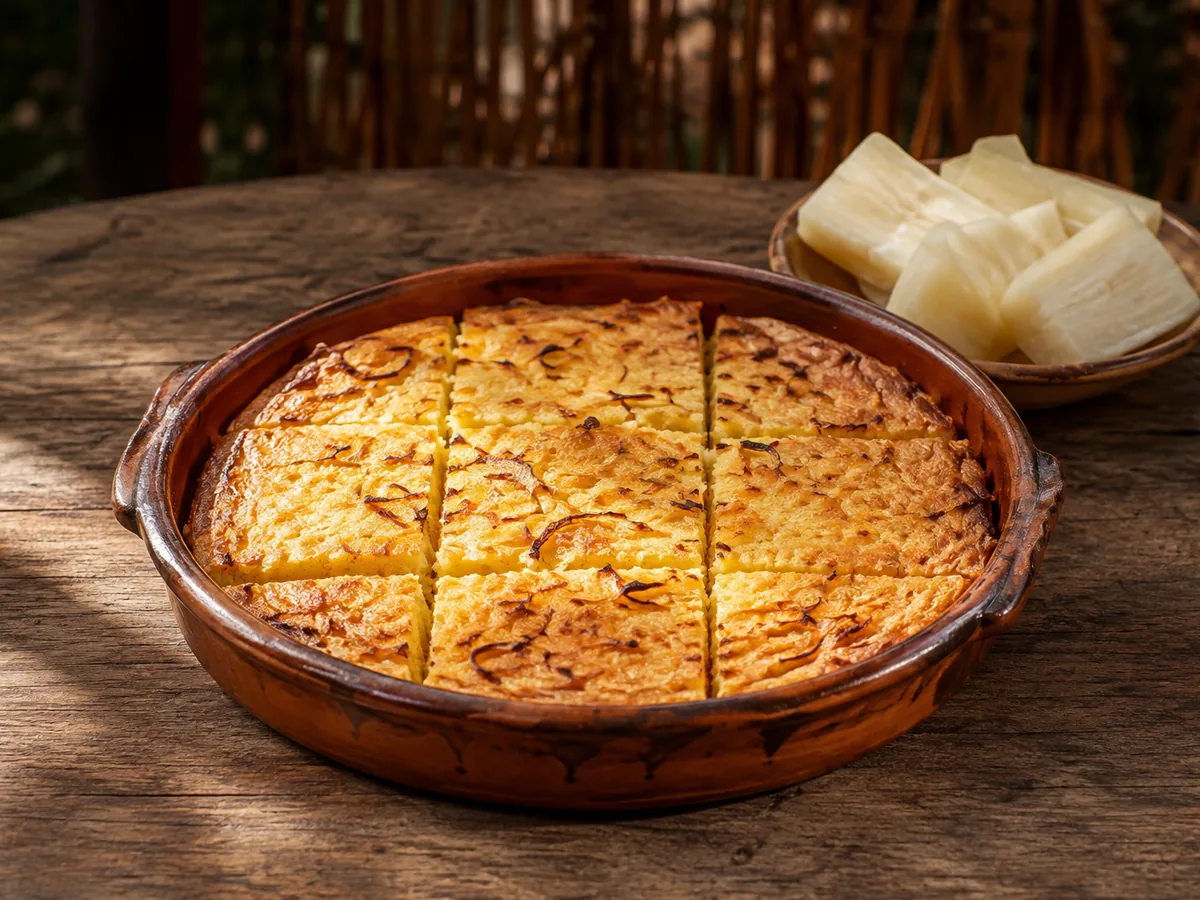
Sopa paraguaya is the world’s only solid soup. It was born in the 1850s in the residence of President Carlos Antonio López, when his cook added too much toasted corn flour to his favourite milk-and-cheese broth, the tykuetĩ.
With a state dinner imminent she made a decision: she poured the thickened batter into a clay roasting tray and slid it into the wood-fired mud oven, the tatakuá. What came out was a moist golden sponge full of sweated onion and melting cheese, and the president declared it the soup of Paraguay.
No asado, holiday or Sunday feast starts without warm squares of it beside boiled mandioca.
The batter
- 500 g4 cupsHarina de maíz paraguaya — finely milled, par-toasted yellow corn flour, not raw polenta or cornstarch
- 600 g4 largeWhite or yellow onions, peeled, halved and cut into fine 3 mm half-moons (corte pluma)
- 150 g⅔ cupRendered pork lard (manteca de cerdo), or unsalted European butter at 82% butterfat
- 6 large6 largeEggs, at room temperature, separated
- 500 g4 cupsQueso Paraguay, or fresh whole-milk farmer's cheese, crumbled into coarse curds
- 500 ml2.1 cupsWhole milk, warmed to 38 °C / 100 °F
- 15 g1 TbspCoarse sea salt, crushed fine
- 2 g½ tspFreshly ground white pepper
- 15 ml1 TbspPork lard or butter, for the pan
Three things make the crumb
Sweating the onions in lard past 110 °C releases their volatiles and caramelises their sucrose. The corn flour is par-toasted before milling, so its starch is already gelatinised and drinks warm milk without going gummy. And the whipped whites trap air that expands in a 200 °C oven while the milk proteins brown on top.
Separate the eggs — always
Tipping whole eggs into the batter removes the air pockets and you get a heavy, rubbery brick. Whip the whites to soft, stable peaks, slacken the batter with a third of them, then fold the rest in gently.
Not coarse cornmeal
North American yellow cornmeal or dry polenta gives a dry, choking crumb. If polenta is all you have, grind it fine and soak it in hot milk for 20 minutes first.
Sweat, never brown
Browned onions turn the cake bitter. Low heat, 12 to 15 minutes, until completely soft and translucent with no scorching at all.
Passive time, counted separately
The onions cool to lukewarm before they meet the eggs, and the baked cake rests 15 minutes so it slices cleanly. Neither is active work and both sit outside the times quoted above.
The five tastes on this plate
Salt is fine sea salt and the sharp lactic salinity of the cheese curds. Fat is warm rendered lard and whole milk making a melt-in-the-mouth crumb. Acid is the gentle lactic tang of fresh curd cutting the pork fat. Heat is sweated onion and white pepper on the finish. Umami is aged dairy and toasted cornmeal Maillard sugars.
Equipment
- Wide skillet
- Stand mixer or hand whisk
- Large mixing bowl and wooden paddle
- Silicone spatula
- 23 × 33 cm ceramic or cast-iron baking dish
- Instant-read thermometer
Traditionally a heavy iron asadera inside a mud-brick tatakuá fired with hardwood embers at about 220 °C. A 23 × 33 cm heavy ceramic dish or cast-iron roasting pan works in a modern kitchen — metal browns the bottom faster, so add 5 minutes to the bake if you use ceramic.
Method
Sweat the onions in lard15 min
Melt the 150 g lard in a wide skillet over medium heat, add the sliced onions and the 15 g salt.
Cook slowly 12 to 15 minutes, stirring, until completely soft, sweet and translucent with no browning at all. Off the heat, cool to lukewarm, about 40 °C.
Melt 150 g lard over medium; add sliced onions and 15 g salt. Cook slowly, stirring, 12–15 minutes until entirely soft and translucent without browning. Remove from heat; cool to lukewarm, about 40 °C.
Beat the egg foam5 min
Whip the 6 egg whites on medium-high 3 to 4 minutes to stiff, glossy peaks.
In a separate bowl, whisk the yolks with the white pepper until pale and creamy.
Whip the 6 egg whites on medium-high 3 to 4 minutes to stiff, glossy peaks.
In a separate bowl, whisk the yolks with the white pepper until pale and creamy.
Build the batter6 min
Tip the lukewarm onions and all their rendered fat into a large bowl and whisk in the yolks.
Pour in the 500 ml warm milk, then add the corn flour in three additions, stirring with a wooden paddle to a smooth, thick golden batter with no dry pockets.
Whisk yolks into lukewarm onions and all their fat. Add 500 ml milk warmed to 38 °C / 100 °F, then fine corn flour in three additions; stir until thick and smooth. If substituting polenta, grind finely and soak in hot milk 20 minutes first.
Fold in cheese and foam4 min
Crumble the cheese by hand into irregular marble-sized chunks and stir them through so the pockets distribute.
Beat in a third of the whites to slacken the batter, then fold the rest in with a spatula in wide circular strokes from the bottom up, keeping the volume.
Stir in cheese crumbled into irregular marble-sized pieces. Beat in one-third of the whites to loosen; gently fold in the rest from the bottom up, preserving the trapped air.
Pan and bake40–45 min
Preheat the oven to 200 °C / 400 °F and grease the pan generously.
Pour the batter in, smooth the top, and bake on the centre rack 40 to 45 minutes, until deeply golden-brown and firm to a gentle touch. The core must read 92–95 °C / 198–203 °F.
Heat oven to 200 °C / 400 °F; grease the pan well. Pour in batter and smooth. Bake on the centre rack 40–45 minutes until deep golden-brown and firm to a gentle touch, reaching 92–95 °C / 198–203 °F internally.
Rest, then cut
Rest in the pan 15 minutes — that is what lets the corn starch and melted cheese firm up so the squares cut sharp instead of crumbling.
Cut into 8 and serve warm.
Rest in the pan 15 minutes so the corn and cheese set enough to slice cleanly. Cut into 8 portions and serve warm.
Sensory cues of doneness
- Visual: a mottled golden-amber surface with blistered dark cheese spots, and a skewer that comes out clean and moist with no wet batter.
- Auditory: a quiet hissing around the rim of the pan through the last 10 minutes.
- Olfactory: caramelised onion, toasted cornmeal, browned pork lard and sizzling country cheese.
Look for a mottled amber top with dark blistered cheese spots; a skewer should emerge moist but free of wet batter. Expect quiet hissing in the last 10 minutes and toasted cornmeal, onion, lard and cheese aromas.
Storing it
It bakes up to 24 hours ahead. Reheat the squares on a sheet at 180 °C / 350 °F for 10 minutes to bring the crust back, or eat it at room temperature as Paraguayans do.
Troubleshooting
- A dense, heavy brick.
The eggs went in whole. Separate them, whip the whites to peaks, and fold them in.
- A dry, choking crumb.
Coarse cornmeal or dry polenta was used. Paraguayan corn flour is par-toasted and milled fine; soak polenta in hot milk first.
- A bitter cake.
The onions browned. They must be sweated gently until sweet and translucent.
Substitutions
One-to-one global substitutions, with the technique adjustment each one requires.
Ingredient substitutions
| Ingredient | Replace with | Culinary impact and technique adjustment |
|---|---|---|
| Harina de maíz paraguaya | Fine yellow corn flour or masa harina — never cornstarch | One-to-one. Italian polenta must be ground fine and soaked in warm milk 20 minutes |
| Queso Paraguay | Half fresh mozzarella, half queso blanco or rinsed feta | One-to-one. Gives the same melting stretch and mild curd acidity |
| Pork lard | Unsalted European butter | One-to-one. Butter is richer in dairy, lard has more rustic snap |
Scaling
Half, for 4 squares
Halve everything into a 20 cm square pan and bake 35 to 40 minutes at 200 °C.
Double, for 16 squares
Double everything across two 23 × 33 cm pans, rotating the racks halfway.
What to serve it with
- Asado a la parrilla — the non-negotiable partner, with short ribs, pork flank and chorizo
- Mandioca hervida — boiled cassava, piping hot with sea salt
- Tereré — ice-cold yerba mate steeped with fresh yuyos, from a guampa
Questions
Can I make it ahead?
Yes, up to 24 hours. Reheat the squares at 180 °C / 350 °F for 10 minutes to restore the crust, or serve at room temperature, which is traditional.
What replaces Queso Paraguay?
A half-and-half blend of fresh whole-milk farmer's cheese or queso fresco for the lactic acidity, with low-moisture whole-milk mozzarella for the melt.
Why is a solid cake called soup?
The name honours President López's cook, who turned his favourite soup into a solid bake by accident in the 1850s — he called it the solid soup of Paraguay and it stuck.