Bife Koygua
Koygua is Guaraní for hidden, and the steak is exactly that — seared ninety seconds a side, then buried under a blanket of slow-stewed onions, tomato and pepper, with fried eggs on top whose yolks run into the pan juices. Chaco ranch-hand food, and it takes forty-five minutes.
- Prep
- 20 min
- Cook
- 25 min
- Serves
- 4 portions
- Difficulty
- Easy
Researched · Kitchen testing pending
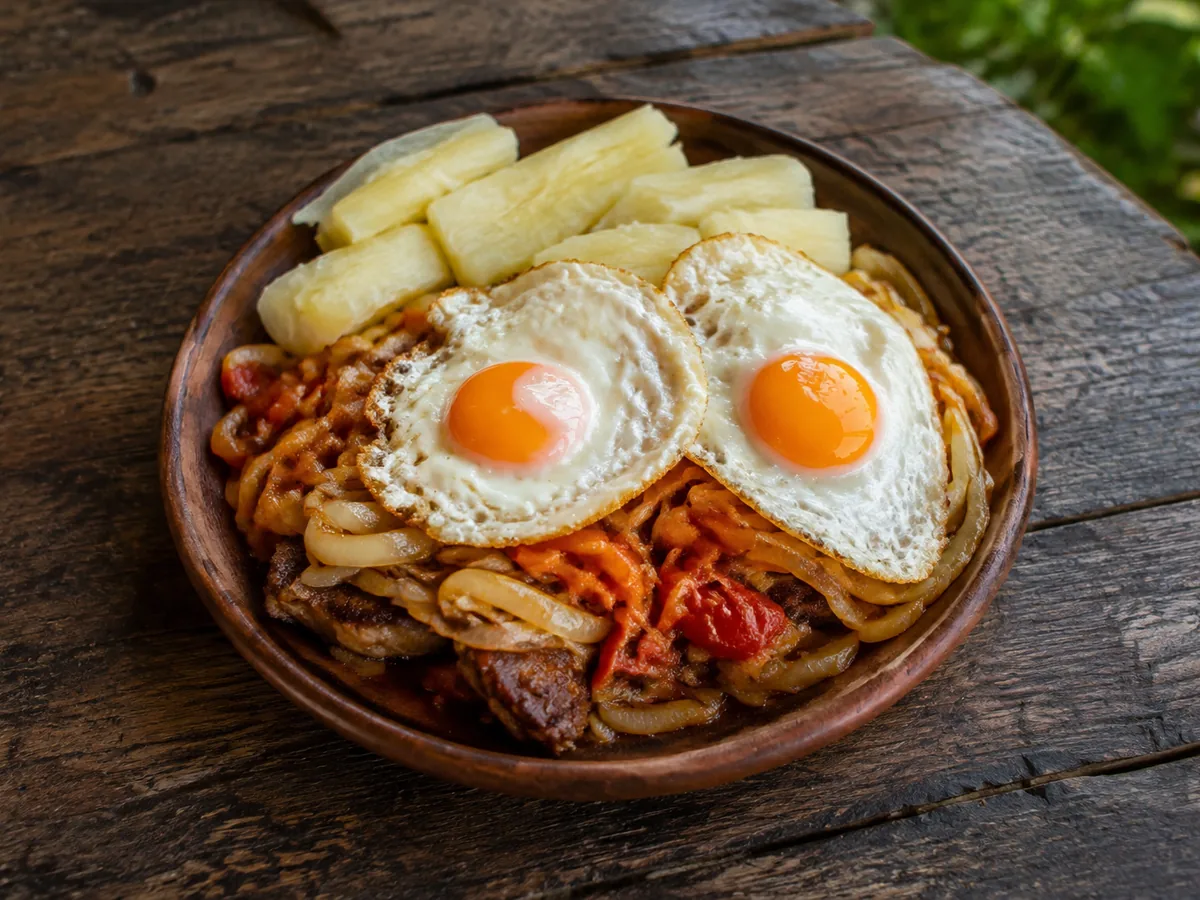
Koygua means hidden in Guaraní. Bife koygua is the hidden steak, because the seared beef lies completely buried under a mountain of slow-stewed sweet onion, ripe tomato, garlic and bell pepper, crowned with fried eggs whose runny yolks enrich the pan juices.
It was the food of gauchos and ranch hands coming back from long days on the Paraguayan Chaco — quick protein, rendered fat, and the sweetness of braised alliums.
Served beside a steaming basket of boiled mandioca, it is an everyday masterpiece.
The steaks
- 800 g1.76 lbBeef top sirloin, ribeye or rump, cut into 4 steaks of 200 g and pounded lightly to 8 mm
- 45 ml3 TbspRendered pork lard, or extra-virgin olive oildivided between the sear and the onions
- 10 g2 tspFine sea salt6 g for the meat, 4 g for the vegetables
- 3 g1 tspCoarsely cracked black peppercorn
The blanket
- 600 g4 largeYellow or white onions, peeled, halved and sliced into thin 4 mm rings
- 4 cloves4 clovesFresh garlic, peeled and sliced thin
- 4 large4 largeRipe plum tomatoes, peeled, seeded and cut into 5 mm half-moons
- 1 large1 largeRed or green bell pepper, cored and sliced into thin strips
- 5 g1½ tspGround cumin seeds, freshly toasted in a dry skillet
- 3 g1 TbspDried wild oregano, crushed
- 60 ml¼ cupRich beef stock, or dry red wine, to deglaze
To finish
- 4 large4 largeEggs
- 15 ml1 TbspOil or lard, for frying the eggs
- 20 g¼ cupFresh flat-leaf parsley, chopped fine
Sear fast, then get them out
Pounding to 8 mm breaks the surface muscle sheaths so heat penetrates fast. Ninety seconds a side in smoking lard at about 220 °C builds the crust and leaves the core pink. Leaving thin steaks in the pan while the onions cook turns them to leather.
The onions deglaze themselves
Tipped onto a fond-covered pan floor, the sliced onions and tomatoes release their own cell water. Covered, the steam collapses the onion walls and their sugars caramelise into the fond — which is why only 60 ml of liquid is needed.
Keep the yolks liquid
The running yolk is the sauce that binds steak and onions. Fry the eggs 90 seconds, until the whites set with lacy edges and the yolk is still domed and fluid.
Don't drown it
Extra stock makes the sauce watery and bland. Sixty millilitres to lift the fond, no more — the vegetables supply the rest.
Passive time, counted separately
The seared steaks rest on a warm plate while the onions cook down, and their resting juices go back into the pan. That sits outside the times quoted above.
The five tastes on this plate
Salt seasons the seared beef and the onion-tomato sauce. Fat is rendered lard, the beef's own marbling, and fluid yolk running into the juices. Acid is stewed plum tomato with the wine or stock deglaze. Heat is sliced garlic, toasted cumin, cracked pepper and sweet stewed pepper. Umami is caramelised beef fond, cooked tomato and seared steak protein.
Equipment
- 12 in seasoned cast-iron skillet with a lid
- Small nonstick or carbon-steel skillet, for the eggs
- Meat mallet
- Wide spatula
- Instant-read thermometer
Traditionally a broad black iron paila over an open hearth. A 12-inch seasoned cast-iron skillet with a lid works in a modern kitchen — cast iron holds its searing heat when cold steaks land on it, so the meat browns instead of greying and boiling.
Method
Season and sear6 min
Pat the steaks dry — dry meat sears best — and season both sides with 6 g salt, the cracked pepper and half the cumin.
Heat 30 ml lard in the skillet over high heat until shimmering and lightly smoking, about 220 °C. Sear in two batches, 90 seconds a side undisturbed, to a dark crust. Onto a warm plate.
Dry the 8 mm steaks; season both sides with 6 g salt, pepper and half the cumin. Heat 30 ml lard on high to about 220 °C. Sear in two batches, undisturbed 90 seconds per side until dark-crusted; transfer to a warm plate.
Sweat the onion blanket8 min
Drop to medium and add the remaining 15 ml lard to the drippings, then the onions, bell pepper and sliced garlic with 4 g salt, the rest of the cumin and the oregano.
Sauté 6 to 8 minutes, scraping every bit of beef fond off the floor of the pan, until the onions are soft, sweet and golden.
Lower to medium. Add remaining 15 ml lard, onions, bell pepper, garlic, 4 g salt, remaining cumin and oregano. Sauté 6–8 minutes, scraping up all beef fond, until onions are soft and golden.
Tomatoes, then cover8 min
Add the sliced tomatoes and the 60 ml stock or wine.
Cover, turn to low, and simmer 6 to 8 minutes until the tomatoes collapse into a glossy compote with the onions.
Add the sliced tomatoes and the 60 ml stock or wine.
Cover, turn to low, and simmer 6 to 8 minutes until the tomatoes collapse into a glossy compote with the onions.
Hide the steaks3 min
Uncover and nestle the steaks back in with all their resting juices, spooning the onion and tomato over them until the meat is completely hidden.
Cover and cook on low strictly 2 to 3 minutes, to 54 °C / 130 °F for medium-rare or 60 °C / 140 °F for medium.
Return steaks and resting juices; completely cover the meat with onion and tomato. Cover and cook on low strictly 2–3 minutes, to 54 °C / 130 °F for medium-rare or 60 °C / 140 °F for medium.
Fry the eggs2 min
In a separate skillet, heat 15 ml oil over medium-high and fry the eggs sunny-side up for 90 seconds — whites set with crisp lacy edges, yolks domed and liquid at about 60 °C / 140 °F.
In a separate skillet, heat 15 ml oil over medium-high and fry the eggs sunny-side up for 90 seconds — whites set with crisp lacy edges, yolks domed and liquid at about 60 °C / 140 °F.
Plate
Lift each steak with its mound of onions, peppers and tomato onto a warm plate with a wide spatula.
Crown with a hot fried egg, spoon the remaining pan juices over, and scatter parsley round the rim. Boiled mandioca alongside.
Lift each steak and its vegetables onto a warm plate. Top with a hot fried egg and remaining pan juices; scatter parsley around the rim. Serve with boiled mandioca.
Sensory cues of doneness
- Visual: the steak invisible under a glistening blanket of soft golden onion, red tomato and green pepper, with a glossy liquid yolk on top.
- Auditory: a roaring sizzle as the steaks hit the lard, then a gentle murmur as the onions collapse under the lid.
- Olfactory: caramelised beef fond, sweet fried onion, garlic, warm oregano and frying egg.
Look for steak hidden beneath glossy soft onions, tomato and pepper, topped with a liquid yolk. Searing should roar, then vegetables simmer gently; expect browned beef, sweet onion, garlic, oregano and fried egg aromas.
Troubleshooting
- Leathery steaks.
They stayed in the pan while the onions cooked. Sear fast, remove, cook the onions down, and return the meat only for the final 2 to 3 minutes.
- Hard yolks.
The eggs were over-fried. The liquid yolk is the sauce — pull them while it still runs.
- A watery, bland sauce.
Too much stock went in. The onions and tomatoes give up plenty of their own; use 60 ml only, to lift the fond.
Substitutions
One-to-one global substitutions, with the technique adjustment each one requires.
Ingredient substitutions
| Ingredient | Replace with | Culinary impact and technique adjustment |
|---|---|---|
| Top sirloin | Ribeye, New York strip or skirt steak | One-to-one, pounded lightly to 8 mm |
| Rendered pork lard | Unsalted butter or extra-virgin olive oil | One-to-one. Butter brings richer dairy notes |
| Beef stock | Dry red wine, or water with a dash of Worcestershire | One-to-one for the deglaze |
Scaling
Half, for 2 portions
Halve everything in a 10-inch skillet. Every cooking time is unchanged.
Double, for 8 portions
Double everything across two 12-inch cast-iron skillets side by side, so the steaks sear rather than steam.
What to serve it with
- Mandioca hervida — boiled cassava for dipping into the yolk and pan sauce
- Arroz blanco, to soak up the tomato-onion juices
- An ice-cold pilsener, or a rustic Malbec
Questions
Which cut is best?
Top sirloin (cuadril), ribeye or a tenderised rump. Look for good marbling and pound lightly to 8 mm for fast, even cooking.
Can I cook the eggs in the same skillet?
Yes, and it is an authentic rustic alternative — make four hollows in the onion compote, crack an egg into each, cover, and steam on low about 3 minutes until the whites set.
Does it work with chicken or pork?
Yes. Thin pork loin cutlets — bife de cerdo koygua — or pounded chicken breasts both work with the identical method.