Mbeju Mestizo
Guaraní for "flat cake", and older than the Spanish arrival by centuries. It never becomes a dough — cold lard is rubbed into cassava starch and corn flour until the mixture is damp sand, tipped loose into a screaming cast-iron pan, and pressed just enough to bond. Three minutes a side.
- Prep
- 15 min
- Cook
- 12 min
- Serves
- 4 flatbreads, 20 cm each
- Difficulty
- Medium
Researched · Kitchen testing pending
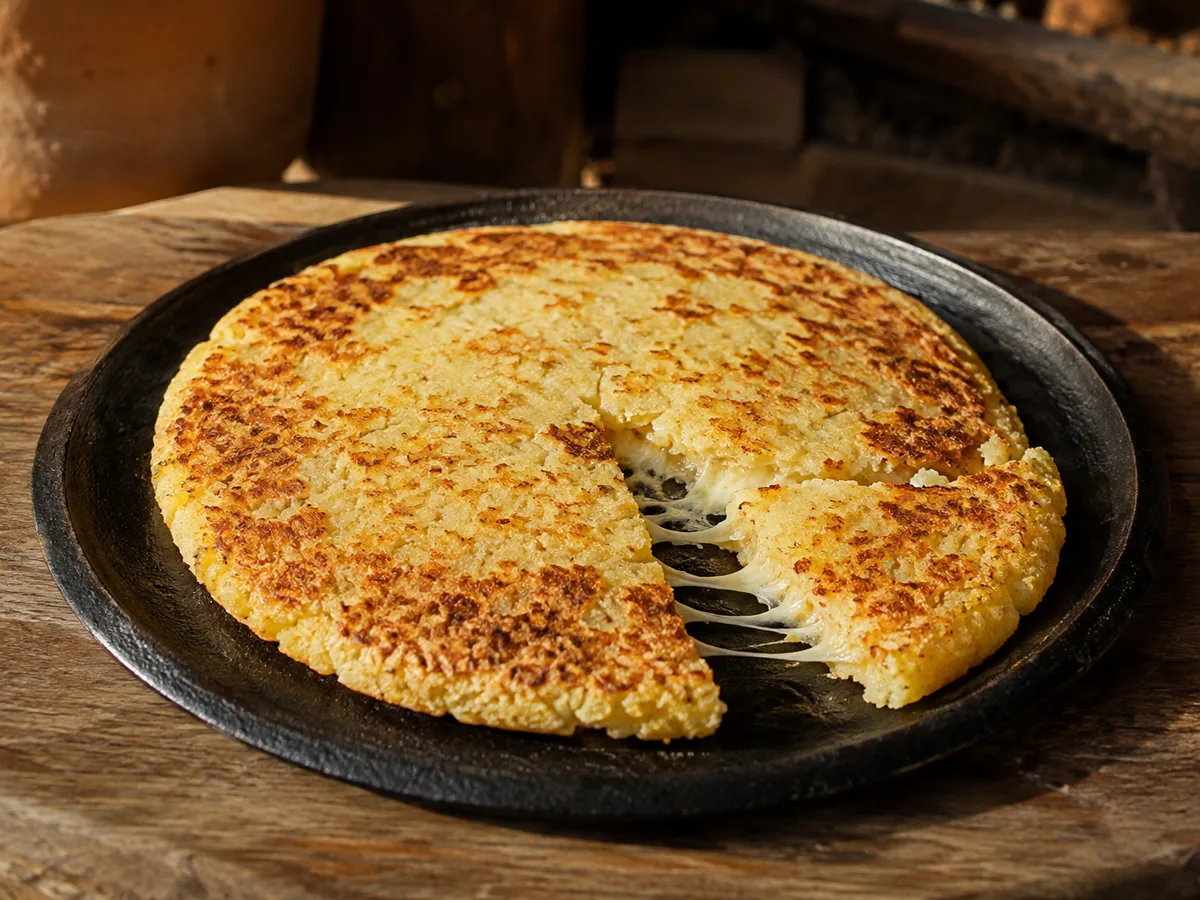
Mbeju is one of the oldest culinary artefacts of the Guaraní, predating European arrival by centuries. The word means flat cake.
The mestizo version is the colonial synthesis: indigenous cassava starch blended with toasted yellow corn flour, rubbed by hand with cold pork lard, eggs and abundant crumbled Queso Paraguay into a coarse, damp, sandy meal.
Tipped into a screaming-hot iron paila and pressed lightly with the back of a spoon, it toasts on both sides into a crisp mottled crust over a chewy, stringy centre. Eaten piping hot with sweet cocido quemado.
The sandy meal
- 350 g3 cupsCassava starch (almidón de mandioca / sweet tapioca starch), sifted
- 150 g1.2 cupsHarina de maíz paraguaya — fine yellow corn flour, not raw polenta
- 120 g½ cup + 1 TbspRendered pork lard, or unsalted European butter, chilled and cut into 1 cm cubes
- 8 g1½ tspFine sea salt
To bind
- 1 large1 largeEgg, at room temperature, lightly beaten
- 300 g2.5 cupsQueso Paraguay, or fresh whole-milk farmer's cheese, crumbled fine
- 80 ml⅓ cupWhole milk, coldadded drop by drop — this must never become a wet dough
To cook
- 15 ml1 TbspPork lard or butter, to wipe the skillet between cakes
It is not a dough, and never becomes one
Cold lard rubbed between the palms into the starches gives a dry, granular crumb — the *arenado*. Cold milk and egg then moisten the surface of each grain without dissolving anything into paste. Squeezed in your fist it should hold as a soft lump that breaks apart when prodded.
What binds it in the pan
Contact heat gelatinises the outer starch at around 65 °C while the lard melts and fries the surface rigid. Inside, the crumbled cheese melts into stretchy webs that hold the sandy grains together — crunch outside, chewy cheese-strung centre.
Cast iron is mandatory
Nonstick lacks the thermal mass to sear the crust instantly, so the mbeju steams and crumbles. The pan must be at about 200 °C before anything goes in.
Press lightly
Compacting it hard gives a dense, rubbery puck. The back of a spoon, just enough to bond the grains into a 1 cm disc.
Too much milk ruins it
Excess liquid turns the meal to glue that sticks and will not toast. A tablespoon at a time, tossed with the fingertips.
The five tastes on this plate
Salt is sea salt through the starch and the sharp salinity of the cheese. Fat is chilled lard rubbed into the grains, crisping them under dry heat. Acid is a subtle lactic tang from the starch and fresh curd. There is no heat at all — the profile is clean toasted starch. Umami is toasted cassava, browned cornmeal sugars and melted aged cheese.
Equipment
- Wide wooden bowl
- 10 in well-seasoned cast-iron skillet
- Spoon and spatula
- Flat plate or lid, for flipping
Traditionally a broad round iron paila over an open hearth. A 10-inch well-seasoned cast-iron skillet works in a modern kitchen, and nothing else does — the thermal mass is the whole point.
Method
Rub the arenado5 min
Combine the cassava starch, corn flour and 8 g salt in a wide bowl and add the cold cubed lard.
Rub vigorously between your palms 3 to 4 minutes until the fat disappears into a uniform, dry, sandy meal — the texture of damp beach sand.
Combine cassava starch, corn flour and 8 g salt. Add cold cubed lard; rub vigorously between your palms 3–4 minutes until evenly sandy with no visible fat pieces.
Cheese, egg, and a little milk5 min
Add the crumbled cheese and the beaten egg and rub through to distribute.
Sprinkle in the cold milk a tablespoon at a time, tossing with your fingertips. Do not knead it into a ball — it must stay loose, sandy and crumbly, holding together only when squeezed in the fist.
Rub in crumbled cheese and beaten egg. Add cold milk one tablespoon at a time, tossing with fingertips. Keep loose and sandy, holding together only when squeezed; never knead into a dough ball.
Heat the pan4 min
Set the cast-iron skillet over medium-high until hot, about 200 °C / 400 °F.
Wipe the floor with a paper towel dipped in lard — barely a sheen, with no oil pooling.
Set the cast-iron skillet over medium-high until hot, about 200 °C / 400 °F.
Wipe the floor with a paper towel dipped in lard — barely a sheen, with no oil pooling.
Toast the first side3 min
Tip a quarter of the mixture, about 220 g, loosely into the pan and spread it to the edges with a spoon.
Press lightly with the back of the spoon to bond the grains into a cohesive disc 1 cm thick — lightly, not packed.
Cook undisturbed over medium 2 to 3 minutes, then shake the pan: it should release and slide as one rigid cake with a golden bottom.
Spread one-quarter of the mixture, about 220 g, loosely in the pan. Press lightly into a 1 cm disc without packing. Cook undisturbed on medium 2–3 minutes until the golden-bottomed cake releases and slides as one piece.
Flip and finish2 min
Cover with a flat plate or lid, invert the pan, and slide the cake back in raw side down.
Cook 2 minutes more, pressing lightly, until golden-brown with dark toasted spots and the cheese has melted through — 70–75 °C / 158–167 °F.
Invert onto a flat plate or lid; slide back raw-side down. Cook 2 minutes more, pressing lightly, until golden-brown with dark toasted spots and melted cheese, reaching 70–75 °C / 158–167 °F.
Serve at once
Slide onto a board and repeat with the remaining mixture, wiping the pan with a trace of lard before each cake.
Tear by hand and eat while the cheese is still molten.
Slide onto a board and repeat with the remaining mixture, wiping the pan with a trace of lard before each cake.
Tear by hand and eat while the cheese is still molten.
Sensory cues of doneness
- Visual: a golden-amber round with dark toasted blisters, and long white strands of cheese when it is broken open.
- Auditory: a lively high crackle the instant the sandy meal hits the iron, settling to a quiet sizzle as the crust sets.
- Olfactory: toasted cornmeal, frying pork lard, toasted cassava and melting cheese.
Look for a golden-amber cake with dark toasted blisters and long melted-cheese strands. The initial crackle should settle to gentle sizzling as the crust sets; expect toasted corn and cassava, frying lard and cheese aromas.
Storing it
The sandy meal can be mixed completely, sealed and refrigerated up to 48 hours. Take it to the pan straight from the fridge.
Troubleshooting
- It sticks and will not toast.
Too much milk turned the meal to glue. It has to stay loose, sandy and crumbly.
- A dense, rubbery puck.
It was pressed too hard. Use the back of a spoon, only enough to bond the grains.
- It falls apart when flipped.
The pan was not hot enough, so the lard melted without crisping the starch. Get it to 200 °C first.
Substitutions
One-to-one global substitutions, with the technique adjustment each one requires.
Ingredient substitutions
| Ingredient | Replace with | Culinary impact and technique adjustment |
|---|---|---|
| Almidón de mandioca | Tapioca starch or tapioca flour | One-to-one. Fine white starch powder only |
| Harina de maíz paraguaya | Masa harina or fine yellow cornmeal | One-to-one, and it carries the nutty aroma and colour |
| Queso Paraguay | Half fresh mozzarella, half queso fresco | One-to-one, crumbled fine by hand |
Scaling
Half, for 2 flatbreads
Halve everything in an 8-to-10 inch skillet. Still 2 to 3 minutes a side.
Double, for 8 flatbreads
Double everything and run two cast-iron skillets so the cakes reach the table hot.
What to serve it with
- Cocido quemado con leche — the traditional companion
- Strong black coffee, against the lard and cheese
- Hot unsweetened mate cocido
Questions
How does mbeju mestizo differ from mbeju tipíraty?
Mestizo uses cassava starch with corn flour. Tipíraty uses the coarse pulp left over from extracting the starch, giving a more rustic, fibrous flatbread.
Can I make it with cassava starch alone?
Yes — that is mbeju tradicional. Drop the corn flour, use 500 g cassava starch, and proceed identically for a chewier, snow-white cake.
Can the mixture be made ahead?
Yes. Mix the sandy meal completely, seal it airtight, and refrigerate up to 48 hours.