Pastel Mandi'o
The monarch of the San Juan bonfire nights in June. No wheat anywhere — the dough is boiled cassava mashed while still steaming, kneaded with toasted corn flour, lard and eggs into something elastic enough to roll to 3 mm without tearing, then folded round spiced beef and deep-fried until it blisters.
- Prep
- 40 min
- Cook
- 25 min
- Serves
- 12 large empanadas, about 140 g each
- Difficulty
- Hard
Researched · Kitchen testing pending
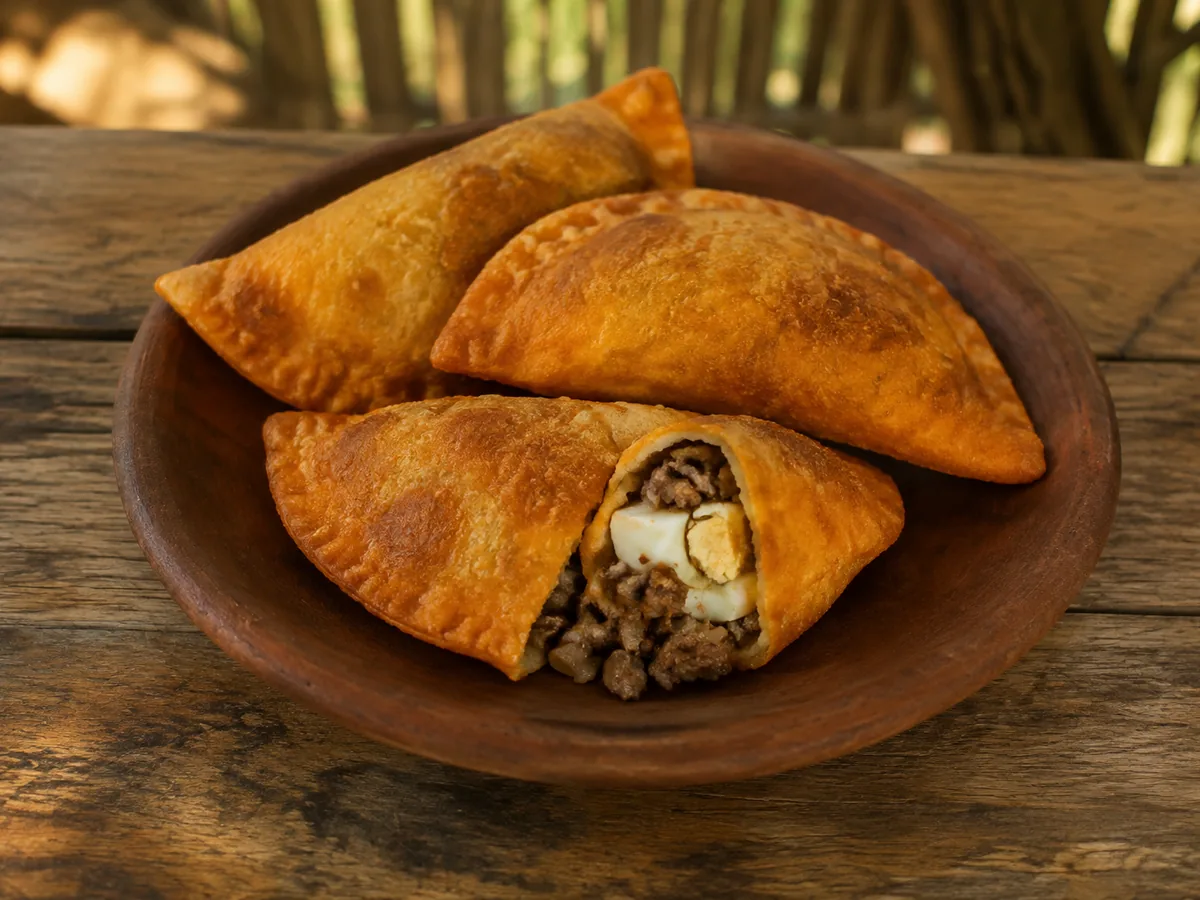
On the cold June nights of the Fiestas de San Juan, bonfires light every town square in Paraguay, and the culinary monarch of the festival is the pastel mandi’o.
Unlike wheat empanadas, the dough is boiled cassava root mashed while still steaming and kneaded with toasted yellow corn flour, rendered lard and eggs into a golden, supple mass. It is folded around a filling of spiced ground beef, sweated onion, garlic, cumin and hard-boiled egg.
Deep-fried in bubbling lard, it comes out blistered and golden-orange outside, with an elastic, chewy cassava crust over hot, juicy meat.
Cassava dough
- 800 g1.76 lbFresh yuca (cassava root), peeled, boiled in salted water until fork-tender, drained hot
- 200 g1.6 cupsHarina de maíz paraguaya — fine yellow corn flour
- 60 g4 TbspRendered pork lard, or unsalted butter, softened
- 2 large2 largeEggs, at room temperature
- 10 g1½ tspFine sea salt
Beef picadillo
- 500 g1.1 lbLean ground beef chuck or top sirloin, cold
- 45 ml3 TbspRendered pork lard, or vegetable oil
- 400 g2.5 cupsYellow onions, peeled and cut into fine 4 mm brunoise
- 4 cloves4 clovesFresh garlic, minced to a paste
- 1 large1 largeRed bell pepper, cored and diced fine
- 6 g1½ tspGround cumin seeds, freshly toasted in a skillet
- 3 g1 TbspDried wild oregano, crushed
- 8 g1½ tspFine sea salt
- 3 g1 tspFreshly ground black peppercorn
- 3 large3 largeHard-boiled eggs, peeled and chopped fine
- 4 stalks4 stalksScallions, sliced fine
To fry
- 1 L4.2 cupsHigh-smoke-point corn oil, or rendered pork lard
Mash the yuca scorching hot
Boiling gelatinises the native amylopectin; mashing while it steams breaks the cell walls into a cohesive paste. Let it cool first and it goes gummy and rubbery, and no amount of kneading recovers it.
How it rolls thin without gluten
The corn flour absorbs the yuca's excess surface water while the raw egg albumin forms a heat-setting network. Together they give a composite dough elastic enough for 3 mm sheets that do not tear.
The filling must be cold
Warm filling steams the delicate cassava dough from inside and blows the seams open in the fryer. Cook it, then cool it completely before assembly.
Press the air out
Trapped air does the same thing as warm filling. Seal the half-moon firmly before crimping with a fork.
180 °C, no lower
Below about 170 °C the porous cassava dough drinks oil like a sponge and turns greasy instead of blistering.
Passive time, counted separately
The picadillo must cool completely, the dough rests 15 minutes, and the fried pasteles rest 3 minutes before serving. None of that is active work and it sits outside the times quoted above.
The five tastes on this plate
Salt seasons both the beef picadillo and the cassava dough. Fat is lard in the dough and the frying fat crisping the starch shell. Acid is low, brightened at the table with lime or pickled chilli. Heat is toasted cumin, garlic, scallion and cracked pepper. Umami is caramelised beef fond, sweated onion and boiled cassava.
Equipment
- Wide skillet, for the filling
- Large pot, for boiling the yuca
- Potato ricer, or a wooden bowl and heavy pestle
- Rolling pin and two sheets of plastic
- Heavy 5 qt Dutch oven and an oil thermometer
- Spider skimmer and wire rack
Traditionally a deep iron caldero of pork lard over roaring wood embers at the San Juan festival. A heavy 5-quart Dutch oven with a clip-on thermometer works in a modern kitchen — the mass is what stops the oil dropping when cold empanadas go in.
Method
Cook the picadillo16 min
Heat 45 ml lard in a wide skillet over medium-high and sear the ground beef 5 to 6 minutes, breaking it into fine morsels.
Add the onions, garlic and bell pepper with the cumin, oregano, black pepper and 8 g salt, and cook 8 to 10 minutes until the onions are soft and glossy.
Stir in the chopped eggs and scallions, then cool completely.
Heat 45 ml lard over medium-high; brown beef 5–6 minutes, breaking it finely. Add onion, garlic, bell pepper, cumin, oregano, black pepper and 8 g salt; cook 8–10 minutes until onions soften. Stir in chopped eggs and scallions; cool completely.
Boil and hot-mash the cassava25 min
Boil the peeled yuca chunks in salted water 20 to 25 minutes until fork-tender, and drain at once.
While it is still steaming, pull out the woody central strings and pass it through a ricer, or mash it smooth with a heavy pestle. No lumps.
Boil peeled yuca in salted water 20–25 minutes until fork-tender; drain immediately. While still steaming, remove woody central fibres and rice or mash thoroughly until entirely smooth.
Knead the mandi'o dough8 min
While the mash is warm, work in the 60 g softened lard, 10 g salt and the 2 eggs by hand.
Knead in the corn flour gradually, then work it vigorously 4 to 5 minutes on an unfloured board into a smooth, pliable, sunset-orange dough that does not stick. Cover and rest 15 minutes.
Work 60 g soft lard, 10 g salt and 2 eggs into warm mash. Gradually knead in corn flour; knead on an unfloured board 4–5 minutes until smooth, pliable and nonsticky. Cover; rest 15 minutes.
Roll and assemble16 min
Divide into 12 balls of about 90 g. Roll each between two sheets of plastic into a 15 cm circle, 3 mm thick.
Put 2 generous tablespoons of cold filling in the centre, fold into a half-moon and press the edges firmly to force out all trapped air, then crimp tightly with a fork.
Divide into 12 balls, about 90 g. Roll between plastic sheets into 15 cm circles, 3 mm thick. Add 2 generous tablespoons cold filling; fold in half, press out all air and seal firmly. Crimp tightly with a fork.
Deep-fry20 min
Heat the litre of oil to 180 °C / 356 °F.
Fry in batches of two or three without crowding, 3 to 4 minutes, flipping once, until deep golden-orange and covered in crisp blisters. The filling should read 74 °C / 165 °F.
Heat 1 litre oil to 180 °C / 356 °F. Fry 2–3 at a time without crowding for 3–4 minutes, turning once, until deep golden-orange and blistered. Check filling reaches 74 °C / 165 °F.
Drain and serve3 min
Lift out with a spider onto a wire rack over a tray.
Rest 3 minutes, then serve hot with lime wedges and spicy ají.
Lift out with a spider onto a wire rack over a tray.
Rest 3 minutes, then serve hot with lime wedges and spicy ají.
Sensory cues of doneness
- Visual: a golden-orange crescent covered in tiny crisp blisters, with rigid dark-amber crimping along the fork-pressed edge.
- Auditory: a rushing sizzle as the cold empanadas enter the fat, then an audible shatter on the first bite.
- Olfactory: fried lard pastry, sweet cooked cassava, toasted cumin, seared beef and green scallion.
Look for golden-orange crescents with tiny crisp blisters and firm dark-amber crimped edges. Expect vigorous sizzling and a crisp first bite, with fried pastry, sweet cassava, cumin, beef and scallion aromas.
Storing it
Freeze assembled raw empanadas on a parchment tray until solid, then bag. Fry straight from frozen at 170 °C / 340 °F for 5 to 6 minutes.
Troubleshooting
- The dough ruptures in the fryer.
The filling went in warm, or air was trapped inside. Cool the picadillo completely and press every pocket of air out before crimping.
- Gummy, rubbery dough.
The cassava was mashed after it cooled. It has to be mashed while steaming hot.
- Greasy rather than crisp.
The oil was below 170 °C. Porous cassava dough soaks it up — hold 180 °C.
Substitutions
One-to-one global substitutions, with the technique adjustment each one requires.
Ingredient substitutions
| Ingredient | Replace with | Culinary impact and technique adjustment |
|---|---|---|
| Fresh yuca | Frozen peeled cassava root | One-to-one. Boil straight from frozen until fork-tender |
| Harina de maíz paraguaya | Masa harina or fine yellow cornmeal | One-to-one. It is what binds the mashed yuca into a pliable dough |
| Rendered pork lard | Unsalted European butter or vegetable shortening | One-to-one in the dough; use a high-smoke-point oil for the frying |
Scaling
Half, for 6 empanadas
Halve everything. Frying stays strictly 3 to 4 minutes a batch.
Double, for 24 empanadas
Double everything and fry in consecutive batches so the oil holds 180 °C.
What to serve it with
- Ky'ÿi — fiery Paraguayan chilli condiment of crushed red bird peppers, oil and vinegar
- Extra hot boiled mandioca alongside
- An ice-cold lager, or tereré, against the fried lard pastry
Questions
Can I bake them instead?
San Juan pasteles are always deep-fried, but you can brush them with oil and bake on parchment at 220 °C / 425 °F for 18 to 20 minutes until crisp.
Can I freeze them raw?
Yes. Freeze assembled empanadas on a parchment tray until rock-solid, then bag, and fry from frozen at 170 °C / 340 °F for 5 to 6 minutes.
Does frozen yuca work?
Yes. Frozen peeled cassava is widely available, boils tender in about 20 minutes and mashes smoothly.