Pajagua Mascada
The other San Juan festival patty, named for the Payaguá, the river navigators of the Paraguay whom early Spanish chroniclers feared. Cooked spiced beef is kneaded straight into hot mashed cassava, so the gelatinised starch wraps the meat and binds it — no flour, no breadcrumbs — then shallow-fried to a chestnut shell.
- Prep
- 30 min
- Cook
- 20 min
- Serves
- 12 patties, about 110 g each
- Difficulty
- Medium
Researched · Kitchen testing pending
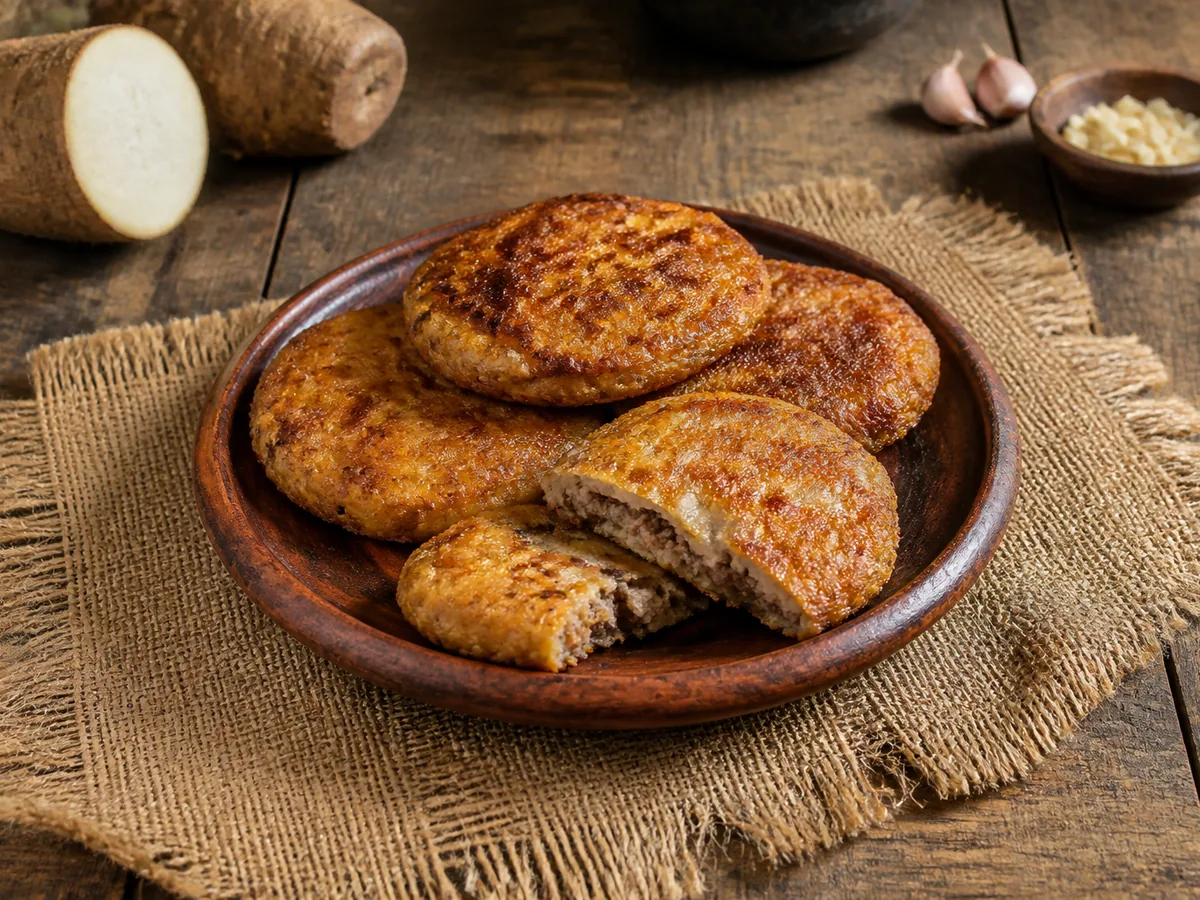
Pajagua mascada is festival food. With pastel mandi’o it anchors the winter celebrations of San Juan, and its name traces back to the Payaguá, the river navigators of the Paraguay whom early Spanish chroniclers wrote about with some fear.
The preparation is a rustic union of earth and cattle: boiled cassava mashed hot and kneaded directly with pre-cooked spiced ground beef, crushed garlic, scallions, cumin, black pepper and pork lard.
Shaped into flat rounds and fried in smoking lard, the cassava starch fries into a dark, blistered, shattering crust over an interior that stays soft, garlicky and deeply meaty.
The patties
- 800 g1.76 lbFresh yuca (cassava root), peeled, boiled in salted water until fork-tender, drained hot
- 500 g1.1 lbLean ground beef chuck or top sirloin, or cooked shredded beef
- 45 ml3 TbspRendered pork lard, or extra-virgin olive oil30 ml for the beef, 15 ml into the mash
- 300 g2 cupsYellow onions, peeled and minced into fine 3 mm brunoise
- 6 cloves6 clovesFresh garlic, minced to a fine paste
- 4 stalks4 stalksScallions, sliced fine
- 8 g2 tspGround cumin seeds, freshly toasted in a skillet
- 3 g1 TbspDried wild oregano, crushed
- 12 g2 tspFine sea salt6 g for the beef, 6 g for the mash
- 3 g1 tspCoarsely ground black peppercorn
- 1 large1 largeEgg, at room temperature, for binding
To shape and fry
- 30 g¼ cupCassava starch or corn flour, for dusting the hands
- 500 ml2.1 cupsRendered pork lard, or high-smoke-point corn oil
The cassava is the binder
Mashed hot, the ruptured cell walls release amylopectin into a sticky cohesive paste. Kneaded with the cooked beef and an egg, that starch wraps each meat particle into a self-bound dough — nothing else is needed.
The beef must be cooked dry
Pre-cooking drives off the free muscle water and builds Maillard fond. Wet beef, or under-mashed yuca, and the patties fall apart in the pan.
185 °C seals it instantly
The surface starch dehydrates on contact into a rigid shell that keeps the oil out while the inside comes up to a soft 75 °C. Below 175 °C the oil seeps into the mash instead.
Smooth the edges
Jagged borders break off and burn in the fat. Smooth each patty's rim with damp fingers before it goes near the oil.
Passive time, counted separately
The cooked beef cools to lukewarm and the kneaded mixture rests 10 minutes. Neither is active work and both sit outside the times quoted above.
The five tastes on this plate
Salt seasons both the boiled yuca and the spiced beef. Fat is lard worked through the meat-and-yuca mash and the frying fat crisping the crust. Acid is low and garlicky, lifted with lime at the table. Heat is raw garlic paste, toasted cumin, scallion and coarse pepper. Umami is caramelised beef fond, sweated onion and boiled cassava.
Equipment
- Skillet, for the beef
- Large pot, for boiling the yuca
- Potato masher or wooden mortar
- 12 in heavy cast-iron skillet
- Metal spatula and wire rack
- Instant-read thermometer
Traditionally a broad flat iron paila over a wood-fire hearth. A 12-inch heavy seasoned cast-iron skillet works in a modern kitchen — the heavy floor holds 185 °C steadily, so the patties crisp rather than burn.
Method
Cook the spiced beef13 min
Heat 30 ml lard in a skillet over medium-high and sear the ground beef 5 minutes until browned.
Add the onions, garlic, cumin, oregano, black pepper and 6 g salt, and cook 6 to 8 minutes until the onions are soft and every drop of pan juice has evaporated.
Stir in the scallions and cool to lukewarm.
Heat 30 ml lard over medium-high; brown beef 5 minutes. Add onion, garlic, cumin, oregano, pepper and 6 g salt; cook 6–8 minutes until onions soften and all juices evaporate. Stir in scallions; cool to lukewarm.
Boil and hot-mash the cassava25 min
Boil the peeled yuca in salted water 20 to 25 minutes until completely soft, and drain at once.
Pull the tough central strings out while it steams, then mash thoroughly until smooth with no lumps. Season with 6 g salt and 15 ml lard.
Boil peeled yuca in salted water 20–25 minutes until completely soft; drain immediately. While steaming, remove central fibres and mash thoroughly until smooth. Add 6 g salt and 15 ml lard.
Knead the matrix5 min
Add the cooked beef and the beaten egg straight into the warm mash.
Knead vigorously by hand 3 to 4 minutes until the beef and yuca fuse into a uniform, pliable, dense dough. If it feels sticky, dust in a tablespoon of cassava starch. Cover and rest 10 minutes.
Knead cooked beef and beaten egg into warm yuca for 3–4 minutes until uniform, dense and pliable. If sticky, add 1 tablespoon cassava starch. Cover and rest 10 minutes.
Shape8 min
Dust your hands with cassava starch and divide into 12 balls of about 110 g.
Flatten each between your palms into a round patty 8 cm across and 1.5 cm thick, smoothing the edges so there are no cracks.
Dust hands with cassava starch; divide into 12 balls, about 110 g. Flatten into patties 8 cm across and 1.5 cm thick. Smooth rims with damp fingers so no cracks remain.
Shallow-fry20 min
Heat the 500 ml of oil in the cast-iron skillet to 185 °C / 365 °F, about 1.5 cm deep.
Slide in 3 or 4 patties and fry undisturbed 3 to 4 minutes until the bottom is deep chestnut-brown and crisp, then flip and give the second side 3 minutes, to a core of 75 °C / 167 °F.
Heat 500 ml oil, about 1.5 cm deep, in cast iron to 185 °C / 365 °F. Fry 3–4 patties undisturbed 3–4 minutes until chestnut-brown and crisp; flip and fry 3 minutes more, to a 75 °C / 167 °F core.
Drain and serve
Onto a wire rack over a tray, and repeat with the rest.
Serve piping hot with lime halves and cold beer.
Drain on a wire rack over a tray; repeat with remaining patties. Serve piping hot with lime halves and cold beer.
Sensory cues of doneness
- Visual: a flat round with a deep chestnut-bronze crust and crisp blistered edges; broken open, pale-gold cassava packed with dark beef and green scallion.
- Auditory: loud violent hissing as the patties enter the fat, and a crisp crunch under a fork.
- Olfactory: fried lard, roasted garlic, sweet toasted cassava, browned beef and toasted cumin.
Look for a chestnut-bronze crust and blistered crisp edges around pale-gold cassava, dark beef and green scallion. Expect strong frying hiss and a crisp crunch, with toasted cassava, beef, garlic, cumin and lard aromas.
Storing it
Shape the raw patties, freeze them solid on a parchment tray and bag for up to 3 months. Fry straight from frozen at 175 °C / 347 °F, 5 minutes a side.
Troubleshooting
- The patties fall apart in the pan.
The beef was still wet, or the yuca was under-mashed. Cook the meat dry and mash the cassava hot so its starch can bind.
- Greasy patties.
The fat was below 175 °C and soaked into the mash. Hold 185 °C so the crust seals on contact.
- Edges that break off and burn.
The rims were left jagged. Smooth them with damp fingers before frying.
Substitutions
One-to-one global substitutions, with the technique adjustment each one requires.
Ingredient substitutions
| Ingredient | Replace with | Culinary impact and technique adjustment |
|---|---|---|
| Fresh yuca | Frozen peeled cassava root | One-to-one. Boil until completely tender and mash while hot |
| Ground beef chuck | Minced leftover roast, braised shank, or ground pork | One-to-one, sautéed with the garlic and cumin |
| Rendered pork lard | High-smoke-point vegetable oil or beef tallow | One-to-one for the frying |
Scaling
Half, for 6 patties
Halve everything in an 8-inch skillet. Still 3 to 4 minutes a side.
Double, for 24 patties
Double everything and fry in batches so the oil temperature holds.
What to serve it with
- Fresh lime squeezed over the hot patty, against the fried crust
- Boiled mandioca alongside, for the double-mandioca feast
- An ice-cold pilsner, or tereré con yuyos
Questions
Can I use leftover asado or pot roast?
Yes, and it is highly traditional. Finely mince the cooked beef, season it with sautéed onion, garlic and cumin, and knead it into the hot mashed yuca.
Can I bake them?
Brush both sides generously with oil and bake on parchment at 220 °C / 425 °F for 15 minutes a side, until golden and crisp.
Can I freeze them shaped?
Yes. Freeze the raw patties solid on a tray, bag them for up to 3 months, and fry from frozen at 175 °C / 347 °F for 5 minutes a side.