So'o Josopy
Guaraní for "pounded meat broth", and the trick is counter-intuitive: raw lean beef is whisked into cold water with corn flour before it ever meets heat. Stirred continuously as it climbs to 75 °C, the proteins set as a velvety suspension of microscopic particles instead of seizing into meatballs.
- Prep
- 20 min
- Cook
- 25 min
- Serves
- 6 soup portions
- Difficulty
- Easy
Researched · Kitchen testing pending
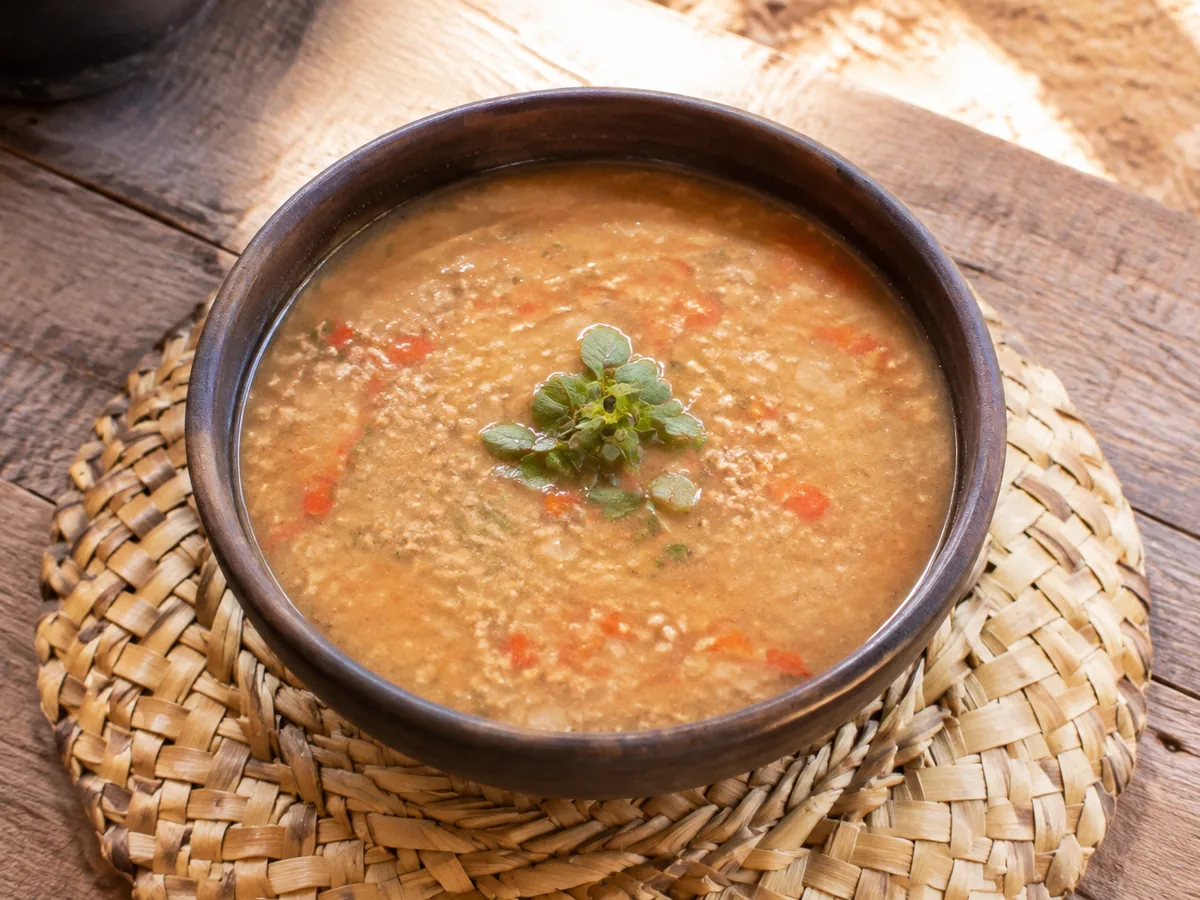
So’o josopy is ancient — created by the Guaraní centuries ago, and the name translates literally as pounded meat broth: so’o, meat, josopy, crushed in a mortar. It was historically made by grinding jerky or fresh beef in a wooden angu’a with a stone pestle.
The dish depends on one extraordinary phenomenon. Raw minced beef is whisked cold, with cold water and toasted corn flour, before it ever touches heat. Brought slowly to a simmer with continuous stirring, the meat proteins never clump; they form a silky suspension of microscopic savoury particles.
Flavoured with sweet onion, garlic, pepper and wild oregano, it is Paraguay’s restorative broth.
The suspension
- 600 g1.32 lbVery lean beef — top round, eye of round or lean sirloin — trimmed of all gristle and fat, ground fine twice
- 1.5 L6.3 cupsCold filtered waterit must be cold — never warm or hot
- 80 g⅔ cupHarina de maíz paraguaya — fine yellow corn flour
- 15 g1 TbspFine sea saltplus more to taste at the finish
Sofrito
- 30 ml2 TbspRendered pork lard, or extra-virgin olive oil
- 300 g2 mediumYellow or white onions, peeled and minced into fine 3 mm brunoise
- 4 cloves4 clovesFresh garlic, minced to a fine paste
- 1 medium1 mediumRed bell pepper, cored and minced into fine 3 mm dice
- 2 large2 largeRipe plum tomatoes, peeled, seeded and chopped fine
- 5 g1½ tspGround cumin seeds, freshly toasted in a dry skillet
- 4 g1½ TbspDried wild oregano, hand-crushed
- 2 g½ tspFreshly ground black peppercorn
To finish
- 30 g½ cupScallions and flat-leaf parsley, chopped fine
Cold water is the entire technique
Ground beef dropped into hot broth seizes instantly — myosin and actin cross-link into dense rubbery clumps. Whisked into cold water first, the muscle fibres separate into a fine milky suspension, and between 65 and 75 °C they coagulate as ultra-fine particles instead of balls.
Stir from the second it hits the heat
Flat wooden spoon, figure-eights across the floor of the pot, without stopping. Corn flour and fine meat settle and scorch within seconds if you walk away.
The thickening moment
The corn starch swells at about 72 °C. You will feel the liquid thicken suddenly and see the pink turn to a warm savoury brown — that is the dish arriving, at roughly 10 to 12 minutes.
Very lean beef only
90/10 or leaner. Fatty mince renders grease that separates and pools on the surface, which ruins the velvet.
Passive time, counted separately
The sofrito is cooked first and cooled to room temperature before it joins the cold suspension. That sits outside the times quoted above.
The five tastes on this plate
Salt seasons the cold suspension and dissolves into the beef particles. Fat is lard carrying the sofrito, against very lean beef. Acid is low, finished with lime squeezed into the bowl. Heat is toasted cumin, garlic, pepper and fresh scallion. Umami is extreme — beef ribonucleotides and glutamates released by the cold-water dispersion.
Equipment
- Small skillet, for the sofrito
- 5 to 6 qt enamelled cast-iron Dutch oven
- Balloon whisk
- Flat wooden spoon
- Wide warm bowls
Traditionally a deep unglazed olla de barro stirred with a long wooden paddle. A heavy 5-to-6 quart enamelled Dutch oven or multi-clad pot works in a modern kitchen — thick walls are what stop the corn flour and meat particles settling and burning.
Method
Cook the sofrito13 min
Heat 30 ml lard in a small skillet over medium and sauté the onions, garlic and bell pepper 6 to 8 minutes until soft and translucent.
Add the tomatoes, cumin, oregano, black pepper and 1 tsp salt and cook 5 minutes to a glossy paste. Cool to room temperature.
Heat 30 ml lard over medium; sauté onion, garlic and bell pepper 6–8 minutes until soft and translucent. Add tomato, cumin, oregano, pepper and 1 teaspoon salt; cook 5 minutes to a glossy paste. Cool to room temperature.
Build the cold suspension5 min
Off the heat, put the ground beef and the corn flour into the cold Dutch oven and pour in 500 ml of the cold water.
Whisk or massage vigorously by hand 2 minutes until it is a smooth, pink, milky liquid with zero meat clumps.
Off heat, combine very lean, finely ground beef and corn flour in a cold pot with 500 ml cold water. Whisk or massage vigorously 2 minutes until smooth, pink and milky with no meat clumps; never use warm water.
Add the rest, cold2 min
Pour in the remaining litre of cold water with 12 g salt.
Whisk the cooled sofrito through until completely blended into the pink liquid.
Pour in the remaining litre of cold water with 12 g salt.
Whisk the cooled sofrito through until completely blended into the pink liquid.
Raise the heat, stirring throughout12 min
Set the pot over medium heat and stir continuously from that moment — figure-eights across the bottom with a flat wooden spoon.
As it climbs toward 75 °C / 167 °F the liquid thickens suddenly into a velvety broth and the pink turns savoury brown. About 10 to 12 minutes.
Place over medium heat and stir continuously from the start, scraping figure-eights across the base with a flat wooden spoon. After about 10–12 minutes, near 75 °C / 167 °F, the mixture thickens and turns from pink to brown.
Simmer gently10 min
The moment it reaches a gentle boil, drop to low and simmer 8 to 10 minutes, stirring often.
Taste and adjust the salt and pepper. It should be thick, smooth and coating the back of a spoon.
The moment it reaches a gentle boil, drop to low and simmer 8 to 10 minutes, stirring often.
Taste and adjust the salt and pepper. It should be thick, smooth and coating the back of a spoon.
Garnish and serve
Off the heat, stir in the scallions and parsley.
Ladle into wide warm bowls and serve at once with boiled mandioca and lime wedges.
Off the heat, stir in the scallions and parsley.
Ladle into wide warm bowls and serve at once with boiled mandioca and lime wedges.
Sensory cues of doneness
- Visual: a thick velvety pale golden-brown broth flecked with microscopic meat particles, red tomato and green herb — and no solid clumps anywhere.
- Auditory: a quiet thick simmer, and the rhythmic scrape of the wooden spoon across the pot floor.
- Olfactory: savoury beef broth, toasted corn flour, sweated garlic, sweet onion and crushed wild oregano.
Look for thick, velvety pale golden-brown broth with fine meat particles, tomato and herbs, never meat clumps. Keep a quiet simmer and scrape the base; expect beef, toasted corn flour, garlic, onion and oregano aromas.
Storing it
Reheat gently over medium-low, stirring constantly. If it has thickened too far on standing, whisk in 100 ml of warm water or broth.
Troubleshooting
- The meat sets into hard little balls.
The water was warm, or the stirring stopped. It must be cold water, and you must stir without pause until it boils.
- A scorched bottom.
The pot was left alone. Corn flour and fine meat settle in seconds — keep the spoon moving.
- Grease pooling on the surface.
The beef was too fatty. Use 90/10 or leaner.
Substitutions
One-to-one global substitutions, with the technique adjustment each one requires.
Ingredient substitutions
| Ingredient | Replace with | Culinary impact and technique adjustment |
|---|---|---|
| Lean beef round | Eye of round, top round, or lean ground turkey | One-to-one. It must be very lean, with all gristle removed |
| Harina de maíz paraguaya | Masa harina or fine yellow corn flour — never cornstarch | One-to-one. It is what binds the broth naturally |
| Rendered pork lard | Unsalted European butter or neutral sunflower oil | One-to-one, for the sofrito |
Scaling
Half, for 3 portions
Halve everything in a 3.5-quart pot. Heating and simmering times are unchanged.
Double, for 12 portions
Double everything in an 11-to-12 quart pot, and stir with extra diligence to keep the larger volume moving.
What to serve it with
- Mandioca hervida caliente — boiled cassava for dipping straight into the soup
- Tortilla paraguaya — crisp pan-fried cheese and scallion fritters
- Mate cocido, or cold tereré, with lime squeezed into the bowl at the table
Questions
Can I blend the raw meat?
Yes — pulsing raw lean beef chunks with 250 ml of cold water in a food processor makes an ideal ultra-fine slurry for a velvety broth.
Does it work with chicken?
Yes. That is ryguasu josopy, made with raw minced chicken breast whisked into cold water with the corn flour the same way.
How does it reheat?
Gently, over medium-low, stirring constantly. Whisk in 100 ml of warm water or broth if it has stiffened on standing.