Kure Akãngue Yvyguy
Yvyguy is Guaraní for "under the earth" — meat wrapped in banana leaves, buried in a pit over red-hot coals and sealed under warm soil for hours. In a kitchen it becomes four hours at 150 °C for the collagen, then a 230 °C blast that flashes the water under the dried skin into glass-brittle crackling.
- Prep
- 35 min
- Cook
- 4 hr 30 min
- Serves
- 8 to 10 feast portions
- Difficulty
- Hard
Researched · Kitchen testing pending
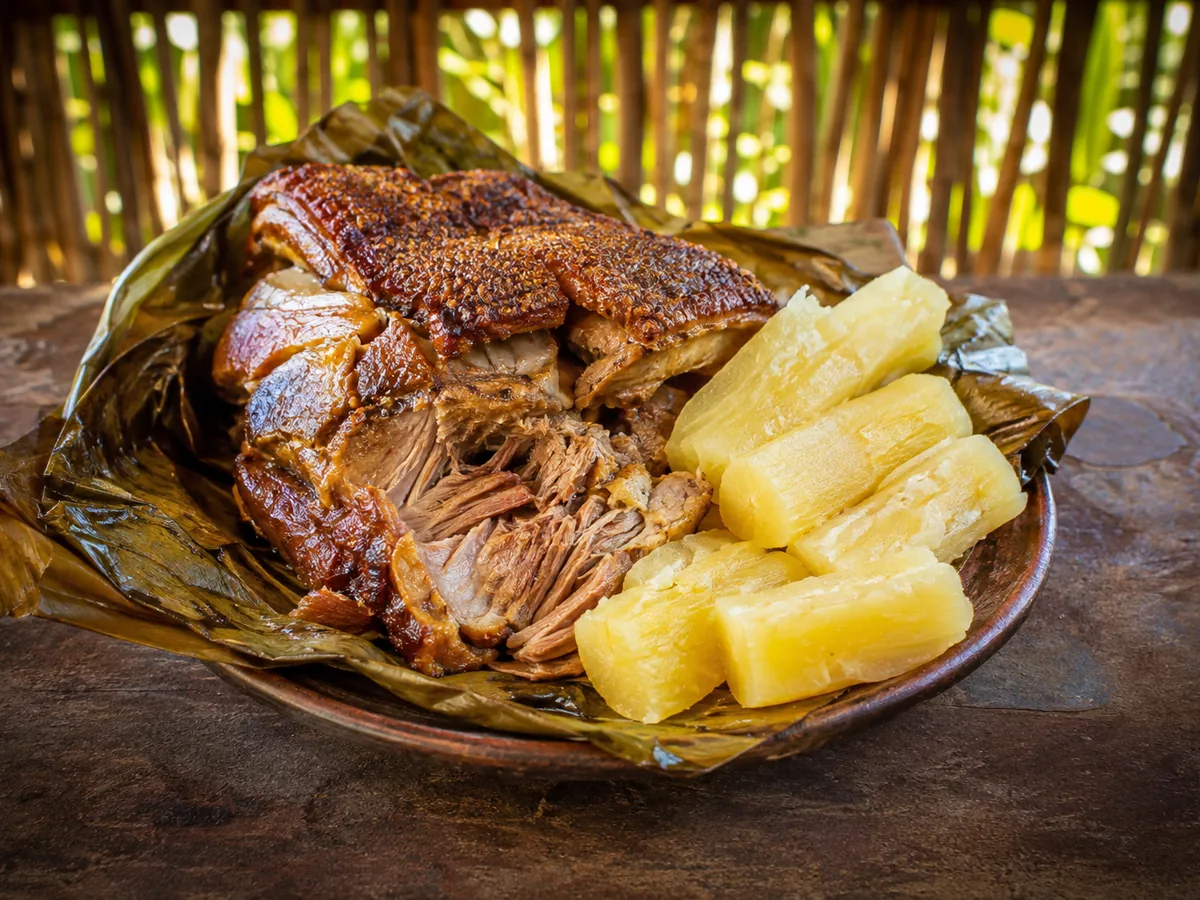
In rural Paraguay the ultimate communal celebration is marked by fire and earth. Yvyguy is Guaraní for “under the earth” — the ancient technique of seasoning whole cuts, wrapping them in banana leaves, burying them in a pit over red-hot coals and sealing them under warm soil for hours.
In domestic kitchens and country ranches the same method runs on a whole pork shoulder, head or beef ribs marinated in bitter Seville orange, crushed garlic, toasted cumin and coarse salt. Roasted low and slow until the meat shreds under a fork and the crackling blisters into brittle glass.
It goes onto wooden boards beside towering platters of steaming boiled mandioca — the bread of Paraguay.
The pork
- 3.5 kg7.7 lbBone-in, skin-on pork shoulder (picnic or Boston butt), skin scored in diagonal diamond slits
- 250 ml1 cupFreshly squeezed bitter orange juice (naranja agria), or 180 ml sweet orange with 70 ml lime
- 10 cloves10 clovesFresh garlic, crushed to a fine paste
- 15 g1 Tbsp + 1 tspGround cumin seeds, freshly toasted in a dry skillet
- 15 g1 TbspDried wild oregano, hand-crushed
- 35 g2 Tbsp + 1 tspCoarse sea salt25 g rubbed into the meat, 10 g into the skin
- 5 g1½ tspFreshly ground black peppercorn
- 60 ml4 TbspAchiote oil, or melted pork lard
- 1 packoptionalSmoked banana leaves, to wrap the meat and mimic the earthen pit
Mandioca hervida
- 2.5 kg5.5 lbFresh yuca (cassava root), peeled and cut into thick 8 cm logs
- 30 g2 TbspCoarse salt, for the boiling water
Liquid is the enemy of crackling
Never let the marinade touch the skin and never baste with pan juices. The skin is scored, rubbed dry with coarse salt, and left uncovered in the fridge so circulating air dehydrates it by osmosis. That dryness is the whole prerequisite for the final blister.
Low first, hot last
Four hours at 150 °C melts the type-I collagen around the shoulder blade into gelatin at 85–90 °C without driving the moisture out. Only then does 230 °C radiant heat flash the residual water under the rind into steam and puff it into cuerito crocante. High heat from the start dries the meat before the collagen can go.
Drain the mandioca the second it's tender
Cassava left standing in its cooking water turns waterlogged and mushy. Drained immediately it stays dry, floury and fluffy.
Look for the split
Boiled yuca is done when it swells and cracks open along its own longitudinal seams and turns snow-white.
Passive time, counted separately
The pork marinates uncovered 12 to 24 hours and rests 20 minutes off the heat before carving. Neither is active work and both sit outside the times quoted above.
The five tastes on this plate
Salt is coarse salt driven into the dense shoulder and the mandioca's boiling water. Fat is rendered crackling and melting intramuscular fat. Acid is sharp, floral bitter orange cutting the pork. Heat is garlic paste, toasted cumin, pepper and oregano. Umami is caramelised drippings, charred skin and slow-roasted garlic.
Equipment
- Sharp utility knife, for scoring
- Large tray, for marinating
- Heavy roasting pan with an elevated V-rack
- 6 qt stockpot
- Heavy serrated bread knife
- Instant-read thermometer
Traditionally wrapped in banana leaves and roasted in a wood-fired tatakuá, or buried in an earthen pit over hardwood embers. A heavy roasting pan with a V-rack works in a modern kitchen — the rack lifts the joint clear of the rendering fat so the skin stays dry, which is the one thing that matters.
Method
Score and marinate — a day ahead20 min
Pat the pork thoroughly dry. Score the skin in a 2 cm diagonal diamond crosshatch, cutting through skin and fat cap but not into the meat.
Whisk the bitter orange, garlic, cumin, oregano, pepper, achiote oil and 25 g coarse salt, and rub it aggressively into the meat side and down between the seams.
Turn skin-side up, wipe the skin completely dry, and rub 10 g coarse salt into the scoring. Refrigerate uncovered 12 to 24 hours.
Dry pork; score skin and fat in 2 cm diamonds without cutting meat. Rub meat only with bitter orange, garlic, cumin, oregano, pepper, achiote oil and 25 g salt. Keep marinade off skin; dry skin completely, rub scoring with 10 g salt and refrigerate uncovered 12–24 hours.
Slow-roast3 hr 45 min
Preheat the oven to 150 °C / 300 °F and set the pork skin-side up on the V-rack.
Pour 250 ml water into the pan beneath the rack, keeping the skin dry, and roast undisturbed 3 hours 45 minutes, until the core reads 88–90 °C / 190–194 °F and yields completely to a probe.
Heat oven to 150 °C / 300 °F. Set pork skin-up on the V-rack; pour 250 ml water beneath it, keeping skin dry. Roast undisturbed 3 hours 45 minutes until the core reaches 88–90 °C / 190–194 °F and yields freely to a probe. Never baste the skin.
Blister the crackling25–30 min
Raise the oven to 230 °C / 450 °F, wiping any rendered droplets off the skin with a clean paper towel first.
Roast 25 to 30 minutes, watching through the door, until the salted skin bubbles, blisters and puffs into shattering golden-chestnut crackling.
Rest on a board 20 minutes before carving.
Wipe rendered droplets off the skin with clean paper; raise oven to 230 °C / 450 °F. Roast 25–30 minutes, watching for puffed, blistered, golden-chestnut crackling. Rest on a board 20 minutes before carving.
Boil the mandioca25 min
While the roast rests, bring 3 litres of water with 30 g coarse salt to a rolling boil and drop in the yuca logs.
Boil hard 20 to 25 minutes until they swell, crack open along their seams, and turn snow-white and fork-tender. Drain immediately and keep warm, covered.
While pork rests, boil 3 litres water with 30 g salt. Add yuca logs; boil hard 20–25 minutes until swollen, split along their seams, snow-white and fork-tender. Drain immediately; keep warm and covered.
Carve and build the board
With a heavy serrated knife, lift the sheet of crackling off and break it into large shards.
Carve the pork into thick slices or pull it into rustic chunks, arrange it on wooden boards ringed with crackling, and serve with a platter of steaming mandioca, sopa paraguaya and lime wedges.
Lift off crackling with a heavy serrated knife; break into large shards. Slice pork thickly or pull into chunks. Arrange with crackling and serve with steaming mandioca, sopa paraguaya and lime wedges.
Sensory cues of doneness
- Visual: skin a mosaic of blistered golden-chestnut crackling, meat leaving the bone with no resistance, and mandioca snow-white and burst along its seams.
- Auditory: a glass-like shattering snap when a knife taps the skin, and the gentle simmer of the cassava pot.
- Olfactory: roasted pork fat, wood smoke, bitter orange, toasted cumin, sweet boiled yuca and garlic.
Look for blistered golden-chestnut skin, meat releasing easily from the bone and white cassava split along its seams. Crackling should shatter when tapped; expect pork fat, bitter orange, cumin, garlic and sweet cassava aromas.
Storing it
Crackling is best eaten fresh. To bring leftovers back, lay it skin-side down in a dry hot skillet for 2 minutes.
Troubleshooting
- Rubbery, chewy skin.
Marinade touched it, or it was basted with pan juices. Liquid ruins crackling — keep the skin bone-dry and blast it only at the end.
- Waterlogged, mushy mandioca.
It sat in the hot cooking water. Drain the second it turns tender.
- Dry meat.
It was roasted hot from the start. Four hours at 150 °C first, high heat only at the finish.
Substitutions
One-to-one global substitutions, with the technique adjustment each one requires.
Ingredient substitutions
| Ingredient | Replace with | Culinary impact and technique adjustment |
|---|---|---|
| Naranja agria | Three parts sweet orange juice to one part fresh lime | One-to-one. Matches the citric acidity and the floral orange aroma |
| Pork shoulder | Bone-in Boston butt, fresh ham, or beef short ribs | One-to-one. Look for a good fat cap |
| Fresh yuca | Frozen peeled cassava root | One-to-one. Boil straight from frozen in salted water |
Scaling
Half, for 4 to 5 portions
Use a 1.8 kg bone-in shoulder. Slow-roast 2 hours 30 minutes at 150 °C, then blister 20 minutes at 230 °C.
Double, for 16 to 20 portions
Roast two 3.5 kg shoulders on two racks, rotating their positions halfway.
What to serve it with
- Mandioca hervida caliente — the non-negotiable bread of the Paraguayan table
- Sopa paraguaya squares and chipa guasú
- Salsa criolla, and ice-cold lager or tereré from a horn guampa
Questions
What is kure akãngue yvyguy traditionally?
A whole pig's head marinated in bitter orange and spices, wrapped in banana leaves and buried under hot coals in an earthen pit for about six hours.
Can I do it with beef short ribs?
Yes — asado paraguayo uses bone-in short ribs seasoned with coarse salt and cooked over hardwood embers, or in the oven with the identical temperature staging.
How do I reheat leftover crackling?
Eat it fresh if you can. Otherwise lay it skin-side down in a dry hot skillet for 2 minutes to bring the brittle crunch back.