Chancho con Yuca
The king of the fritanga. The pork simmers in its own marinade until the water goes, and then — without anything being added — the pan temperature climbs and the same pork begins frying in its rendered lard. Fry it raw instead and the achiote burns black long before the meat is done.
- Prep
- 30 min
- Cook
- 1 hr 15 min
- Serves
- 6 hearty street-style portions
- Difficulty
- Medium
Researched · Kitchen testing pending
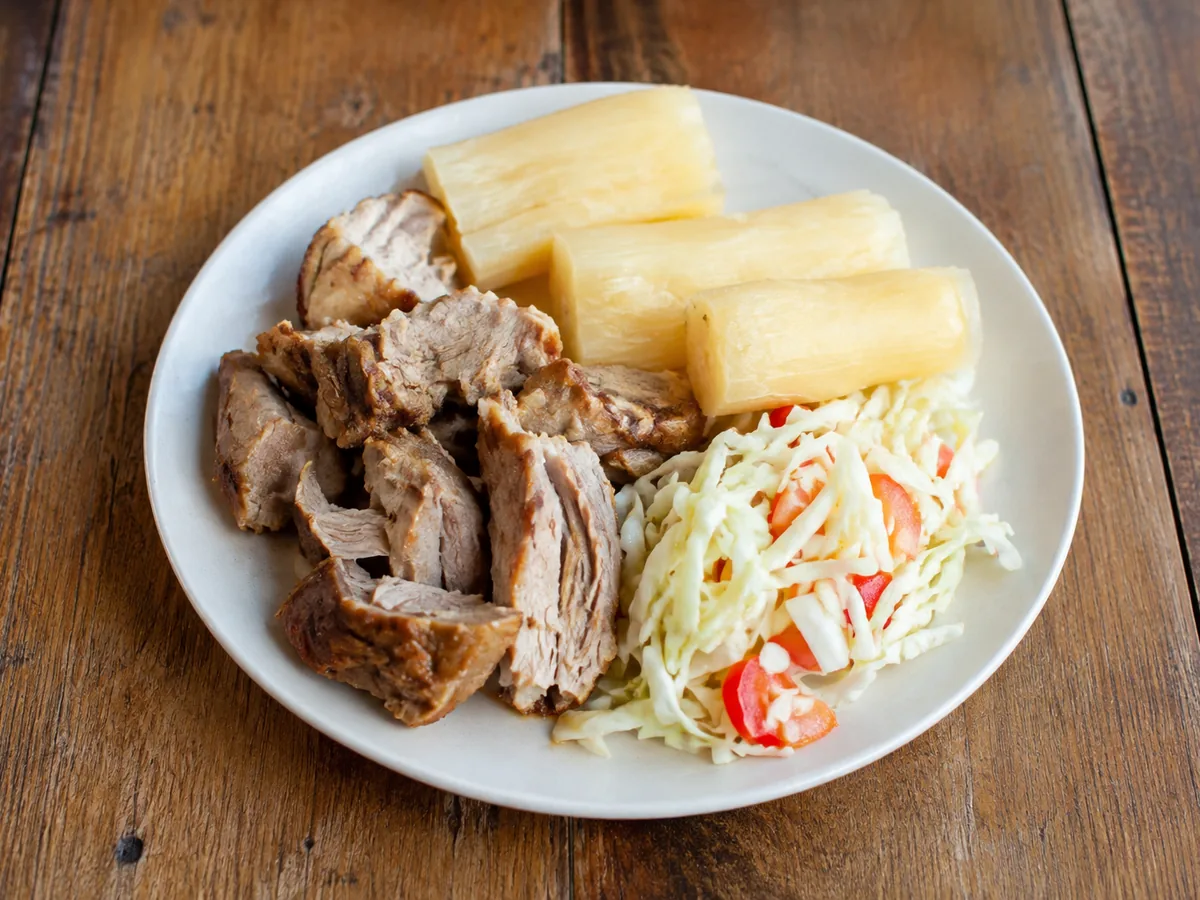
Along the pavements of León and Masaya, weekend smoke rises from the fritangas. Chancho con yuca is the king of Nicaraguan street food.
Chunks of pork shoulder and belly marinate overnight in sour orange, crushed garlic, toasted cumin, oregano and vivid red achiote. The pork simmers in its own marinade with a little water until tender, then fries in its own rendered lard until deeply bronzed and glazed.
It goes over a bed of steaming boiled yuca that splits open like snow, under a mountain of crunchy vinegar-pickled cabbage.
The pork
- 1.5 kg3.3 lbPork shoulder or boneless country ribs, cut into 5 cm cubes
The marinade
- 180 ml¾ cupFreshly squeezed sour orange juice, or 3 parts orange to 1 part lime
- 45 g3 TbspArtisanal achiote paste
- 8 cloves8 clovesFresh garlic, crushed to a paste
- 8 g2 tspCumin seeds, freshly toasted and ground
- 4 g1.5 TbspDried wild oregano, crushed
- 20 g1 Tbsp + 1 tspFine sea salt12 g onto the pork, 8 g into the yuca water
- 4 g1 tspCoarsely ground black pepper
The braise
- 250 ml1 cupCold filtered water
The yuca
- 1.5 kg3.3 lbFresh yuca, peeled, woody core removed, cut into 8 cm logs
The curtido
- 400 g½ headGreen cabbage, shredded into 2 mm ribbons
- 3 large3 largeRipe plum tomatoes, cut into fine 5 mm dice
- 60 ml¼ cupWhite cane vinegar
To serve
- 4 sheets4 sheetsFresh banana leaves, washed and cut into 30 × 30 cm squares
Braise, then fry — in the same pot
Forty-five minutes with water at 90 °C turns the collagen to gelatin. Once the water has boiled off, the pan climbs to about 175 °C and the pork fries in its own rendered lard with nothing added.
Why raw frying fails
Achiote paste burns black well before pork cubes cook through. The water phase is what protects it.
Sour orange drops the pH to 4.2
That denatures the surface proteins and lets the garlic and the fat-soluble bixin pigments penetrate deep into the cubes over twelve hours. Sweet commercial orange juice does neither.
Drain the yuca at once
Left in its water after it splits, it goes waterlogged and soggy. Out the moment it is tender.
The yuca is a sponge
Neutral and fluffy, it drinks the acidic curtido juices and the warm pork fat. That is its job on the plate.
Passive time, counted separately
The pork marinates 12 to 24 hours. That sits outside the times quoted above.
The five tastes on this plate
Salt is the pork marinade and the salted yuca water. Fat is rendered pork frying the meat into a glaze and dripping onto the cassava. Acid is sour orange in the marinade and cane vinegar in the slaw. Heat is garlic paste, toasted cumin, black pepper and optional pickled chilli. Umami is seared pork fond, achiote carotenoids and sweet boiled yuca.
Equipment
- Large bowl, for the marinade
- 7 qt enamelled cast-iron Dutch oven
- 8 qt pot, for the yuca
- Glass bowl and tongs
Traditionally a cast-aluminium caldero over wood coals. A 7-quart enamelled Dutch oven works in a modern kitchen — the enamel handles the transition from boiling water to high-heat frying without hot spots.
Method
Marinate the pork, the day before15 min
Whisk the sour orange juice, achiote paste, garlic, cumin, oregano, black pepper and 12 g salt smooth, and toss the pork cubes until every piece is coated red.
Cover and refrigerate 12 to 24 hours.
Whisk sour orange juice, achiote, garlic, cumin, oregano, pepper and 12 g salt until smooth. Coat every pork cube in the red marinade, cover and refrigerate 12–24 hours.
Braise45 min
Tip the pork and all its juices into the Dutch oven with the 250 ml water.
Boil, then cover partially and simmer over medium-low 45 minutes until the pork is tender and the water has almost gone.
Put pork and all marinade in the heavy pot with 250 ml water. Bring to boiling, partially cover and simmer over medium-low, around 90 °C, for 45 minutes until tender and nearly dry.
Fry to a crimson glaze15 min
Uncover and raise to medium-high. As the last water goes, the pork starts frying in its own lard.
Fry 12 to 15 minutes, turning with tongs every couple of minutes, until deeply browned, crisp at the edges and glossy red, at 85–88 °C.
Uncover and raise to medium-high. Let remaining water evaporate, then fry in rendered pork fat, around 175 °C, turning every couple of minutes for 12–15 minutes until crisp, deeply browned and glossy red, with pork at 85–88 °C.
Boil the yuca30 min
Bring 3 litres of water with 8 g salt to a rolling boil and add the yuca logs.
Boil 25 to 30 minutes until snow-white, swollen and split open down the centre. Drain immediately and keep warm.
Bring 3 litres water and 8 g salt to a rolling boil. Add yuca and boil 25–30 minutes until swollen, snow-white and split through the centre. Drain immediately and keep warm.
Toss the curtido5 min
Toss the shredded cabbage, diced tomato, vinegar, 1 tsp salt and a pinch of pepper, working it with your hands for 30 seconds to soften the cabbage slightly.
Toss shredded cabbage, diced tomato, vinegar, 1 tsp salt and a pinch of pepper. Work together with your hands for 30 seconds to soften the cabbage slightly.
Plate on banana leaf
Lay a leaf square on each plate, set 3 or 4 steaming chunks of yuca in the centre, mound the crisp glazed pork over them, and top generously with the slaw. Serve immediately.
Place a banana-leaf square on each plate. Arrange 3 or 4 steaming yuca pieces in the centre, pile crisp glazed pork above and finish generously with curtido. Serve immediately.
Sensory cues of doneness
- Visual: crimson-glazed crisp pork with caramelised edges over snow-white split yuca, crowned with green and red slaw.
- Auditory: a lively sizzle as the last water evaporates and the pork begins to fry.
- Olfactory: roasted pork fat, sour orange, toasted cumin, sweet achiote, garlic and vinegar cabbage.
Look for crimson pork with crisp caramelized edges, split white yuca and fresh green-red slaw. Listen for sizzling once braising water evaporates; the finished aroma should combine pork fat, sour orange, achiote, garlic, cumin and vinegar.
Troubleshooting
- Blackened, bitter pork.
It was fried raw and the achiote burned. Simmer with water first, then fry.
- Sweet, cloying meat.
Sweet commercial orange juice was used. It needs sour orange, or orange with lime.
- Soggy yuca.
It sat in its cooking water. Drain it the moment it is tender.
Substitutions
One-to-one global substitutions, with the technique adjustment each one requires.
Ingredient substitutions
| Ingredient | Replace with | Culinary impact and technique adjustment |
|---|---|---|
| Sour orange | 3 parts orange juice to 1 part lime | One-to-one. The same acidity |
| Pork shoulder | Pork butt, country ribs, or pork belly | One-to-one in 5 cm cubes; a 50/50 belly mix is richer still |
| Fresh yuca | Frozen peeled cassava | One-to-one, boiled from frozen in salted water |
Scaling
Half, for 3 portions
Halve everything in a 4-quart pot. The frying phase runs about 10 minutes.
Double, for 12 portions
Double everything in an 11-quart Dutch oven, frying the pork in two batches so it browns rather than steams.
What to serve it with
- More vinegar cabbage and tomato slaw over the pork
- Chileras nicaragüenses — pickled onion and congo chilli in vinegar
- A cold Toña, or chilled tamarind fresco
Questions
Can I use pork belly?
Yes. A 50/50 mix of shoulder and belly gives real richness and crisp cracklings.
What if I cannot find achiote paste?
Blend 2 Tbsp sweet paprika with 1 tsp ground coriander and 1 Tbsp oil.
Air fryer?
Braise on the stove first, then air-fry the cooked chunks at 200 °C for 8 minutes for the crisp edges.