Arroz a la Valenciana
Nothing like Spanish paella — where that is dry, crusty and saffroned, this is moist, buttery and rich. Three meats are cooked separately and folded in with the broth so none of them overcook, and parboiled rice is sealed in foaming butter so it drinks a litre of stock without bursting into starch.
- Prep
- 35 min
- Cook
- 45 min
- Serves
- 8 to 10 feast portions
- Difficulty
- Medium
Researched · Kitchen testing pending
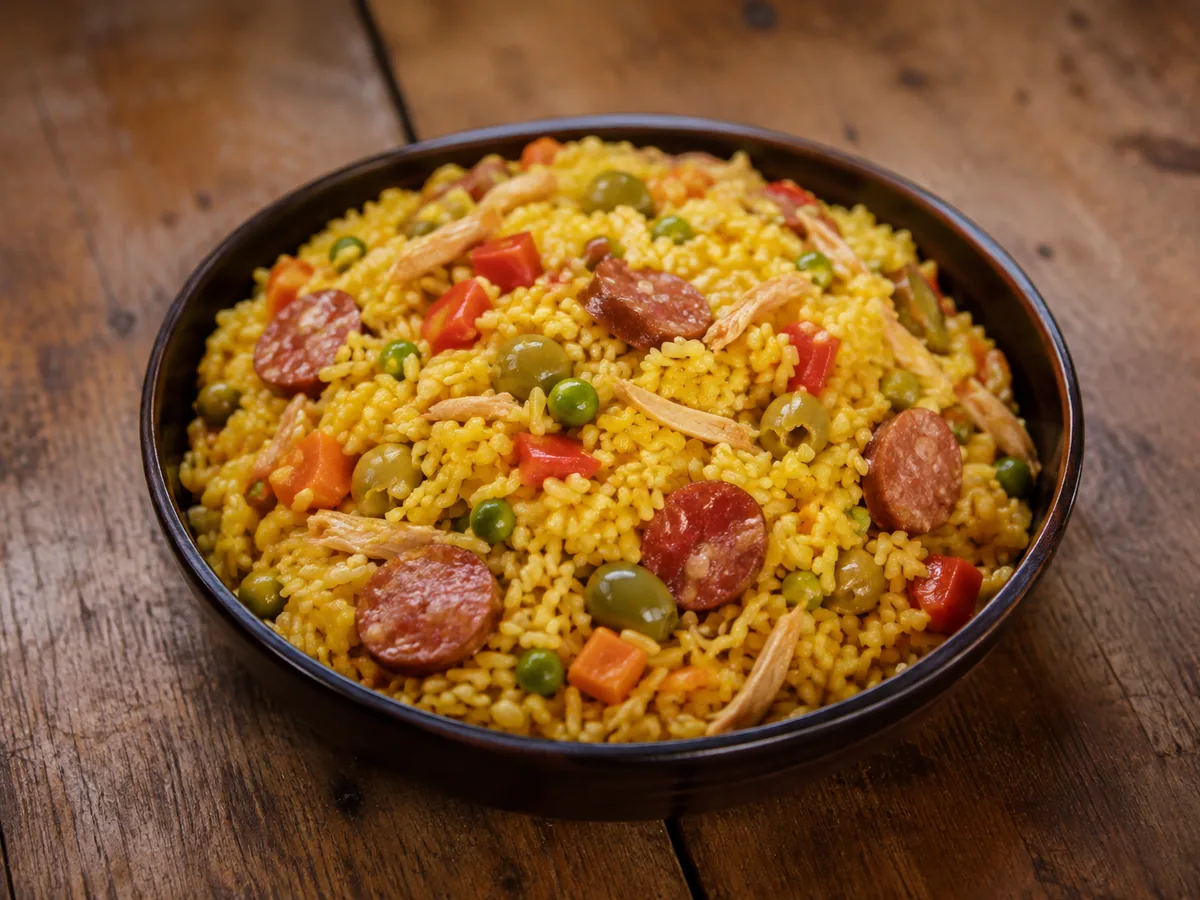
Arroz a la Valenciana is the festive soul of Nicaraguan celebration. At birthdays, quinceañeras and weddings, a giant golden caldero always anchors the table.
Unlike Spanish paella, which is dry and crusty with saffron, the Nicaraguan version is moist, buttery and rich. It combines shredded chicken, tender pork cubes and sliced salchichón, with rice cooked in sweet onion, green chiltoma, garlic and red pepper, bathed in butter, tomato paste, Worcestershire and chicken broth.
Folded with sweet corn, carrot, peas and green olives, it is traditionally served with potato crisps, white bread and refried beans.
The meats
- 600 g1.32 lbBone-in chicken thighs or breasts, poached and shredded into thick ribbons
- 400 g14 ozBoneless pork shoulder, cut into small 1.5 cm cubes and browned
- 250 g9 ozNicaraguan salchichón, or cooked smoked sausage, sliced into 5 mm coins
The rice
- 600 g3 cupsParboiled long-grain white rice, rinsed until the water runs clear
- 1 L4.2 cupsRich chicken bone broth, hot
- 100 g7 TbspUnsalted European butter, 82% butterfat60 g into the sofrito, 40 g dotted over before the steam
The sofrito
- 30 ml2 TbspAchiote oil
- 2 large2 largeYellow onions, cut into fine 4 mm brunoise
- 6 cloves6 clovesFresh garlic, minced to a paste
- 2 large2 largeSweet green chiltoma peppers, seeded and finely diced
- 1 large1 largeRed bell pepper, cored and finely diced
- 4 large4 largeRipe plum tomatoes, peeled, seeded and puréed smooth
- 60 g4 TbspDouble-concentrated tomato paste
- 45 ml3 TbspWorcestershire sauce (salsa inglesa)
- 15 g1 TbspFine sea salt
- 3 g1 tspFreshly ground black pepper
The vegetables
- 150 g1 cupSweet corn kernels, fresh or frozen
- 150 g1 cupSweet green peas, fresh or frozen
- 150 g1 cupCarrots, peeled and cut into 4 mm dice
- 80 g½ cupPitted green Manzanilla olives, sliced into rings
To finish
- 30 g½ cupFresh parsley or cilantro, chopped fine
Parboiled rice, sealed in butter
Parboiled grain absorbs a litre of stock without bursting. Three minutes in foaming butter and achiote oil at about 150 °C wraps each grain in a hydrophobic barrier before any liquid arrives.
Cook the meats separately
Chicken poached, pork browned, sausage seared — each to its own doneness, then folded in with the broth. Cooked together in the pot, the chicken would be dry long before the pork was ready.
1.7 parts broth to 1 part rice
One litre of hot stock to 600 g of rice. The butter then emulsifies into the tomato juices, which is what makes this moist and glistening rather than dry.
Never short-grain
Short-grain rice sheds far too much starch and the festive pot turns to glue.
Peas and olives go in late
Added at the start they turn grey and dull. They join with the meats before the steam.
Do not stir while steaming
Stirring breaks the grains and releases starch. Twenty minutes with the lid down and nothing else.
Passive time, counted separately
The finished pot rests covered 5 minutes off the heat. That sits outside the times quoted above.
The five tastes on this plate
Salt is sea salt, seasoned broth, Worcestershire and cured olives. Fat is generous butter, pork drippings and achiote oil on every grain. Acid is puréed tomato, tomato paste and the tamarind in the Worcestershire. Heat is garlic, sweet chiltoma, black pepper and the sausage spicing. Umami is chicken, browned pork fond, cured sausage and reduced stock.
Equipment
- Pot, for poaching the chicken
- Skillet, for the pork and sausage
- 8 to 10 qt enamelled Dutch oven with a heavy lid
- Large fork, for fluffing
Traditionally a large aluminium caldero over gas burners. An 8-to-10 quart enamelled Dutch oven works in a modern kitchen — the heavy lid is what traps steam evenly so the rim cooks at the same rate as the centre.
Method
Cook the meats30 min
Poach the chicken in 1.2 L salted water with half an onion and garlic 20 minutes to 74 °C, then shred into ribbons and keep the broth.
Brown the pork cubes in a skillet 6 minutes until golden, and give the sausage coins 2 minutes. Set the meats aside.
Poach chicken in 1.2 L salted water with half an onion and garlic for 20 minutes, reaching 74 °C. Shred and reserve broth. Separately brown pork cubes 6 minutes until golden and sear sausage coins 2 minutes; set aside.
Sofrito in butter12 min
Melt 60 g butter with the achiote oil over medium and sauté the onion, chiltoma, red pepper and garlic 6 to 8 minutes until soft.
Stir in the tomato paste, puréed tomato, Worcestershire, black pepper and 1 Tbsp salt and cook 4 minutes into a glossy red sauce.
Melt 60 g butter with achiote oil over medium. Soften onion, chiltoma, red pepper and garlic 6–8 minutes. Stir in tomato paste, puréed tomato, Worcestershire, black pepper and 1 Tbsp salt; cook 4 minutes until glossy.
Toast the rice3 min
Add the rinsed parboiled rice and stir constantly 3 minutes, coating every grain in the red butter sofrito until it smells nutty.
Add rinsed parboiled rice to the red butter sofrito, around 150 °C. Stir constantly for 3 minutes until every grain is coated and smells nutty; do not substitute short-grain rice.
Stock and vegetables8 min
Pour in 1 litre of hot broth and add the carrot, corn and peas.
Bring to a rolling boil and boil uncovered 6 to 8 minutes until the liquid drops level with the rice and steam craters appear.
Pour in 1 litre hot broth; add carrot, corn and peas. Boil uncovered 6–8 minutes until liquid is level with the rice and steam craters appear.
Fold in the meats and steam20 min
Scatter the shredded chicken, pork cubes, sausage coins and olives across the top, and dot the remaining 40 g of butter over the surface.
Lowest heat, lid on tight, steam undisturbed 20 minutes. Do not lift it.
Scatter chicken, pork, sausage and olives over the rice; dot with the remaining 40 g butter. Cover tightly, reduce to the lowest heat and steam 20 minutes without stirring or lifting the lid.
Fluff and rest
Scatter the parsley over, fold and fluff from the bottom up with a large fork so the meats and vegetables distribute evenly, and rest covered 5 minutes.
Add parsley and gently fold from the bottom upward with a large fork to distribute meats and vegetables. Remove from heat and rest covered 5 minutes.
Sensory cues of doneness
- Visual: glossy golden-orange rice packed with white chicken, brown pork, pink sausage coins, green peas, red pepper and olives.
- Auditory: a gentle crackle at the pot floor as the steam finishes, and grains falling loose from a lifted spoon.
- Olfactory: browned butter, sweet chiltoma, roasted chicken, sausage spice and sweet tomato.
Look for glossy golden-orange rice with separate grains and colourful meats and vegetables. A gentle crackle should mark the end of steaming; the aroma should combine browned butter, sweet pepper, chicken, sausage and tomato.
Storing it
It holds heat exceptionally well in a covered casserole, and tastes better the next day as the butter and spices settle.
Troubleshooting
- Sticky, glued rice.
Short-grain rice was used. It has to be long-grain parboiled.
- Grey, dull peas and olives.
They went in at the beginning. Add them with the meats before the steam.
- A soggy, broken pot.
The rice was stirred while steaming. Lid down for the full 20 minutes.
Substitutions
One-to-one global substitutions, with the technique adjustment each one requires.
Ingredient substitutions
| Ingredient | Replace with | Culinary impact and technique adjustment |
|---|---|---|
| Parboiled rice | Long-grain white rice | Reduce the broth by 150 ml; parboiled gives the least sticky grains |
| Salchichón | Smoked kielbasa, frankfurters, or Vienna sausages | One-to-one, sliced into 5 mm coins |
| Achiote oil | Neutral oil infused with 1 Tbsp sweet paprika | One-to-one for the golden colour |
Scaling
Half, for 4 to 5 portions
Halve everything in a 5-quart pot. The steam stays 20 minutes.
Double, for 20 portions
Double everything in a 16-to-20 quart stockpot over a wide flame spreader.
What to serve it with
- Salted potato crisps — the classic Nicaraguan party pairing
- Soft white sandwich bread
- Silky refried red beans
- A cold Toña, or Flor de Caña 12 with cola and lime
Questions
Why "a la Valenciana" if it is not paella?
Spanish settlers brought the Valencian rice idea, and Nicaraguan cooks rebuilt it with butter, pork, Latin sausage and local vegetables into something quite distinct.
Can it be made ahead?
Yes — it holds heat well in a covered casserole and is arguably better the next day.
Which sausage?
Nicaraguan salchichón is traditional; smoked kielbasa, good frankfurters or cooked chorizo all substitute well.