Quesillo con Trenza
From Nagarote on the Managua–León road. Braided pasta filata cheese is softened in 60 °C water — never boiling, which splits it into butterfat and rubber — wrapped in a tortilla straight off the comal, and drowned in cream at 4 °C. The whole dish is that temperature gap.
- Prep
- 20 min
- Cook
- 10 min
- Serves
- 6 large quesillos
- Difficulty
- Easy
Researched · Kitchen testing pending
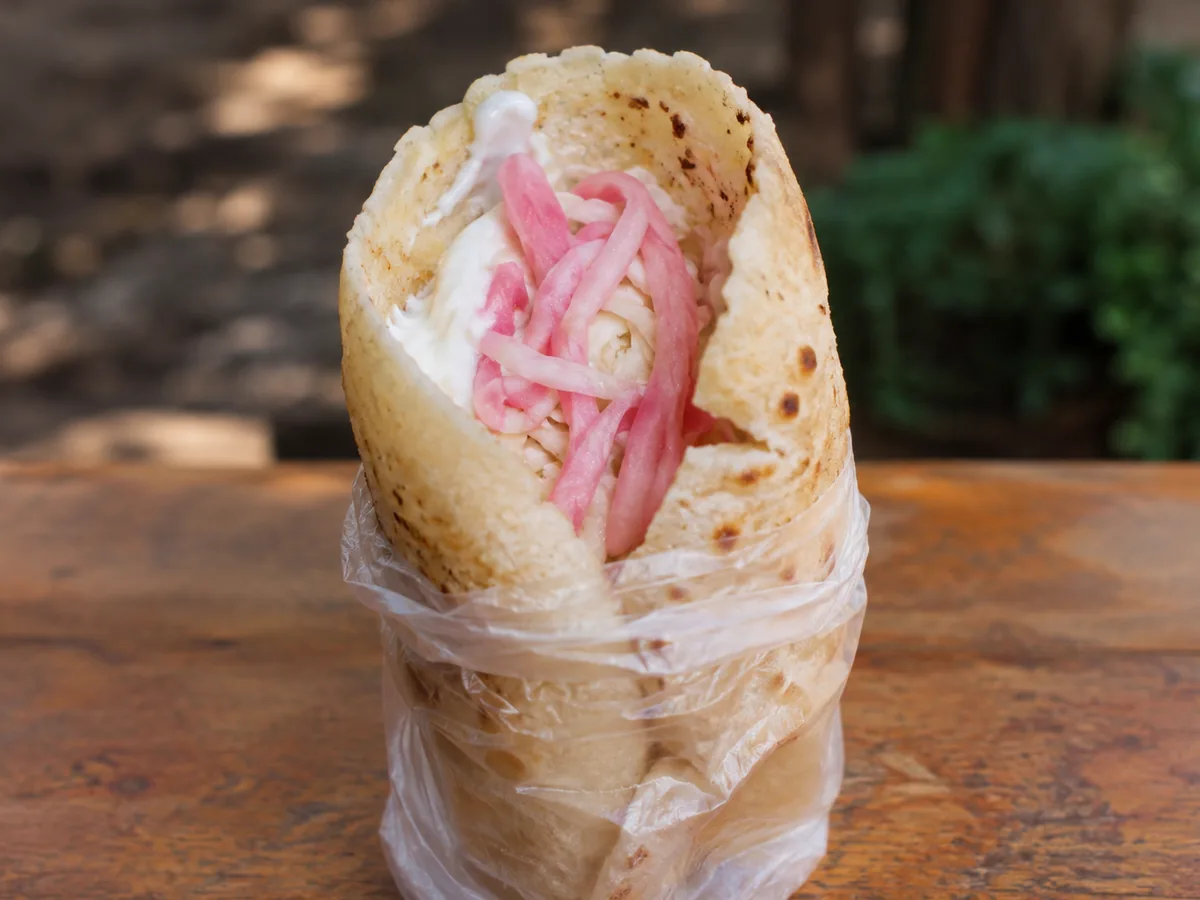
Along the highway from Managua to León, the roadside town of Nagarote is the birthplace of quesillo — street food in its purest, most tactile form.
It centres on stretched-curd cow’s milk cheese braided by hand into coils called trenzas. The cheese is warmed gently in hot water until it softens into an elastic ribbon, then wrapped immediately inside a piping-hot freshly pressed white corn tortilla. Over it goes a heap of finely minced white onion pickled in dark cane vinegar.
The whole bundle is drowned in a ladle of thick ice-cold cultured cream, served in a plastic bag, and eaten while the cheese is still stretching.
The cheese
- 600 g1.32 lbFresh braided quesillo nicaragüense, or fresh Oaxaca cheese or mozzarella in brine
- 500 ml2.1 cupsHot filtered water at 60 °C, for softening
The pickled onions
- 350 g2 largeWhite onions, minced into fine 2 mm brunoise
- 120 ml½ cupBlack cane vinegar (vinagre negro), or raw cider vinegar
- 10 g2 tspFine sea salt6 g into the onions, 4 g over the cream
To assemble
- 6 large6 largeFreshly pressed white corn tortillas, hot from the comal
- 250 ml1 cupRich Nicaraguan cultured sour cream, about 25% butterfat, chilled cold
- 6 bags6 bagsClear sandwich bags or greaseproof parchment, for authentic serving
60 °C, and 60 to 90 seconds
Quesillo is a stretched-curd cheese with aligned casein fibres. Warm water softens the fat and loosens the matrix into pliable ribbons. Boiling water at 100 °C separates it into greasy butterfat and rubbery whey, and there is no coming back.
The tortilla must be hot
Straight off a 190 °C comal, soft and pliable, so it traps the residual heat around the cheese. A cold tortilla cracks and the whole thing falls apart.
Thick cream, not thin
Watery sour cream simply runs off. Real crema nica is thick, cultured, un-homogenised and around 25% butterfat.
Vinegar at pH 2.8
Black cane vinegar pickles the minced onion and cuts the heavy milk lipids on the tongue. Without that acid the whole bite is just fat.
Hot meets cold, deliberately
Molten cheese and warm corn against cream straight from the fridge. The thermal contrast in a single bite is the entire point of the dish.
Passive time, counted separately
The onions macerate at least 30 minutes, and up to 24 hours. That sits outside the times quoted above.
The five tastes on this plate
Salt is the briny curds, the salted onions and a pinch over the cream. Fat is dense cultured cream and melting whole-milk cheese. Acid is sharp black cane vinegar in the onions. Heat is the raw onion bite, softened by maceration. Umami is fresh cheese curds and toasted corn.
Equipment
- Glass jar, for the onions
- Bowl and a thermometer, for the water
- 12 in cast-iron skillet or comal
- Fork
Traditionally a flat clay comal for the tortillas and a pot of hot water for the cheese, served in plastic bags. A cast-iron skillet and a bowl of 60 °C water works in a modern kitchen — the thermometer matters more than anything else here.
Method
Pickle the onions10 min
Combine the minced onion, the 120 ml black cane vinegar and 6 g salt in a glass jar and stir well.
Macerate at least 30 minutes, up to 24 hours, until the raw sting has gone and the onions are translucent, crisp and tart.
Mix minced onion, 120 ml black cane vinegar and 6 g salt in a glass jar. Macerate at least 30 minutes, up to 24 hours, until translucent, crisp and tart without harsh raw sting.
Soften the quesillo2 min
Cut the braid into 6 portions of about 100 g and pour the 60 °C water over them.
Leave strictly 60 to 90 seconds — the cheese turns glossy and stretches into pliable ribbons without melting away. Lift out with a fork.
Cut quesillo braid into 6 portions of about 100 g. Pour 60 °C water over them for strictly 60–90 seconds until glossy and stretchable; do not use boiling water. Lift out with a fork.
Warm the tortillas5 min
Heat the tortillas on a dry skillet at 190 °C for 30 seconds a side until steaming, soft and pliable.
Heat tortillas on a dry skillet at 190 °C for 30 seconds per side, until steaming, soft and flexible. Use them hot so they roll without cracking.
Roll
Lay a hot tortilla flat inside a bag or on parchment and place 100 g of warm stretchy cheese in the centre.
Fold the bottom edge over the cheese and roll into a snug cylinder, leaving the top open.
Lay a hot tortilla inside a bag or on parchment. Place 100 g warm stretchy cheese centrally, fold the bottom over it and roll snugly, leaving the top open.
Onions and cold cream
Spoon 2 generous tablespoons of pickled onion over the exposed cheese.
Pour 3 to 4 tablespoons of ice-cold crema over the top so it cascades down into the tortilla, and sprinkle a pinch of salt over the cream.
Add 2 generous tablespoons pickled onion over the exposed cheese. Pour 3–4 tablespoons ice-cold thick crema into the opening and sprinkle with a pinch from the remaining 4 g salt.
Serve street-style
Twist the bottom of the bag and eat immediately, while the cheese is warm and stretching and the cream is still cold.
Twist the bottom of the serving bag and eat immediately, while the cheese remains warm and stretchy and the thick crema is still cold.
Sensory cues of doneness
- Visual: a warm tortilla overflowing with stretchy white cheese, studded with pickled onion, under a thick blanket of cold cream.
- Auditory: a soft squelch through the warm corn and molten cheese, and the quiet drip of cream.
- Olfactory: toasted corn off the comal, warm milk curds, pungent cane vinegar and rich cultured cream.
Look for pliable tortilla surrounding stretchy white cheese, tart onion and thick cold cream. Serve while aromas of toasted corn and warm curds contrast with sharp cane vinegar and cultured cream.
Troubleshooting
- Greasy, rubbery cheese.
The water was boiling. It must be 60 °C, and only for 60 to 90 seconds.
- Cream running off the tortilla.
The sour cream was too thin. Use a thick cultured crema.
- A cracked, breaking tortilla.
It went in cold. Straight off a hot comal, soft and pliable.
Substitutions
One-to-one global substitutions, with the technique adjustment each one requires.
Ingredient substitutions
| Ingredient | Replace with | Culinary impact and technique adjustment |
|---|---|---|
| Quesillo nicaragüense | Fresh queso Oaxaca, or mozzarella in brine | One-to-one, softened in 60 °C water for 60 seconds |
| Crema nica | Crema agria, Salvadoran crema, or crème fraîche | One-to-one, provided it is genuinely thick |
| Black cane vinegar | Raw cider vinegar, or malt vinegar | One-to-one for pickling the onions |
Scaling
Half, for 3 quesillos
Macerate the onions in 60 ml vinegar. Assembly takes about 5 minutes.
Double, for 12 quesillos
Warm the cheese in two batches so it stays hot and stretchy for every roll.
What to serve it with
- Cold tiste — roasted corn, cacao, cinnamon and sugar
- Fresco de cacao con leche over crushed ice
- Extra black cane vinegar on the side
Questions
What is vinagre negro?
Unpasteurised artisanal vinegar fermented from bananas or cane juice — darker and milder than white vinegar. Raw cider vinegar is a good substitute.
What cheese can I use?
Fresh queso Oaxaca unbraided into ribbons, or fresh whole-milk mozzarella in water, softened in warm water.
Why serve it in a plastic bag?
The bag catches the cold cream and vinegar juices as you bite, so you can drink the cream-vinegar broth at the end.