Sopa de Queso
Holy Week, when meat is off the table. One cheese-masa dough is used in two physical states: two-thirds fried into crisp rosquillas, one-third blended with milk and whisked into the broth, where the corn starches gelatinise at 85 °C into a velvety golden potage.
- Prep
- 35 min
- Cook
- 30 min
- Serves
- 6 bowls, with 18 to 20 rosquillas
- Difficulty
- Medium
Researched · Kitchen testing pending
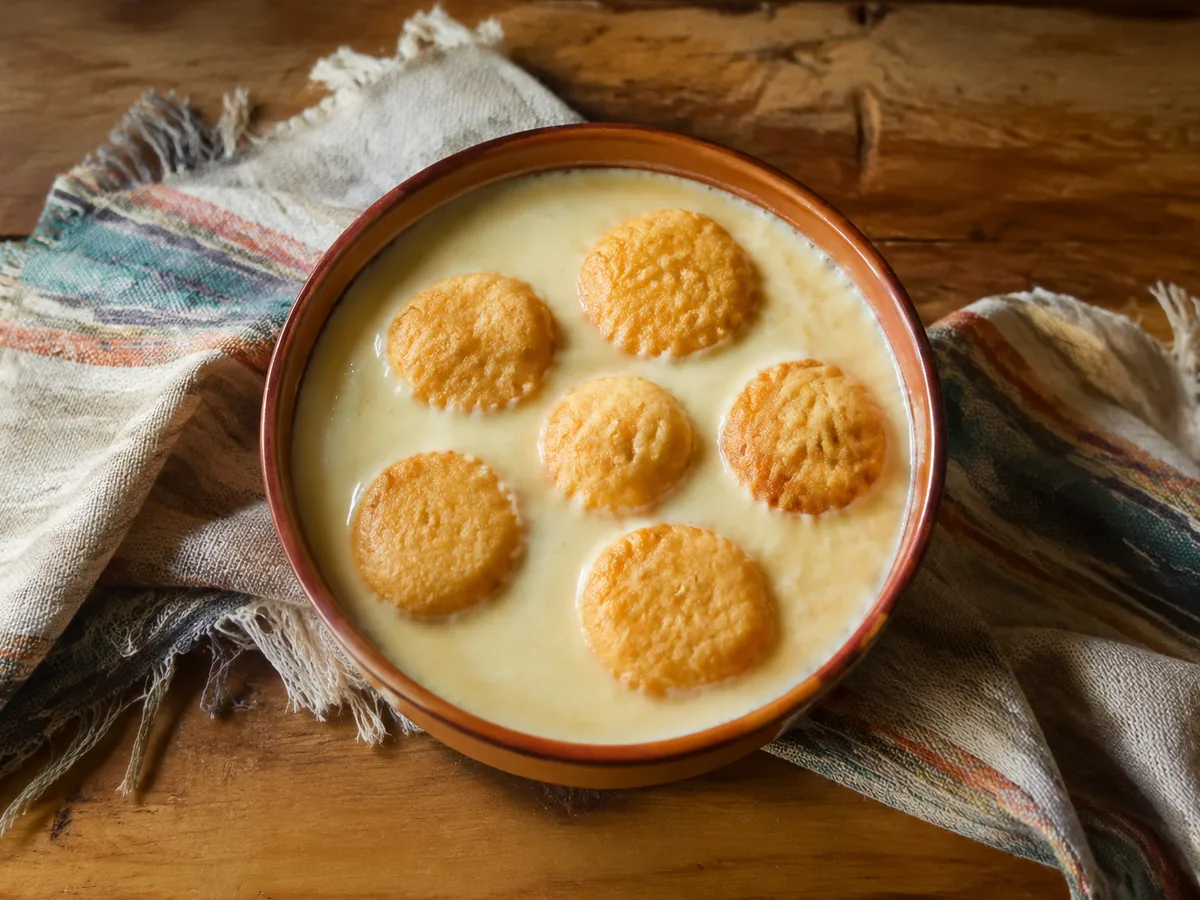
During the heat of Semana Santa, when Catholic tradition forbids meat, kitchens across Nicaragua fill with the smell of sopa de queso. It is a celebration of maize and dairy.
The base is a golden vegetable broth seasoned with sweet onion, green chiltoma, ripe tomato and hierbabuena. The cook makes a rich dough of fresh white corn masa, grated dry salty queso seco and eggs — half of it shaped into ring-shaped fritters and fried crisp, the rest dissolved with milk and whisked into the hot broth until it thickens into a velvety golden cream.
The fried rings go into the steaming soup right before serving, softening slightly while keeping their crunch.
The cheese-masa dough
- 600 g4 cupsFresh white corn masa, or 350 g masa harina with 350 ml warm water
- 400 g3.5 cups packedNicaraguan queso seco, grated as finely as powder
- 2 large2 largeEggs at room temperature, lightly beaten
- 30 ml2 TbspRendered pork lard, or melted butter
- 15 ml1 TbspFresh sour orange juice, or lime juice
- 3 g1 tspFreshly ground white pepper
To fry
- 1 L4.2 cupsHigh-smoke-point vegetable oil or lard
The broth
- 1.8 L7.5 cupsRich vegetable stock, or water1.5 L into the pot, 300 ml into the slurry
- 350 ml1.5 cupsWhole milk, warm
The sofrito
- 30 ml2 TbspAchiote oil
- 1 large1 largeYellow onion, peeled and cut into 4 mm brunoise
- 1 large1 largeSweet green chiltoma pepper, cored and minced fine
- 4 cloves4 clovesFresh garlic, minced to a paste
- 3 large3 largeRipe plum tomatoes, peeled, seeded and puréed smooth
- 8 g2 tspCumin seeds, freshly toasted and ground
- 3 g1 TbspDried wild oregano, crushed
- 12 g2 tspFine sea saltadded carefully — the queso seco is already salty
To finish
- 20 g½ cup packedFresh spearmint (hierbabuena), washed and chopped
One dough, two states
Two-thirds of it becomes fried rings, one-third becomes the thickener. The same cheese-and-corn mixture gives the soup both its body and its crunch.
Dry aged cheese, never fresh
Queso seco is around 32% moisture with dense protein. Young wet cheese like fresh mozzarella melts in the oil and spatters violently.
Blend the masa slurry
Raw masa dropped into hot broth becomes dense dumplings. Blended smooth with warm milk and stock for a full minute, it disperses into a lump-free velvet.
Stir in figure-eights
Gelatinising corn starch settles on the bottom instantly. Keep a wooden spoon moving across the floor of the pot for the whole ten to twelve minutes.
Rosquillas at the table
Dropped into the pot fifteen minutes early they go to mush. They go into the bowls right before serving, so the shell softens while the inside stays crisp.
A splash of sour orange in the dough
It tenderises the corn masa proteins and keeps the fried rosquilla from eating heavy and greasy.
Passive time, counted separately
The finished soup steeps 3 minutes off the heat with the mint. That sits outside the times quoted above.
The five tastes on this plate
Salt is dominated by the sharp aged salinity of the queso seco. Fat is the fried rosquillas, whole milk and achiote oil. Acid is sour orange in the dough, sweet-tart tomato and fresh spearmint. Heat is toasted cumin, garlic, sweet chiltoma and white pepper. Umami is aged cheese peptides, toasted masa and vegetable broth.
Equipment
- Wide mixing bowl
- 5 qt Dutch oven with a deep-fry thermometer
- 6 qt enamelled cast-iron Dutch oven
- Blender
- Slotted spoon and a wooden spoon
Traditionally a clay olla for the soup and an iron paila for the frying. A 6-quart enamelled Dutch oven and a separate 5-quart pot with a thermometer work in a modern kitchen — the soup pot needs even low heat, the frying pot needs a steady 180 °C.
Method
Knead the cheese-masa dough10 min
Combine the masa, grated queso seco, melted lard, sour orange juice, white pepper and beaten eggs, and knead 4 to 5 minutes into a smooth pliable cheese-rich dough.
Divide it: two-thirds for the rosquillas, one-third for the soup.
Knead masa, grated aged queso seco, melted lard, sour orange, white pepper and beaten eggs 4–5 minutes until smooth and pliable. Reserve two-thirds for rings and one-third for soup; avoid wet fresh cheese, which spatters in oil.
Shape and fry the rosquillas20 min
Roll walnut-sized pieces of about 30 g into ropes 12 cm long and 1.5 cm thick, and pinch the ends into rings.
Fry at 180 °C in batches of five or six, 3 to 4 minutes, turning, until deep golden-amber and crisp. Drain on paper towel.
Roll 30 g dough pieces into ropes 12 cm long and 1.5 cm thick; pinch ends into rings. Fry at 180 °C in batches of five or six, turning for 3–4 minutes until deep golden and crisp. Drain on paper.
Cook the sofrito11 min
Heat the achiote oil over medium and sauté the onion, chiltoma and garlic 5 to 6 minutes until soft.
Stir in the puréed tomato, cumin, oregano and pepper and cook down 5 minutes into a fragrant red paste.
Heat achiote oil over medium; soften onion, chiltoma and garlic 5–6 minutes. Add puréed tomato, cumin, oregano and pepper; cook down 5 minutes into a fragrant red paste.
Build and thicken15 min
Pour 1.5 L stock into the sofrito and bring to a gentle simmer.
Blend the reserved third of the dough with the 350 ml warm milk and 300 ml cold stock for 60 seconds until completely smooth, then pour it into the simmering soup, whisking constantly.
Add 1.5 L stock to sofrito and bring to a gentle simmer. Blend reserved dough with 350 ml warm milk and 300 ml cold stock for 60 seconds until completely smooth. Pour into simmering soup while whisking constantly.
Simmer to velvet12 min
Cook over medium-low 10 to 12 minutes, stirring in figure-eights across the bottom, as the corn starches gelatinise into a creamy broth.
Taste before adding any salt — the cheese has already contributed a great deal.
Cook over medium-low 10–12 minutes, stirring figure-eights across the bottom throughout, until the broth becomes creamy. Taste before adding salt because the aged cheese already seasons the soup.
Mint, then the rings
Off the burner, stir in the chopped hierbabuena, cover and steep 3 minutes.
Ladle into wide bowls and drop 3 or 4 crisp rosquillas into each bowl at the table.
Off heat, stir in chopped hierbabuena, cover and steep 3 minutes. Ladle into wide bowls and add 3 or 4 crisp rosquillas per bowl only at the table so they retain texture.
Sensory cues of doneness
- Visual: a velvety sunset-gold soup with golden-brown cheese rings floating on it, flecked with tomato and bright green mint.
- Auditory: a brisk hiss as the rosquillas hit the oil, and quiet simmering murmurs in the soup pot.
- Olfactory: fried cheese and toasted cornmeal, sweet chiltoma, cumin and spearmint.
Check for velvety golden soup flecked with tomato and green mint, topped with golden-brown rings. Keep the soup gently simmering; the finished aroma should combine fried cheese, toasted corn, chiltoma, cumin and spearmint.
Troubleshooting
- The cheese melts and spatters in the oil.
A young wet cheese was used. It must be dry, aged and crumbly.
- Dumplings instead of a smooth soup.
Raw masa went in unblended. Blend it into a slurry with milk first.
- Soggy rosquillas.
They sat in the pot. Float them in the bowls at the table.
Substitutions
One-to-one global substitutions, with the technique adjustment each one requires.
Ingredient substitutions
| Ingredient | Replace with | Culinary impact and technique adjustment |
|---|---|---|
| Queso seco | Cotija, dry aged queso blanco, or bone-dry crumbled feta | One-to-one, provided it is dry, salty and crumbly |
| Fresh corn masa | Masa harina hydrated with warm water | One-to-one, hydrated until it feels like soft clay |
| Hierbabuena | Fresh spearmint | One-to-one — never peppermint |
Scaling
Half, for 3 portions
Halve everything in a 4-quart pot. Frying and simmering times are identical.
Double, for 12 portions
Double everything in a 12-quart pot, frying the rosquillas in batches of eight.
What to serve it with
- A basket of extra warm rosquillas de queso for dipping
- Steamed white rice
- Chilled tamarind juice with chia
- A cold Toña, or chicha de maíz
Questions
What replaces Nicaraguan queso seco?
Cotija, aged feta patted bone-dry and crumbled, or aged Parmigiano mixed with dry farmer's cheese.
Can the rosquillas be baked?
At 200 °C for 15 to 18 minutes, yes — but frying in lard gives the authentic blistered shell.
Why sour orange in the dough?
It tenderises the corn masa proteins and keeps the fried ring from eating heavy.