Tacos al Pastor
Pork in a guajillo-achiote adobo, cut thin and cooked until the edges char against pineapple sugar. The trompo is the ideal; the skillet is a labelled substitute, not a quiet equivalent.
- Prep
- 1 hr
- Cook
- 1 hr 30 min
- Serves
- 8 servings, about 20–24 tacos
- Difficulty
- Medium
Researched · Kitchen testing pending
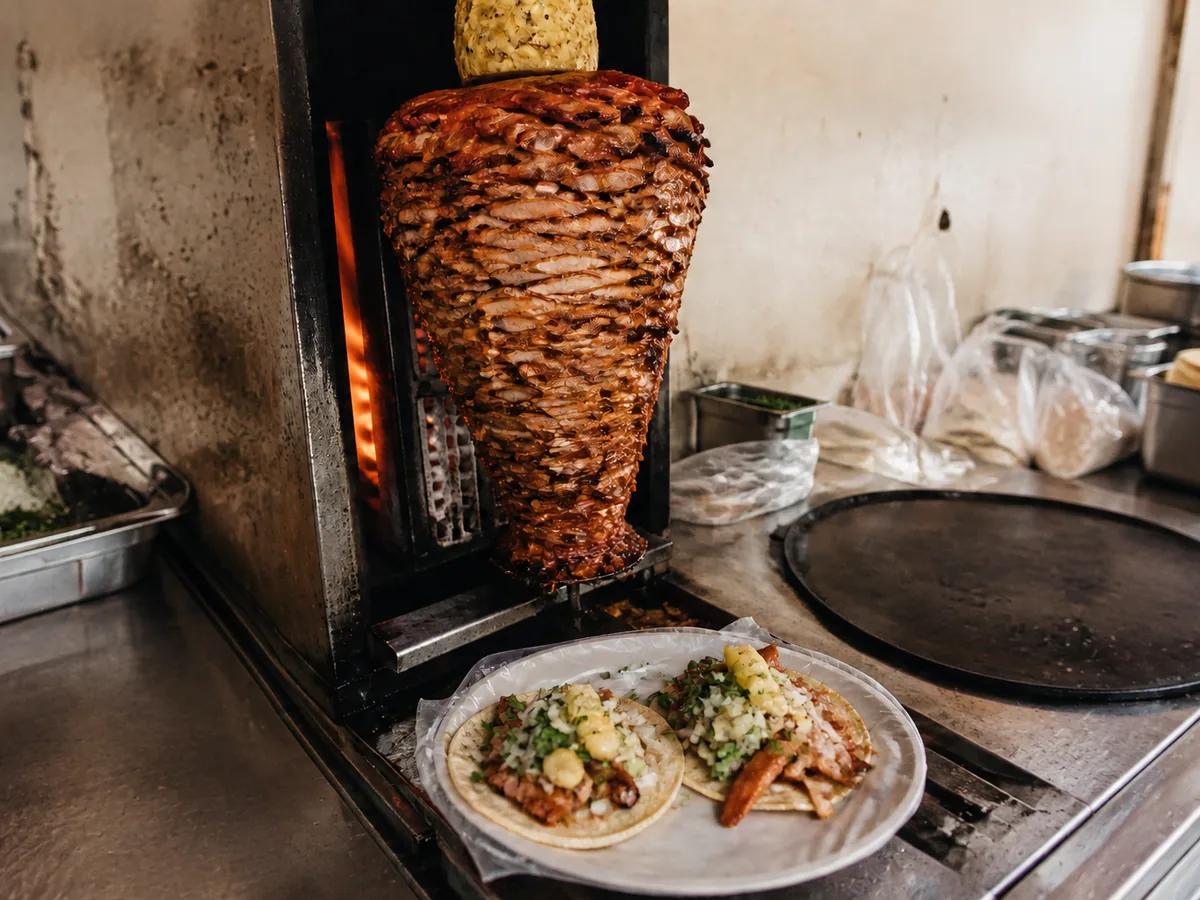
Pineapple on the cutting board is not garnish theatre. Its juice carries bromelain and enough sugar to brown hard against chile paste, which is why al pastor tastes like itself instead of generic red pork.
The dish sits in a clean Lebanese–Mexican line: vertical spit cooking that Lebanese immigrants brought to Mexico met local pork, dried chile adobo and corn tortillas, and the trompo became the standard.
A home sheet pan is no taquería spinner, and this page does not pretend otherwise. The pan method is labelled a substitute; it chases the same adobo and edge char, and slices thin enough that each bite still reads as pastor — not carnitas, and not shawarma with a Spanish name taped on.
Al pastor is chile-achiote-marinated pork cooked so the exterior takes colour while the interior stays juicy, then shaved thin and finished with pineapple, onion and cilantro on warm corn tortillas. The trompo is the ideal geometry: fat bastes downward, edges crisp, and you carve only what you serve. Home pan, sheet and broiler methods are honest substitutes when you lack a spit — they are not failures, but they are labelled here so nobody confuses a weeknight sear with the classic cylinder of meat.
Pork
- 1.2 kg2⅔ lbBoneless pork shoulder (Boston butt)excess hard fat trimmed, but leave a thin fat cap where there is one
Adobo
- 4 chiles4 chilesGuajillo chilesabout 30 g / 1 oz; stems and seeds removed
- 2 chiles2 chilesAncho chilesabout 20 g / ⅔ oz; stems and seeds removed. Optional depth — guajillo can solo
- 15 g1½ TbspAchiote paste (annatto), crumbled
- 60 ml¼ cupDistilled white vinegar, or apple cider vinegar
- 60 ml¼ cupPineapple juicefrom the fresh fruit you will cook with, or canned unsweetened
- 6 cloves6 clovesGarlic
- 1 tsp1 tspDried Mexican oregano
- ½ tsp½ tspGround cumin
- ½ tsp½ tspBlack pepper, freshly ground
- ¼ tsp¼ tspGround canela (true cinnamon)or a tiny pinch
- 2 cloves2 clovesWhole clovesor a pinch of ground clove
- 1½ tsp1½ tspKosher salt, for the adobomore for finishing
- 15 ml1 TbspNeutral oil
- 1–2 tsp1–2 tspSugar or honeyonly if your chiles taste hollow after blending — optional
Pineapple, onion, tortillas, finish
- ½ pineapple½ pineappleRipe pineapple, peeled and coredcut 2 thick rounds (2 cm / ¾ in) for cooking, the rest into small dice for serving
- 1 large1 largeWhite onionhalf in thick rings or wedges for the grill or pan, half finely diced for the salsa bar
- 1 bunch1 bunchCilantro, leaves and tender stems chopped
- 24 tortillas24 tortillasSmall corn tortillasabout 10–12 cm / 4–5 in
- 2 limes2 limesLimes, cut into wedges
- Neutral oil, for the pan
- Extra salt
Prep state
Pork sliced or portioned as directed; chiles stemmed and seeded; pineapple peeled and cored; garlic peeled; adobo ingredients measured.
How to cut the pork
For a trompo or a stacked roast, slice into sheets about 5–8 mm (¼–⅓ in) thick, across the grain as much as the cut allows. For home pan chunks, cut into 2.5–3 cm (1–1¼ in) pieces, or keep 1 cm (⅜ in) steaks for faster char.
Equipment
- Ideal — countertop vertical broiler or home trompo, or a vertical skewer setup holding stacked meat over a drip tray
- Ideal — sharp carving knife or long thin slicer
- Instant-read thermometer
- Substitute — heavy cast-iron skillet or griddle, or a rimmed sheet pan and oven broiler
- Substitute — tongs and a sharp knife
- Blender, for the adobo
- Nonreactive bowl or zip bag, for marinating
- Wire rack set in a sheet pan, optional, for airflow in the oven method
Method
Soften the chiles and blend the adobo20 min
Cover the guajillos, and the anchos if using, with just-boiled water. Soak 15 minutes until flexible, then drain.
Blend the chiles with the achiote, vinegar, pineapple juice, garlic, oregano, cumin, pepper, canela, clove, salt and oil until completely smooth, 60–90 seconds. The paste should look brick-orange to deep red and smell sharp from vinegar, earthy from annatto and fruity from chile — not dusty. Taste a dab: salty, tangy, gently bitter from the chile skin. Strain it if your blender leaves flecks.
Why vinegar and pineapple juice: acid helps the adobo wet the meat and brightens rich pork, and pineapple juice adds sugar for browning. Bromelain can soften the surface if you marinate far beyond 24 hours, so do not walk away for days.
Soak guajillos and optional anchos in just-boiled water 15 minutes; drain. Blend with achiote, vinegar, pineapple juice, garlic, oregano, cumin, pepper, cinnamon, cloves, salt and oil 60–90 seconds until smooth. Taste, adding optional sugar only if needed; strain remaining flecks.
Marinate4–24 hr
Toss the pork thoroughly with the adobo so every face is coated. Stack it in a nonreactive dish, cover, and refrigerate.
If you are using a vertical spit later, you can marinate already stacked on the skewer inside a bag, or marinate loose and stack just before cooking. Flip the stack once if liquid pools.
Cut pork across the grain into 5–8 mm (¼–⅓ in) sheets for stacking, or 1 cm (⅜ in) steaks or 2.5–3 cm (1–1¼ in) chunks for pan cooking. Coat thoroughly with adobo, cover in a nonreactive dish and refrigerate 4–24 hours; turn once if liquid pools.
Stack and cook on the trompo45–90 min
This is the ideal geometry, and the timing depends on the diameter of your stack.
Thread a pineapple round onto the spit base if your setup allows, then stack the meat sheets evenly, ending with another pineapple round on top. Cook according to your machine, with the outer surface taking steady colour. You are aiming for an exterior that darkens and lightly chars while the interior of the cylinder climbs toward safe pork temperature.
Carve thin shavings when the outer layer is browned; the freshly exposed face then cooks for the next round of slices. Finished shavings should hit at least 63 °C / 145 °F with a rest if you carve larger pieces, or cook through as you crisp them on a plancha after shaving — many stands finish shaved meat on the flat top with a slap of pineapple.
Sensory: edges smell sweet-smoky, fat renders glossy, and the pineapple on the spit picks up chile and drips sticky juices onto the meat.
Stack pork sheets evenly on the spit between pineapple rounds. Follow the machine instructions, browning the exterior steadily. Shave only browned outer layers, allowing each newly exposed face to cook. Finish shavings on a plancha until cooked through; larger pieces should reach at least 63 °C / 145 °F and rest 3 minutes, as in the pan method.
Warm the tortillas and assemble10 min
Heat the corn tortillas on a dry comal until pliable and spotty, 30–45 seconds per side, and keep them wrapped in a clean towel.
Build each taco with a pile of thin pork, diced pineapple, diced white onion, cilantro and a squeeze of lime. Salt the meat again at the cutting board if the shavings taste shy — slicing exposes new surface that wants a final pinch.
Warm tortillas on a dry comal 30–45 seconds per side until flexible and spotted; wrap in a clean towel. Fill with thinly sliced pork, diced pineapple, onion, cilantro and lime. Taste pork and add a final pinch of salt if needed.
Method B — home pan, sheet or broiler (labelled substitute)
This is the weeknight path. Same adobo, same thin slice, same pineapple — different geometry. Steps 1 and 2 are identical to the trompo method, and step 4, warming the tortillas and assembling, still finishes the plate. For pan cooking, 1 cm (⅜ in) steaks or 2.5 cm (1 in) chunks work best, giving more surface per bite without drying a huge roast. It is an honest substitute, not a claimed equivalent. Cook time here is 25–40 minutes depending on which route you take, against the 45–90 minutes the trompo needs. The facts row at the top of this page quotes the trompo, because that is the featured method.
Cast-iron hard sear20–30 min
Heat a cast-iron skillet over medium-high until a drop of water skitters — about 200–220 °C / 400–425 °F at the surface if you can measure it. Film with 15 ml (1 Tbsp) oil. Shake excess marinade off the pork; too wet and you steam.
Sear in a single layer without crowding, working in batches, 2–4 minutes per side until you see dark chile lacquer and blackened freckles at the edges. Internal temperature for chunks: 63 °C / 145 °F then rest 3 minutes, or cook to 71 °C / 160 °F if you prefer fully white pork with less blush.
On the empty hot pan, sear the pineapple rounds and onion wedges until charred in spots, 2–3 minutes per side. Chop the pineapple; keep the onion as charred slices, or chop it.
Why high heat: pastor needs Maillard and some sugar scorch on the adobo. Medium heat gives you grey boiled pork in red sauce — closer to a stew, which is a different taco.
Heat cast iron over medium-high to 200–220 °C / 400–425 °F; add 15 ml (1 Tbsp) oil. Shake off excess marinade and sear pork in uncrowded batches 2–4 minutes per side until dark at edges. Reach 63 °C / 145 °F, resting 3 minutes, or cook to 71 °C / 160 °F. Sear pineapple and onion in the empty pan 2–3 minutes per side; chop as desired.
Oven sheet and broiler variant25–35 min
Heat the oven to 220 °C / 425 °F. Spread the marinated pork in one layer on a sheet, on a rack if you like. Roast 12–18 minutes until it browns. Finish under the broiler 2–4 minutes, watching constantly, until the tips char. Rest 5 minutes. Broil the pineapple and onion on a separate sheet for the last 5–8 minutes.
Slice the pork thin across the grain — card-thin if you can. Then, if you want taquería edges, toss the slices back into a ripping-hot cast-iron for 60–90 seconds with a spoon of pan juices and a few pineapple bits.
Roast pork in one layer at 220 °C / 425 °F for 12–18 minutes until browned. Broil 2–4 minutes, watching constantly; rest 5 minutes. Broil pineapple and onion separately during the last 5–8 minutes. Slice pork thinly across the grain; optionally crisp 60–90 seconds in hot cast iron with a spoonful of pan juices and pineapple.
Storing it
Marinate refrigerated at or below 4 °C / 40 °F only. Do not reuse leftover raw marinade as a sauce unless you boil it hard for a full minute. Cooked pork keeps 3–4 days refrigerated. Reheat quickly in a hot skillet to 74 °C / 165 °F so the edges re-crisp; a microwave softens the char. Freeze cooked, sliced pastor up to 2 months and thaw overnight in the fridge. Fresh pineapple dice is best the day of — acid and juice weep if it sits. Discard pork left over 2 hours at room temperature.
Troubleshooting
- Pale and steamy.
The pan was crowded or the heat too low. Cook in batches, and wait for the roar of a real sear.
- Burned before it cooked.
Sugar in the adobo plus too-thin pieces on excessive heat. Sear hot but briefly, then finish thicker chunks in a 180 °C / 350 °F oven to temperature.
- Dry.
Overcooked lean trimmed meat, or sliced and held too long under heat. Leave some fat on, and carve and serve in waves.
- Bitter adobo.
Chiles scorched if you dry-toasted them before soaking, or seeds left in. This recipe softens them in water; if you do dry-toast, keep it gentle.
- Chalky bits of achiote.
The paste was not blended or strained. Warm it with a spoon of vinegar before blending to loosen it.
- It tastes like generic chile pork.
Missing achiote, missing pineapple, or the slices are not thin and charred enough. Those three are the pastor signal.
- Tortillas crack.
Old tortillas, or not heated enough. Warm them until steam-flexible, and lightly sprinkle water on bone-dry ones before the comal.
Substitutions
Traditional, the trompo ideal: pork shoulder stacked on a vertical spit with pineapple, carved to order, sometimes finished on a plancha, served on small corn tortillas with onion, cilantro and salsa. The adobo is built on guajillo and achiote with vinegar and spices.
Known departures in this recipe
Home cast-iron or broiler in place of a trompo — labelled a substitute, not claimed as an equivalent. Optional ancho for depth. Chicken al pastor exists in some shops but is outside this write-up. Flour tortillas are a common swap, but not a recommended one if you want the classic starch-chile balance.
What this is not
This is not carnitas, which is confit-style slow pork. Nor is it Levantine shawarma spicing under a new title — the Lebanese–Mexican lineage is named above, and the seasoning stays Mexican chile and achiote.
Scaling
For 4 servings, halve the pork and adobo, and keep the full pineapple if you like leftover grilled fruit. For a party, double pork and adobo but keep cooking in batches — doubling in one skillet kills browning.
Trompo diameter matters more than weight
A fat stack needs more time for the interior. Carve the outer meat progressively rather than waiting for the core to cook as one roast.
Salt does not scale linearly
If you double, start at 1.75× and taste after cooking.
What to serve it with
- Corn tortillas — non-negotiable for the classic plate
- Diced white onion and cilantro
- Grilled or fresh pineapple
- Lime wedges
- Salsa verde, or a simple chile de árbol salsa
- Cucumber spears or pickled jalapeños, for cold crunch
- Cold Mexican lager, agua de horchata, or pineapple agua fresca
Questions
Can I use pork loin?
Loin runs lean and dries. Shoulder is the right call. If loin is what you have, slice it thin, marinate shorter — 2–4 hours — and pull it at 63 °C / 145 °F.
Is achiote optional?
You can make a guajillo taco without it, but then stop calling it al pastor. Annatto's peppery-earth pigment and flavour are part of the identity.
Fresh or canned pineapple?
Fresh tastes brighter and chars better. Canned pineapple in juice, not heavy syrup, works in a pinch — blot it well before searing.
How thin is thin?
Think deli shavings more than stew chunks: 1–2 mm (about 1/16 in) after cooking if you can manage it. Thick cubes read as adobo kebabs.
How spicy is it?
Guajillo is mild. Add a toasted chipotle or árbol to the blender only if you want heat beyond the classic profile.
Can I marinate for two days?
Up to 24 hours is the sensible limit. Past that, acid and pineapple enzymes mush the surface. If you need to pause, freeze the meat in adobo and thaw it in the fridge overnight before cooking.
Trompo or pan — which should I claim?
Say trompo when you used a vertical spit. Say home skillet or broiler when you did. Guests care less about apology than about honest naming and a taco that still has charred chile-pineapple edges.