Mole Poblano
Mulato, ancho and pasilla toasted and blended with nuts, seeds and fruit, then fried hard before any stock goes near it. Chocolate is a late seasoning, not the headline.
- Prep
- 2 hr
- Cook
- 1 hr
- Serves
- 8 generous servings
- Difficulty
- Hard
Researched · Kitchen testing pending
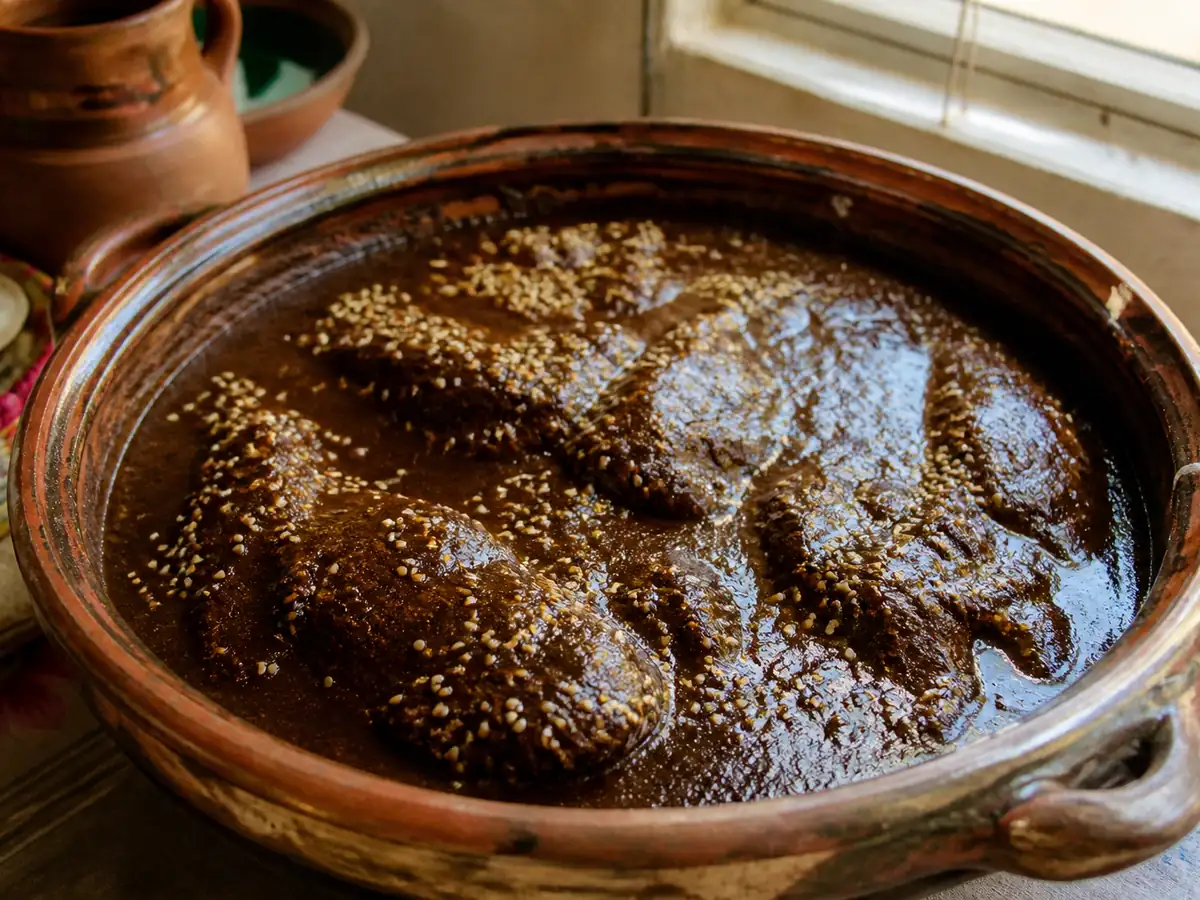
Dried chiles earn a permanent tub in the pantry the way other people keep pasta, because mole poblano is not a single afternoon whim so much as a sequence of small, deliberate heat treatments that reward whoever is willing to stand at the stove and listen.
This version is built for a home kitchen: chicken instead of the whole turkey that Puebla tables still bring out for weddings and Christmas, but the sauce itself stays in the classic lane — mulato, ancho and pasilla, toasted nuts and seeds, a little fruit for body, tomato and tomatillo for acid, and Mexican chocolate stirred in late so it softens bitterness without turning the pot into dessert.
Mole poblano is a Puebla sauce whose depth comes from layered Maillard work on chiles, nuts, seeds and aromatics, then a second fry of the blended paste that drives off raw water and concentrates fat-soluble flavour before stock thins it. Chocolate is a late seasoning, not the headline. Turkey is the holiday bird; chicken is the route to the same sauce without wrestling a 6 kg carcass on a Tuesday.
Dried chiles (sauce base)
- 6 chiles6 chilesMulato chilesabout 60 g / 2 oz; stems and seeds removed
- 4 chiles4 chilesAncho chilesabout 45 g / 1½ oz; stems and seeds removed
- 3 chiles3 chilesPasilla chilesabout 30 g / 1 oz; stems and seeds removed
- 750 ml3 cupsJust-boiled water, for softeningthe soaking liquid is used later — do not tip it away
Nuts, seeds and thickeners
- 60 g½ cupRaw almondsor 40 g / ⅓ cup almonds plus 30 g / 3 Tbsp unsalted roasted peanuts
- 60 g6 TbspSesame seeds, divided40 g / ¼ cup for the sauce, plus 20 g / 2 Tbsp toasted alongside it and set aside for the garnish
- 30 g2 TbspRaw pepitasoptional, but traditional in many Puebla households
- 1 tortilla1 tortillaStale corn tortilla, tornor 20 g / ⅓ cup torn bolillo or white bread
- 40 g¼ cupRaisins
- ½ plantain½ plantainRipe plantain, sliced 1 cm / ⅜ in thickabout 100 g / 3½ oz peeled
Aromatics and fresh produce
- 1 medium1 mediumWhite onion, quarteredabout 180 g / 6 oz
- 6 cloves6 clovesGarlic, peeled
- 2 medium2 mediumRoma tomatoes, cored and halvedabout 250 g / 9 oz
- 2 tomatillos2 tomatillosTomatillos, husked and rinsedabout 100 g / 3½ oz
Spices (whole, toasted briefly)
- 4 cloves4 clovesWhole cloves
- 6 peppercorns6 peppercornsBlack peppercorns
- 1 stick1 stickCanela (true cinnamon), about 5 cm / 2 inor ¾ tsp ground canela
- ½ tsp½ tspAnise seedsor 1 small piece of star anise
- 1 tsp1 tspDried Mexican oregano
- ¼ tsp¼ tspThyme leavesoptional
Fats, stock, chocolate, seasoning
- 80–100 ml⅓–scant ½ cupNeutral oil or lard, divided15 ml / 1 Tbsp for the plantain and raisins, then the remainder — 65–85 ml / about ⅓ cup — for frying the paste; lard is traditional, avocado or grapeseed oil works
- 1 L4 cupsChicken stock, warm, low sodium preferredplus more to loosen
- 40–50 g1½–1¾ ozMexican chocolate (Abuelita-style tablet or similar), choppedor 30 g / 1 oz unsweetened cacao plus 1 tsp sugar, to taste
- 15 ml1 TbspApple cider or white vinegaras needed, to brighten
- 1½–2 tsp1½–2 tspKosher saltto start, then adjust
- 5–10 g1–2 tspSugaronly if the chiles run harsh — taste first
Chicken
- 1.6–1.8 kg3½–4 lbBone-in chicken piecesthighs and drumsticks preferred; breasts are fine if left on the bone
- ½ onion½ onionWhite onion, for the poaching liquid
- 2 cloves2 clovesGarlic, smashed
- 1 leaf1 leafBay leaf
- Salt, for the poaching water
- Water or light stock, to cover
Prep state
Dried chiles stemmed and seeded; chicken portions patted dry; aromatics peeled and chopped as listed; stock warm.
On starch
The stale tortilla or bread in the nut and seed group is the thickener. No extra flour is needed.
Equipment
- Large dry comal, cast-iron skillet, or heavy stainless pan for toasting
- Deep heavy pot or Dutch oven (6–7 L / 6–7 qt) for frying paste and simmering
- High-powered blender, or a blender worked in batches — a food processor alone will leave grit
- Fine-mesh strainer or chinois
- Kitchen tongs, wooden spoon, ladle
- Instant-read thermometer
- Baking sheet lined with parchment, for toasted ingredients to cool
Method
Toast the dried chiles6–8 min
Set a dry comal or skillet over medium heat. Working in batches, press each chile flat for 20–30 seconds per side until the skin turns a shade darker, smells fruity and a little like toasted cocoa, and stays flexible. You want aroma, not black ash. If a chile scorch-smokes aggressively, pull it; burned chile makes the whole mole bitter in a way sugar cannot fix.
Transfer toasted chiles to a bowl, cover with 750 ml (3 cups) just-boiled water, and weight with a small plate. Soak 20–25 minutes until pliable.
Sensory check: steam should smell raisiny and deep red-brown, not acrid. Softened flesh tears easily between fingers.
Press seeded, stemmed chiles flat in a dry pan over medium, 20–30 seconds per side until fragrant, darker and still flexible; avoid scorching. Cover with 750 ml (3 cups) just-boiled water, weigh down and soak 20–25 minutes until pliable.
Toast nuts, seeds, spices and starch10–12 min
In the same dry pan over medium, toast almonds (and peanuts if using) until fragrant and spotted, 4–5 minutes, shaking often. Tip onto the sheet to cool. Toast all 60 g of sesame seeds until they jump and turn pale gold, 2–3 minutes; set 20 g (2 Tbsp) aside for the garnish and keep the remaining 40 g for the blender. Toast pepitas until they pop, 2 minutes.
Briefly toast cloves, peppercorns, canela and anise 45–60 seconds until the oils bloom — stop before the spices smell like burnt incense. Toast the torn tortilla or bread until dry and spotted.
Cool everything. Hot nuts blend into a paste that tastes oily and dull.
Dry-toast nuts over medium 4–5 minutes, shaking. Toast 60 g sesame 2–3 minutes until pale gold; reserve 20 g (2 Tbsp) for garnish and 40 g for sauce. Toast optional pepitas 2 minutes, whole spices 45–60 seconds without burning, and tortilla or bread until dry and spotted. Cool everything.
Char and soften the fresh aromatics12–15 min
Raise the heat to medium-high. Dry-char the onion quarters, garlic, tomato halves and tomatillos until blistered and soft in spots, turning as needed, 8–12 minutes total. You are building sulfur-sweet notes and some free glutamates.
In a slick of 15 ml (1 Tbsp) of the oil in a separate skillet, fry the plantain slices until deep gold on both sides, 3–4 minutes. Fry the raisins in the same fat 30–60 seconds until they plump and darken at the edges. Drain on paper.
Dry-char onion, garlic, tomatoes and tomatillos over medium-high, turning 8–12 minutes until blistered and softened. In another skillet, fry plantain in 15 ml (1 Tbsp) oil for 3–4 minutes until golden both sides, then raisins 30–60 seconds until plump. Drain on paper.
Poach the chicken while you build the paste35–45 min
In a pot, cover the chicken with water or light stock by 2–3 cm (1 in). Add the onion half, smashed garlic, bay and 2 tsp salt. Bring to a bare simmer — about 90–95 °C / 195–205 °F, a surface tremble, not a rolling boil — and cook until thighs register 74 °C / 165 °F at the bone, 30–40 minutes depending on size. Skim the foam.
Lift the chicken to a tray. Strain and reserve at least 500 ml (2 cups) of this broth to combine with the 1 L of stock later if you want deeper poultry taste. Keep the chicken loosely covered so the skin does not dry into leather.
Why the gentle simmer: aggressive boiling squeezes protein, yields stringy meat, and clouds the liquid you may fold back into the mole.
Cover chicken with water or light stock by 2–3 cm (1 in); add half onion, garlic, bay and 2 tsp salt. Simmer gently at 90–95 °C / 195–205 °F, skimming, 30–40 minutes until thighs reach 74 °C / 165 °F near the bone. Remove and loosely cover chicken; strain and reserve at least 500 ml (2 cups) broth.
Blend the paste10 min
Drain the chiles, reserving the soaking liquid. In a blender, working in two batches if needed, combine the drained chiles, toasted nuts and seeds (the 40 g of sesame, not the reserved garnish), spices, tortilla or bread, plantain, raisins, charred onion, garlic, tomato and tomatillo, with enough chile soaking liquid — start with 250 ml (1 cup) — to form a thick, spoonable purée.
Blend at least 90–120 seconds per batch until the paste looks smooth and the pitcher feels warm from friction. Gritty mole is almost always under-blended chile skin and sesame hull, not a missing ingredient.
Pass the purée through a fine-mesh strainer into a bowl, pressing with a ladle. Discard the fibrous pulp, or re-blend it once with a splash more liquid if you are stubborn. You should have a dense, brick-red to mahogany paste.
Drain chiles, reserving liquid. Blend with toasted nuts, 40 g sesame, optional pepitas, spices, tortilla or bread, plantain, raisins and charred vegetables. Start with 250 ml (1 cup) soaking liquid; blend 90–120 seconds per batch until smooth and spoonable. Strain, pressing firmly; discard fibrous pulp or reblend once with more liquid.
Fry the paste — the step that separates kitchen mole from a chile smoothie12–18 min
Heat the remaining oil or lard, 65–85 ml (about ⅓ cup), in the Dutch oven over medium-high until it shimmers — about 175–180 °C / 350 °F if you check with an infrared thermometer, or until a crumb of paste sizzles on contact. Add the paste carefully; it will spit.
Stir nearly constantly with a wooden spoon. The paste will seize, darken, and release oil at the edges. Cook until it smells round and cooked with no raw chile sharpness, the colour deepens one full shade, and fat beads on the surface — usually 12–18 minutes. If it sticks hard, drop to medium and add a spoon of stock to loosen, then keep frying.
Why: you are evaporating water and frying suspended solids so starches gelatinise and chile sugars lightly caramelise. Skipping this leaves a thin, raw, separated sauce that no amount of late chocolate can rescue.
Heat remaining 65–85 ml (about ⅓ cup) fat over medium-high to 175–180 °C / 350 °F. Carefully add paste; it spatters. Stir nearly constantly 12–18 minutes until darker, cooked-smelling and releasing oil. If sticking, lower to medium and loosen with a spoonful of stock.
Thin, simmer and chocolate45–60 min
Whisk in 1 L (4 cups) warm stock, plus the reserved poaching broth if using, in stages until the sauce coats a spoon but still pours — think heavy cream, not pudding. Bring to a gentle simmer at about 90–95 °C / 195–205 °F. Partially cover and cook 40–50 minutes, stirring every 5–7 minutes so the bottom does not scorch. Salt in stages.
In the last 10 minutes, stir in the chopped Mexican chocolate until melted. Taste: you want chile first, nut richness second, a soft bitter-cocoa finish, and enough salt to make the fruit notes read as savoury. Add vinegar by the teaspoon if the sauce tastes flat; add a pinch of sugar only if a chile batch ran unusually bitter.
Nestle the chicken pieces into the mole for the final 10–15 minutes so they warm through and take on a glaze — or shred the meat off the bone and fold it in if you prefer serving from a cazuela with rice.
Whisk in 1 L (4 cups) warm stock gradually, plus optional poaching broth, until pourable and spoon-coating. Partially cover; simmer at 90–95 °C / 195–205 °F for 40–50 minutes, stirring every 5–7 minutes and salting gradually. Melt chocolate in the final 10 minutes; add vinegar by teaspoons if flat, sugar only if unusually bitter. Warm chicken in sauce for the final 10–15 minutes.
Finish5 min
Taste again for salt. The sauce should sheet on the back of a spoon and leave a clean line when you draw a finger through it. Toast the reserved 20 g (2 Tbsp) of sesame seeds one last minute in a dry pan and shower them over the plated chicken and sauce.
Adjust salt and check that mole coats a spoon, holding a clean line drawn through it. Toast the reserved 20 g (2 Tbsp) sesame for one final minute in a dry pan; scatter over plated chicken and sauce.
Storing it
Cool the mole — sauce alone, or with chicken — to room temperature in no more than 2 hours, then refrigerate in shallow containers. It keeps 4 days at or below 4 °C / 40 °F. Freeze the sauce up to 3 months; chicken texture is better if you freeze sauce only, unless you accept slight softening on thaw. Reheat to a full simmer, 74 °C / 165 °F in the centre of the meat. Mole often tastes rounder on day two as starches settle and chile harshness fades — plan ahead if you can. Discard it if it smells sour beyond the intentional vinegar brightening, or if you see mould.
Troubleshooting
- Bitter.
Chiles burned during the toast, or seeds and veins left in aggressively. Next time toast lighter and seed thoroughly. A teaspoon of sugar or more chocolate can soften bitterness, not erase it.
- Gritty.
Under-blended or unstrained. Re-blend with warm stock and strain again.
- Thin and raw-tasting.
The paste was not fried long enough. Reduce uncovered to thicken and cook the edge off.
- Broken, with an oily slick on top.
The emulsion was stressed by heat shock or too much fat. Whisk in a ladle of warm stock off the heat, or blend a cup of the sauce and stir it back.
- Flat.
Undersalted, or missing acid. Salt first, then vinegar by drops.
- Too sweet.
Chocolate, plantain or raisin heavy for your chile batch. Balance with salt, vinegar, and a spoon of unthinned chile paste if you reserved any.
Substitutions
Traditional: whole turkey, or large pieces, for festive service; lard as the frying fat; grinding on a metate; a long simmer in a clay cazuela; sesame as both thickener and garnish; chocolate as one note among many.
This recipe's labelled departures
Chicken, for weeknight scale and even cooking. Blender and strainer instead of a metate. Optional peanut alongside almond for accessibility. Oil allowed if you do not keep lard. Jarred mole paste is not the method here — if you ever use a jar, treat it as a different dish, still fry the jarred paste in fat before thinning, and label it a shortcut, not poblano from scratch.
Scaling
Half the recipe works in a 4 L pot; frying times drop slightly because the paste bed is shallower — watch colour, not the clock. For a crowd, double everything except the cloves and anise, which scale faster than the chiles. Keep the paste under about 4 cm (1½ in) deep while frying so it cooks evenly; use two pans if you need to. Stock is the adjustable variable: thicker for enchiladas, looser for swimming chicken pieces.
What to serve it with
- Mexican rice, or plain white rice
- Warm corn tortillas
- Refried beans on the side
- Sliced white onion
- A simple lettuce or radish plate, for crunch against the rich sauce
- Cold agua fresca, or a not-too-oaky red if you drink wine with mole
Questions
Can I make the sauce without the chicken?
Yes. Use vegetable or chicken stock, fry and simmer the mole on its own, and serve it over roasted squash, enchiladas, or poached chicken added later.
Is Mexican chocolate required?
It is the classic finishing package of fat, sugar and cocoa. Unsweetened cacao plus a little sugar and a pinch of cinnamon gets you close. Do not dump in sweet baking chocolate chips; they skew candy.
Why three chiles instead of one?
Mulato brings chocolate-cherry depth, ancho adds raisin-sweet red fruit, and pasilla contributes herbal darkness. One chile makes a chile sauce; the trio is why people recognise poblano.
Can I skip straining?
You can, if your blender is excellent and you accept a rustic texture. For guests, strain.
How spicy is this?
These three chiles are mild to medium. The heat is warmth and aroma more than burn. Add a toasted chipotle or mora only if you want smoke and kick, knowing that is a personal fork in the road.
Turkey instead of chicken?
For a holiday bird, use the same mole under and over roasted or poached turkey pieces. Scale the sauce up; a 5–6 kg turkey needs roughly 1.5× this batch.
Can I make it ahead?
Best practice: finish the mole a day ahead, chill it, reheat gently, and warm the chicken in the sauce before serving.