Pozole Rojo
Nixtamalised hominy and pork under a guajillo-ancho liquor that is toasted, soaked, blended, strained and fried before it ever meets the caldo. The garnish table is not decoration — it is half the dish.
- Prep
- 1 hr 20 min
- Cook
- 3 hr 30 min
- Serves
- 8 generous bowls
- Difficulty
- Medium
Researched · Kitchen testing pending
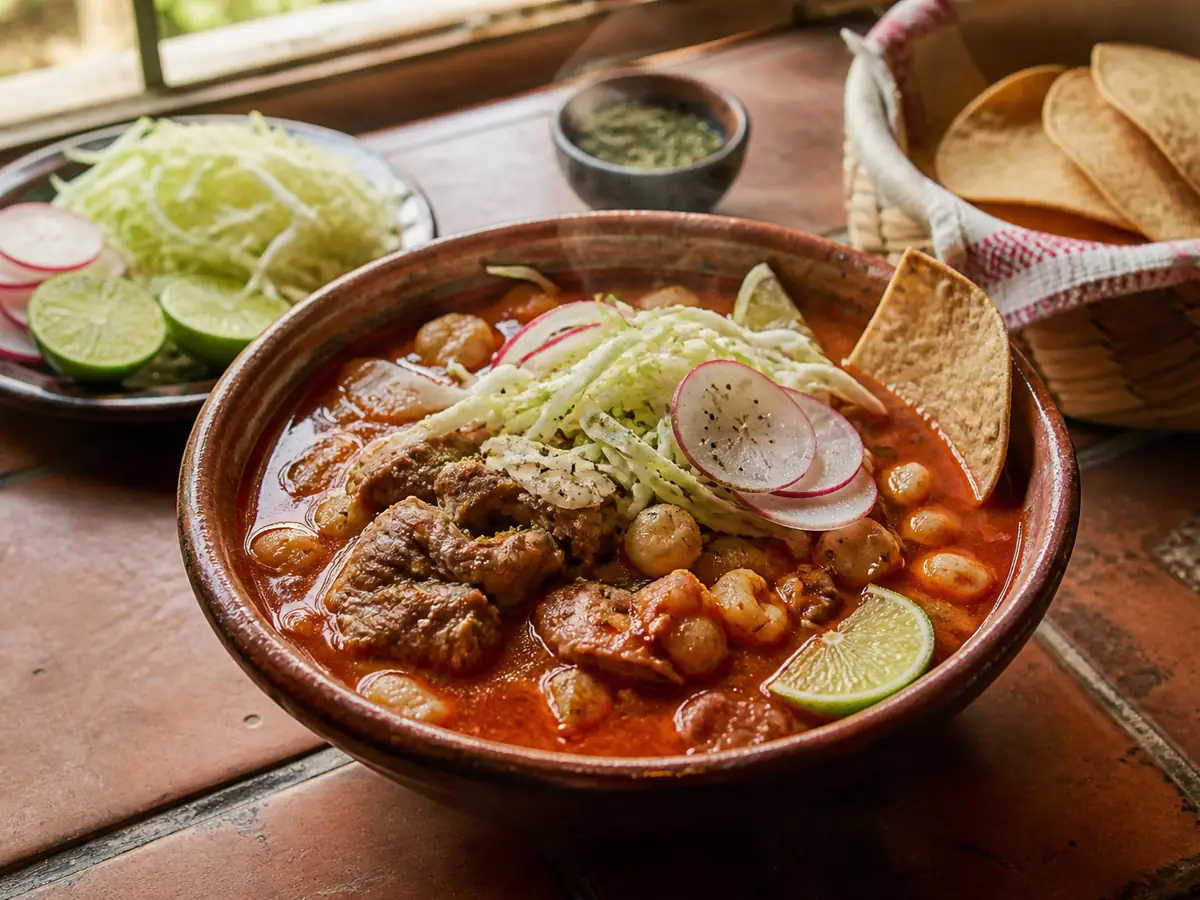
Guajillo skins flex on a hot comal long before the pot looks like dinner, and that is the correct order of operations: dry chile first, then pork water, then the long marriage that turns nixtamalised corn into something you build with radish and lime at the table.
Red pozole is a broth dish, not a stew you hide under cream — hominy, pork, and a fried guajillo-ancho purée that should taste deep and clear, never muddy. Pozole verde from Guerrero is a one-sentence cousin — tomatillo, pepita, green chile, a different map — and this page stays rojo. It is also not menudo: no tripe, no honeycomb, no Saturday-morning hangover identity borrowed from another pot.
Pozole rojo sits in the family of ritual Mexican broths where nixtamalised maize shares the pot with pork and a red chile liquor you toast, soak, blend, strain and fry before it ever meets the caldo. The garnish table is not optional garnish theatre — it is half the dish: shredded lettuce or cabbage, radish, onion, Mexican oregano, lime, and tostadas for crunch between spoons. Collagen cuts give body; shoulder gives the eating meat. Heat stays mostly in guajillo and ancho; árbol is a volume knob, not the base.
Pork and broth base
- 1.6 kg3½ lbPork shoulder, bone-in preferredcut into 4–5 cm / 1½–2 in pieces
- 500–700 g1–1½ lbPork neck bones, trotters, or a small piece of head meatoptional — collagen and body. Omit for a cleaner, lighter bowl
- 1 large1 largeWhite onion, peeled and halvedabout 300 g / 10 oz
- 8 cloves8 clovesGarlic, peeled
- 2 leaves2 leavesBay leaves
- 15 g1 TbspKosher saltplus more later
- 4–4.5 L16–18 cupsCold water, to cover by 4–5 cm / 1½–2 into start
Hominy — dried path, preferred
- 500 gabout 1 lbDried pozole corn / maíz cacahuazintle, rinsed
- Water for the overnight soak, then fresh water in the pot as needed
Hominy — canned path, labelled weeknight
- 1.6 kg56 ozWhite or yellow hominy, drained weight2 large cans of about 800 g / 28 oz drained each; rinse until the packing-liquid smell fades
Red chile broth
- 8 chiles8 chilesDried guajillo chilesabout 60 g / 2 oz; stems and seeds removed
- 3 chiles3 chilesDried ancho chilesabout 40 g / 1½ oz; stems and seeds removed
- 1–2 chiles1–2 chilesDried chiles de árbol, stems removedoptional, for sharper heat
- 3 cloves3 clovesGarlic
- ½ medium½ mediumWhite onion
- ½ tsp½ tspDried Mexican oreganoplus more for the table
- ¼ tsp¼ tspGround cuminoptional — some cooks refuse it; a whisper is enough
- 15 ml1 TbspNeutral oil or pork fat, for frying the purée
- Kosher salt and black pepper
Garnish table (do not skip)
- ½ head½ headIceberg lettuce or green cabbage, shredded fineabout 300 g / 10 oz
- 1 bunch1 bunchRadishes, thinly slicedabout 200 g / 7 oz
- 1 large1 largeWhite onion, finely diced
- Dried Mexican oregano, in a small bowl
- 4–6 limes4–6 limesLimes, cut into wedges
- Warm tostadas, or thick tortilla chips
- Ground chile piquín or crushed árbol, for extra fire
- Avocado slices, optional
Prep state
Chiles stemmed and seeded; pork cut; garnishes washed and waiting cold.
Choosing a hominy path
Dried corn soaks and cooks inside the broth for hours. Canned is already cooked — add it only for the last 45–60 minutes so the kernels stay intact.
Passive time, counted separately
The dried path needs an 8–12 hour soak the night before. That is hands-off and sits outside the times quoted above: same-day with canned hominy runs about 3½–4 hours, while dried cacahuazintle is an overnight soak plus about 4–5 hours the next day.
Equipment
- 8–10 L / 8–10 qt heavy stockpot or Dutch oven
- Dry skillet or comal, for toasting chiles
- Blender, and a fine- or medium-mesh strainer
- Tongs, ladle, skimmer, deep bowls
- Instant-read thermometer, optional but useful for simmer discipline
Method
Hominy prepovernight, or 5 min
Dried path: rinse the cacahuazintle. Cover with cold water by at least 8 cm (3 in) and soak 8–12 hours. Drain. The kernels look plump but still firm — that is correct.
Canned path: drain into a colander and rinse under cold water 60–90 seconds, rubbing lightly until the tinny aroma mostly goes. Set aside until the caldo has body.
On the soak: skipping the overnight bath on dried corn leaves hard centres next to blown skins. Water equalises hydration so the long simmer finishes every kernel.
For dried corn, rinse, cover with cold water by at least 8 cm (3 in), soak 8–12 hours and drain. For canned hominy, drain and rinse under cold water 60–90 seconds, rubbing gently; set aside for the final cooking stage.
Build the pork caldo2–2 hr 30 min
Place the shoulder and the optional bones or head meat in the stockpot. Add the onion halves, 8 garlic cloves, bay leaves and 15 g (1 Tbsp) salt. Cover with cold water by 4–5 cm (1½–2 in). Bring toward a boil over medium-high. As foam rises — usually around 90–95 °C / 195–205 °F, before a hard boil — skim it. Drop to a gentle simmer: lazy bubbles, the pot roughly 90–93 °C / 195–200 °F. A rolling boil emulsifies fat and turns the later red broth greasy instead of clear.
Simmer uncovered or partially covered for 1½ hours.
If using dried hominy: add the drained soaked corn now and continue until pork and hominy are both tender, usually another 1–1½ hours. Kernels should bloom open at one end — the "flower" — and crush easily between your fingers; the pork should shred with a fork without dissolving.
If using canned: simmer the pork alone until tender, about 2–2½ hours from the start, then add the rinsed canned hominy for the final 45–60 minutes only.
Sensory cues: a clean pork-and-onion smell, not barnyard. Fat floats in clear gold discs. Taste the liquid at 90 minutes — after a salt check it should already be worth sipping.
Lift the pork to a board when tender. Discard the bay and the spent onion if it is falling apart. Strain the broth if you want a cleaner bowl; otherwise fish out the solids. Shred or chop the shoulder into bite-size pieces and discard large fat caps if you want leaner bowls. Return the meat to the pot. Neck bones can stay for gnawing guests, or come out before the children's bowls.
Cover pork and optional bones with cold water by 4–5 cm (1½–2 in); add onion, 8 garlic cloves, bay and 15 g (1 Tbsp) salt. Heat over medium-high, skim at 90–95 °C / 195–205 °F, then simmer gently at 90–93 °C / 195–200 °F. After 1½ hours add soaked dried corn; cook another 1–1½ hours until kernels bloom and crush easily and pork shreds. For canned corn, cook pork 2–2½ hours until tender; add corn only for the final 45–60 minutes. Remove bay and spent onion, shred pork and return; remove bones for children.
Red chile purée and fry30 min, overlapping the simmer
While the pot works, toast the guajillos, anchos and optional árbol in a dry skillet over medium heat 15–25 seconds per side until fragrant and slightly flexible. Burnt chile smells acrid and tastes bitter — pull any blackened pieces. Cover the toasted chiles with boiling water and soak 15–20 minutes until soft.
Drain. Blend with 3 garlic cloves, ½ onion, the oregano, the cumin if using, and 250–300 ml (1–1¼ cups) hot pork broth until velvet-smooth, 1–2 minutes. Strain into a bowl, pressing hard; skins left behind grit the pozole.
Heat 15 ml (1 Tbsp) oil or pork fat in a skillet over medium until it shimmers, about 160–170 °C / 320–340 °F if you check. Pour in the strained chile; it should sizzle and darken within a minute. Stir and fry 5–8 minutes until the raw edge is gone, the colour goes brick, and a spoon dragged across the pan leaves a brief trail.
Why fry the chile: water-blended dried chile is still raw in Mexican sauce logic. Fat and heat bloom the fat-soluble flavours and cook out dusty, harsh notes, so the broth tastes finished rather than blended.
Toast chiles over medium 15–25 seconds per side; discard blackened pieces. Cover with boiling water, soak 15–20 minutes and drain. Blend 1–2 minutes with 3 garlic cloves, ½ onion, oregano, optional cumin and 250–300 ml (1–1¼ cups) hot pork broth; strain. Heat 15 ml (1 Tbsp) fat to 160–170 °C / 320–340 °F over medium. Stir-fry purée 5–8 minutes until brick-red and a spoon leaves a trail.
Marry the chile and the caldo30–45 min
Loosen the chile skillet with a ladle of hot broth and pour it into the big pot. Stir. The liquid should turn a clear deep red, not muddy brown. Simmer gently 30–45 minutes so pork, hominy and chile become one broth. Salt in stages; chile concentrates salt perception. Black pepper to taste. If the pot reads flat, a teaspoon of vinegar or a squeeze of lime in the pot — not only at the table — wakes it. Acid is balance, not failure.
On the post-chile simmer: short-cutting leaves chile sitting on pork water. Time lets collagen, corn starch and chile pigments integrate. The surface should show little chile-oil diamonds.
Final texture: broth light-bodied but not watery, hominy soft with a slight chew, meat in shreds and chunks. Serve steaming, about 80–85 °C / 175–185 °F in the bowl, so the garnishes stay crisp on contact.
Loosen chile paste with a ladle of broth and stir into the pot. Simmer gently 30–45 minutes; season gradually with salt and pepper, adding a teaspoon of vinegar or squeeze of lime if flat. Serve around 80–85 °C / 175–185 °F with tender hominy and shreddable pork.
Set the table and ladle
Arrange the shredded lettuce or cabbage, radish coins, diced onion, oregano, lime wedges, ground chile and tostadas in the centre of the table. Ladle the pozole into deep bowls — broth, hominy and pork in fair shares.
Each person builds their own: oregano crushed between the palms, onion, radish, cool greens, lime until the broth brightens, chile if wanted. Tostadas on the side for crunch, or broken in if that is how your table eats.
Temperature contrast is the point: hot broth, cold garnish, brittle tostada. Without the table you made pork-and-corn soup. With it, you made pozole.
Ladle broth, hominy and pork into deep bowls. Set out cold shredded lettuce or cabbage, sliced radishes, diced onion, oregano, lime, ground chile and tostadas so diners can garnish their own bowls; keep the tostadas crisp.
Storing it
Cool quickly in shallow containers; no longer than 2 hours from stove to chill. Refrigerate up to 4 days at or below 4 °C / 40 °F. Fat sets on top — leave it as a seal, or lift it for lighter reheating. Freeze the broth with meat and hominy up to 3 months and thaw overnight in the fridge. Reheat gently to a simmer, centre at or above 74 °C / 165 °F, 10–15 minutes, adding water if it has thickened. Keep the garnishes separate; cut radish and lettuce oxidise. Tostadas go stale — seal them, or refresh at 150 °C / 300 °F for 5 minutes. Discard if the broth smells sour beyond the intentional acid, or if you see mould.
Troubleshooting
- Thin broth.
Short simmer, no bones, or undersalted. Cook longer, add bones next time, and salt at the end.
- Bitter or dusty chile.
Burned in the toast, or the purée went in unfried. Toast gently, and always fry the strained chile.
- Hominy with hard centres.
Dried corn under-soaked or undercooked. Soak overnight, and simmer until the kernels flower.
- Mushy hominy.
Canned hominy added too early. Add canned only for the last 45–60 minutes.
- Greasy mouthfeel.
A hard boil emulsified the fat. Simmer gently, and chill then lift the fat.
- Muddy colour.
Unstrained chile skins. Strain the purée, and fry until it is brick-clear.
- Bland bowl.
The garnish was skipped, or there was no lime. Oregano, lime and onion fix more than salt alone.
- Too spicy.
Too many árbol. Pull them next batch, and cool the bowl with extra hominy and lime.
Substitutions
Traditional lean: shoulder plus head or trotters for gelatin; dried cacahuazintle simmered for hours in the same pot; guajillo-ancho broth fried in fat; oregano and raw garnish at the table; tostadas. Head meat is still non-negotiable in many kitchens for texture.
Labelled departures
Canned hominy as an honest weeknight path with a shorter final simmer. Optional skip of head meat when the counter is empty — neck bones still give collagen. A pinch of cumin in the blender, which is a regional split.
What stays out of this pot
Tripe does not go in here; that is menudo, a different dish and a different smell. Pozole verde stays a cousin for another day, not a second method on this page.
Scaling
Half, for 4 bowls
Halve the pork, chile and water, and use a 5–6 L pot. Simmer times stay similar — collagen does not clock by volume. Use one large can of hominy, or about 250 g dried.
Double, for 16 bowls
Use a 16 L or larger pot, or two pots. Toast and fry the chile in two batches so the purée actually fries instead of steaming. Salt in stages after combining; large volumes hide under-seasoning until the last ladle. The garnish table scales linearly — do not skimp on radish and lime.
What to serve it with
- The full garnish table above — the non-negotiable core
- Warm tostadas, or freshly fried thick tortillas
- A simple side of refritos, if the meal needs ballast
- Cold Mexican lager, or agua de jamaica
- Leftover shredded pork tucked into next-day tacos, with the same oregano-lime logic
Questions
Is this the same as menudo?
No. Menudo centres on tripe in chile broth. This recipe uses pork muscle and optional collagen cuts — never tripe.
White or yellow hominy?
Either. White is common in many red pozoles; yellow reads slightly sweeter and more corn-forward. Do not substitute sweet corn kernels — they are not nixtamalised.
Can I use chicken?
Bone-in thighs and drumsticks, with a shorter simmer of about 1–1½ hours. Call it pozole de pollo rojo and garnish it the same. Pork remains classic for this red version.
How spicy is the default?
Guajillo and ancho are mild to medium — dried fruit more than burn. Árbol is the volume knob. Skip it for mixed heat tolerance.
Do I have to fry the chile?
You can dump blended chile straight in, and some home cooks do. The broth will taste sharper and less round. The fry is the difference between red and finished.
Whole pods or chile powder?
Whole dried pods, toasted and blended, beat powder for flavour and body. Powder can patch colour in a pinch but tastes flatter.
Can I make it ahead?
Yes, and day-two pozole is often better. Chill overnight, lift the excess fat if you want, reheat, and set a fresh garnish table.
Why Mexican oregano?
It is more citrus-floral than Mediterranean oregano. If that is all you have, use less and add a pinch of marjoram. Not identical, not ruined.
How much salt?
Start with the tablespoon in the pot, salt again after the chile goes in, and once more at the end. Taste with a bit of garnish on the spoon — lime and onion change perceived salt.