Chiles en Nogada
Puebla's Independence-season plate — roasted poblano, fruit-studded pork-and-beef picadillo, and a cold peeled-walnut cream freckled with pomegranate and parsley. The nogada is served cold on purpose, and the egg bath is a labelled regional fork, not the identity.
- Prep
- 2 hr 15 min
- Cook
- 1 hr
- Serves
- 8 stuffed chiles
- Difficulty
- Hard
Researched · Kitchen testing pending
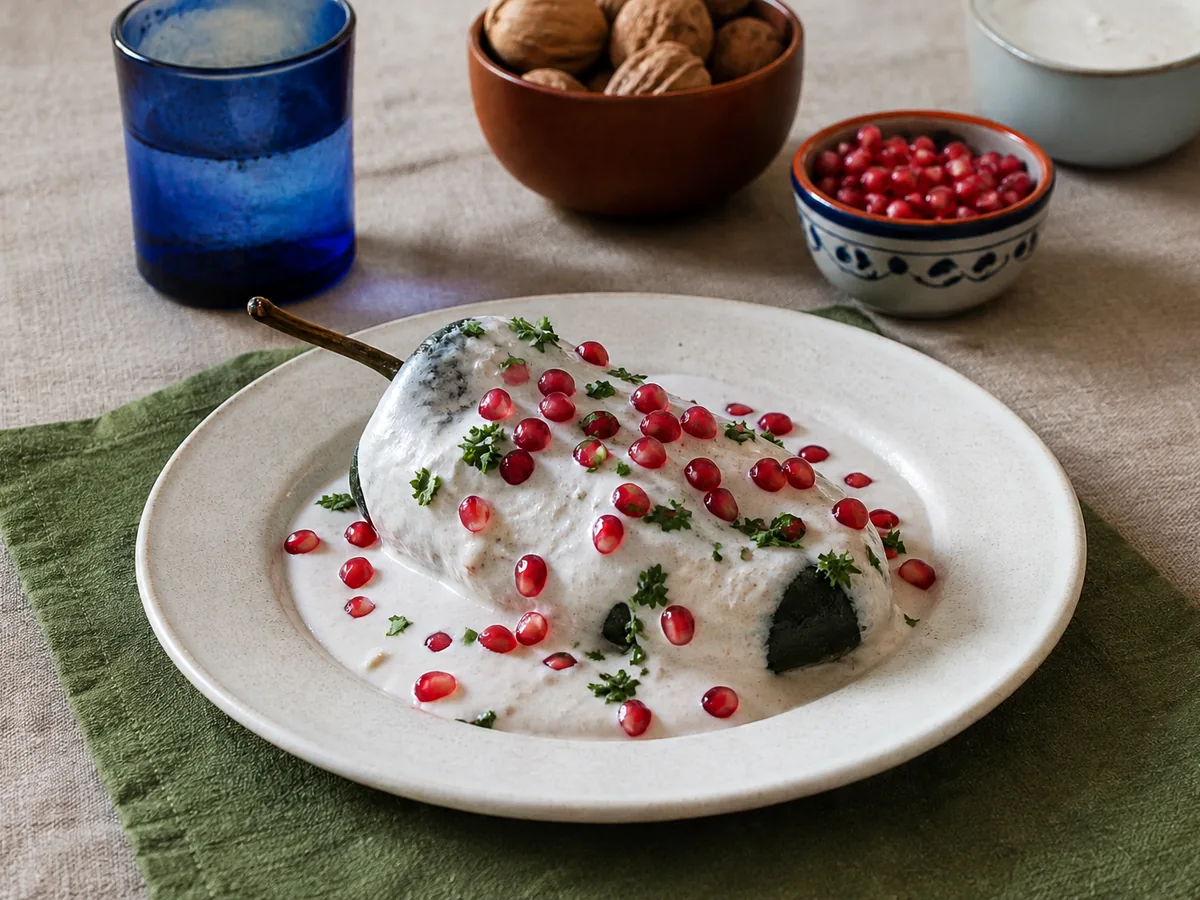
August walnuts and September pomegranate are the calendar, not a mood board: chiles en nogada only tastes like itself when the nogada is cold, the picadillo carries fruit, and the poblano still reads as chile under a white sauce freckled red and green.
This is Puebla’s Independence-season plate — stuffed roasted poblano, fruit-studded pork-and-beef picadillo, peeled-walnut cream sauce served cold, pomegranate arils, and parsley. It is not a deep-fried chile relleno wearing a different hat. The egg bath, capeado, is a labelled regional fork; many home tables roast and peel the chile, stuff it, and sauce it without batter so the nogada stays the star.
The dish is a composed plate, not a casserole. A roasted, peeled poblano holds a sweet-savoury picadillo of ground meat, tomato, onion, apple, pear, peach or plantain, raisins, almonds and warm spices; cold nogada blankets the chile; and pomegranate and parsley finish the green, white and red of the flag without turning dinner into costume. Chile relleno identity is cheese-stuffed, egg-battered, fried, and sauced hot in tomato — different architecture altogether.
Poblanos
- 8 large8 largePoblano chiles, firm and straight enough to stuffabout 1–1.2 kg / 2¼–2½ lb total; no soft spots
- 15 ml1 TbspNeutral oilonly if roasting on a sheet under the broiler — a burner blister needs none
- Kosher salt, for a light interior season after peeling
Picadillo (fruit and meat)
- 30 ml2 TbspNeutral oil or lard
- 1 medium1 mediumWhite onion, finely dicedabout 180 g / 6 oz
- 3 cloves3 clovesGarlic, minced
- 350 g12 ozGround pork
- 350 g12 ozGround beef, 80–85% leanor all pork if you prefer one meat
- 2 medium2 mediumRoma tomatoes, grated or finely choppedabout 250 g / 9 oz; or 200 g / 7 oz canned crushed tomato
- 1 tsp1 tspKosher saltplus more to taste
- ½ tsp½ tspBlack pepper
- ½ tsp½ tspDried Mexican oregano
- ¼ tsp¼ tspGround cinnamoncanela preferred
- ⅛ tsp⅛ tspGround clovea pinch — clove scales aggressively
- 1 small1 smallApple, peeled and small-dicedabout 150 g / 5 oz
- 1 firm1 firmPear, peeled and small-dicedabout 150 g / 5 oz
- 1 ripe1 ripePeach, or ½ ripe plantain, small-dicedabout 100–120 g / 3½–4 oz
- 40 g¼ cupRaisins
- 40 g⅓ cupSlivered almonds, lightly toasted
- 30 g3 TbspCandied citron, or chopped dried pineappleoptional — a labelled old-school sweet note
- 60–80 ml¼–⅓ cupStock or water, as needed to loosen
- 1 tsp1 tspSugaronly if the fruit is underripe and the mix tastes harsh — taste first
Nogada (cold walnut sauce) — seasonal walnuts
- 200 gabout 1¾ cupsFresh walnut halvesharvest or seasonal if you can get them
- Hot water for blanching and peeling, plus cold water rinses
- 200 ml¾ cup + 1 TbspMexican crema or crème fraîche
- 100 ml⅓ cup + 1 TbspWhole milkplus more to loosen
- 60 g2 ozQueso fresco or mild goat cheese, crumbledoptional body — a common modern help, labelled as such
- 15–30 ml1–2 TbspDry sherry or white wineoptional, traditional in many recipes
- 1 tsp1 tspSugaror to taste
- Pinch of salt
- Pinch of cinnamon, optional
Finish
- 1–2 large1–2 largePomegranates, seededabout 200–250 g / 7–9 oz arils
- Small handful of flat-leaf parsley, leaves only, chopped or left small
- Pomegranate molasses is not traditional here — skip it
Optional capeado (egg bath — labelled regional)
- 4 large4 largeEggs, separated
- 30 g¼ cupAll-purpose flour, for dusting
- Neutral oil for shallow or deep frying, enough for 2–3 cm / ¾–1 in depth in a skillet
- Only use this block if you want battered chiles; otherwise skip it entirely
Prep state
Walnuts soaking; meat thawed; fruit diced; pomegranates seeded; parsley picked.
Why seasonal walnuts matter
Fresh harvest walnuts peel cleaner and taste milky-sweet. Old pantry walnuts turn the sauce bitter and beige. Out-of-season walnuts from a sealed bag will work if they taste fresh and you peel them — but if they smell paint-rancid, do not make nogada. Make something else.
Passive time, counted separately
The nogada needs at least 20–30 minutes in the fridge, and longer is better, so it reaches the plate genuinely cold. The picadillo also has to come down to just-warm before it meets a chile. Neither is active work, and both sit outside the times quoted above; the whole same-day session runs roughly 3–3½ hours, with walnut peeling as the hidden tax.
Equipment
- Gas burner, broiler, or very hot comal for blistering poblanos
- Plastic bag, or a bowl and wrap, for steaming the skins
- Large skillet for the picadillo, and a saucepan if you warm anything separately
- Blender or food processor for the nogada
- Fine strainer, optional, for an ultra-smooth sauce
- Baking sheet, kitchen towels, and tweezers or a paring knife for walnut skins
- Instant-read thermometer for the meat filling
Method
Peel the walnuts — start here30–45 min
Cover the walnuts with boiling water and soak 5–10 minutes. Slip the skins with your fingers or a paring knife; white-cream nut meat is the goal, and brown skin left on turns the nogada tannic and grey. Work in a bowl of cold water so peeled nuts do not oxidise as fast. Pat dry.
If the walnuts are stubbornly skinned from age, peel what you can and accept a slightly darker sauce, or buy a fresh bag — seasonal fruit is the point of this dish's calendar.
Why peel: walnut pellicle is bitter. Nogada should taste sweet-milky and nutty, not like walnut tea left on the radiator.
Use fresh-tasting walnuts, discarding any rancid nuts. Cover with boiling water for 5–10 minutes, then remove brown skins with fingers or a small knife. Keep peeled nuts in cold water as you work, then pat dry.
Roast and peel the poblanos25–35 min
Blister the poblanos over a gas flame, under a hot broiler, or on a ripping comal, turning until the skins blacken and blister all over — 8–12 minutes total depending on method. Bag them, or cover them in a bowl, for 10–15 minutes so steam loosens the skins.
Peel under a gentle rinse or with a towel, keeping the stems on. Cut a careful slit down one side and remove the seeds and membranes while keeping the chile intact as a pocket. Lightly salt the interior and lay it on a towel to dry.
Sensory: the flesh should be soft but not collapsed into mush, and the stem firm enough to hold shape. If a chile tears badly, keep it for the "ugly but covered in nogada" pile — sauce forgives.
On the roast: direct fire gives smoky depth without frying. You are not chasing chile-relleno batter adhesion here unless you take the optional capeado fork later.
Blister poblanos over flame, under a hot broiler or on a hot comal, turning for 8–12 minutes. Cover 10–15 minutes, then peel, retaining stems. Slit one side, remove seeds and membranes without tearing, lightly salt inside and dry on a towel.
Cook the fruit picadillo35–45 min
Heat the oil or lard in a wide skillet over medium until it shimmers, about 160 °C / 320 °F. Soften the onion 5–6 minutes until translucent, then add the garlic for 45–60 seconds until fragrant, not brown. Add the pork and beef, break them up, and cook until no longer pink and the edges take light colour, 8–10 minutes. Spoon off excess fat if the pan is swimming — leave a glossy sheen.
Stir in the tomato, salt, pepper, oregano, cinnamon and clove. Cook 5–7 minutes until the tomato darkens and the raw edge goes. Fold in the apple, pear, peach or plantain, raisins, almonds and the optional citron. Add 60–80 ml stock if it looks dry. Simmer gently, stirring, until the fruit softens but still holds its dice and the mixture mounds on a spoon, 10–15 minutes. Target internal temperature for the meat mix is at or above 74 °C / 165 °F.
Taste: savoury first, fruit sweetness second, spice in the background. Cool until just warm before stuffing — hot filling steams the chile into shreds and melts the later cold sauce on contact.
Why fruit in the meat: the contrast against cold walnut cream is structural, not decorative. Picadillo without fruit is taco filling; with fruit it is nogada filling.
Heat fat over medium to about 160 °C / 320 °F. Soften onion 5–6 minutes, add garlic 45–60 seconds, then brown crumbled meats 8–10 minutes; remove excess fat. Cook tomato and seasonings 5–7 minutes. Add fruit, raisins, almonds and optional citron; loosen with 60–80 ml stock if dry. Simmer 10–15 minutes until fruit is tender but intact and meat reaches at least 74 °C / 165 °F. Taste; use sugar only if harsh. Cool to barely warm.
Blend the nogada and keep it cold10 min
In a blender, combine the peeled walnuts, crema, milk, optional cheese, optional sherry, sugar, salt and cinnamon. Blend until smooth and pourable but thick enough to coat a chile without running off like water — add milk by the tablespoon.
Taste for sweetness and salt. Chill at least 20–30 minutes, longer if you can, so it serves cold against room-temperature or barely warm chiles.
Sensory and temperature: the sauce should smell like fresh walnuts and dairy, and the colour should read ivory. Serve it fridge-cold, roughly 4–8 °C / 40–45 °F, not lukewarm. Warm nogada tastes heavy and loses the flag-plate contrast.
Blend peeled walnuts, crema, milk, optional cheese and sherry, sugar, salt and optional cinnamon until smooth and coating-thick. Add milk by tablespoons as needed; adjust sweetness and salt. Refrigerate at least 20–30 minutes; serve cold, roughly 4–8 °C / 40–45 °F.
Stuff15 min
Blot the chile interiors dry. Spoon the picadillo in loosely until filled but not bursting — about 80–100 g (⅓ to a scant ½ cup) per chile depending on size. Close the slit as best you can and lay the stuffed chiles on a platter.
Blot chile interiors dry. Spoon in just-warm picadillo loosely, about 80–100 g (⅓ to a scant ½ cup) per chile without bursting. Close the slits and arrange on a platter.
Sauce and finish5 min
Spoon cold nogada generously over each chile until it is mostly white. Scatter the pomegranate arils and the parsley. Serve immediately so the cold sauce does not warm through on a hot plate — use room-temperature platters.
This is the default path, and the recommended one: roasted stuffed poblanos as they are, under cold nogada, so walnut and pomegranate stay loud.
Cover each stuffed chile generously with cold nogada, then scatter pomegranate seeds and parsley. Use room-temperature platters and serve immediately to preserve the contrast between cold sauce and barely warm or room-temperature chiles.
Optional capeado — the egg bath, labelled regional
This is restaurant and Puebla-regional service, not a requirement of the dish's identity. It also moves you closer to chile-relleno technique, so if you take it, keep the nogada cold and the picadillo fruity or the plate becomes "fried stuffed pepper with white sauce." Allow 20–25 minutes if you are using it.
Flour, foam, fry20–25 min
Pat the stuffed chiles dry and dust them lightly in flour. Whip the egg whites to soft-firm peaks, then fold in the yolks. Heat the oil to about 175–180 °C / 350 °F.
Dip each chile in the egg foam and fry, turning gently, until golden — 2–4 minutes per side. Drain on a rack, then sauce and finish as above.
Dry stuffed chiles and dust lightly with flour. Whip egg whites to soft-firm peaks and fold in yolks. Heat oil to 175–180 °C / 350 °F. Dip chiles in foam, fry gently 2–4 minutes per side until golden, drain on a rack and finish with cold nogada and garnishes.
Storing it
Picadillo: cool within 2 hours, refrigerate up to 4 days at or below 4 °C / 40 °F, or freeze up to 2 months. Reheat to at least 74 °C / 165 °F before stuffing, then cool slightly. Roasted peeled chiles: refrigerate up to 2 days, well covered so they do not pick up fridge odours. Nogada: refrigerate up to 2 days, stir before using, and do not leave it at room temperature more than 1–2 hours — it is dairy and nuts. Assembled sauced chiles do not store well; the sauce weeps and the chiles sog. For guests, hold the components separate and assemble at the last minute. Discard nogada that smells sour or bitter-rancid beyond walnut tannin.
Troubleshooting
- Bitter or grey nogada.
Skins left on, or rancid nuts. Peel thoroughly, and buy fresher walnuts.
- Nogada too thin.
Over-loosened with milk. Blend in more walnuts or a spoon of cheese, and chill to thicken.
- Nogada too thick.
Not enough dairy. Thin with cold milk by the tablespoon.
- Chile falling apart.
Over-roasted or over-handled. Roast to blister, not charcoal, and support it with a spatula.
- Watery picadillo.
The tomato was not cooked down, or the fruit was wet. Simmer uncovered, and drain the fruit if it is slick.
- Clove or cinnamon too loud.
The warm spices were scaled like salt. Cut them back, and balance with tomato and salt.
- The plate tastes like a relleno.
You defaulted to heavy fry and hot tomato logic. Skip the capeado, or keep the nogada cold and the fruit clear.
- Pomegranate looks sparse.
Under-seeded. Budget a second fruit — the arils are the red.
Substitutions
Traditional lean: late-summer and early-autumn Puebla service tied to Independence season; fresh walnuts peeled for a pale nogada; fruit picadillo; roasted poblano; cold walnut sauce; pomegranate and parsley; often a mix of meats; sometimes capeado.
Labelled departures
Queso fresco in the blender for body when walnuts alone run thin, which is a common modern help. An optional skip of the capeado so the dish does not collapse into chile-relleno identity. All-pork picadillo when beef is unavailable. Candied citron marked optional. No deep-fry as the default method.
On out-of-season walnuts
A sealed bag will work if the nuts taste fresh and you peel them. If they smell paint-rancid, do not make nogada — make something else. There is no rescue for a rancid sauce.
Scaling
Half, for 4 chiles
Halve everything, and blend the nogada in a smaller jar or with a stick blender. Walnut peeling still takes patience — do not rush the skins.
Double, for 16 chiles
Two baking sheets for the roasted poblanos. Cook the picadillo in two skillets or a wide Dutch oven so the fruit sautés instead of steaming. Blend the nogada in batches for smoothness. Assemble in waves so early plates are not waiting under warm lights.
For a buffet
Offer sauced chiles to order: stuffed chile on the plate, nogada spooned tableside, arils last.
What to serve it with
- White rice, or a very plain arroz blanco — a rich plate wants quiet sides
- Warm corn tortillas on the side
- A simple green salad with lime, and no creamy dressing
- Cold white wine, sparkling water with lime, or a light beer
Not recommended: a heavy mole or a second chile-cream dish on the same plate.
Questions
Do I have to use the egg bath?
No. Capeado is a regional and restaurant option. Roasted, peeled, stuffed and cold-sauced is a complete, traditional-leaning plate.
Is this just chile relleno?
No. Relleno is typically cheese-filled, egg-battered, fried, and served hot with tomato sauce. Nogada is fruit picadillo, cold walnut sauce, pomegranate, and seasonal logic.
Can I use pecans?
Pecans make a different, sweeter sauce. Label it as a departure if you must — walnut is the name of the sauce, from nogal.
Why cold sauce on a roasted chile?
Contrast. Warm nogada dulls; cold nogada against a room-temperature chile and warm-spiced fruit is the structure.
Is there a vegetarian version?
Replace the meat with finely diced mushrooms and courgette cooked down hard, keep the fruit and spices, and accept it as a labelled departure — not "the" Independence plate, but workable.
How far ahead can I work?
Picadillo and peeled chiles a day ahead; nogada the morning of; assemble at service. Pomegranate arils can be seeded the day before and chilled dry.
My walnuts are still bitter after peeling. Now what?
They may be old. Soak the peeled nuts briefly in milk, drain, and blend; or add a touch more sugar and crema. If it is still harsh, the bag is the problem.
What if pomegranate is out of season?
Then it is not really nogada season. Frozen arils are a last resort and often watery — pat them dry. Do not swap in dried cranberries and call it the same dish.