Carnitas
Michoacán pork cooked gently in its own lard until the collagen gives, then driven hot so the edges crisp while the inside stays spoon-tender. Orange is a perfume in the fat, not a Cuban mojo bath — and the final dry heat is the step a slow cooker cannot do for you.
- Prep
- 45 min
- Cook
- 3 hr 20 min
- Serves
- About 1.4–1.6 kg / 3–3½ lb finished meat (8–10 taco-heavy servings)
- Difficulty
- Medium
Researched · Kitchen testing pending
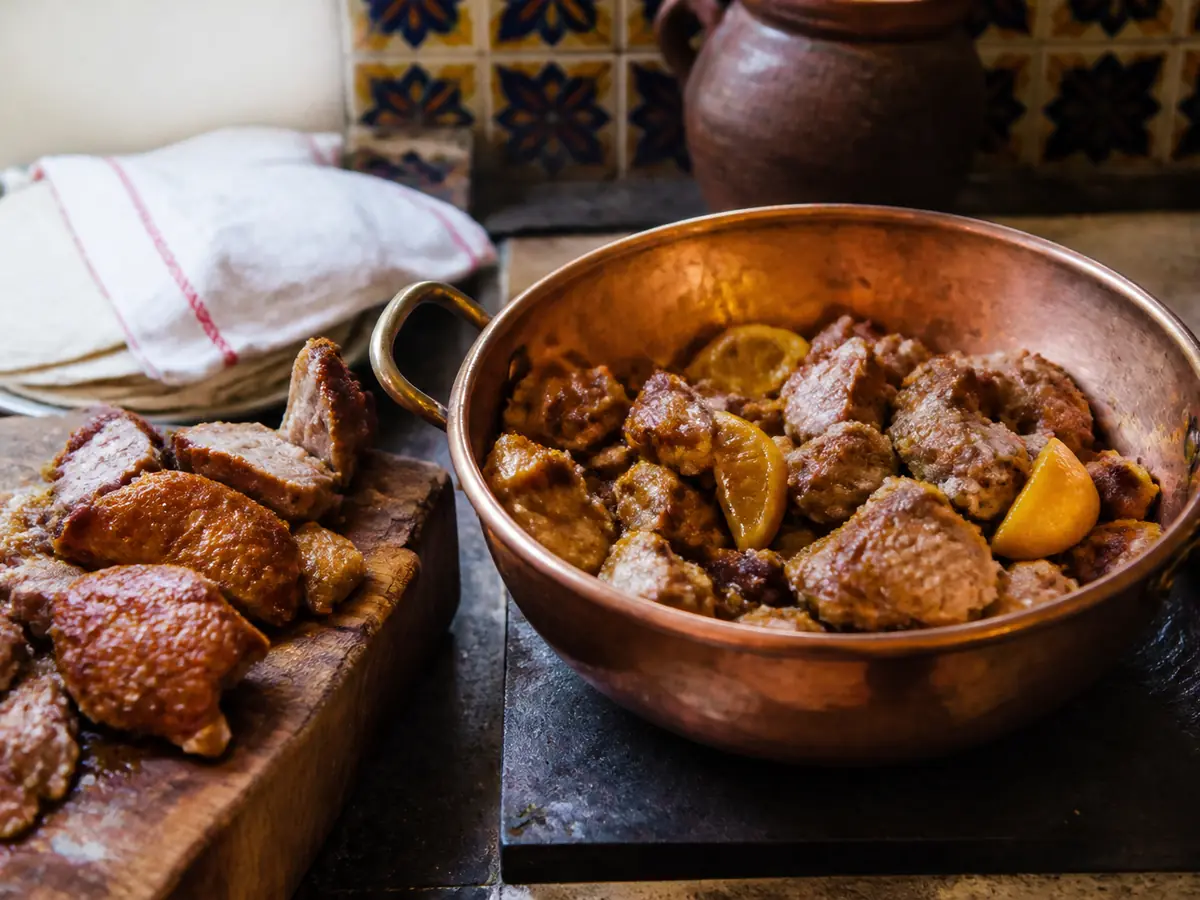
Pork and fat need time more than clever seasoning. Carnitas are shoulder — and often more of the pig — cooked gently in its own lard until the collagen gives, then driven hot so the edges crisp while the inside stays spoon-tender.
Orange shows up as a bright, oily perfume in the pot, not a Cuban mojo bath and not lechón asado with sour orange and garlic paste as the whole identity. The traditional copper cazo over a wood fire is the reference; a Dutch oven on a home burner is the labelled departure that still gets you shreddable-then-crisped pork. Milk or Coca-Cola in the pot exists in some home legends, and both are marked as departures below rather than as the headline method. A crockpot can hold a braise, but it is not how this recipe leads, because carnitas need a final dry heat to blister.
Michoacán carnitas are pork cooked submerged, or nearly submerged, in fat at a steady moderate bubble until the meat is past “braised tender” and into “fibres separate with a pull” — then exposed to higher heat so the surfaces caramelise and crunch. Salt is primary. The eating format is chopped or pulled pork piled on warm corn tortillas with salsa, onion, cilantro and lime, not sliced roast pork.
Pork and fat
- 2 kg4½ lbBoneless pork shoulder (Boston butt), cut into 6–8 cm / 2½–3 in chunksleave a good fat cap on some pieces
- 300–500 g10–18 ozFresh pork fat or lard, enough to come at least halfway up the meatmore is more traditional; you can supplement with rendered fat from the shoulder as it cooks
- 18–20 g1 Tbsp + 1 tspKosher saltplus more to finish
Aromatics (Michoacán-leaning home pot)
- 1 large1 largeOrange, halvedabout 200–250 g / 7–9 oz; slightly bitter or Seville if available, otherwise a juicy navel
- ½½White onion
- 6 cloves6 clovesGarlic, smashed
- 2 leaves2 leavesBay leaves
- 1 tsp1 tspDried Mexican oregano
- ½ tsp½ tspBlack peppercorns, lightly crushed
- 1 small stick1 small stickCanela (true cinnamon)optional — some pots use it; keep it light
- 60–120 ml¼–½ cupWateroptional, and only a splash if your fat does not yet cover and the pot threatens to scorch at the start — evaporate it as you go
Labelled departures (do not treat as core)
- 120 ml½ cupWhole milkadded mid-cook; softens and browns differently — mark it on the invite if you use it
- 120 ml½ cupCoca-Colasugar and acid, a shortcut some cooks swear by; also a departure from a clean lard-and-orange pot
- Neither is required for carnitas that taste like carnitas
For serving
- Warm corn tortillas
- Finely diced white onion
- Chopped cilantro
- Lime wedges
- Salsa verde or salsa roja
- Pickled jalapeños or radish, optional
Prep state
Pork cut; orange halved; fat measured; salt ready.
On the cut size
Tiny cubes overcook into dry confetti before the collagen melts. Big chunks give you a shreddable interior and a crispable face later.
Passive time, counted separately
The salted pork can sit 20–30 minutes at room temperature while you set the pot, or stay salted in the fridge up to overnight — pat it dry again if it goes wet. That rest is hands-off and sits outside the times quoted above, which cover the roughly 3½–4½ hour session from cold kitchen to chopped pork.
Equipment
- 6–7 L / 6–7 qt Dutch oven or other heavy deep pot — the labelled home stand-in for a copper cazo
- Tongs, and a spider or slotted spoon
- Sheet pan or cast-iron skillet for the final crisping
- Instant-read thermometer
- Sharp knife or cleaver for chopping
- Optional slow cooker, for the gentle phase only — you still finish under the broiler or in a hot pan
Method
Cut and salt10 min
Pat the pork dry. Cut it into large chunks so the pieces survive the long cook without shredding into the fat early. Toss with the kosher salt.
Let it sit at room temperature 20–30 minutes while you set the pot, or refrigerate it salted up to overnight — pat it dry again before cooking if it is wet.
Pat pork dry, cut into large chunks and toss with kosher salt. Rest 20–30 minutes at room temperature while preparing the pot, or refrigerate salted up to overnight. Pat dry again before cooking if wet.
Load the pot5 min
Place the pork in the Dutch oven and add the lard or fat in and around the meat. Squeeze the orange halves lightly into the pot, then drop the rinds in. Nestle in the onion, garlic, bay, oregano, peppercorns and the optional canela.
The fat should reach at least halfway up. If you have enough to cover, better still — that gives confit-style evenness.
Why orange: the peel oils and juice perfume the fat and nudge browning. This is not a sour-orange garlic marinade in the Cuban lechón sense. You are seasoning a fat bath, not building mojo.
Arrange pork and lard in a heavy pot, with fat reaching at least halfway up the meat, preferably covering it. Lightly squeeze orange halves into the pot and add rinds, onion, garlic, bay, oregano, peppercorns and optional cinnamon.
Gentle cook until shreddable2 hr 30 min – 3 hr 30 min
Set over medium heat until the fat melts and a lazy bubble starts — aim for roughly 95–105 °C / 200–220 °F in the fat once it settles. That is a bare simmer in liquid fat, not a deep fry. If the pot races toward aggressive frying, with large furious bubbles and meat seizing hard on the outside, drop the heat. Stir every 20–30 minutes so pieces rotate and nothing sticks dry above the fat line.
After about 2 hours, test a chunk: it should yield to a fork but may still feel slightly elastic. Continue until a stout fork twists the fibres apart easily and a thermometer in a thick piece reads around 93–96 °C / 200–205 °F. Carnitas want collagen melt, not the 63 °C / 145 °F roast-pork-chop target.
Sensory cues: the kitchen smells like pork fat and orange peel, not scorched milk or burnt sugar — unless you added those departures. The meat goes from pink-grey to beige-brown, and edges may already pick up gold where they peeked above the fat.
Why this temperature band: too hot too early and you deep-fry the exterior before the inside relaxes, giving crust without succulence. Too cool forever and you get a soft braise that does not respond well to the later crisp.
Heat over medium until fat melts, then maintain gentle bubbling at 95–105 °C / 200–220 °F, reducing heat if frying aggressively. Turn pieces every 20–30 minutes. Test after 2 hours; continue until fork-shreddable and about 93–96 °C / 200–205 °F internally.
Optional milk or Coke — labelled departure only
If you are using milk or Coke, add it at about the 90-minute mark, nestled into a space in the pot, and continue.
Milk solids will brown and stick more, so stir with care. Coke adds sugar that accelerates a dark lacquer, so watch the heat and do not let the sugar burn on the bottom.
The default recipe skips both.
If choosing the optional milk or Coke variation, add it into a gap in the pot around minute 90 of the gentle cook. Stir carefully and control heat to prevent milk solids or sugar burning; the default uses neither.
Drain and rest briefly10 min
Lift the pork to a sheet pan or bowl with a spider. Strain and reserve the fat — it is gold for beans, eggs, and the next round.
Discard the spent orange rinds, the bay, and the onion if it is falling apart, or leave the soft garlic to mash into the chopped meat if you like. Rest the meat 5–10 minutes so the juices settle. It should be shreddable with fingers or forks but still chunky.
Lift pork onto a tray. Strain and reserve fat. Discard orange rinds, bay and any collapsing onion; retain soft garlic for mashing into meat if desired. Rest pork 5–10 minutes, keeping tender pieces chunky.
Crisp — the step crockpots skip15–25 min
Oven or broiler path: heat the oven to 230 °C / 450 °F, or set the broiler high. Spread the pork in a single layer on a sheet pan and spoon 30–45 ml (2–3 Tbsp) of the reserved fat over the top. Roast or broil until the edges darken and crisp, turning once, 10–20 minutes depending on intensity. Pull it when you hear a faint sizzle and see mahogany lacquer in spots — not black ash.
Skillet path: heat a cast-iron skillet over medium-high with a film of reserved fat until it shimmers, about 190 °C / 375 °F. Sear piles of pork, pressing lightly, until a crust forms, 3–5 minutes per batch.
Why crisp separately: the long fat cook makes the meat tender; the hard finish makes it carnitas. Stopping at soft leaves you with confit pork — excellent, but not the full Michoacán street bite.
Roast in one layer at 230 °C / 450 °F, or broil on high, with 30–45 ml (2–3 Tbsp) reserved fat, turning once, 10–20 minutes until edges crisp without burning. Alternatively, sear in a thin film of fat over medium-high, about 190 °C / 375 °F, pressing lightly, 3–5 minutes per batch until crusted.
Chop and season5 min
Rough-chop to taco size, mixing crisp edges with soft interiors. Taste, and sprinkle salt if it needs it. A squeeze of fresh orange or lime over the cutting board is optional and bright.
Serve immediately, while the crust still crackles.
Chop roughly into taco-size pieces, combining crisp edges and tender interiors. Taste and add salt as needed, with an optional squeeze of orange or lime. Serve immediately while the crust is crisp.
Storing it
Cool the pork within 2 hours. Refrigerate in shallow containers up to 4 days at or below 4 °C / 40 °F, and keep a spoon of fat over the meat as a seal if you like. Freeze up to 3 months and thaw overnight in the fridge. Reheat for serving by crisping again in a hot skillet with a little fat, to at least 74 °C / 165 °F in the centre — microwaving alone softens the crust into sadness. Reserved fat keeps refrigerated about a week, or freezes longer; smell it before reuse, because rancid fat ruins the next batch. Discard meat that smells sour or develops a sticky slime.
Troubleshooting
- Dry, stringy meat.
A lean cut, too hot too early, or over-crisped. Use more fat, a gentler bubble, and a shorter time under the broiler.
- Soft, but no crust.
You skipped the final high heat. Broil or sear after draining.
- Greasy mouthfeel.
Under-drained, and no acid at the table. Drain well, and serve with lime and salsa.
- Bland.
Undersalted, or no orange oils. Salt in stages, and squeeze the orange into the fat.
- Burnt sugar taste.
Coke or milk solids scorched. Lower the heat, stir, or skip the sugar departures.
- Meat falling into mush in the pot.
Cut too small, or stirred too hard late on. Use larger chunks and gentle turns.
- It tastes like a Cuban roast.
A heavy garlic-citrus marinade mindset. Stay in the fat-cook and orange-perfume lane.
- The crockpot result is soft only.
No crisping step. Always finish hot and dry.
Substitutions
Traditional lean: a copper cazo; plenty of pork fat; mixed cuts — shoulder, ribs, sometimes offal in full town spreads; orange; a long cook; a final fry or crisp in the same fat; chopped to order; tortillas and salsa.
Labelled departures
A Dutch oven instead of copper, where the heat profile is less even so watch for hot spots. Boneless shoulder only, for home scale. Milk or Coke as optional additives. Broiler crisping instead of a final plunge in the cazo.
On the slow cooker
Acceptable for the gentle collagen phase, on low for 6–8 hours with some fat and orange — but not the headline method. You must drain and crisp under a broiler or in a skillet afterwards, or you have pulled pork in orange perfume, not carnitas.
Not Cuban lechón
No long sour-orange-and-garlic marinade identity, and no whole-hog crisp skin as the point of this page.
Scaling
Half
About 1 kg / 2¼ lb pork in a 4 L pot, with the same temperature logic. Check tenderness early — shallower pots evaporate faster.
Double
Two pots beat one overcrowded pot. Crowding drops the temperature into a steamy braise and blocks browning later. Crisp on two sheet pans, and rotate the racks.
How the fat and salt scale
Fat scales with meat surface, not only weight — keep the pieces at least half-submerged. Salt at roughly 1% of meat weight, by feel and taste, not only by the printed spoon.
What to serve it with
- Warm corn tortillas — double them up if they tear
- Diced onion, cilantro and lime
- Salsa verde (tomatillo), or a roasted tomato salsa
- Refried beans and pickled onions on the side
- Agua de horchata, or cold beer
- Next day, carnitas hash with eggs, or tortas with avocado and jalapeño
Questions
Can I use pork loin?
A poor choice — too lean. Shoulder, butt, or a mix with some belly or rib meat is the point.
How much orange?
One large fruit for 2 kg of meat is enough perfume. More juice turns the pot into a braise with citrus broth; keep the fat dominant.
Is lard required?
Yes, for classic flavour and heat transfer. A mix of lard and the shoulder's own render is fine. Straight oil works as an emergency departure but tastes thinner.
Do I need milk or Coke?
No. Both are labelled home departures. Master salt, fat, time and crisp first.
Can I use a crockpot as the main method?
Not here. If you use one for the soft phase, drain thoroughly and crisp hard afterwards — or do not call the soft result the finished dish.
Dutch oven or copper?
A copper cazo is traditional. A Dutch oven is the home departure that still works if you manage a gentle bubble and a proper crisp.
How fine do I chop?
Taco-fine, not pâté. Keep some crispy shards visible.
Can I make them ahead?
Yes: cook through the gentle phase, chill in the fat, then crisp from cold — adding a few extra minutes — before serving. Fresh crisp is what guests remember.
Why not call this pulled pork?
Pulled pork is usually a water or stock barbecue braise with a sauce identity. Carnitas are fat-cooked and crisped, orange-perfumed, and taco-chopped. Related tenderness, different craft.