Enchiladas Verdes
Charred tomatillo salsa verde, corn tortillas given a ten-second pass through hot oil so they roll without dissolving, poached shredded chicken, then crema, white onion and queso fresco over the top. Not suizas, not red — green from start to finish.
- Prep
- 55 min
- Cook
- 20 min
- Serves
- 4 generous servings (12 enchiladas)
- Difficulty
- Medium
Researched · Kitchen testing pending
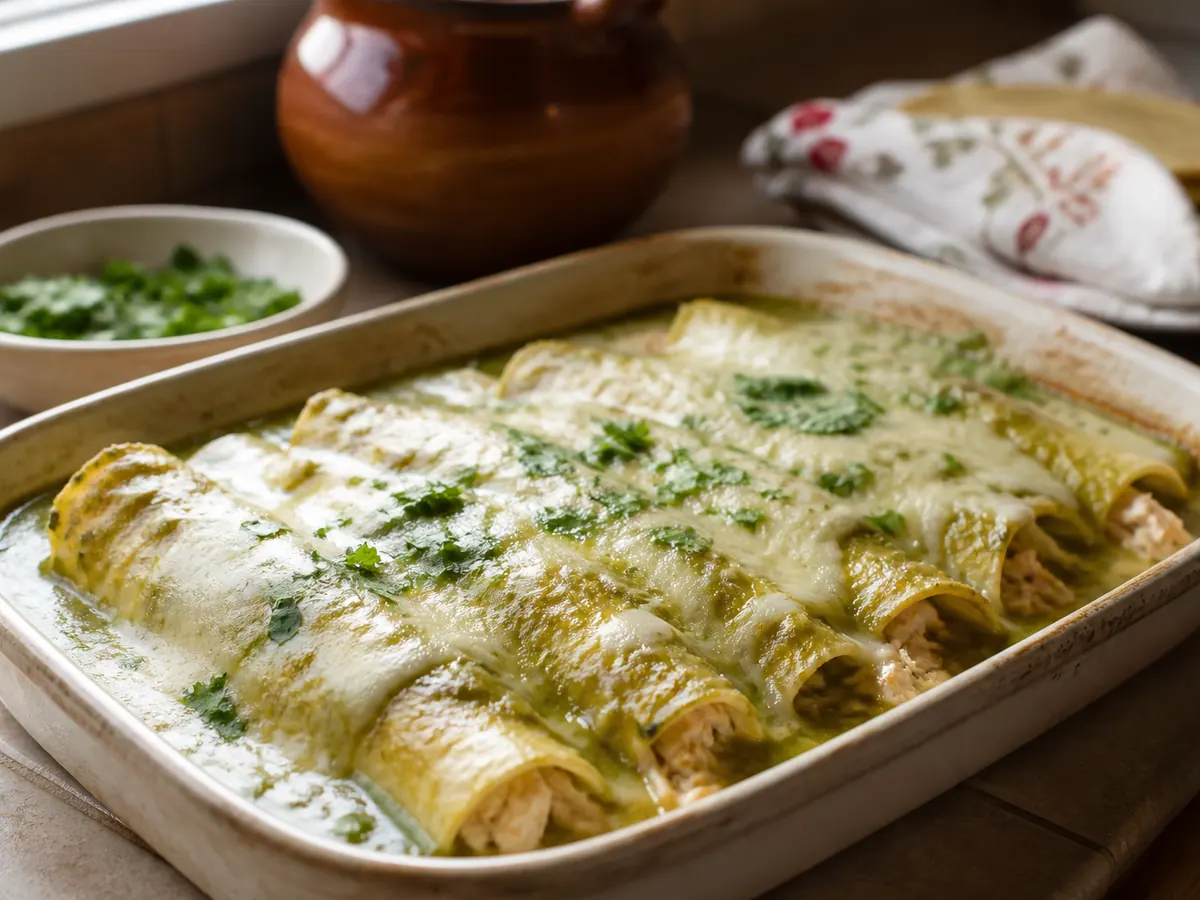
Enchiladas verdes start when tomatillos blister and go mottled in a hot skillet — the kitchen fills with that sharp, grassy smell that means salsa verde is ready. Soft corn tortillas get a quick pass through hot oil so they roll without tearing, then chicken, green sauce, crema, onion and queso fresco. This is a weeknight plate if the sauce is ready; it is also a table dish when you make the salsa from scratch.
This is not enchiladas suizas. Suizas lean cream-heavy and Swiss-inspired, and there is a creamier departure below, labelled clearly. It is also not red enchiladas. This page stays with tomatillo salsa verde from start to finish.
Enchiladas verdes are for when the kitchen should smell like tomatillo and chile, and the plate should look generous without feeling heavy. Flash-fry the tortillas, simmer the salsa until it loses its raw edge, and do not drown the chicken. The rest is onion, crema and cheese — simple on purpose, because the green sauce already did the work.
Chicken filling
- 700 g1½ lbBoneless skinless chicken thighsor breasts if you prefer leaner meat
- 1 small1 smallWhite onion, halved
- 2 cloves2 clovesGarlic, smashed
- 1 leaf1 leafBay leaf
- 5 g1 tspKosher salt, for the poaching water
- Water to cover
Salsa verde
- 700 g1½ lbTomatillos, husks removed and rinsed
- 2–32–3Serranos, or 2 jalapeñosseeded if you want milder heat
- ½½White onion, roughly chopped
- 3 cloves3 clovesGarlic, peeled
- 30 g½ packed cupCilantro, leaves and tender stems
- 10 g2 tspKosher saltplus more to taste
- 15 ml1 TbspNeutral oil, for simmering the blended sauce
- 120–180 ml½–¾ cupChicken poaching liquid or water, as needed
Assembly
- 1212Corn tortillas, 15 cm / 6 infresh if you can get them
- 60–80 ml¼–⅓ cupNeutral oil, for flash-frying
- 120 ml½ cupMexican cremaor thinned sour cream
- 1 small1 smallWhite onion, finely diced
- 100 g3½ ozQueso fresco or cotija, crumbled
- Cilantro leaves, for finishing
- Lime wedges
Why flash-fry the tortillas
Corn tortillas will dissolve in salsa verde if you dunk them raw and roll them cold. A brief fry — 10 to 15 seconds per side in hot oil — sets the surface so the tortilla bends without tearing and does not turn to paste under the sauce. You are not deep-frying to crisp chips; you want pliable, lightly sealed wrappers. If you skip the fry, warm the tortillas on a dry comal until soft, but know they will soften further in the sauce and may leak.
Corn, not flour
Flour turns gummy under salsa verde and is not traditional for this dish.
Kitchen rhythm
Run this in overlapping lanes so nothing sits cold. Start the chicken first — it needs the full poach and shred. While it simmers, char the tomatillos and aromatics. Blend and simmer the salsa while you shred. Flash-fry the tortillas last, right before you roll, so they stay warm. Oven time is short; use those 15–20 minutes to dice onion, crumble cheese and warm plates. An hour and a quarter from cold kitchen to table is realistic if you do not wander off mid-char.
Equipment
- Saucepan for poaching the chicken
- Dry cast-iron skillet or comal for charring
- Blender
- Saucepan for simmering the blended salsa
- Skillet for flash-frying the tortillas
- 23×33 cm / 9×13 in baking dish
- Rack or paper towels for draining
Method
Poach and shred the chicken18–22 min
Put the chicken in a saucepan with the halved onion, smashed garlic, bay leaf and salt. Cover with cold water by about 2.5 cm / 1 in. Bring to a bare simmer over medium heat — do not hard-boil, because boiling tightens the meat and squeezes out the juices.
Once small bubbles appear around the edges, about 90–95 °C / 195–205 °F at the surface, lower the heat and poach gently for 18–22 minutes, until the thickest piece registers 74 °C / 165 °F and the meat shreds easily.
Transfer the chicken to a plate. Strain and reserve the liquid; you will use some in the salsa. Shred the chicken with two forks while it is still warm — warm meat pulls apart cleanly, cold meat fights you. Taste, season the shreds with a pinch of salt, and set aside.
Cover chicken, onion, garlic, bay and salt with cold water by 2.5 cm / 1 in. Gently poach at 90–95 °C / 195–205 °F for 18–22 minutes until 74 °C / 165 °F internally and easily shredded. Strain and reserve broth; shred chicken warm and season.
Char and blend the salsa verde8–12 min
Heat a dry cast-iron skillet or comal over medium-high. Add the tomatillos, chiles and the half onion. Char until the tomatillos are blotchy, soft and leaking juice — about 8–12 minutes, turning often. The skins should look collapsed in places; that cooked sweetness balances the raw tartness. The chiles should blister, and the onion should take colour on its cut faces. Add the garlic for the last 2–3 minutes so it softens without burning black.
Move everything to a blender with the cilantro and salt. Add 120 ml (½ cup) of the reserved chicken liquid. Blend until smooth but still slightly textured, 30 to 45 seconds — you want body, not baby food.
Taste. It should be bright, salty enough, and hot enough that you notice the chile after the tomatillo. Adjust the salt and chile if needed.
Dry-char tomatillos, chiles and onion over medium-high, turning for 8–12 minutes until blistered, soft and juicy. Add garlic for the last 2–3 minutes without burning. Blend with cilantro, salt and 120 ml (½ cup) chicken broth for 30–45 seconds; adjust seasoning.
Fry the salsa8–10 min
Warm 15 ml (1 Tbsp) oil in a saucepan over medium heat. Pour in the blended salsa — it should sizzle. Cook 8–10 minutes, stirring, until the colour deepens a shade and the raw edge cooks off.
The sauce should coat a spoon but still pour. Thin it with more poaching liquid if it thickens past that point. Hold it warm.
Heat 15 ml (1 Tbsp) oil over medium. Add blended salsa and stir 8–10 minutes until darker and cooked-tasting. Thin with reserved broth as needed so it coats a spoon but pours easily. Keep warm.
Flash-fry the tortillas10 min
Heat 60–80 ml (¼–⅓ cup) oil in a skillet over medium-high until a scrap of tortilla sizzles on contact, about 180 °C / 350 °F.
Working one at a time, fry each tortilla 10–15 seconds per side until soft and lightly blistered, not crisp. Drain on a rack or paper towels, and stack them as you go so they stay warm and pliable.
If the oil cools, wait for it to recover before the next tortilla — cold oil soaks instead of sealing.
Heat 60–80 ml (¼–⅓ cup) oil over medium-high to about 180 °C / 350 °F. Fry tortillas individually 10–15 seconds per side until pliable, not crisp. Drain and stack warm. Let oil regain heat between tortillas if needed.
Roll, sauce and bake15–20 min
Heat the oven to 190 °C / 375 °F. Spread a thin layer of salsa verde across the bottom of a 23×33 cm / 9×13 in baking dish, just enough that the rolls do not stick.
Lay a tortilla flat. Put about 40–45 g (3 Tbsp) shredded chicken down the centre. Roll it snugly, or fold it in half if you prefer folded enchiladas, and place it seam-side down in the dish. Repeat until all twelve are lined up. They should sit close but not crushed.
Ladle the remaining salsa over the top so every tortilla is blanketed — gaps of bare tortilla will dry out and crack. Dot or drizzle with about half the crema.
Bake 15–20 minutes, until the sauce bubbles at the edges and the tops look hot and slightly set. The internal sauce temperature should be around 75–80 °C / 165–175 °F if you check: hot through, not scorched.
Heat oven to 190 °C / 375 °F. Spread salsa in a 23×33 cm / 9×13 in dish. Fill each of 12 tortillas with 40–45 g (3 Tbsp) chicken; roll seam-down or fold, fitting snugly without crushing. Cover completely with remaining salsa and half the crema. Bake 15–20 minutes until bubbling at edges and sauce reaches about 75–80 °C / 165–175 °F.
Finish and serve
Pull the dish. Shower it with diced white onion, crumbled queso fresco or cotija, the remaining crema, and cilantro. Serve at once with lime wedges.
The onion should stay crisp and the cheese should stay cool against the hot sauce. That contrast is part of the point.
Top the hot enchiladas with diced white onion, crumbled queso fresco or cotija, remaining crema and cilantro. Serve immediately with lime wedges, keeping the fresh toppings cool and crisp against the sauce.
Sensory checkpoints
- Tomatillos on the pan: the grassy smell turns sweeter, the skins blister and soften, juice pools.
- Blended salsa: bright green, pourable, tart with a chile finish.
- Simmered salsa: a deeper green-olive tone, less raw, coating a spoon.
- Fried tortilla: flexible, warm, a faint toasted-corn smell — not oily or brittle.
- Out of the oven: sauce bubbling at the rim, steam when you cut in, chicken moist rather than dry.
Check that charred tomatillos are soft and juicy, salsa is pourable and spoon-coating after simmering, and tortillas remain warm and flexible. Finished enchiladas should steam when cut, with bubbling sauce and moist chicken.
Storing it
Cool leftovers within 1 hour. Refrigerate in a covered dish up to 3 days. Reheat covered at 175 °C / 350 °F for 15–20 minutes until hot in the centre, 74 °C / 165 °F. The tortillas will soften further; that is normal. Freeze assembled but unbaked, with sauce on top, up to 1 month; thaw overnight in the fridge before baking and add 5–10 minutes to the oven time. Crema and fresh onion and cheese toppings are best added after reheating, not before freezing.
Salsa verde alone keeps 4–5 days refrigerated, or 2 months frozen. The chicken filling keeps 3 days refrigerated.
Troubleshooting
- The sauce tastes too sharp or raw.
You undercooked the simmer. Give it another 5 minutes. A pinch of sugar can round extreme tartness, but prefer more cook time first.
- The sauce is too thick.
Whisk in warm poaching liquid a splash at a time.
- The sauce is too thin.
Simmer uncovered a few more minutes, or blend in one extra roasted tomatillo if you have one.
- The tortillas tore while rolling.
The oil was not hot enough, or the tortillas were stale. Warm them longer, and use fresher tortillas next time. Patch with a dab of sauce and keep going — rustic is fine.
- The enchiladas fell apart in the dish.
You skipped the fry, or used very thin tortillas. Flash-fry the next batch. For this one, spoon it into bowls and call it enchilada casserole — still good.
- Too spicy.
Seed the chiles next time, and serve with extra crema and avocado. Dairy calms heat.
- Not spicy enough.
Blend in a roasted serrano, or serve with a side of chopped raw chile and onion.
- The chicken is dry.
You boiled hard, or used breast overcooked past 74 °C / 165 °F. Thighs forgive more. Moisten the shreds with a spoon of salsa before filling.
Substitutions
Traditional, and this recipe's spine: tomatillo salsa verde; corn tortillas briefly fried; shredded chicken; rolled; sauce; crema; white onion; queso fresco or cotija. No heavy cream blanket as the default.
Enchiladas suizas-style
Stir 120 ml (½ cup) crema or Mexican table cream into the salsa before baking, and top with a melting cheese such as Oaxaca or Monterey Jack. Creamier, richer, less sharp — call it suizas so guests know what changed. This page does not lead with it. If you want that, label it and enjoy it on purpose.
Other labelled departures
Folded instead of rolled, which is faster and follows the same sauce logic. A vegetable filling of roasted courgette and corn, or mushrooms, seasoned like the chicken. Or skip the oven and sauce the filled tortillas on the plate, enchiladas ahogadas style — faster, with a brighter sauce and less melding.
On heat and texture
Salsa verde should taste alive. If it tastes flat it usually needs salt, or a minute more char on the tomatillos — not cream. Cream belongs in the suizas departure. The flash-fry oil should shimmer; if you see smoke, back the heat down, because burnt oil makes the tortillas bitter and the whole tray suffers. When you pull the dish, listen for a soft bubble at the edges. Silence can mean the sauce never got hot enough in the centre — give it five more minutes.
Scaling
For a crowd
Double the salsa in a wider pan so it reduces evenly, and fry the tortillas in batches, holding them wrapped in a clean towel.
What not to do
Do not sauce and hold rolled enchiladas for an hour before baking — the tortillas will soften past the point of clean slices. Roll, sauce, bake.
What to serve it with
- Lime wedges at the table, always
- Rice or beans on the side — three enchiladas is a solid plate with them, two with heavy sides
- Extra crema and avocado for anyone who wants the heat calmed
- A side of chopped raw chile and onion for anyone who wants it louder
Questions
Can I use canned tomatillos?
Yes, in a pinch. Drain them well; you may need less liquid. Fresh charred tomatillos taste brighter.
Corn or flour tortillas?
Corn. Flour turns gummy under salsa verde and is not traditional for this dish.
Serrano or jalapeño?
Serrano runs hotter and cleaner; jalapeño is milder and grassier. Serranos are the usual choice for verdes.
Do I have to fry the tortillas?
Strongly recommended. Dry-warming works for soft tacos; for sauced enchiladas, frying protects the structure.
Can I make components ahead?
Yes. Poach and shred the chicken a day ahead, and make the salsa 1–2 days ahead. Flash-fry the tortillas and assemble just before baking so they do not sit soggy.
Why not red sauce?
Different dish. Guajillo-ancho red enchiladas are cousins, not substitutes. Keep this green.
Is crema required?
It balances acid and heat. Thinned sour cream works. Plain yoghurt is a stretch but usable if you must.
Queso fresco or cotija?
Fresco is milder and moist; cotija is saltier and drier. Either finishes well, and fresco suits chicken verdes.
How many enchiladas per person?
Three is a solid plate with rice or beans; two if you serve heavy sides.
Can I grill the tomatillos?
Yes — the same blistering goal. Do not walk away; they go from perfect to ash fast.