Cochinita Pibil
Yucatán pork stained brick-red by achiote and sour orange, wrapped in banana leaf so it steams in its own marinade until it pulls into long juicy strands. Pit-style logic in a home oven — with pickled red onions on the table before anyone asks.
- Cook
- 3 hr 45 min
- Serves
- 6–8 servings
- Difficulty
- Medium
Researched · Kitchen testing pending
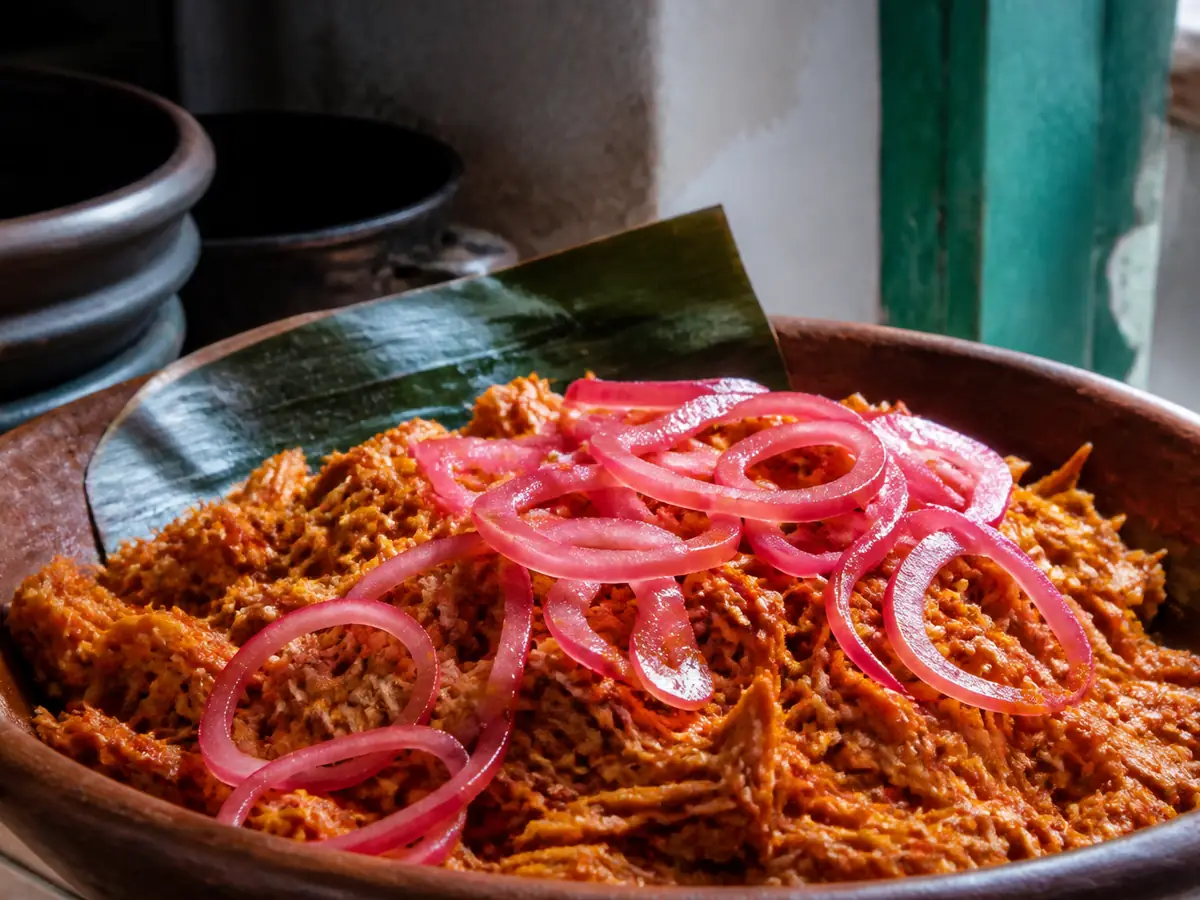
Banana leaves crackle when they hit a hot pan, and that sound — followed by the grassy, tea-like smell of toasted leaf — is the signal that this is Yucatán cooking, not just “pork with spice.”
Cochinita pibil is slow-cooked pork stained brick-red by achiote, brightened with sour orange, wrapped so the meat steams in its own marinade until it pulls apart in long, juicy strands. It is not Cuban lechón. It is not a pressure-cooker stunt as the headline. It is a pit-style roast you can do in a home oven if you respect the marinade, the leaf, and the time.
Cochinita pibil rewards an overnight marinade and an oven left undisturbed for hours. Toast the leaves, trust the achiote, and put the pickled onions on the table before anyone asks. The pork will tell you when it is ready — when a fork twists and the strands shine with red-orange juice, you are done.
Pork and marinade
- 1.8–2 kg4–4½ lbPork shoulder (Boston butt), bone-in or boneless, cut into 6–8 large chunks
- 100 g3½ ozAchiote paste (recado rojo), good quality
- 180 ml¾ cupSour orange juice (naranja agria)labelled substitute — 120 ml / ½ cup fresh orange juice + 45 ml / 3 Tbsp fresh lime juice + 15 ml / 1 Tbsp white vinegar
- 60 ml¼ cupWhite vinegarin addition, if using true sour orange; skip the extra if you used the substitute blend, which already includes vinegar
- 1 medium1 mediumWhite onion, roughly chopped
- 6 cloves6 clovesGarlic
- 8 g1½ tspDried Mexican oreganoYucatecan if you have it
- 5 g1 tspGround cumin
- 3 g½ tspGround black pepper
- 3 g½ tspGround allspiceoptional, but traditional in many recados
- 12 g2 tspKosher saltplus more to taste
- 2 leaves2 leavesBay leaves
Wrap and cook
- 2–3 large2–3 largeBanana leaves, thawed if frozen and wiped cleanlabelled foil backup — heavy-duty foil if leaves are unavailable; the flavour will be milder
- 120 ml½ cupWater, or diluted marinade, for the pan bottomkeeps the steam going
Cebollas encurtidas (pickled red onions)
- 2 medium2 mediumRed onions, thinly sliced
- 180 ml¾ cupSour orange juice, or the orange-lime-vinegar blend
- 5 g1 tspKosher salt
- 2 g½ tspDried oregano
- Pinch of black pepper
- 11Habanero, halvedoptional — seeds in for heat
To serve
- Warm corn tortillas
- Extra pickled onions
- Optional habanero salsa, labelled hot — 2 roasted habaneros, 2 roasted garlic cloves, a pinch of salt, a splash of sour orange or lime, blended rough; warn guests
- Fresh cilantro
- Lime wedges
Achiote paste quality matters
Cheap, chalky paste tastes dusty and flat. Good paste smells earthy, peppery and slightly bitter, and it stains your fingers orange for a reason. Buy from a brand you trust, or make a rough paste from annatto seeds if you have a strong blender and patience.
Why banana leaf and why low heat
The leaf is not decoration. It traps steam, perfumes the meat, and keeps the surface from drying into a bark before the interior softens. Low oven heat, 160 °C / 325 °F, mimics the slow pit — collagen melts over hours. Rush it hotter and you get tough edges and a dry centre. You want fork-tender strands that still look like pork, not paste.
Passive time, counted separately
The pork needs at least 4 hours in the marinade and ideally overnight, 8–12 hours, and it rests 15–20 minutes still wrapped after the oven. Neither is active work, and both sit outside the time quoted above. Plan a day ahead for the best flavour.
Equipment
- Blender
- Nonreactive bowl or zip bag for marinating
- Large roasting pan or Dutch oven with a lid, or a double layer of foil
- Gas flame or hot dry skillet, for making the leaves pliable
- Instant-read thermometer
- Two forks for shredding
Method
Blend the marinade
In a blender, combine the achiote paste, sour orange juice (or the labelled substitute), the vinegar as specified, onion, garlic, oregano, cumin, black pepper, the allspice if using, and the salt. Blend until smooth and thick, about 45–60 seconds.
It should look like a rusty red slurry and smell citrusy under the earthy achiote. Taste a drop: salty, tart, slightly bitter from the annatto. If the paste was hard, warm it briefly with a spoon of the juice before blending so it emulsifies.
Blend achiote, sour orange, onion, garlic, oregano, cumin, pepper, optional allspice and salt 45–60 seconds until smooth. Add the extra 60 ml vinegar only with true sour orange; omit it with the listed substitute blend. Soften hard paste briefly with a spoonful of juice before blending.
Marinate the pork4 hr minimum, overnight preferred
Pat the pork dry and place the chunks in a nonreactive bowl or zip bag. Pour the marinade over and massage so every face is coated — achiote stains everything, so wear an apron. Tuck in the bay leaves.
Cover and refrigerate at least 4 hours, ideally overnight. Flip once halfway if the meat is not fully submerged. Cold marinade needs time to move past the surface; overnight is worth it.
Pat pork dry; coat every side with marinade in a nonreactive bowl or zip bag and add bay leaves. Cover and refrigerate at least 4 hours, ideally 8–12 hours overnight. Turn halfway if not fully submerged; achiote stains.
Prepare the banana leaves
Thaw frozen leaves in the fridge or under cool water, and wipe both sides.
To make them pliable and fragrant, pass each leaf over a medium gas flame or a hot dry skillet for a few seconds, until the colour shifts to a glossier green and the leaf softens. Do not burn holes.
Overlap the leaves in a large roasting pan or Dutch oven to form a nest, shiny side up if you can tell. Leave enough overhang to fold over the pork.
Thaw leaves in the refrigerator or under cool water; wipe both sides. Pass over medium flame or a hot dry skillet for seconds until glossy and pliable without burning holes. Overlap shiny-side-up in the roasting pan with enough overhang to enclose pork.
Wrap and roast3 hr 30 min – 4 hr
Heat the oven to 160 °C / 325 °F. Lift the pork and marinade into the leaf nest and pour any remaining marinade over the top. Add 120 ml (½ cup) water around — not on — the packet if your pan is dry; steam matters. Fold the leaves over to enclose, and cover the pan tightly with a lid or a double layer of foil so steam cannot escape easily.
Roast 3½–4 hours. At 2½ hours, peek carefully: the meat should be dark red-orange, swimming in juices, and starting to yield to a fork. Return it to the oven until a fork twists with almost no resistance and the thickest piece hits at least 93 °C / 200 °F internally — pork shoulder wants that higher temperature so the collagen fully softens.
If the leaves look dry on top, spoon some juices over before resealing.
Heat oven to 160 °C / 325 °F. Place pork and all marinade in leaves; add 120 ml (½ cup) water around the packet if the pan is dry. Fold leaves closed and seal pan tightly with lid or double foil. Roast 3½–4 hours, checking carefully at 2½ hours. Baste dry leaves and reseal; continue until fork-tender and at least 93 °C / 200 °F internally.
Rest and shred15–20 min
Remove the pan from the oven and rest the pork 15–20 minutes still wrapped — the juices redistribute, and shredding too soon dumps liquid and dries the strands.
Open the leaves and transfer the pork to a board or bowl. Shred with two forks, discarding large fat globs if you prefer leaner bites; some fat is flavour, so keep a little. Moisten the shreds with the pan juices until glossy, not swimming. Taste, and add salt if needed.
The colour should be deep orange-red, and the smell citrus-earthy, not scorched.
Rest pork 15–20 minutes still wrapped, then open and shred with two forks. Remove large fat pieces if desired, retaining some for flavour. Add pan juices until glossy rather than soupy, then taste and adjust salt.
Make the cebollas encurtidas30 min minimum
While the pork cooks — or the night before — toss the sliced red onions with sour orange (or the substitute), salt, oregano, pepper and the optional habanero. Massage for 1 minute until the onions wilt slightly and turn neon pink at the edges.
Rest at least 30 minutes at room temperature, or refrigerate up to 5 days. They should taste bright and salty-tart, with snap still in the onion.
While pork cooks, or the night before, massage sliced red onions with sour orange or substitute, salt, oregano, pepper and optional habanero for 1 minute. Rest at least 30 minutes at room temperature, or refrigerate up to 5 days; retain some crunch.
Serve
Pile the shredded cochinita on warm corn tortillas and top with the pickled red onions. Offer the habanero salsa on the side, clearly labelled hot — habanero is floral and fierce, and a little goes far. Cilantro and lime finish the plate. Beans and rice are welcome neighbours, not requirements.
Serve shredded cochinita on warm corn tortillas with pickled onions, cilantro and lime. Offer optional habanero salsa separately, clearly labelled hot. Beans and rice are optional accompaniments.
Sensory checkpoints
- Marinade: brick-red, thick, citrus over earthy achiote, with no chalky dust smell.
- Toasted banana leaf: pliable, tea-like aroma, not bitter smoke.
- Mid-cook peek: meat submerged in orange-red juices, leaf intact, steam billowing when opened.
- Done pork: shreds in long strands, internally around 93 °C / 200 °F or above, juices clear-orange rather than watery grey.
- Pickled onions: vivid pink, crunchy, sharp enough to cut the rich pork.
Check for thick brick-red marinade, pliable fragrant leaves and abundant orange-red cooking juices. Open carefully around steam. Finished pork should shred into long strands at around 93 °C / 200 °F or above; onions should remain bright pink, tart and crunchy.
Storing it
Cool the shredded pork in its juices within 1 hour. Refrigerate up to 4 days in a covered container. Reheat gently in a covered skillet with a splash of water or reserved juices until steaming, 74 °C / 165 °F. Freeze up to 2 months and thaw overnight in the fridge. Pickled onions keep refrigerated up to 5 days; they soften over time but stay usable. Leftover banana leaves can be rinsed, dried and frozen for another roast.
Marinated raw pork can sit refrigerated up to 24 hours. Beyond that, freeze the marinated chunks and thaw them before cooking.
Troubleshooting
- The meat tastes bland or pale.
Weak achiote paste, or a short marinade. Use better paste next time, marinate overnight, and do not rinse the meat before cooking.
- The meat is dry.
The oven was too hot, the wrap leaked steam, or there was not enough marinade and juice. Keep the seal tight, add a splash of water to the pan, and pull it only when truly fork-tender — then moisten the shreds.
- A bitter or dusty flavour.
Low-quality achiote, or a burned banana leaf. Taste the paste before using it, and toast the leaves gently.
- Too acidic.
Cut the vinegar slightly next time, and balance the plate with avocado or beans. Sour orange should brighten, not strip enamel.
- Not tender after 4 hours.
The chunks may be large, or the oven may run cool. Continue cooking sealed and check every 20–30 minutes. Collagen waits for temperature and time, not the clock alone.
- The banana leaves tore, or were unavailable.
A foil wrap works as a labelled departure. Double-foil it tightly. You lose the leaf aroma but keep the moisture.
- The habanero onions came out too spicy.
Remove the chile half earlier. Serve mild onions and keep the hot salsa separate.
- Achiote stained the cutting board forever.
Oil the board lightly next time, or use plastic. Lemon and salt scrubbing helps, but prevention is easier.
Substitutions
Traditional, and this recipe's spine: pork shoulder in achiote and sour orange; a banana leaf wrap; slow moist heat, whether pit or oven; served with cebollas encurtidas and tortillas. Optional habanero on the side, labelled hot.
Pit note
In Yucatán, pib means cooking in an earthen pit with hot stones and buried leaves. Home ovens approximate the low, enclosed heat. If you ever cook in a pit, the same marinade and leaf logic apply, but timing depends on fire management — follow a trusted pit guide rather than improvising with this oven schedule alone.
Labelled departures
Orange, lime and vinegar in place of naranja agria, as stated above — close enough for home kitchens outside the peninsula. Foil instead of banana leaf, which retains moisture but gives a milder aroma. An Instant Pot or pressure cooker is not the headline; if you must, marinate as written, then pressure 60–75 minutes on high with natural release, reduce the juices and shred. The texture leans softer and less roasted, so call it a weeknight departure, not cochinita from the pib.
Pollo pibil
The same marinade with a shorter cook, roughly 1½–2 hours in the oven, until the chicken reaches 74 °C / 165 °F and is tender. A different animal, the same recado idea.
This is not Cuban lechón
Lechón leans garlic-citrus mojo and often crisp skin on a whole hog. Cochinita pibil is achiote-forward, leaf-wrapped, shredded, Yucatecan.
What to serve it with
- Warm corn tortillas, charred lightly on a comal if they taste flat
- Extra pickled red onions, more than you think you need
- Habanero salsa on the side, labelled hot
- Cilantro and lime wedges
- Beans and rice, welcome neighbours rather than requirements
Questions
What is naranja agria?
Bitter or sour orange, used across Yucatán and the Caribbean. If you cannot find it, use the orange-lime-vinegar substitute and label it as such — do not pretend it is identical.
Which cut of pork?
Shoulder, or butt. Leg works; loin dries out. Fat and collagen are friends here.
Bone-in or boneless?
Either. Bone-in can taste slightly richer; boneless shreds with less fuss. Same marinade either way.
Can I use powdered annatto only?
You can bloom the seeds in oil and blend with spices, but commercial paste already includes spices. If you use seeds alone, add garlic, oregano, cumin, pepper and salt to build a recado.
Why 93 °C / 200 °F for pork?
Shoulder is not a chop. You cook past "safe" into "collagen melted." Safe is 63–71 °C for some cuts; shoulder wants higher for a shreddable texture.
Must I use banana leaves?
For the closest flavour, yes. Foil is the honest backup.
How hot is the habanero salsa?
Very. Serve it optional and labelled. One dab per taco is plenty for most people.
Can I make this for a crowd?
Double the recipe across two pans so heat circulates. Do not stack one giant pile that never cooks through.
Store-bought or handmade tortillas?
Warm corn tortillas, period. Char them lightly on a comal if they taste flat.
Is cumin traditional?
Many home recados include it; some purists keep the paste simpler. A modest amount is listed in the ingredients, so you can omit it.