Mayi Moulen ak Fèy Lalo
Jute leaves carry a soluble mucilage rich in rhamnose and galacturonic acid, and forty-five minutes of simmering releases it. That sap is the emulsifier — it binds rendered pork fat, crab liquor and tomato paste into a velvety green sauce, poured over coarse cornmeal cooked to a deliberate al dente.
- Prep
- 30 min
- Cook
- 1 hr 15 min
- Serves
- 6 hearty portions
- Difficulty
- Hard
Researched · Kitchen testing pending
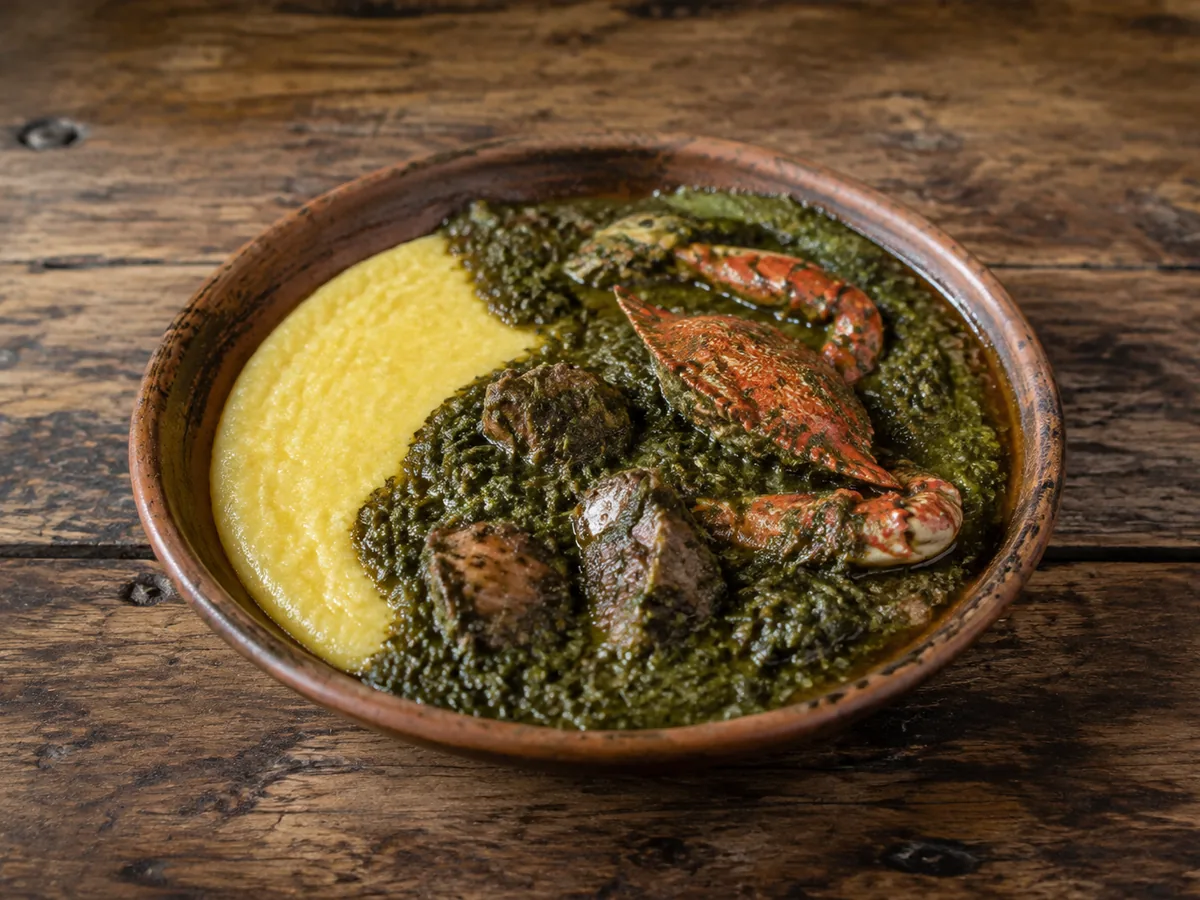
In the Artibonite valley and the coastal city of Saint-Marc, Sunday cooking means fèy lalo. Lalo is the deep green leaf of the jute plant, prized for its silky mucilaginous body and its iron minerality.
The leaves are slow-braised with salted pork belly, blue swimming crabs and garlic-scallion épice until meltingly tender, and that rich stew is poured straight over mayi moulen — coarse stone-ground yellow cornmeal cooked with garlic, butter and bean broth.
Nutty textured corn against unctuous mineral greens is about as Haitian as a plate gets.
The lalo
- 600 g1.3 lbFresh or frozen jute leaves (fèy lalo), thick stems removed, washed and chopped
- 500 g1.1 lbSalted pork belly (ti-salé), or smoked ham hock, cut into 3 cm cubes
- 4 whole4 wholeFresh blue swimming crabs, cleaned and halved, claws gently cracked
- 60 ml4 TbspHaitian green épice
- 30 ml2 TbspNeutral cooking oil, or lard
- 1 large1 largeYellow onion, cut into 4 mm dice
- 6 cloves6 clovesFresh garlic, minced to a paste
- 30 g2 TbspTomato paste
- 1 whole1 wholeScotch bonnet pepper, unpunctured with the stem intact
- 4 sprigs4 sprigsFresh thyme
- 3 whole3 wholeWhole cloves, ground
- 10 g2 tspFine sea saltlightly — the pork is already salted
- 3 g1 tspFreshly ground black pepper
- 750 ml3.2 cupsWater, or light chicken stock
The cornmeal
- 400 g2.5 cupsCoarse stone-ground yellow cornmeal (mayi moulen)
- 1 L4.2 cupsWater
- 45 g3 TbspUnsalted butter
- 2 cloves2 clovesFresh garlic, crushed, for the cooking water
The mucilage is the sauce
Lalo leaves hold complex acidic polysaccharides. Forty-five minutes of simmering breaks down the cellulose and releases that sap, which then acts as a natural emulsifier binding pork fat, crab liquor and tomato into one velvety green sauce.
Blanch the pork first
Fifteen minutes at a boil pulls the excess cure out of ti-salé. Skip it and the whole pot is inedibly salty — and you cannot take it back out.
Coarse cornmeal, al dente
Large endosperm particles swell at 88–90 °C with constant stirring, which leaves tender individual grains with a distinct bite. Pushed hotter or stirred less they burst into smooth mush.
Stream and whisk
Coarse meal dumped in at once lumps instantly. A steady stream into boiling water with vigorous whisking is the only way.
Crack the claws gently
Over-cracked shells let the meat escape into the braise. A gentle crack lets the liquor out while keeping the meat in.
Passive time, counted separately
The cornmeal steams 15 minutes covered on the lowest heat after its active stirring. That sits outside the times quoted above.
The five tastes on this plate
Salt is the cured pork, the sea salinity of the crab and the seasoned cornmeal. Fat is rendered pork belly and butter coating the coarse grains. Acid is quiet and mineral, balanced by sweet crab and corn. Heat is garlic, black pepper and the floating Scotch bonnet. Umami is crab shell liquor, cured pork fond and the mineral-dense jute.
Equipment
- 6 qt enamelled cast-iron Dutch oven
- 4 qt heavy saucepan
- Whisk and a stiff flat-edged wooden spoon
- Wide shallow bowls
Traditionally a cast-aluminium chaudron with a wooden bwa mayi paddle. A 6-quart Dutch oven for the lalo and a 4-quart saucepan for the cornmeal works in a modern kitchen — use a stiff flat-edged spoon so the starch never catches on the floor of the pan.
Method
Desalinate and brown the pork27 min
Boil the ti-salé cubes in water 15 minutes to draw out the cure, and drain.
Heat the oil in the Dutch oven over medium and sauté the pork 6 minutes until golden, add the onion, garlic and épice for 4 minutes, then the tomato paste and ground cloves for 2 minutes more.
Boil salted pork cubes in water 15 minutes; drain. Heat oil over medium and brown pork 6 minutes. Add onion, garlic and épice for 4 minutes, then tomato paste and ground cloves for 2 minutes.
Simmer the lalo and crabs45 min
Add the cracked crabs, chopped lalo, thyme and the 750 ml water, and rest the whole unbroken Scotch bonnet on top.
Boil, then cover and simmer on low 45 minutes, until the pork reads 90–93 °C and the leaves have turned silky and dark forest-green. Discard the pepper and season.
Add crabs with gently cracked claws, chopped lalo, thyme and 750 ml water; place intact Scotch bonnet on top. Boil, cover and simmer low 45 minutes until pork reaches 90–93 °C and leaves are silky dark green. Discard pepper; season lightly.
Cook the mayi moulen15 min
Bring the 1 L water to a boil with the butter, crushed garlic and 1 tsp salt.
Stream in the cornmeal slowly, whisking constantly, then drop the heat to low, switch to a wooden spoon, and stir across the bottom 10 to 12 minutes as it swells into a thick golden porridge.
Cover tightly, lowest heat, and steam 15 minutes.
Boil 1 L water with butter, crushed garlic and 1 tsp salt. Slowly stream in cornmeal, whisking constantly. Reduce to low, 88–90 °C, and stir the bottom 10–12 minutes until thick. Cover tightly; steam on lowest heat 15 minutes.
Assemble
Spoon warm mayi moulen into wide shallow bowls and press a shallow well in the centre.
Ladle the lalo stew with its pork and cracked crabs straight over the cornmeal. Serve hot.
Spoon warm cornmeal into wide, shallow bowls and make a shallow well in each centre. Ladle the lalo, pork and cracked crabs over it; serve hot.
Sensory cues of doneness
- Visual: a silky dark forest-green stew holding pink crab claws and pork belly, over golden coarse cornmeal.
- Auditory: thick subterranean plops as the lalo reduces, and a quiet steam rustle from the cornmeal pot.
- Olfactory: crab shell, cured pork, earthy jute, garlic, clove and sweet roasted corn.
Look for silky dark-green stew with pink crab claws and pork over coarse golden cornmeal. The greens should bubble thickly; the cornmeal should retain tender individual grains with some bite.
Troubleshooting
- Lumpy cornmeal.
It went in all at once. Stream it slowly into boiling water while whisking hard.
- An unpalatably salty stew.
The pork was not blanched. Boil and drain it before it goes anywhere near the pot.
- Empty crab shells.
They were cracked too hard. A gentle crack keeps the meat inside through the braise.
Substitutions
One-to-one global substitutions, with the technique adjustment each one requires.
Ingredient substitutions
| Ingredient | Replace with | Culinary impact and technique adjustment |
|---|---|---|
| Fèy lalo | Frozen lalo, molokhia, or collard greens with spinach | One-to-one. The same earthy greens profile |
| Blue crabs | Picked blue crab meat, gulf shrimp, or smoked herring | One-to-one for the seafood sweetness |
| Coarse cornmeal | Coarse stone-ground polenta | One-to-one. Never fine cornmeal, cornstarch or flour |
Scaling
Half, for 3 portions
Halve everything in a 3.5-quart pot. Cook times are unchanged.
Double, for 12 portions
Double everything in an 11-quart Dutch oven, stirring the cornmeal with a heavy paddle.
What to serve it with
- Sos pwa nwa, the velvety black bean sauce, over the cornmeal
- Wedges of buttery ripe avocado
- A cold Prestige, or sugarcane limeade
Questions
What if I cannot find lalo?
Frozen lalo is widely sold at Haitian grocers. Egyptian molokhia, or tender collards mixed with spinach, also work.
What exactly is mayi moulen?
Coarse stone-ground yellow cornmeal cooked like polenta, but seasoned with garlic, butter and bean broth.
Can it be vegetarian?
Yes. Leave out the pork and crab and braise the lalo with wild mushrooms, vegetable stock and olive oil.