Pwason Boukannen ak Pwason Gros Sel
The two pillars of Haitian seafood: whole snapper smoked over wood coals, or poached in a fiery lime court-bouillon. Either way it is scored three times to the backbone, because without those slits the thick dorsal muscle stays raw while the tail dries out — and it comes off the heat at 60 to 63 °C.
- Prep
- 20 min
- Cook
- 20 min
- Serves
- 4 whole fish
- Difficulty
- Medium
Researched · Kitchen testing pending
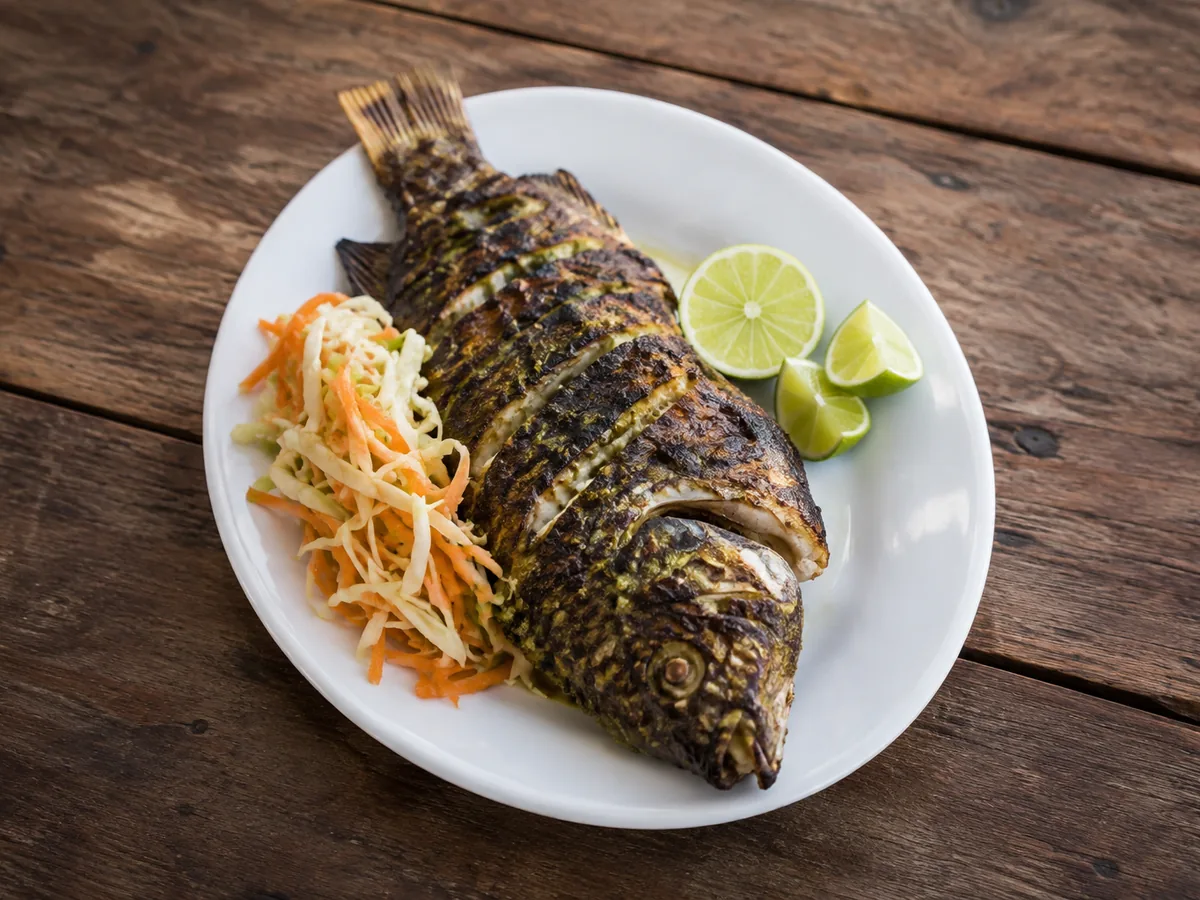
Along the coastlines of Jacmel, Jérémie and Port-Salut, fishermen bring in red snapper from wooden skiffs each morning. Pwason gros sel and pwason boukannen are the two pillars of Haitian seafood cooking.
For gros sel, a whole scored snapper is seasoned with coarse sea salt, citrus, garlic and wild thyme, then poached gently in a fiery court-bouillon of sliced shallots, sweet peppers, whole cloves and Scotch bonnet. Boukannen is the same fish taken to the grill and smoked over wood coals instead.
The poaching liquor becomes a tart, spicy lime broth, and the fish stays succulent and flaking clean off the bone.
The fish
- 1.8 kg4 wholeFresh whole red snapper (vivano), scaled, gutted, gills removed, about 450 g each
- 4 large4 largeFresh limes, halved — two to wash the fish, two juiced for the broth
- 20 g1 Tbsp + 1 tspCoarse sea salt (gros sel), lightly crushed
- 6 cloves6 clovesFresh garlic, crushed to a paste
- 45 ml3 TbspHaitian green épice
- 3 g1 tspFreshly ground black pepper
The court-bouillon
- 45 ml3 TbspExtra-virgin olive oil, or unsalted butter
- 2 medium2 mediumShallots or red onions, sliced into thin 3 mm rings
- 1 large1 largeRed bell pepper, cored and cut into thin julienne
- 1 large1 largeGreen bell pepper, cored and cut into thin julienne
- 4 whole4 wholeWhole cloves
- 4 sprigs4 sprigsFresh thyme
- 1 to 2 whole1 to 2 wholeFresh Scotch bonnet peppers, sliced into rings, or left whole for milder heat
- 400 ml1.7 cupsCold filtered water, or light fish stock
To finish
- 30 g½ cupFresh flat-leaf parsley and scallions, chopped fine
Score to the bone, three times a side
Whole fish cook from the outside in, and the dorsal muscle is the thickest part. Three diagonal slashes to the backbone let heat and salt reach it, so it finishes at the same moment as the tail.
85 °C, never a boil
Fish muscle is short fibres bound by delicate collagen sheets. A rolling boil tears a whole fish into shreds; a whispering sub-boil holds it intact.
Cook it to 63 °C
Past 65 °C the protein strands contract hard and expel their water. Twelve to fourteen minutes and a probe in the thickest part is the whole technique.
What the lime does to the skin
Citric acid lowers the broth pH, which coagulates the surface proteins into a tender intact skin instead of letting it slide off into the liquid.
Boukannen or gros sel
Boukannen is the same seasoned fish rubbed with spice and smoked over wood coals on a grill; gros sel is this gentle poach in the spicy court-bouillon. The preparation below is the poach.
Passive time, counted separately
The scored fish marinates 20 minutes before it goes into the pan. That sits outside the times quoted above.
The five tastes on this plate
Salt is coarse gros sel rubbed into the skin and the cuts. Fat is olive oil or butter mounting the tart broth. Acid is fresh lime straight through the sweet flesh. Heat is Scotch bonnet, shallot, garlic and ground clove. Umami is snapper collagen, the reduced court-bouillon and the allium épice.
Equipment
- Wide 12 to 14 in stainless skillet or enamelled braiser with a tight lid
- Sharp knife, for scoring
- Instant-read thermometer
- Two fish spatulas
Traditionally a wide shallow aluminium paila with a lid over charcoal embers. A 12-to-14 inch skillet works in a modern kitchen — the broad base lets all four fish lie side by side in one layer, and whole fish must never be stacked.
Method
Clean and score12 min
Rub the snappers inside and out with lime halves and coarse salt, rinse in cold water and pat completely dry.
Cut 3 diagonal slashes to the bone on each side, and season the skin, the cuts and the cavity with 15 g coarse salt, the garlic paste, the épice and black pepper. Marinate 20 minutes.
Rub snappers inside and out with lime and coarse salt; rinse cold and dry thoroughly. Make 3 diagonal cuts to the bone on each side. Season skin, cuts and cavities with 15 g salt, garlic, épice and pepper; marinate 20 minutes.
Build the court-bouillon8 min
Heat the olive oil in the wide skillet over medium and sauté the shallot rings, bell peppers and cloves 4 minutes until glistening.
Add the 400 ml water, the lime juice, thyme and Scotch bonnet, bring to a gentle boil, and simmer 4 minutes so the aromatics infuse.
Heat olive oil over medium in a wide skillet; sauté shallots, bell peppers and cloves 4 minutes. Add 400 ml water, lime juice, thyme and Scotch bonnet, whole for milder heat. Bring to a gentle boil; simmer 4 minutes.
Lower the fish in2 min
Slide the seasoned snappers gently into the simmering liquid in a single layer and spoon the hot broth and peppers over each one.
Drop to medium-low so the liquid holds a gentle 85 °C sub-boil, and cover tightly.
Lay seasoned fish gently into the broth in one layer; spoon broth and peppers over them. Reduce to medium-low, maintaining liquid at 85 °C without boiling, and cover tightly.
Poach14 min
Poach undisturbed, strictly 12 to 14 minutes.
Uncover, baste with the hot broth, and probe the thickest dorsal muscle — it must read 63 °C, with the flesh pulling cleanly from the central bone.
Poach undisturbed for 12–14 minutes. Uncover, baste with hot broth and probe the thickest dorsal flesh; continue if needed until it reaches 63 °C and the flesh pulls cleanly from the backbone.
Finish and serve
Scatter the parsley and scallion over, lift each fish onto a warm wide plate with two spatulas, and spoon the hot lime-and-shallot broth generously over the top.
Serve immediately.
Scatter parsley and scallions over the fish. Using two spatulas, transfer each to a warm plate and spoon lime-shallot broth generously over it. Serve immediately.
Sensory cues of doneness
- Visual: bright crimson skin over snow-white opaque flesh pulling from the bone, and eyes gone white and opaque.
- Auditory: a whispering sub-boil and gentle steam hissing under the lid.
- Olfactory: fresh ocean fish, wild thyme, sharp lime, sautéed shallot, clove and fruity Scotch bonnet.
Look for crimson skin, opaque white flesh releasing from the bone and opaque eyes. The covered pan should steam gently without a rolling boil, with aromas of lime, thyme and shallot.
Troubleshooting
- The fish falls apart into shreds.
The liquid was boiling. Hold a gentle 85 °C sub-boil.
- Dry, chalky white meat.
It poached past 15 minutes. Pull it at 60–63 °C.
- Raw at the middle, dry at the tail.
It was not scored. Three diagonal slashes to the bone on each side.
Substitutions
One-to-one global substitutions, with the technique adjustment each one requires.
Ingredient substitutions
| Ingredient | Replace with | Culinary impact and technique adjustment |
|---|---|---|
| Red snapper (vivano) | Black sea bass, yellowtail snapper, or whole branzino | One-to-one, kept whole with the scales removed |
| Coarse gros sel | Coarse kosher salt, or Maldon | One-to-one, rubbed into the cuts |
| Scotch bonnet | Habanero | One-to-one — sliced into rings, or floated whole for milder heat |
Scaling
Half, for 2 fish
Two fish in a 10-inch skillet. The poach stays about 12 minutes.
Double, for 8 fish
Eight fish across two 14-inch skillets side by side. Never stack whole fish on top of each other.
What to serve it with
- Mayi moulen with garlic and butter
- Banan peze
- Diri ak pwa
- A cold Prestige, or a flinty coastal Sauvignon Blanc
Questions
What is the difference between boukannen and gros sel?
Boukannen is rubbed with spices and smoked over wood coals on a grill. Gros sel is gently poached in the spicy court-bouillon.
What fish substitutes well?
Yellowtail snapper, black sea bass, porgy or whole sea bream, one-to-one.
Can I use fillets?
Yes. Skin-on snapper or sea bass fillets, with the poach cut to strictly 6 to 8 minutes.