Banan Peze avec Pikliz
Fried twice, and the one-second dip between the two fries is the whole trick. Salted garlic water seasons the interior by capillary draw and leaves a film on the surface; at 190 °C that film flashes to steam and blows microscopic blisters into a crust that shatters without absorbing oil.
- Prep
- 20 min
- Cook
- 15 min
- Serves
- 18 to 20 discs, 6 side portions
- Difficulty
- Easy
Researched · Kitchen testing pending
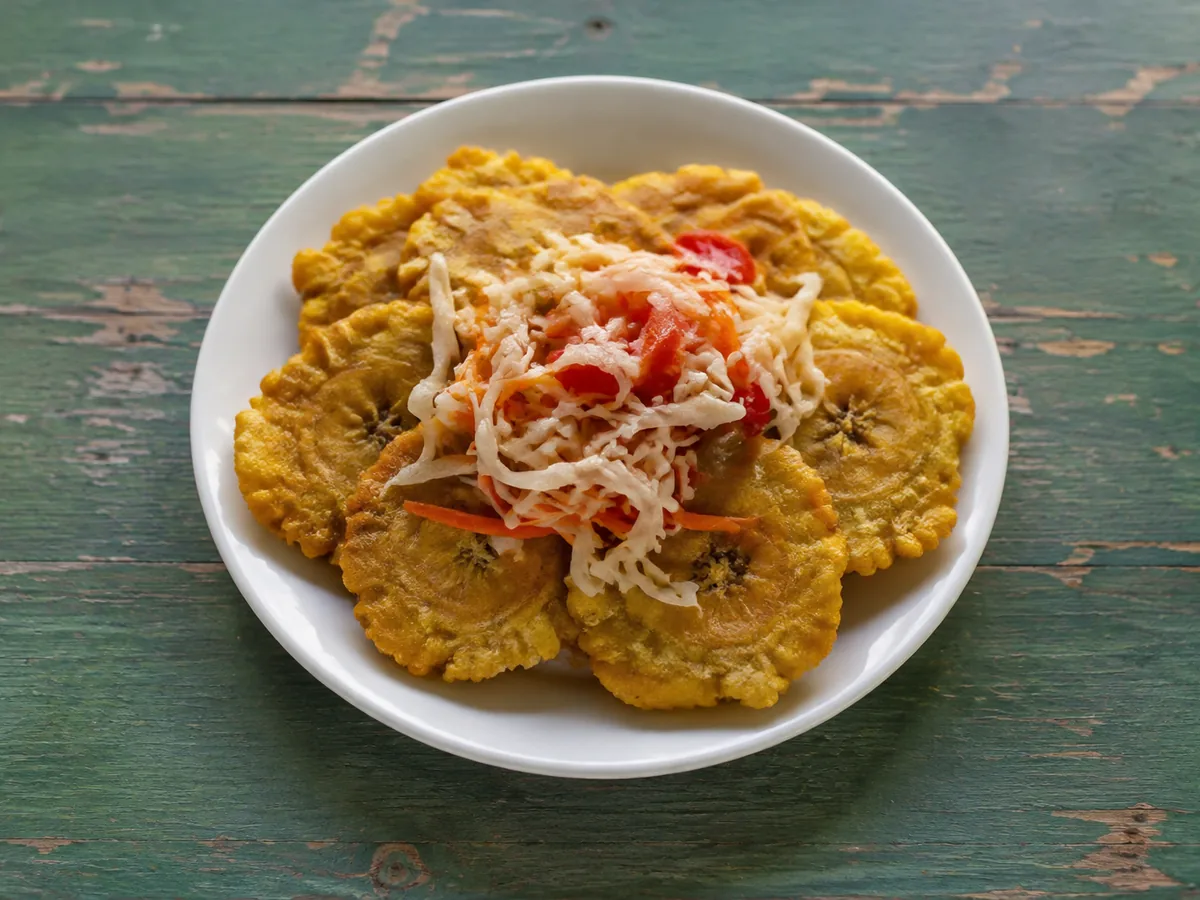
In Haiti no platter of griot, tassot or fried fish is complete without banan peze. Unlike sweet yellow plantains, it is made exclusively from unripened, rock-hard bannann vèt.
The plantains are sliced into thick rounds, soaked in salted garlic water, and fried gently until tender to the centre. Each piece is then smashed flat in a hinged wooden pezwa, dipped back into the garlic water for a heartbeat, and dropped into screaming-hot oil.
The exterior starches flash into a shatteringly crisp golden crust while the inside stays tender and fluffy — and then it is crowned with cold, fiery pikliz.
The plantains
- 1.2 kg4 largeUnripened green plantains (bannann vèt), rock-hard with dark green skins
The garlic salmuera
- 500 ml2.1 cupsCold filtered water
- 4 cloves4 clovesFresh garlic, crushed flat
- 15 g1 TbspFine sea salt, dissolved into the water
To fry and serve
- 1 L4.2 cupsHigh-smoke-point oil or lard
- 480 ml2 cupsSpicy Haitian pikliz
Green, and rock hard
Yellow or spotted plantains make sweet, limp, greasy fritters. Only unripened fruit has the raw un-gelatinised amylose the technique depends on.
Two temperatures, two jobs
The first fry at 160 °C gelatinises the interior starches so the dense tissue turns soft and pliable. The second at 190 °C does nothing to the inside — it is entirely about the crust.
Smash while steaming
Hot rounds flatten into broad discs with thin jagged borders. Left to cool first they shatter into crumbs under the press.
One second in the water
Long enough to leave a film and season the inside, short enough not to waterlog. Leave them submerged and the oil spits violently and the crust never forms.
The pikliz is the point
Cold vinegar-cured cabbage against hot starchy plantain. Without it this is a side dish; with it, it is the supreme Caribbean snack.
Passive time, counted separately
The cut rounds soak in the garlic water 15 minutes before the first fry. That sits outside the times quoted above.
The five tastes on this plate
Salt is the garlic salmuera drawn into the porous starch between fries. Fat is the frying oil crisping the exterior matrix. Acid is entirely the cold vinegar pikliz. Heat is garlic from the soak and Scotch bonnet from the slaw. Umami is caramelised plantain starch and toasted garlic.
Equipment
- Wide bowl, for the salmuera
- 12 in cast-iron skillet or deep fryer with an oil thermometer
- Plantain press (pezwa), tortilla press, or a flat-bottomed mug
- Tongs, spider skimmer and a wire rack
Traditionally a cast-aluminium chaudron with a hinged wooden pezwa. A 12-inch cast-iron skillet works in a modern kitchen, and a tortilla press, a small cutting board or the flat bottom of a heavy mug does the smashing perfectly well.
Method
Make the garlic salmuera3 min
Whisk the 500 ml cold water with the crushed garlic and 15 g salt until the salt has fully dissolved.
Whisk 500 ml cold water with the crushed garlic and 15 g salt until the salt dissolves completely.
Peel and cut10 min
Trim the ends, slit the thick green peel lengthwise in three places with a knife tip, and pull the skin away with your thumb.
Slice crosswise into thick 3 cm rounds and submerge in the garlic water 15 minutes. Drain and pat dry.
Trim the green plantains, slit each peel lengthwise in three places and remove it. Cut into 3 cm rounds; soak in the garlic water 15 minutes, then drain and pat dry.
First fry, at 160 °C8 min
Heat the oil to 160 °C and fry the rounds in batches 4 to 5 minutes, turning, until a knife glides into the centre with no resistance.
They should still be pale yellow with no browning at all. Onto a tray.
Heat oil to 160 °C. Fry in batches for 4–5 minutes, turning, until a knife enters the centre easily. Keep the rounds pale yellow without browning; transfer to a tray.
Smash7 min
While each round is still steaming hot, set it in the oiled press — or between two sheets of parchment — and press firmly into a disc 8 mm thick with thin jagged edges.
While still steaming hot, flatten each round in an oiled press or between parchment sheets to an 8 mm disc with thin, irregular edges.
Dip and flash fry7 min
Raise the oil to 190 °C. With tongs, dip each disc into the salmuera for strictly 1 second — it will hiss — and lower it straight into the oil.
Fry 90 to 120 seconds a side until the edges are blistered, golden-brown and shatteringly crisp.
Raise oil to 190 °C. Using tongs, dip each disc in salmuera for strictly 1 second and lower into the oil; expect hissing. Fry 90–120 seconds per side until blistered, golden-brown and crisp.
Drain and serve
Lift out with a spider onto a wire rack for a minute, salt if you like, and serve piping hot crowned with cold pikliz.
Drain on a wire rack for 1 minute, add salt if desired, and serve piping hot with cold pikliz on top.
Sensory cues of doneness
- Visual: a golden-yellow disc with jagged paper-thin browned edges and a pale tender centre.
- Auditory: a roaring sizzle as the dipped disc hits the oil, and a glass-like crunch when bitten.
- Olfactory: toasted plantain starch, garlic salmuera steam, clean hot oil and cane vinegar.
Look for golden-yellow discs with thin browned edges and pale, tender centres. The crust should crunch sharply, with aromas of toasted plantain, garlic and vinegar.
Storing it
The first fry and the smashing can be done up to 4 hours ahead. Keep the discs covered at room temperature and do the dip and second fry just before serving.
Troubleshooting
- Sweet, limp, greasy discs.
Ripe plantains were used. They must be rock-hard and green.
- They crumble under the press.
They cooled before smashing. Press them while steaming hot.
- Violent spattering and a soft crust.
They sat in the salmuera. One second only.
Substitutions
One-to-one global substitutions, with the technique adjustment each one requires.
Ingredient substitutions
| Ingredient | Replace with | Culinary impact and technique adjustment |
|---|---|---|
| Green plantains | No substitute | Only unripened green fruit has the structural starch this needs |
| Pezwa press | A flat-bottomed mug, or a heavy wooden board | A purely mechanical substitute — it works identically |
| Pikliz | Spicy escabeche, or a jalapeño slaw | Similar acidic heat, if not the same one |
Scaling
Half, for 2 to 3 portions
Halve everything in an 8-inch skillet.
Double, for 12 portions
Double everything, frying in batches of six so the oil holds 190 °C.
What to serve it with
- Griot de porc
- More pikliz, cold from the jar
- Tassot de cabrit
- A cold Prestige, or fresh passion fruit juice
Questions
What if I have no pezwa?
The flat bottom of a heavy mug, a small wooden board, or a tortilla press lined with plastic wrap all work.
Can they be made ahead?
Do the first fry and the smashing up to 4 hours ahead, then dip and do the second fry right before serving.
Why the salt-water dip?
The water flash-vaporises in the hot oil into microscopic crisp bubbles, and seasons the interior on the way.