Légume Haïtien
Do not be misled by the name — this is a rich, unctuous braise, not a light medley. The vegetables are steamed soft in the beef vapours, lifted out, and crushed by hand in a mortar. A blender would rupture every cell and give you watery purée; a pestle leaves the rustic texture the dish is built on.
- Prep
- 40 min
- Cook
- 2 hr
- Serves
- 8 hearty portions
- Difficulty
- Hard
Researched · Kitchen testing pending
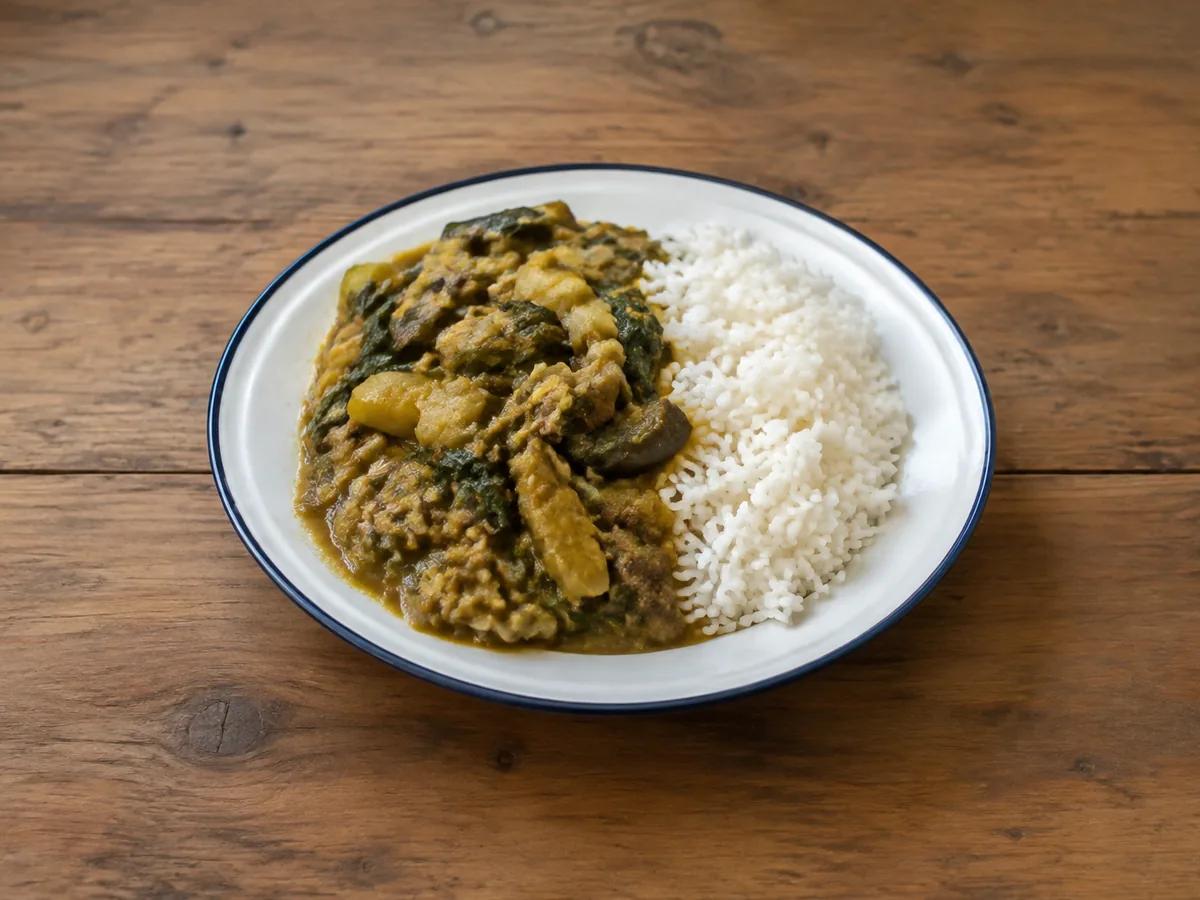
Légume Haïtien is the comforting soul of the Haitian home table, and the name undersells it badly. This is not a light vegetable medley but a rich, unctuous, slow-braised stew.
Purple eggplant, pale chayote, green cabbage, spinach and carrots are braised with seasoned beef chuck, oxtail, or blue crabs until completely soft. The vegetables are then lifted out, transferred to a wooden mortar, and crushed with a pestle into a thick rustic mash.
Returned to the meat juices with garlic-scallion épice and tomato paste, it simmers down into something deeply complex and velvety, served over white rice with cornmeal.
The meat
- 800 g1.76 lbBeef chuck or shank, cut into 4 cm chunks
- 400 g14 ozBeef oxtail or pork neck bones, for the gelatin base
- 60 ml4 TbspHaitian green épice
- 30 ml2 TbspBitter Seville orange juice, or lime juice
- 45 ml3 TbspNeutral vegetable oil or butter
The vegetables
- 600 g2 largeGlobe eggplants, peeled and cut into 4 cm cubes
- 500 g2 mediumChayote squash (mirliton), peeled, cored and cut into 4 cm cubes
- 400 g½ headGreen cabbage, chopped into coarse chunks
- 300 g4 cups packedFresh spinach or watercress (kreson), washed
- 250 g2 largeCarrots, peeled and cut into 2 cm coins
The pot
- 1 large1 largeYellow onion, finely diced
- 6 cloves6 clovesFresh garlic, minced to a paste
- 45 g3 TbspTomato paste
- 4 whole4 wholeWhole cloves, ground
- 6 g1.5 tspCumin seeds, toasted and ground
- 3 g1 TbspDried wild oregano
- 18 g1 Tbsp + 1 tspFine sea saltdivided between the meat and the mash
- 3 g1 tspFreshly ground black pepper
- 1 whole1 wholeScotch bonnet pepper, unpunctured with the stem on
- 500 ml2.1 cupsRich beef stock, or water
Crush, never blend
Eggplant and chayote are over 90% water behind pectin walls. A pestle ruptures those walls enough to release body while leaving small visible chunks. A blender liberates all the water at once and gives you baby food.
The vegetables steam, not boil
Layered on top of the simmering beef under a tight lid, they collapse in the rising vapours rather than sitting in liquid — which is why they concentrate instead of leaching.
The uncovered simmer is the dish
Twenty-five to thirty minutes with the lid off drives out the free vegetable water so the pectins and the beef gelatin can emulsify into a thick glossy stew. Skip it and you have soup.
Handle the pepper gently
It is easy to tear the Scotch bonnet while fishing the vegetables out. Do it carefully — one puncture floods the whole pot.
The oxtail is structural
Its collagen is what supplies the gelatin half of the emulsion. Pork neck bones do the same job.
Passive time, counted separately
The finished pot rests 10 minutes off the heat. That sits outside the times quoted above.
The five tastes on this plate
Salt seasons the braised beef and penetrates the mash. Richness comes from gelatin released from oxtail collagen, along with marrow and oil coating the vegetable fibres. Acid is tomato paste and sweet chayote against the beef fat. Heat is garlic, black pepper, toasted cumin and the floating Scotch bonnet. Umami is beef fond, oxtail gelatin and concentrated cooked eggplant.
Equipment
- 7 to 8 qt enamelled cast-iron Dutch oven
- Wooden mortar and pestle, or a sturdy potato masher and wide bowl
- Slotted spoon
- Wooden paddle
Traditionally a cast-aluminium chaudron with a wooden pilon. A 7-to-8 quart Dutch oven and a sturdy hand masher works in a modern kitchen — the one tool you must not reach for is the blender.
Method
Season and brown the meat55 min
Season the chuck and oxtail with the sour orange juice, the épice, ground cloves, black pepper and 10 g salt.
Sear in the oil over medium-high 8 minutes until browned, add the onion and garlic for 3 minutes, then pour in the 500 ml stock, cover, and simmer 45 minutes.
Season chuck and oxtail with sour orange, épice, cloves, pepper and 10 g salt. Sear in oil over medium-high 8 minutes. Add onion and garlic for 3 minutes, then 500 ml stock; cover and simmer 45 minutes.
Vegetables on top40 min
Layer the eggplant, chayote, cabbage, carrot and spinach directly over the simmering beef and rest the whole unbroken Scotch bonnet on top.
Cover tightly and simmer over medium-low 35 to 40 minutes — the vegetables collapse and steam tender in the rising beef vapours.
Layer eggplant, chayote, cabbage, carrot and spinach over the simmering beef; place the intact Scotch bonnet on top. Cover tightly and simmer over medium-low 35–40 minutes until the vegetables collapse and steam tender.
Mash by hand15 min
Lift the soft eggplant, chayote, cabbage and carrot out with a slotted spoon into a wide bowl or wooden mortar, leaving the beef, the broth and the intact pepper in the pot.
Crush with a pestle or masher into a coarse rustic mash with small visible chunks. No blender.
Carefully lift soft eggplant, chayote, cabbage and carrot into a bowl, leaving beef, broth and intact pepper in the pot. Mash by hand, retaining small chunks; do not blend or puncture the pepper.
Simmer down30 min
Stir the tomato paste, cumin, oregano and remaining salt into the pot, then return the mash and stir it thoroughly through the beef and juices.
Simmer uncovered over medium-low 25 to 30 minutes, stirring often with a wooden paddle, until the liquid has gone and the stew is thick, dark and glossy.
Stir tomato paste, cumin, oregano and remaining salt into the pot; return and combine the mash. Simmer uncovered over medium-low 25–30 minutes, stirring often, until thick, dark and glossy with no loose liquid.
Finish
Discard the Scotch bonnet and check the beef is fork-tender at 93–96 °C.
Rest 10 minutes off the heat, then ladle over white rice.
Discard the Scotch bonnet and check that the beef is fork-tender at 93–96 °C. Rest off heat 10 minutes, then serve over white rice.
Sensory cues of doneness
- Visual: a thick dark bronze-green rustic mash studded with tender beef, with no separated watery liquid anywhere.
- Auditory: thick slow bubbling as the mash concentrates.
- Olfactory: stewed eggplant, sweet cabbage, roasted garlic, clove, beef marrow and wild thyme.
Check for a thick bronze-green mash with tender beef and no separated water. It should bubble slowly and thickly, smelling of cooked eggplant, cabbage, garlic, cloves and beef marrow.
Storing it
Better the next day as the eggplant and beef equilibrate. Reheat gently in a skillet on low.
Troubleshooting
- A smooth, baby-food texture.
An electric blender was used. Crush by hand and keep visible chunks.
- A watery stew.
The uncovered simmer was skipped. Cook until the liquid has gone and it is unctuous.
- Blistering heat throughout.
The Scotch bonnet was torn while lifting the vegetables out. Handle it gently.
Substitutions
One-to-one global substitutions, with the technique adjustment each one requires.
Ingredient substitutions
| Ingredient | Replace with | Culinary impact and technique adjustment |
|---|---|---|
| Chayote (mirliton) | Zucchini, or yellow summer squash | One-to-one, simmered tender the same way |
| Watercress | Collard greens, Swiss chard, or lacinato kale | One-to-one for the greens |
| Beef chuck and oxtail | Pork shoulder with blue crabs | One-to-one, and an excellent traditional seafood variation |
Scaling
Half, for 4 portions
Halve everything in a 4-quart Dutch oven. Every timing is unchanged.
Double, for 16 portions
Double everything in a 14-quart stockpot, mashing the vegetables in two batches.
What to serve it with
- Diri blan ak sos pwa — white rice under a silky bean sauce
- Mayi moulen, the savoury coarse cornmeal
- Banan peze
- A chilled Prestige, or creamy jus de corossol
Questions
Can crab or pork go in?
Yes. Blue crabs and smoked pork belly are both traditional, simmered straight in with the beef.
What if I cannot find chayote?
Zucchini or peeled butternut squash substitutes one-to-one.
Does it keep?
It is better the next day. Reheat gently in a skillet.