Tassot de Cabrit
Griot's rugged cousin. Goat muscle is dense, lean and barely marbled, so it gets ninety gentle minutes to turn its cross-linked collagen into gelatin — and then strictly three to four minutes in the oil, because anything longer drives the moisture back out of meat that had almost none to begin with.
- Prep
- 30 min
- Cook
- 1 hr 42 min
- Serves
- 6 portions
- Difficulty
- Hard
Researched · Kitchen testing pending
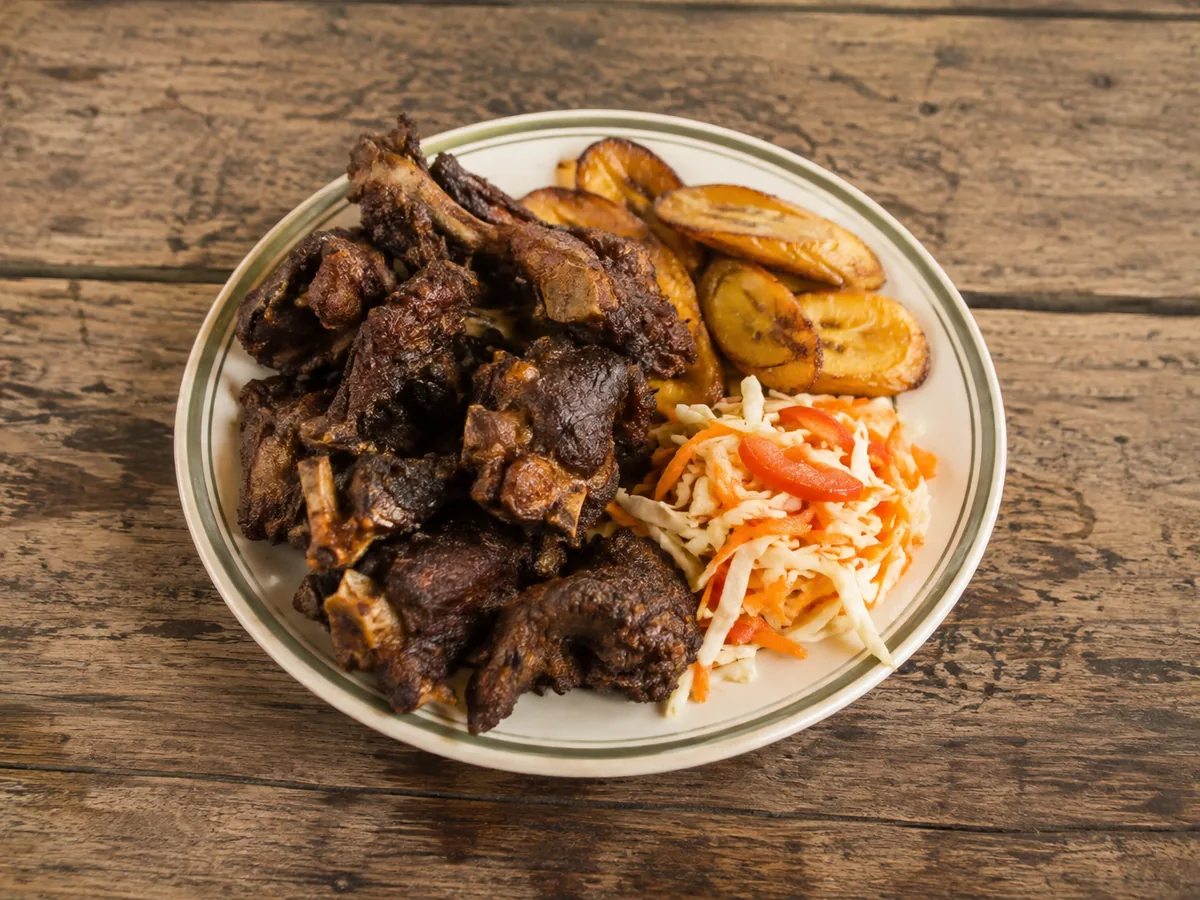
Tassot de cabrit is the rugged, deeply savoury cousin of griot, made from goat and reflecting Haiti’s pastoral traditions.
Goat has a lean muscular texture and a distinctly grassy flavour that demands aggressive seasoning. The meat is cut into chunks, washed with cut limes and sour oranges, and marinated overnight in green épice, garlic, shallot, thyme and Scotch bonnet. It is braised gently in its own juices until meltingly tender.
The cooked morsels are then flash-fried until the outside is dark bronze and crackling while the inside stays tender and gamey, and served with hot banan peze and cold pikliz.
The goat
- 1.8 kg4 lbBone-in goat shoulder or leg, chopped through the bone into 5 cm pieces
The wash and marinade
- 3 large3 largeBitter Seville oranges, halved, or 2 sweet oranges with 2 limes
- 3 large3 largeFresh limes, halved, for scouring the meat
- 120 ml½ cupHaitian green épice — scallion, garlic, parsley, thyme, shallot and sweet pepper
- 6 cloves6 clovesFresh garlic, crushed to a paste
- 8 g2 tspCumin seeds, freshly toasted and ground
- 4 g1.5 TbspDried wild oregano, crushed
- 4 whole4 wholeWhole cloves, ground
- 15 g1 TbspFine sea salt
- 4 g1 tspFreshly ground black pepper
The braise
- 300 ml1.25 cupsCold filtered water
- 4 sprigs4 sprigsFresh thyme
- 1 whole1 wholeScotch bonnet pepper, pierced once with a knife tip
To fry
- 1 L4.2 cupsHigh-smoke-point oil or lard
Braise before you fry
Frying raw marinated goat produces something rock-hard and inedible. The braise is not a shortcut step — it is where the collagen becomes gelatin.
Why the citrus wash
Goat is lean, muscular and distinctly grassy. Scrubbing with lime and sour orange and then marinating in the juice weakens the exterior collagen sheaths so the épice can get in over twelve hours.
Bone-dry before the oil
Fifteen minutes of air-drying after the paper towels. Wet meat spatters and steams its own crust soft.
Three to four minutes, no more
Past four minutes at 185 °C the internal moisture is driven out and lean goat toughens. Fast and hot is the whole technique.
Pierce the pepper once
Unlike the soup, here a single knife-tip pierce is wanted — enough heat to season a braise this aggressive, without emptying the pepper into it.
Passive time, counted separately
The goat marinates 12 to 24 hours and air-dries 15 minutes after braising. Neither is active work.
The five tastes on this plate
Salt seasons the lean muscle through the long marinade. Fat is frying oil and goat tallow crisping the crust. Acid is the sour orange and lime wash, answered by the vinegar in the pikliz. Heat is Scotch bonnet, raw garlic, black pepper and toasted cumin. Umami is bone marrow, simmered collagen fond and the allium épice.
Equipment
- 6 to 7 qt enamelled cast-iron Dutch oven
- 12 in cast-iron skillet or pot with a deep-fry thermometer
- Baking sheet and paper towel
- Wire rack and tongs
Traditionally a heavy cast-aluminium chaudron over charcoal. A 6-to-7 quart Dutch oven for the braise and a thermometer-fitted cast-iron pan for the fry works in a modern kitchen.
Method
Scrub and marinate15 min
Scrub the goat vigorously with cut limes, sour orange halves and coarse salt, rinse with hot water and drain thoroughly.
Toss with the épice, sour orange juice, garlic paste, cumin, oregano, ground cloves, black pepper and the 15 g salt, massaging it in. Cover and refrigerate 12 to 24 hours.
Scrub goat with lime, sour orange halves and coarse salt; rinse hot and drain well. Massage with épice, sour orange juice, garlic, cumin, oregano, ground cloves, pepper and 15 g salt. Cover and refrigerate 12–24 hours.
Braise tender1 hr 30 min
Tip the goat and all its marinade into the Dutch oven with the 300 ml water, the thyme and the pierced Scotch bonnet.
Boil, drop to medium-low, cover with the lid slightly ajar, and simmer 1 hour 15 minutes to 1 hour 30 minutes until fork-tender at 90–93 °C and the liquid has reduced to a thick glaze.
Combine goat and marinade with 300 ml water, thyme and Scotch bonnet pierced once. Boil, reduce to medium-low and simmer with lid slightly ajar 1¼–1½ hours at 90–93 °C, until fork-tender and the liquid becomes a thick glaze.
Dry the pieces5 min
Lift the goat onto a paper-towel-lined tray, shake off loose herbs, and pat every surface completely dry.
Air-dry 15 minutes — this is not optional.
Lift goat onto a paper-towel-lined tray and shake off loose herbs. Pat every surface completely dry, then air-dry for 15 minutes; do not skip drying before frying.
Flash fry12 min
Heat the oil to 185 °C and fry in two batches, strictly 3 to 4 minutes, turning with tongs, until deep golden-bronze and crisp.
Drain on a wire rack 2 minutes.
Heat oil to 185 °C. Fry in two batches for strictly 3–4 minutes each, turning with tongs, until deeply golden-bronze and crisp. Drain on a wire rack 2 minutes.
Plate
Heap the hot tassot onto platters and serve immediately with banan peze and cold pikliz.
Heap the hot tassot onto platters and serve immediately with banan peze and cold pikliz.
Sensory cues of doneness
- Visual: dark golden-brown nuggets with caramelised edges, the meat pulling cleanly off the bone.
- Auditory: a fierce high-pitched crackle as the dry goat hits the oil, and a crisp crunch when bitten.
- Olfactory: roasted game, fried garlic, sour orange, toasted cumin and clove.
Look for dark golden-brown pieces with caramelised edges and meat pulling cleanly from the bone. The crust should crunch, with aromas of roasted goat, fried garlic, sour orange, cumin and clove.
Troubleshooting
- Rock-hard, inedible meat.
It was fried without being braised. Goat must be tender before it meets oil.
- A soft crust and a spattering pan.
The meat was wet. Pat dry and air-dry 15 minutes.
- Dry, tough nuggets.
They fried too long. Three to four minutes at high heat.
Substitutions
One-to-one global substitutions, with the technique adjustment each one requires.
Ingredient substitutions
| Ingredient | Replace with | Culinary impact and technique adjustment |
|---|---|---|
| Goat (cabrit) | Bone-in lamb shoulder, or beef chuck | One-to-one in 5 cm chunks, with the same braise and fry timings |
| Bitter Seville orange | Equal parts fresh orange and lime juice | One-to-one. The same acidity |
| Scotch bonnet | Habanero | One-to-one. The same floral heat |
Scaling
Half, for 3 portions
Halve everything in a 4-quart pot. The braise stays 1 hour 15 minutes.
Double, for 12 portions
Double everything in a 12-quart pot, frying in four batches so the oil holds 185 °C.
What to serve it with
- Pikliz, cold and sharp
- Banan peze
- Diri ak pwa wouj
- A chilled Prestige, or a Barbancourt rum punch with lime and nutmeg
Questions
Can I use lamb?
Yes. Bone-in lamb shoulder in 5 cm chunks works outstandingly, with identical braise and fry timings.
Can it be made with beef?
Yes — that is tassot bœuf, with chuck or flank cut into 5 cm chunks, braised tender and fried crisp.
Air fryer?
Yes. Spray the braised dry cubes with oil and air-fry at 200 °C for 8 to 10 minutes.