Cook-up Rice
The Saturday night and Old Year's Night pot. Parboiled rice simmered in thick coconut milk with salt beef, smoked pigtail, chicken, black-eyed peas and split peas, thyme and a single whole wiri wiri, sealed under foil and steamed until the grains glisten and the cured meats have seasoned the whole pot.
- Prep
- 30 min
- Cook
- 1 hr 15 min
- Serves
- 8
- Difficulty
- Medium
Researched · Kitchen testing pending
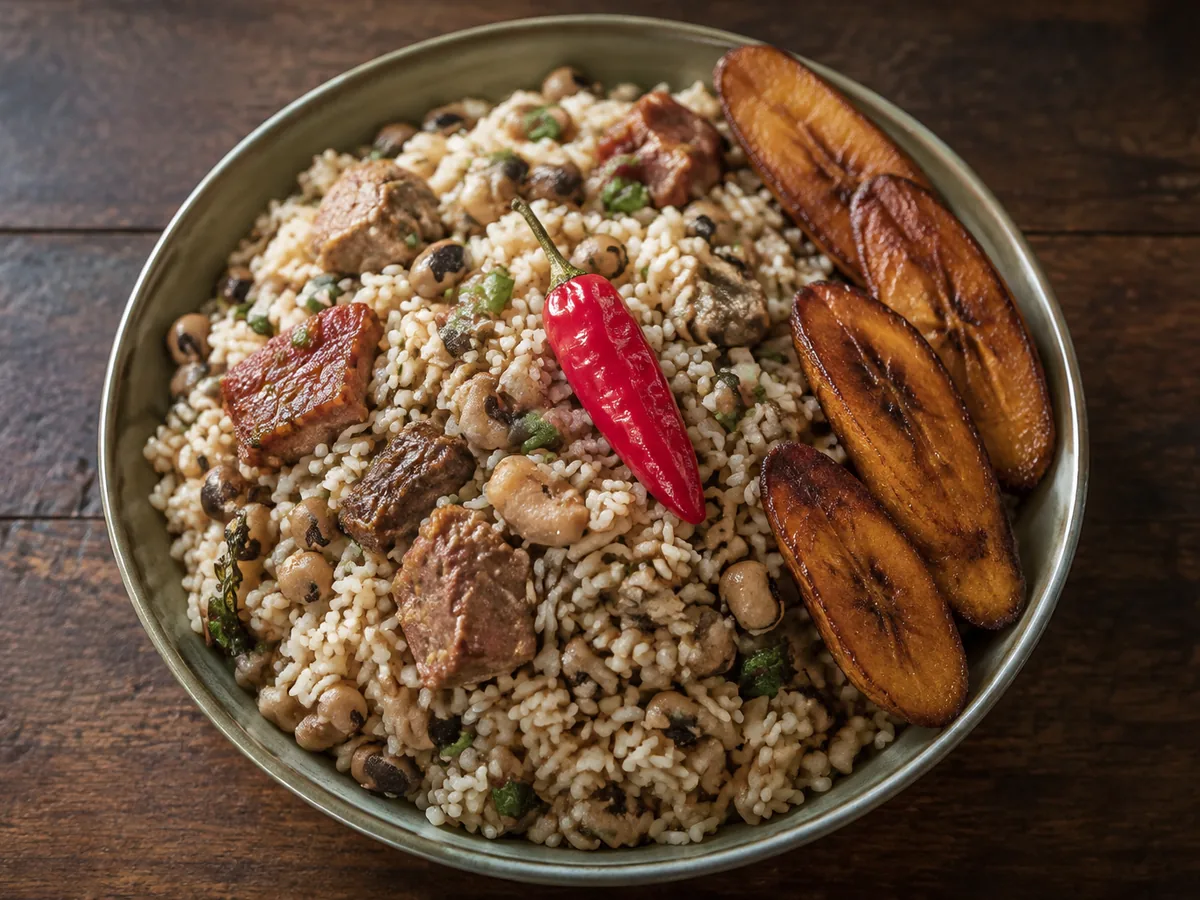
Cook-up rice is Guyana’s Saturday night pot and its Old Year’s Night staple, born on the plantations where field workers put their weekend rations, salted beef, pickled pork, backyard coconut milk and peas, into one pot with local rice.
It sits somewhere between separate grains and a creamy, wet richness. Thick first-press coconut milk coats every grain and pea, balancing the salt of the cured meats and the perfume of broad-leaf thyme, all under the steam of a single whole wiri wiri.
Meats and peas
- 350 g¾ lbSalted beef brisket, soaked overnight and cut into 3 cm cubes
- 350 g¾ lbSmoked pigtail or smoked ham hock, soaked and cut into 2 cm joints
- 400 g0.9 lbBoneless, skinless chicken thighs, in 3 cm chunks
- 250 g1¼ cups driedDried black-eyed peas, soaked overnightor two cans, drained
- 100 g½ cupYellow split peas, rinsed
Rice and liquid
- 500 g2½ cupsParboiled long-grain rice, washed until the water runs clear
- 600 ml2½ cupsThick coconut milk, first press or full-fat canned
- 700 ml3 cupsUnsalted chicken stock or water
Aromatics
- 1 large1 largeYellow onion, finely diced
- 4 stalks4 stalksScallions, sliced, whites and greens separated
- 5 cloves5 clovesGarlic, minced
- 4 sprigs4 sprigsBroad-leaf thyme, leaves stripped
- 1 whole1 wholeWiri wiri pepper, whole with stem
- 30 ml2 TbspVegetable oil
- 3 g1 tspFreshly cracked black pepper
- to tasteto tasteFine sea saltonly at the end, after tasting the cured meats
Parboiled rice, and why
Coconut milk is rich in lauric acid, and its fat coats every grain as the starch swells at 95 °C. That coating limits how much water gets in, and parboiled rice, with its already-set starch mantle, holds together under it. Plain long-grain blows out into mush.
Desalting the meats
Salt beef and pigtail carry up to a tenth of their weight in salt. An overnight soak and a twenty-minute boil pull most of it out. Skip that and the rice absorbs it all.
The five tastes on this plate
Salt is the cured beef and pigtail, and nothing added until the end. Richness comes from coconut milk and gelatin released from the pigtail's collagen. Acid is the gentle sweetness of cooked scallion against the coconut. Heat is one whole pepper and black pepper. Umami is salt beef, smoked pork and chicken fond.
Equipment
- 6-quart heavy Dutch oven or wide rondeau with a tight lid
- Medium saucepan, for desalting
- Parchment or foil, to seal under the lid
A cast-aluminium Guyanese caldero with a curved base spreads heat up the sides. A heavy Dutch oven does the same; the tight seal is what matters.
Method
Desalt the cured meats20 min
Cover the salt beef and pigtail with cold water in a saucepan, bring to a rolling boil, and cook 20 minutes. Drain, rinse under cold water, and set aside.
After soaking the salt beef and pigtail overnight, cover with fresh cold water. Boil hard 20 minutes; drain, rinse under cold water and reserve.
Par-cook the peas25 min
In a separate pot, cover the soaked black-eyed peas and the split peas with a litre of fresh water and simmer 25 minutes until tender to the bite but not mushy. Drain.
In a separate pot, cover the soaked black-eyed peas and the split peas with a litre of fresh water and simmer 25 minutes until tender to the bite but not mushy. Drain.
Brown the chicken6 min
Heat the oil in the Dutch oven over medium-high and sear the chicken 5 to 6 minutes until golden fond forms. Lift out.
Heat the oil in the Dutch oven over medium-high and sear the chicken 5 to 6 minutes until golden fond forms. Lift out.
Sweat the aromatics4 min
In the same oil, sweat the onion, scallion whites, garlic and thyme over medium heat 4 minutes until translucent and fragrant.
In the same oil, sweat the onion, scallion whites, garlic and thyme over medium heat 4 minutes until translucent and fragrant.
Combine and toast the rice4 min
Return the chicken, salt beef and pigtail, add the peas, and stir 2 minutes. Add the washed rice and stir 2 minutes more to coat the grains in the pan fat.
Return the chicken, salt beef and pigtail, add the peas, and stir 2 minutes. Add the washed rice and stir 2 minutes more to coat the grains in the pan fat.
Add the liquids and the pepper8 min
Pour in the coconut milk and stock, season with black pepper and no salt, and set the whole wiri wiri on top. Boil uncovered over medium-high 6 to 8 minutes until the liquid drops to the level of the rice.
Pour in the coconut milk and stock, season with black pepper and no salt, and set the whole wiri wiri on top. Boil uncovered over medium-high 6 to 8 minutes until the liquid drops to the level of the rice.
Seal and steam30 min
Reduce to the lowest heat. Lay parchment or foil over the pot and clamp the lid on. Steam undisturbed 25 to 30 minutes.
Reduce to the lowest heat. Lay parchment or foil over the pot and clamp the lid on. Steam undisturbed 25 to 30 minutes.
Check, fold and rest12 min
Uncover. The liquid should be absorbed and the grains tender and glossy with coconut. Taste, and salt only if the cured meats left it short. Fold in the scallion greens without breaking the pepper, cover, and rest 10 minutes before serving with fried plantains.
Check liquid is absorbed and rice is tender and glossy. Taste before adding salt. Gently fold in scallion greens, keeping the pepper intact; cover and rest 10 minutes. Serve with fried plantains.
Sensory cues of doneness
- Visual: glistening golden-taupe rice clinging to plump black-eyed peas, mahogany beef and pink pigtail, flecked with scallion.
- Auditory: a thick, gentle bubble with hollow pops as the coconut cream reduces to oil at the pot's edge.
- Olfactory: sweet coconut, smoky pork fat, crushed thyme and alliums.
Look for glossy golden-taupe rice, plump peas, mahogany beef and pink pigtail flecked with scallion. Expect gentle thick bubbling with hollow pops and aromas of coconut, smoked pork, thyme and alliums.
Troubleshooting
- Mushy, broken rice.
Regular long-grain rice. Parboiled rice is what survives coconut fat.
- An oversalted pot.
Salt added early, or the meats were not boiled. Taste in the last five minutes before adding any salt.
- Greasy pools and white curds.
The coconut milk boiled hard under the lid and split. Keep the covered stage at a low, steady simmer.
Substitutions
One-to-one swaps, with the technique change each one needs.
Ingredient substitutions
| Ingredient | Replace with | Culinary impact and technique adjustment |
|---|---|---|
| Smoked pigtail | Smoked pork neck bones, smoked turkey wings or smoked slab bacon | One-to-one |
| Wiri wiri pepper | Whole habanero or Scotch bonnet, unpierced | One-to-one |
| Salt beef | Corned beef brisket soaked 12 hours in fresh water | One-to-one |
Scaling
Half, for 4
Halve everything with 300 ml coconut milk and 350 ml stock in a 4-quart pot. Steaming stays at 25 minutes.
Double, for 16
Double the meats and aromatics but cut the combined liquid by about 15 percent, 1 litre coconut milk and 1.2 litres stock, so the big pot does not pool.
What to serve it with
- Sweet fried ripe plantains
- Shredded cabbage and cucumber salad dressed with lime
- Banks lager, or mauby over crushed ice
Questions
What is the difference between dry and wet cook-up?
Dry is a pilaf with separate grains. Wet is looser and creamier, closer to risotto, with an extra 150 ml stock stirred in toward the end.
Can it be vegetarian?
Yes. Ital cook-up drops the meats, doubles the peas, and often adds pumpkin, okra and soy chunks.
Why two kinds of peas?
Black-eyed peas keep their bite and shape. The split peas break down and thicken the coconut liquid.