Pepperpot
The national dish and the Christmas morning pot. Beef chuck, oxtail and trotters simmered for three hours in cassareep, the black bittersweet reduction of bitter cassava juice, with cinnamon, clove, wild thyme and whole wiri wiri peppers floated unbroken on top. Better the next day, and the day after.
- Prep
- 45 min
- Cook
- 3 hr 30 min
- Serves
- 8 to 10
- Difficulty
- Hard
Researched · Kitchen testing pending
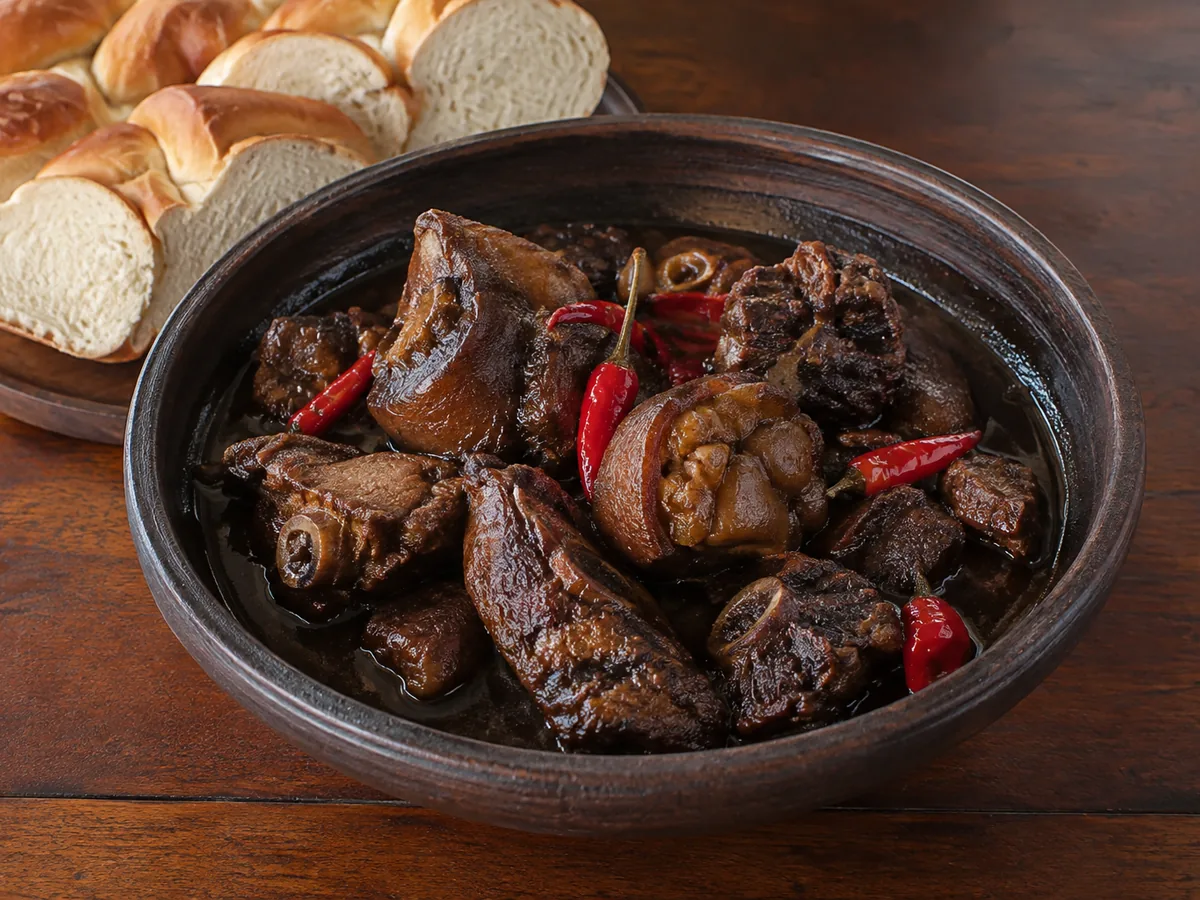
Pepperpot is Guyana’s national dish and it begins with the Lokono and Kalina peoples of the interior, who learned to boil the poison out of bitter cassava juice and reduce it to cassareep, a black, sticky, bittersweet syrup that flavours and preserves at once. Hunting parties kept a pot going for weeks over open fires.
It became the Christmas morning tradition of every community in the country. Families make it days ahead, and each daily boil deepens it as oxtail, cow heel, trotters and chuck melt into a glossy black liquor with wiri wiri, cinnamon, clove and broad-leaf thyme. It is eaten with thick slices of hand-kneaded plait bread to catch the sauce.
Meats
- 900 g2 lbBeef chuck, trimmed and cut into 5 cm cubes
- 700 g1½ lbBeef oxtail, cut through the joints into 4 cm rounds
- 700 g1½ lbPork trotters or cow heel, split and cut into 5 cm chunks
- 120 ml½ cupWhite cane vinegar, for the initial wash only
Pot
- 240 ml1 cupPure Guyanese cassareep
- 8 whole8 wholeWiri wiri peppers, whole with stems, skins unbroken
- 2 sticks2 sticksCeylon cinnamon quills
- 6 whole6 wholeCloves
- 6 sprigs6 sprigsBroad-leaf thyme, bruised
- 8 sprigs8 sprigsFine-leaf thyme
- 8 cloves8 clovesGarlic, crushed to a paste with salt
- 1 medium1 mediumYellow onion, finely grated
- 45 g3 TbspDemerara sugar
- 18 g1 TbspCoarse sea salt
- 1.8 L7½ cupsBoiling water, enough to submerge the meat
What cassareep is
Bitter cassava juice carries cyanogenic glycosides. Hours of boiling drive the cyanide off as gas and leave a sterile, dark syrup dense with sugars, phenolics and organic acids. Cassareep does not make room-temperature storage safe. Divide pepperpot into shallow containers and refrigerate within 2 hours, or 1 hour above 32 °C; daily boiling does not replace refrigeration.
Why trotters
Lean beef has nowhere near enough collagen. Trotters and cow heel give up gelatin over three hours, and that gelatin is what turns cassareep and water into a glossy, lip-coating gravy.
Keep it under a boil
Between 88 and 93 °C the collagen converts and the meat stays moist. Boiled hard, the chuck contracts and dries out before the collagen has finished.
The five tastes on this plate
Salt is sea salt against Demerara sugar and the bitter cassareep. Fat is marrow and the gelatin of oxtail and trotters. Acid is the mild organic acid in the cassava juice, with no citrus. Heat is the whole peppers' aroma without their seeds. Umami is cassareep and long-simmered connective tissue.
Equipment
- 6 to 8-quart enamelled cast-iron Dutch oven with a heavy lid
- Wide metal spoon, for skimming
- Two-pronged fork
The Amerindian pot is an unglazed earthenware canari that holds a steady gentle heat. Use enamelled cast iron, never bare aluminium: the tannins in cassareep react with it and dull the colour.
Method
Wash and season the meats50 min
Rinse the chuck, oxtail and trotters in cold water with the vinegar. Drain, pat dry, and check the bones for loose fragments. In a non-reactive bowl rub the meat with the garlic paste, grated onion, both thymes and the salt, and leave 45 minutes at cool room temperature.
Rinse chuck, oxtail and trotters in cold water with vinegar; drain and dry. Check for bone fragments. In a non-reactive bowl, rub with garlic paste, grated onion, both thymes and salt. Leave 45 minutes at cool room temperature.
Coat in cassareep5 min
Tip the meat and every scrap of seasoning into the Dutch oven. Do not brown it; the dish relies on water and cassareep alone. Pour the cassareep over and stir until every surface is glazed dark and sticky.
Tip the meat and every scrap of seasoning into the Dutch oven. Do not brown it; the dish relies on water and cassareep alone. Pour the cassareep over and stir until every surface is glazed dark and sticky.
Add the spice and water5 min
Add the Demerara sugar, cinnamon and cloves, then enough boiling water to submerge everything.
Add the Demerara sugar, cinnamon and cloves, then enough boiling water to submerge everything.
Boil and skim15 min
Bring to a vigorous boil over medium-high heat and boil 15 minutes, skimming the grey scum as it rises.
Bring to a vigorous boil over medium-high heat and boil 15 minutes, skimming the grey scum as it rises.
Float the peppers and simmer low3 hr
Set the eight whole wiri wiri on the surface, checking each skin is intact. Turn the heat to its lowest, cover tightly, and simmer at 88 to 92 °C for 3 hours, checking every 45 minutes that it is only trembling.
Set the eight whole wiri wiri on the surface, checking each skin is intact. Turn the heat to its lowest, cover tightly, and simmer at 88 to 92 °C for 3 hours, checking every 45 minutes that it is only trembling.
Test and reduce30 min
At three hours the chuck and oxtail should be fork-tender and the trotter skin gelatinous. Uncover and simmer over medium-low 20 to 30 minutes to reduce the liquid to a glossy, viscous sauce. Taste: it should balance bittersweet molasses, gelatin and warm spice. Adjust with a pinch of salt or a teaspoon more sugar if bitterness leads.
After 3 hours, check chuck and oxtail are fork-tender and trotter skin gelatinous. Uncover; reduce on medium-low 20–30 minutes until glossy and viscous. Taste for bittersweet, gelatin-rich spice; add a pinch of salt or teaspoon of sugar if too bitter.
Rest overnight and serve
For an overnight rest, divide the pepperpot into shallow containers and refrigerate promptly as described below. Rest it in the refrigerator, not on the counter, while the cassareep flavours the centre of the meat. To serve, bring it back to a gentle boil for 10 minutes and ladle meat and black gravy into wide bowls with an unbroken pepper on top.
For overnight resting, promptly refrigerate in shallow containers; never rest on the counter. To serve, return to a gentle boil for 10 minutes, then ladle meat and black gravy into wide bowls with a whole pepper.
Sensory cues of doneness
- Visual: an inky, glossy broth that coats the back of a spoon, meat pulling cleanly from the bones, whole red peppers bobbing unbroken.
- Auditory: a slow, thick plop-plop under the lid rather than watery splashing.
- Olfactory: bittersweet molasses, cinnamon, clove, wild thyme and roasted marrow.
Look for glossy black broth coating a spoon, meat releasing from bones and unbroken peppers. Keep a slow, thick bubbling under the lid; expect bittersweet molasses, cinnamon, cloves, thyme and marrow aromas.
Storing it
Divide leftovers into shallow containers and refrigerate within 2 hours, or within 1 hour above 32 °C / 90 °F. Keep for 3–4 days in the refrigerator or freeze for longer storage. Reheat to 74 °C / 165 °F. See [USDA leftover-storage guidance](https://www.fsis.usda.gov/food-safety/safe-food-handling-and-preparation/food-safety-basics/leftovers-and-food-safety).
Troubleshooting
- A searing, painful pot instead of a warm one.
A pepper burst. Handle them by the stem, check for cracks, and never stir them under.
- Thin, cloying sauce.
Imitation cassareep cut with corn syrup or burnt sugar. Use pure bitter cassava cassareep from Guyana.
- The sauce curdled and the meat stalled.
Lime or vinegar went into the pot. Acid is for the raw meat wash only, and it is rinsed away.
Substitutions
One-to-one swaps, with the technique change each one needs.
Ingredient substitutions
| Ingredient | Replace with | Culinary impact and technique adjustment |
|---|---|---|
| Guyanese cassareep | 200 ml pomegranate molasses, 40 ml blackstrap molasses and 1 tsp Worcestershire | There is no true match; this is the emergency approximation |
| Wiri wiri peppers | Whole Scotch bonnet or habanero, strictly intact | Same rule, never pierce them |
| Pork trotters | Smoked pork hocks, split cow heel or marrow bones | One-to-one. The collagen is the point |
Scaling
Half, for 4 to 5
Halve the meat, cassareep and water. Time stays at 2½ to 3 hours; collagen follows temperature, not volume.
Double
Double the meats and aromatics with 400 ml cassareep and 3.2 litres water, in a pot wide enough to reduce.
What to serve it with
- Thick warm slices of plait bread, or tennis rolls, for the gravy
- Steamed sweet cassava wedges
- El Dorado 12-year rum neat with a drop of water, or cold ginger beer
Questions
Can it really sit out without spoiling?
No. Do not use cassareep or daily reboiling as a home-preservation method. Follow the refrigeration limits above. Discard leftovers kept at room temperature beyond those limits; reheating does not reliably make them safe.
Why are trotters or cow heel mandatory?
They release the gelatin that turns the braising liquid into pepperpot's velvety, lip-coating gravy. Lean beef alone cannot.
Can I use Scotch bonnet instead of wiri wiri?
Yes, kept strictly whole. Wiri wiri is rounder and brighter, almost tomato-like; Scotch bonnet is more tropical fruit.