Chicken Curry with Dhalpuri Roti
Indo-Guyanese Sunday cooking. A wet paste of curry powder, roasted geera, turmeric and garlic is fried in hot oil until the water is gone and the oil splits out, the bunjal, before the chicken and potatoes go in. Alongside, a split-pea-stuffed flatbread rolled paper-thin, puffed on a hot tawa and clapped between the hands.
- Prep
- 50 min
- Cook
- 50 min
- Serves
- 6, with 6 large rotis
- Difficulty
- Hard
Researched · Kitchen testing pending
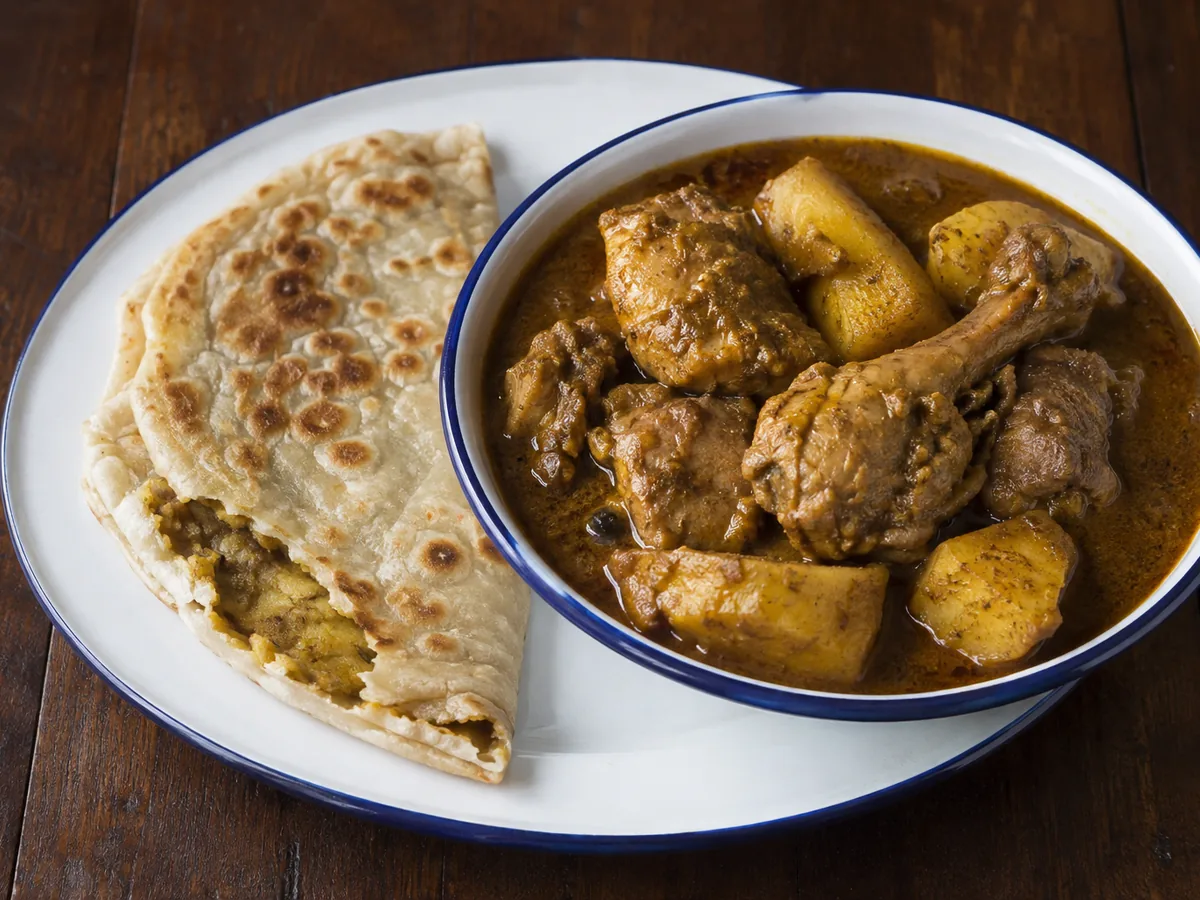
Chicken curry with dhalpuri roti is the Indo-Guyanese table, brought by indentured workers from Uttar Pradesh and Bihar between 1838 and 1917 and rebuilt on the Demerara coast around freshly roasted cumin, turmeric, coriander, wild thyme and wiri wiri, with no curry leaf in sight.
The curry is made by bunjal: the spice paste is fried until its moisture is gone and the oil splits, so the aromatics bloom and coat the meat before any liquid arrives. The roti is a hand-kneaded flatbread stuffed with fine ground split peas, rolled thin and puffed on an iron tawa into paper layers that peel apart around the curry.
Curry
- 1.4 kg3 lbBone-in chicken thighs and drumsticks, skin removed, chopped into 4 cm chunks
- 450 g3 mediumYukon Gold or russet potatoes, peeled and quartered
- 20 g2 TbspCumin seeds, toasted in a dry pan and groundroasted geera
- 30 g3 TbspCaribbean curry powder, Madras style
- 5 g1 tspGround turmeric
- 8 g1½ tspGaram masala
- 9 cloves9 clovesGarlic, crushed to a paste
- 1 large1 largeYellow onion, finely minced
- 3 whole3 wholeWiri wiri peppers, seeded and minced
- 4 sprigs4 sprigsFine-leaf thyme, chopped
- 60 ml¼ cupVegetable or mustard oil
- 15 g1 TbspFine sea salt
- 700 ml3 cupsHot water
Dhalpuri roti
- 500 g4 cupsPlain flour
- 12 g1 TbspBaking powder
- 320 ml1⅓ cupsLukewarm water
- 250 g1¼ cups driedYellow split peas, boiled with turmeric and garlic until tender, drained dry and ground
- 80 ml⅓ cupGhee or oil, for brushing
The bunjal
A wet masala paste dropped into 170 °C oil boils off its water. The cuminaldehyde and curcumin dissolve into the fat, the onion and garlic sugars brown, and the paste darkens and pulls away from the oil. Only then does the meat go in. Add water before that and the spices taste raw and powdery.
Why the roti puffs
A rested dough is extensible enough to roll paper-thin around a pocket of dry ground split peas without tearing. On a 220 °C tawa the water in the filling flashes to steam and forces the two gluten skins apart into a balloon.
Dry dhal or torn roti
Boiled peas must drain and air-dry before grinding. A wet filling tears through the dough on the rolling pin.
The five tastes on this plate
Salt is in the chicken seasoning and the split-pea stuffing. Fat is the frying oil of the bunjal and ghee on the bread. Acid is the mild acid of cooked alliums against the earthy spice. Heat is minced wiri wiri and the pepper in the garam masala. Umami is bone-in chicken collagen, caramelised alliums and roasted cumin oil.
Equipment
- 5-quart cast-iron Dutch oven or a deep karahi
- 12-inch seasoned cast-iron griddle or crêpe pan, as the tawa
- Rolling pin
- Food processor, for the dhal
- Insulated container or a heavy cloth, for the roti
The Guyanese kitchen uses an iron karahi for the curry and a round cast-iron tawa with a wooden dabber for the roti. A flat griddle pan is the tawa's stand-in and must be searing hot.
Method
Season the chicken30 min
Toss the chicken with half the garlic paste, half the thyme, one minced wiri wiri, a teaspoon of salt and a tablespoon of curry powder. Marinate 30 minutes.
Toss the chicken with half the garlic paste, half the thyme, one minced wiri wiri, a teaspoon of salt and a tablespoon of curry powder. Marinate 30 minutes.
Make the dhal filling30 min
Boil the split peas with a teaspoon of turmeric, two garlic cloves and half a teaspoon of salt for 20 minutes until tender but firm at the centre. Drain 10 minutes in a colander until dry. Grind with a tablespoon of roasted geera and a minced wiri wiri until powdery and light.
Boil split peas with 1 teaspoon turmeric, 2 garlic cloves and ½ teaspoon salt for 20 minutes until tender but firm-centred. Drain and air-dry 10 minutes. Grind with 1 tablespoon roasted geera and 1 minced wiri wiri until light and powdery.
Knead and rest the dough40 min
Whisk the flour, baking powder and half a teaspoon of salt. Add the warm water gradually and knead 8 minutes to a soft, supple dough. Cover with a damp cloth and rest 30 minutes.
Whisk the flour, baking powder and half a teaspoon of salt. Add the warm water gradually and knead 8 minutes to a soft, supple dough. Cover with a damp cloth and rest 30 minutes.
Fill the loyahs20 min
Divide the dough into six balls. Press a deep well into each, pack in three tablespoons of ground dhal, and pinch the edges over to seal. Rest 15 minutes.
Divide the dough into six balls. Press a deep well into each, pack in three tablespoons of ground dhal, and pinch the edges over to seal. Rest 15 minutes.
Bunjal the curry paste5 min
Heat the oil in the Dutch oven over medium-high. Mix the remaining curry powder, turmeric, garam masala, ground geera and garlic with 60 ml water to a wet paste and slide it into the oil. Fry 4 to 5 minutes, stirring constantly, until the water is gone, the paste is deep ochre and clear oil separates at the edges.
Heat oil over medium-high to about 170 °C. Mix remaining curry powder, turmeric, garam masala, geera and garlic with 60 ml water. Fry paste 4–5 minutes, stirring constantly, until dry, deep ochre and separating from clear oil.
Sear the chicken in the masala8 min
Add the chicken and stir vigorously over high heat 6 to 8 minutes until every piece is coated and the meat has contracted and released its juices.
Add the chicken and stir vigorously over high heat 6 to 8 minutes until every piece is coated and the meat has contracted and released its juices.
Simmer with the potatoes25 min
Add the potatoes, the rest of the thyme and 700 ml hot water. Boil, then cover and simmer over medium-low 25 minutes until the chicken is tender and the potatoes pierce with no resistance.
Add the potatoes, the rest of the thyme and 700 ml hot water. Boil, then cover and simmer over medium-low 25 minutes until the chicken is tender and the potatoes pierce with no resistance.
Thicken the gravy8 min
Uncover, crush one potato piece against the pot wall, and simmer 8 minutes until the gravy clings to the meat. Adjust the salt.
Uncover, crush one potato piece against the pot wall, and simmer 8 minutes until the gravy clings to the meat. Adjust the salt.
Roll and cook the roti15 min
Heat the tawa to about 220 °C. Dust a filled ball with flour and roll gently from the centre outward into a thin 25 cm circle without piercing the skin. Lay it on the tawa. After 30 seconds, when small bubbles show, flip and brush with ghee. Cook 40 seconds as it balloons, flip once more, brush again, and move to an insulated container.
Heat tawa to 220 °C. Flour a filled ball; gently roll centre-out into a thin 25 cm circle without tearing. Cook 30 seconds until bubbles appear; flip, brush with ghee, cook 40 seconds until puffed. Flip, brush again; transfer to an insulated container.
Clap and serve
Clap each hot roti sharply between cupped hands to release the steam and separate the layers. Serve folded beside a bowl of curry, to tear and scoop.
Clap each hot roti sharply between cupped hands to release the steam and separate the layers. Serve folded beside a bowl of curry, to tear and scoop.
Sensory cues of doneness
- Visual: golden-ochre chicken in a thick, reduced gravy with rounded potato edges, and a roti that balloons on the tawa with golden spots.
- Auditory: a sharp sputter as the wet paste hits the oil, settling into a steady dry hiss as the water leaves.
- Olfactory: a warm, nutty wave of toasted geera, garlic, wild thyme and toasted wheat.
Look for golden-ochre chicken in thick gravy, tender rounded potatoes and puffed roti with golden spots. The masala sputter becomes a dry hiss; expect toasted geera, garlic, thyme and wheat aromas.
Storing it
Cooked rotis wrapped in foil and a towel stay soft 24 hours, or freeze and revive on a dry hot skillet for 20 seconds a side.
Troubleshooting
- The dhal tears through the roti.
The boiled peas were wet. Air-dry them before grinding.
- Gritty, raw-tasting curry.
Water went in before the paste separated from the oil. Finish the bunjal first.
- Stiff roti that will not puff.
Under-rested dough or a cool tawa. Rest the dough, and heat the griddle to a full 220 °C.
Substitutions
One-to-one swaps, with the technique change each one needs.
Ingredient substitutions
| Ingredient | Replace with | Culinary impact and technique adjustment |
|---|---|---|
| Caribbean curry powder | 2 Tbsp ground coriander, 1 Tbsp turmeric, 1 tsp cumin, ½ tsp each black pepper and ginger, ¼ tsp mustard | Approximates the blend, with no fennel or anise |
| Yellow split peas | Chana dal or red lentils, boiled firm-tender | One-to-one |
| Ghee | Clarified butter or avocado oil | One-to-one |
Scaling
Half
Halve everything, kneading the dough with 160 ml water and simmering the curry in 400 ml. Times are unchanged.
Double
Double the curry and fry the paste in two batches, or in a wide 10-quart vessel, so the bunjal browns evenly.
What to serve it with
- Mango achar and kuchela, the spicy green mango pickles
- Steamed rice, for those who want both
- Banks lager, coconut water, or a dark Demerara rum punch
Questions
Why bone-in chicken?
Marrow and cartilage release gelatin and minerals over the braise, and that is the body of the gravy.
What does clapping the roti do?
Clapping the hot bread between cupped hands breaks the surface steam tension and separates the dhal layer from the thin crust, keeping it tender.
Can the roti be made ahead?
Yes. Wrapped tight in foil and a towel they stay soft for a day, or freeze and reheat on a dry skillet.