Chowmein
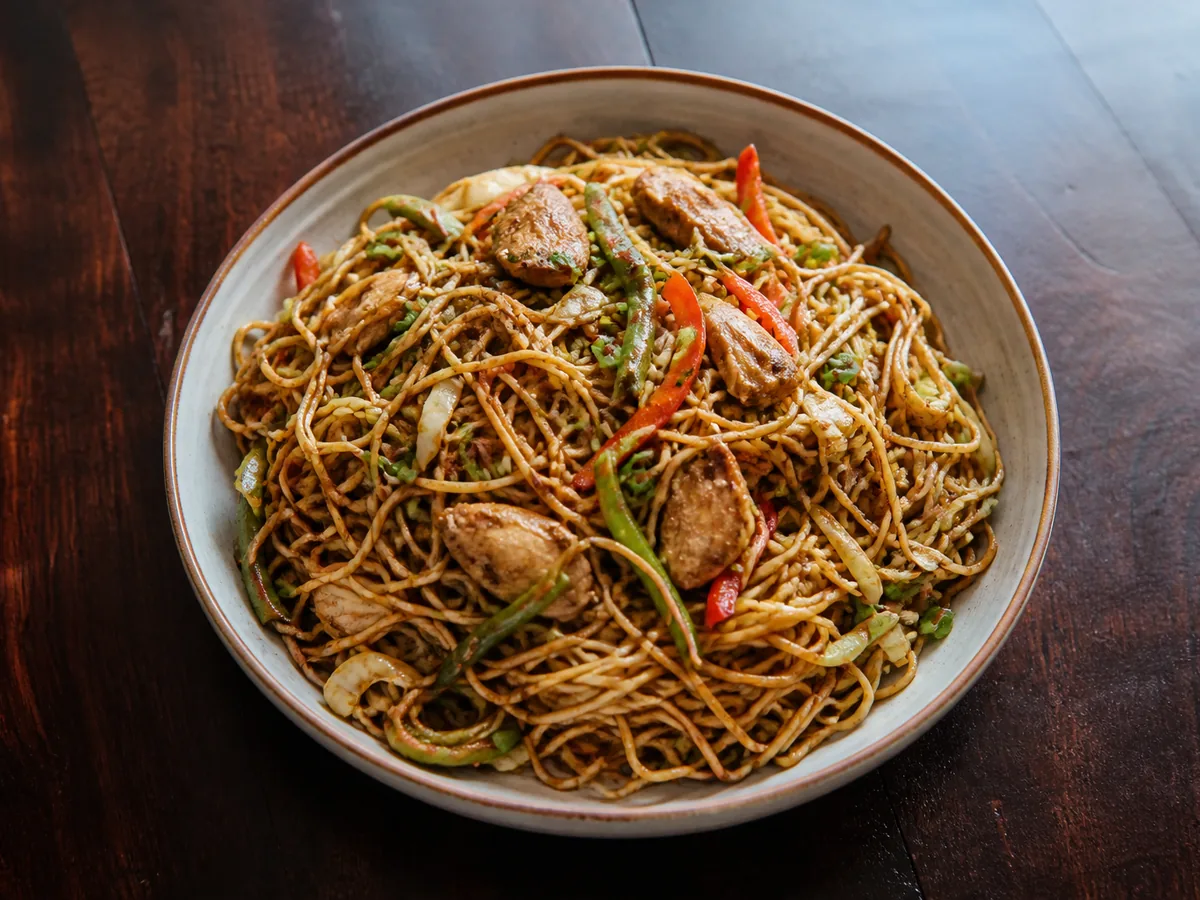
The Chinese-Guyanese wok dish found in every home and school canteen. Thin egg noodles boiled just short of al dente and rinsed cold, then flash-fried over maximum heat with marinated chicken, bora beans, carrot and cabbage in dark mushroom soy, oyster sauce and a fennel-free five-spice, finished with scallion and served with pepper sauce.
- Prep
- 30 min
- Cook
- 15 min
- Serves
- 6
- Difficulty
- Medium
Researched · Kitchen testing pending
Chowmein is the legacy of the Chinese contract labourers who came to Guyana from 1853, mostly from Guangdong and Hong Kong, and who adapted Cantonese wok cooking to the Caribbean pantry. It is in every home, school canteen and Creole restaurant in the country.
Unlike Western takeaway chow mein, the Guyanese dish uses thin dried egg noodles boiled just short of done, dressed in dark mushroom soy and a local spice blend, and flash-fried in an iron karahi with marinated chicken, shredded carrot and cabbage and tender bora beans. It is finished with scallion and eaten with hot pepper sauce.
- 450 g1 lbDried Guyanese egg noodles, or fresh Chinese egg noodles
- 500 g1.1 lbBoneless chicken thighs or breast, sliced into thin 1 cm strips
- 200 g2 cupsBora, yardlong beans, cut into 3 cm pieces
- 150 g2 mediumCarrots, cut into fine matchsticks
- 200 g3 cupsGreen cabbage, finely shredded
- 60 g5 stalksScallions, in 2 cm batons
- 25 g6 clovesGarlic, finely minced
- 15 g1 TbspFresh ginger, finely grated
- 2 whole2 wholeWiri wiri peppers, seeded and minced
- 45 ml3 TbspDark mushroom soy sauce
- 30 ml2 TbspLight soy sauce
- 30 ml2 TbspOyster sauce
- 15 ml1 TbspSesame oil
- 5 g1 tspFive-spice, fennel-free and anise-free, of cinnamon, clove, Sichuan pepper, ginger and black pepper
- 8 g1½ tspDemerara sugar
- 60 ml¼ cupVegetable oil, for the wok
- to tasteto tasteFine sea salt and cracked black pepper
Dry noodles, or glue
Noodles boiled 3 to 4 minutes, rinsed cold and tossed in oil carry no surface starch and no free water. Wet noodles drop the wok below 150 °C and steam into a gummy mass.
Wok hei
At 190 °C in an iron karahi, droplets of oil vaporise, catch in the heat column above the pan and deposit smoky pyrolytic compounds on the food. That is the breath of the wok, and it needs maximum heat and constant tossing.
The five tastes on this plate
Salt is light and dark soy in the noodles and chicken. Fat is the wok oil and a finishing thread of sesame. Acid is the mild acidity of alliums and fermented soy. Heat is minced wiri wiri and black pepper. Umami is mushroom soy, oyster sauce and seared chicken.
Equipment
- 14-inch carbon-steel wok, or a 12-inch heavy stainless skillet
- Two wok ladles or spatulas
- Large pot and colander, for the noodles
A round-bottomed carbon-steel wok over a high-output flame is the Guyanese iron karahi's equal. On a domestic stove use the largest burner on its highest setting and work in one fast batch.
Method
Parboil the noodles6 min
Cook the noodles in a large pot of boiling water 3 to 4 minutes until flexible but firm. Drain, rinse under cold water for a minute, drain thoroughly, toss with 15 ml oil, and spread on a tray to cool.
Cook the noodles in a large pot of boiling water 3 to 4 minutes until flexible but firm. Drain, rinse under cold water for a minute, drain thoroughly, toss with 15 ml oil, and spread on a tray to cool.
Marinate the chicken15 min
Toss the chicken strips with 15 ml light soy, half the garlic, half the ginger, the five-spice and black pepper. Marinate 15 minutes.
Toss the chicken strips with 15 ml light soy, half the garlic, half the ginger, the five-spice and black pepper. Marinate 15 minutes.
Mix the sauce2 min
Whisk the dark mushroom soy, the remaining light soy, oyster sauce, Demerara sugar and sesame oil.
Whisk the dark mushroom soy, the remaining light soy, oyster sauce, Demerara sugar and sesame oil.
Sear the chicken4 min
Heat the wok over high until it smokes. Add 30 ml oil and the chicken and stir-fry hard 3 to 4 minutes until golden and cooked through, 75 °C. Remove.
Heat the wok over high until it smokes. Add 30 ml oil and the chicken and stir-fry hard 3 to 4 minutes until golden and cooked through, 75 °C. Remove.
Stir-fry the vegetables4 min
Add the remaining oil to the smoking wok, then the rest of the garlic and ginger and the wiri wiri for 30 seconds. Add the bora and carrot and stir-fry 2 minutes over high heat, then the cabbage for 1 minute until crisp-tender.
Add remaining oil to the smoking wok; stir-fry remaining garlic, ginger and wiri wiri 30 seconds. Add bora and carrot; stir-fry on high 2 minutes. Add cabbage and cook 1 minute until crisp-tender.
Noodles, chicken and sauce4 min
Add the cooled noodles and the chicken on top of the vegetables. Pour the sauce over evenly. With two spatulas, toss continuously over maximum heat 3 to 4 minutes, lifting from the bottom so the noodles caramelise against the hot metal.
Add the cooled noodles and the chicken on top of the vegetables. Pour the sauce over evenly. With two spatulas, toss continuously over maximum heat 3 to 4 minutes, lifting from the bottom so the noodles caramelise against the hot metal.
Finish and serve
Fold in the scallion batons for the last 30 seconds. Tip onto a platter and serve at once with pepper sauce, pickled onion and, if you like, chicken gravy.
Fold in the scallion batons for the last 30 seconds. Tip onto a platter and serve at once with pepper sauce, pickled onion and, if you like, chicken gravy.
Sensory cues of doneness
- Visual: tangled, glossy mahogany noodles studded with bright green bora, orange carrot and seared chicken.
- Auditory: a loud hiss as the cold noodles meet the smoking wok, and crackling as the pan is tossed.
- Olfactory: smoky sesame and dark soy, ginger, garlic and warm cinnamon and clove.
Look for glossy mahogany noodles with bright bora, carrot and seared chicken. Expect a loud hiss and crackle during tossing, with smoky sesame, dark soy, ginger, garlic, cinnamon and clove aromas.
Troubleshooting
- Soggy, gummy noodles.
Over-boiled, or not rinsed cold. Boil to al dente and cool completely before frying.
- Pale noodles with no depth.
Light soy stood in for dark mushroom soy. The dark soy is the glaze and the umami.
- Waterlogged vegetables.
The wok was covered. Flash-fry uncovered over maximum heat.
Substitutions
One-to-one swaps, with the technique change each one needs.
Ingredient substitutions
| Ingredient | Replace with | Culinary impact and technique adjustment |
|---|---|---|
| Bora | Fine green beans or sugar snap peas | One-to-one |
| Egg noodles | Dried ramen without the seasoning, or fresh lo mein | Fresh noodles need only 1 to 2 minutes in the pot |
| Oyster sauce | Vegetarian mushroom stir-fry sauce or kecap manis | One-to-one |
Scaling
Half
Halve everything and stir-fry in one batch in a 12-inch skillet.
Double
Double the ingredients and fry in two separate batches. One big batch drops the wok heat and steams the noodles.
What to serve it with
- Guyanese pepper sauce, wiri wiri in vinegar
- Fried chicken wings and pickled vegetables
- Chilled Banks, ginger beer, or a cold cream soda
Questions
How is it different from Chinese chow mein?
Bora beans, wiri wiri, a distinct spice blend, and it comes to the table with pepper sauce and pickles.
Can I use fresh lo mein?
Yes. Boil fresh noodles only 1 to 2 minutes before rinsing and drying.
Is the spice blend fennel-free?
Yes. Commercial five-spice often carries star anise and fennel; this one is cinnamon, clove, Sichuan pepper, ginger and black pepper only.