Pholourie with Mango Sour
The Indo-Guyanese street fritter sold in brown paper bags at markets and school gates. Soaked yellow split peas ground to a slurry, beaten into a flour batter with yeast, turmeric and roasted geera, fermented until spongy, and dropped into hot oil where each spoonful swells into a hollow golden sphere, eaten with a tart, fiery green mango sauce.
- Prep
- 25 min
- Cook
- 20 min
- Serves
- 8, about 40 fritters
- Difficulty
- Medium
Researched · Kitchen testing pending
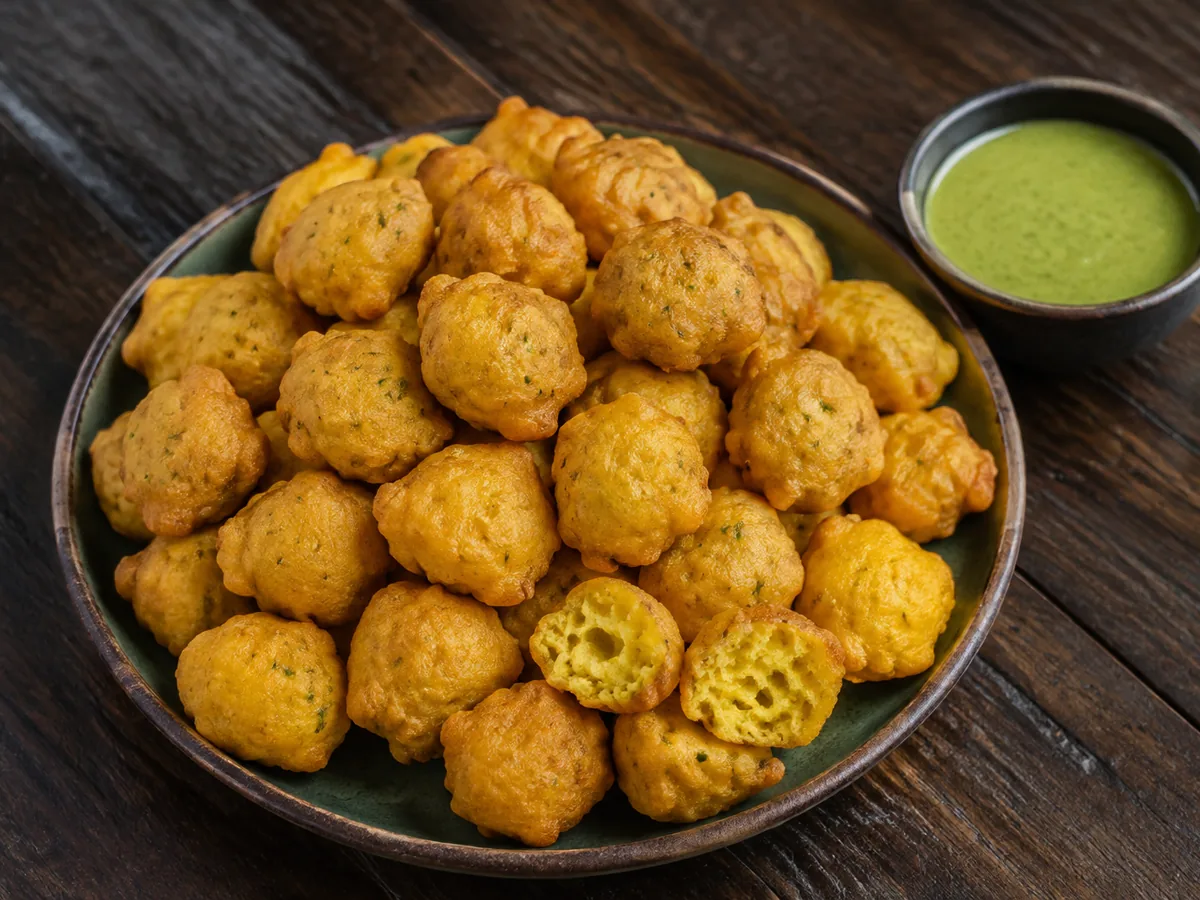
Pholourie is Indo-Guyanese street food descended from the Bhojpuri fritters of the indentured sugar workers. It is sold in small brown paper bags at Georgetown markets, ferry terminals and school gates.
The whole dish is a contrast. Golden spheres of stone-ground yellow split pea batter seasoned with turmeric, roasted geera and garlic fry into puffs that are airy inside and crisp outside. They are speared on toothpicks while hot and dunked in mango sour, a cooked green mango sauce sharp with vinegar and fierce with wiri wiri.
Fritters
- 250 g1¼ cups driedYellow split peas, soaked overnight and drained
- 200 g1½ cupsPlain flour
- 7 g2¼ tspActive dry yeast
- 6 g1½ tspBaking powder
- 6 g1½ tspGround turmeric
- 10 g1 TbspCumin seeds, toasted and ground fine
- 6 cloves6 clovesGarlic, crushed to a paste
- 2 whole2 wholeWiri wiri peppers, minced
- 8 g1½ tspFine sea salt
- 240 ml1 cupLukewarm water
- 1 L4 cupsNeutral oil, for deep frying
Mango sour
- 400 g2 mediumUnripe green mangoes, peeled and grated or diced
- 350 ml1½ cupsWater
- 30 ml2 TbspWhite cane vinegar
- 15 g1 TbspDemerara sugar
- 10 g2 TbspCulantro or cilantro, finely minced
Why they float
Yeast and baking powder fill the fermented batter with gas. In 180 °C oil the surface water flashes to steam, the bubbles expand, and the ball swells and rises. The shell browns and dries into a crisp skin that keeps the oil out while the inside steams to a sponge.
Raw peas only
Canned peas are already cooked and have no raw protein structure to make a batter. The fritter needs dried yellow split peas soaked raw.
The five tastes on this plate
Salt seasons both the fritter and the sour. Fat is clean frying oil in a crisp shell. Acid is green mango and cane vinegar. Heat is garlic and wiri wiri in both. Umami is roasted cumin oil and puréed legume.
Equipment
- 5-quart heavy Dutch oven or a deep karahi, with a thermometer
- Food processor
- Slotted spider
- Wire rack over a tray
- Small saucepan, for the sour
A deep cast-iron karahi holds its heat through batch after batch. Whatever the pot, keep a full litre of oil in it for thermal mass, even for a half batch.
Method
Make the mango sour25 min
Put the mango, 350 ml water, three minced garlic cloves, one minced wiri wiri and half a teaspoon of salt in a saucepan and simmer over medium heat 20 minutes until soft. Mash to a pulpy sauce, stir in the vinegar, sugar and culantro, and cool.
Simmer mango, 350 ml water, 3 minced garlic cloves, 1 minced wiri wiri and ½ teaspoon salt over medium heat 20 minutes until soft. Mash to a pulpy sauce; stir in vinegar, sugar and culantro, then cool.
Grind the split peas3 min
Blend the drained peas with 180 ml water, the remaining garlic and wiri wiri and the salt for 2 to 3 minutes until very smooth.
Use raw dried split peas soaked overnight and drained, not canned peas. Blend with 180 ml water, remaining garlic, wiri wiri and salt for 2–3 minutes until very smooth.
Beat the batter5 min
Whisk the flour, yeast, baking powder, turmeric and ground geera. Pour in the pea purée and the rest of the water and beat hard with a wooden spoon 3 minutes until smooth and stretchy, like a thick cake batter.
Whisk flour, yeast, baking powder, turmeric and ground geera. Add pea purée and remaining water; beat vigorously with a wooden spoon 3 minutes until smooth, stretchy and thick like cake batter.
Ferment45 min
Cover with a damp cloth and leave somewhere warm 45 minutes until doubled, spongy and bubbling on top.
Cover with a damp cloth and leave somewhere warm 45 minutes until doubled, spongy and bubbling on top.
Heat the oil8 min
Heat a litre of oil in the Dutch oven over medium-high to 180 °C.
Heat a litre of oil in the Dutch oven over medium-high to 180 °C.
Drop and fry4 min per batch
Wet your fingers. Scoop a walnut-sized ball of batter, about a tablespoon, and slide it smoothly into the oil close to the surface. Fry 8 to 10 at a time. They sink for a few seconds, then pop up. Turn constantly with the spider 3 to 4 minutes until evenly golden-amber and crisp.
With wet fingers, slide walnut-sized portions, about 1 tablespoon each, into oil close to the surface. Fry 8–10 at a time, turning constantly with a spider for 3–4 minutes until evenly golden-amber and crisp.
Drain and serve
Lift onto a wire rack, never paper towels. Pile hot into paper-lined baskets with small bowls of mango sour, warm or chilled, for dipping.
Lift onto a wire rack, never paper towels. Pile hot into paper-lined baskets with small bowls of mango sour, warm or chilled, for dipping.
Sensory cues of doneness
- Visual: round golden spheres bobbing in the oil and turning amber; a pale-green pulpy sauce flecked with red pepper.
- Auditory: a lively hiss as the batter drops in, and a light hollow sound when the fritters are tossed in a bowl.
- Olfactory: toasted geera, turmeric, fried garlic and the sharp tang of hot mango vinegar.
Look for round amber fritters and pale-green pulpy mango sauce flecked with pepper. Expect lively frying, a hollow sound when fritters are tossed, and aromas of geera, turmeric, fried garlic and sharp mango vinegar.
Storing it
Mango sour keeps 3 weeks in a clean glass jar in the fridge. The fritters do not keep; fry them to order.
Troubleshooting
- Dense, heavy balls.
The batter did not ferment, or it was cold. It needs its 45 minutes somewhere warm until it is spongy.
- Greasy fritters.
Oil under 170 °C. Slow steam lets oil into the centre; hold 180.
- Tails and splatter.
Dropped from too high, or the batter is too thin. Slide it in close to the surface with a quick thumb push.
Substitutions
One-to-one swaps, with the technique change each one needs.
Ingredient substitutions
| Ingredient | Replace with | Culinary impact and technique adjustment |
|---|---|---|
| Green mango | Granny Smith apple, tamarind paste, or sour golden apple | One-to-one for the sour |
| Yellow split peas | Chana dal or red lentils, soaked raw | One-to-one |
| Culantro | Cilantro with a pinch of lime zest | One-to-one |
Scaling
Half
Halve the batter and sour. Keep the full litre of oil for its thermal mass.
Double
Double everything and fry in batches of 10 to 12, letting the oil return to 180 °C between them.
What to serve it with
- Tamarind sour and spicy mango achar
- Extra fresh wiri wiri
- Ice-cold Banks, mauby over crushed ice, or a sorrel cooler
Questions
Can I use canned peas or pea flour?
No. Canned peas are cooked and cannot hold a batter. Dried split peas, soaked raw overnight, are the recipe.
Why green mango?
Unripe mango is all citric and malic acid and no sugar, which gives the sour its bracing edge against the fried fritter.
How long does the sour keep?
About 3 weeks refrigerated in a clean jar, thanks to its acidity.