Garlic Pork
The Madeiran Portuguese Christmas gift. Cubes of fatty pork shoulder packed into jars with three heads of crushed garlic, a bunch of thyme, wiri wiri and salt, covered in cane vinegar and cured cold for three or four days, then cooked in a dry pan with no oil at all until the vinegar boils off, the fat renders and the pork fries itself to a mahogany crust.
- Prep
- 30 min
- Cook
- 40 min
- Serves
- 8 to 10
- Difficulty
- Medium
Researched · Kitchen testing pending
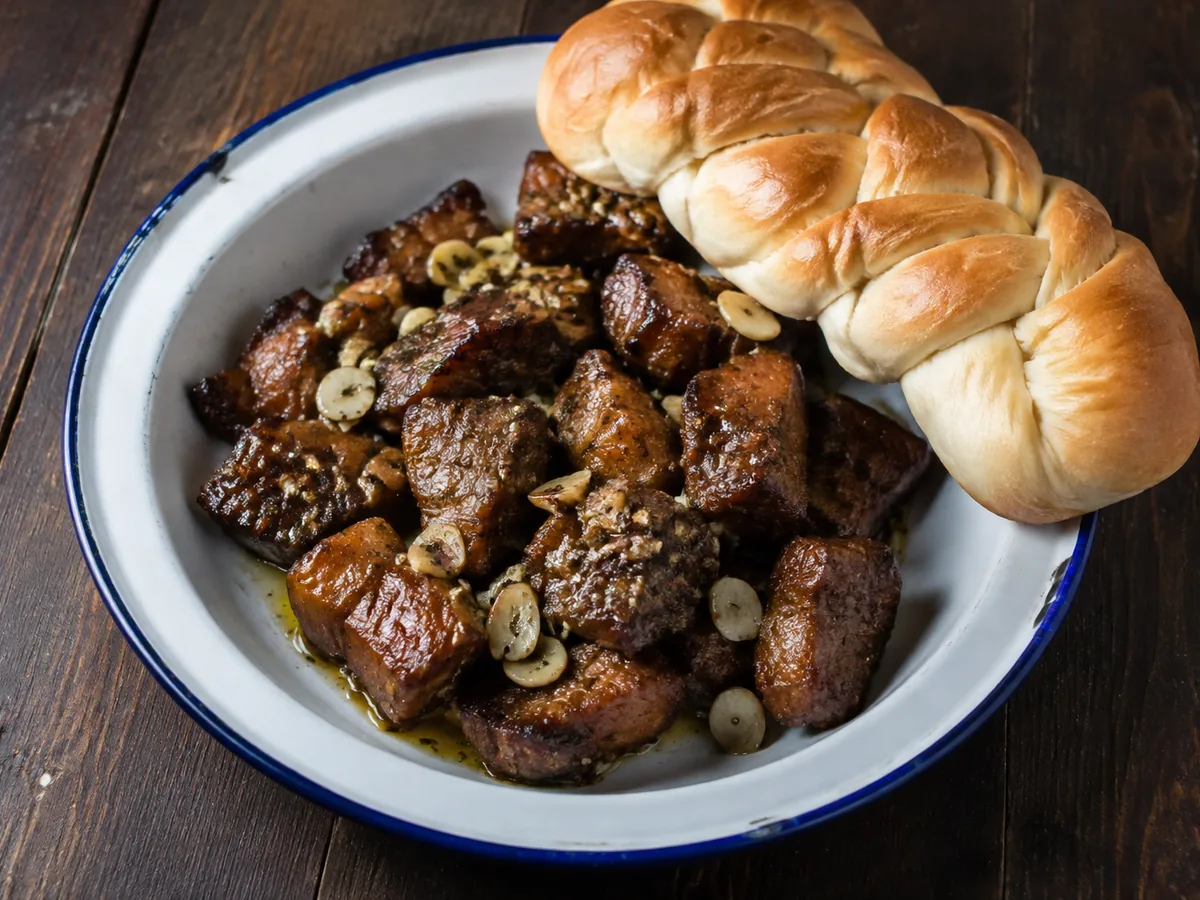
Garlic pork, carne vinha d’alhos, came to British Guiana with Madeiran Portuguese contract labourers between 1835 and 1882, along with their Catholic Christmas. The Iberian method of holding fatty pork in wine or vinegar with raw garlic and salt was adapted to the tropics with wild thyme and wiri wiri.
The pork cures in jars for days before Christmas. On Christmas morning it is lifted from the brine, dried, and dropped into a scorching pan with no oil. It simmers in its own juices, then fries in its own rendered lard into dark mahogany morsels loud with garlic and thyme, eaten with crusty bread.
- 1.8 kg4 lbBoneless pork shoulder with a good fat cap, cut into 4 cm cubes, each keeping some fat
- 120 g3 headsGarlic, peeled and mashed to a coarse paste
- 30 g1 large bunchFine-leaf thyme, leaves stripped and chopped
- 8 whole8 wholeWiri wiri peppers, bruised, seeds intact
- 500 ml2 cupsDistilled white cane vinegar, 5 percent
- 250 ml1 cupBoiled water, cooled
- 35 g2 TbspCoarse sea salt, non-iodised
- 6 g2 tspBlack peppercorns, crushed
- 4 whole4 wholeBay leaves, bruised
How the cure works
The vinegar takes the pork below pH 4.2, where bacteria cannot grow, while its acid slowly denatures the surface proteins, cold-cooking the outside and drawing moisture out. Allicin from the crushed garlic and carvacrol from the thyme both inhibit microbes through the multi-day soak.
Why two parts vinegar to one part water
Undiluted vinegar over four days turns the muscle to leather. Cutting it with water moderates the acid so flavour goes in without over-pickling.
No oil in the pan
The cured pork first boils in its own vinegar and juices. When that water has gone the pan climbs from 100 to 180 °C, the fat cap renders into lard, and the meat moves from simmering to frying in its own fat.
The five tastes on this plate
Salt is sea salt driven deep during the cure. Fat is the shoulder's own rendered lard. Acid is clean cane vinegar, cure and palate cleanser at once. Heat is raw allicin from a great deal of garlic and the wiri wiri. Umami is pork broken down by acid and then browned hard.
Equipment
- Sterilised 2-quart glass Mason jars, or an earthenware crock
- Mortar or food processor
- 12-inch cast-iron skillet
- Wire rack
Cure only in glass or ceramic. The acid attacks aluminium and copper and leaves a metallic taste. The Guyanese pan is a cast-aluminium caldero; cast iron renders the fat just as evenly.
Method
Cube the pork10 min
Cut the shoulder into even 4 cm cubes, making sure each keeps a small cap of fat.
Cut the shoulder into even 4 cm cubes, making sure each keeps a small cap of fat.
Make the curing paste10 min
Pound the garlic, thyme, bruised peppers, salt, crushed peppercorns and bay leaves in a mortar or processor to a coarse, wet paste.
Pound the garlic, thyme, bruised peppers, salt, crushed peppercorns and bay leaves in a mortar or processor to a coarse, wet paste.
Coat and pack10 min
Rub the paste thoroughly into the pork. Pack the cubes tightly into the jars. Pour over the vinegar and cooled water so every piece is submerged.
Rub the paste thoroughly into the pork. Pack the cubes tightly into the jars. Pour over the vinegar and cooled water so every piece is submerged.
Cure cold3 to 5 days
Seal the jars. In Guyana they went into a dark cupboard for 3 to 4 days; in a home kitchen use the coldest part of the refrigerator for 3 to 5 days, turning the jars once a day.
Seal the jars and refrigerate in the coldest part of the refrigerator for 3–5 days, turning the jars once daily.
Drain for cooking15 min
Lift out the pork you want to cook and drain 15 minutes in a colander, then pat thoroughly dry. Keep 60 ml of the brine.
Lift out the pork you want to cook and drain 15 minutes in a colander, then pat thoroughly dry. Keep 60 ml of the brine.
Simmer off the water15 min
Set the skillet over medium heat. Add the pork in a single layer with the reserved brine and no oil. Cover and simmer over medium-low 15 minutes as the meat gives up its juices and vinegar.
Set the skillet over medium heat. Add the pork in a single layer with the reserved brine and no oil. Cover and simmer over medium-low 15 minutes as the meat gives up its juices and vinegar.
Render and fry20 min
Uncover and raise the heat to medium-high. Let the water boil away, 8 to 10 minutes. As the lard renders and coats the pan, the pork begins to fry in its own fat. Turn the cubes continuously 10 to 12 minutes until glossy, deep mahogany and crisp, 74 °C inside.
Uncover and raise to medium-high; boil off water 8–10 minutes. Once the rendered fat coats the pan, turn cubes continuously while frying 10–12 minutes until glossy, deep mahogany and crisp, reaching 74 °C inside.
Drain and serve3 min
Lift out with a slotted spoon, drain 3 minutes on a rack, and serve hot on a board with thick slices of plait bread and sweet butter.
Lift out with a slotted spoon, drain 3 minutes on a rack, and serve hot on a board with thick slices of plait bread and sweet butter.
Sensory cues of doneness
- Visual: crisp, deeply caramelised mahogany cubes with blistered edges, flecked with toasted garlic and thyme.
- Auditory: a wet sputtering boil for the first twenty minutes, then a violent, crackling sizzle as the lard takes over.
- Olfactory: sizzling garlic, toasted thyme, hot rendered lard and caramelised vinegar.
Look for crisp mahogany cubes with blistered edges and toasted garlic and thyme. Wet bubbling should become a crackling sizzle as the water evaporates; expect garlic, thyme, rendered pork fat and caramelised vinegar aromas.
Storing it
Fully cured pork can be drained and frozen raw for up to 3 months. Do not freeze it mid-cure; freezing stops the curing.
Troubleshooting
- Grey, steamed meat with no crust.
Too much pork in a small pan boiled in its juices without reaching frying temperature. Cook in batches.
- A metallic taste.
It was cured in a reactive metal bowl. Glass or ceramic only.
- Bitter, burnt garlic.
High heat from the start. Render gently and raise the heat only for the last ten minutes.
Substitutions
One-to-one swaps, with the technique change each one needs.
Ingredient substitutions
| Ingredient | Replace with | Culinary impact and technique adjustment |
|---|---|---|
| Pork shoulder | Pork belly, or bone-in country ribs | One-to-one. Belly gives ultra-rich crackling bites |
| White cane vinegar | Apple cider vinegar or distilled white vinegar | One-to-one. Cider vinegar adds a faint fruit note |
| Wiri wiri peppers | Crushed bird's eye chillies or habanero | One-to-one |
Scaling
Half
Halve everything and cure in one 1-quart jar. Frying time is the same.
Double
Double the ingredients across several 2-quart jars, and fry in two or three batches so the pan is never crowded.
What to serve it with
- Warm crusty plait bread rolls
- Extra pickled wiri wiri and sliced cucumber
- Banks lager, Demerara rum with coconut water, or Christmas sorrel
Questions
Why water in the brine?
Straight 5 percent vinegar over four days toughens the fibres to leather. One part water to two parts vinegar lets the flavour in without over-pickling.
Can I freeze it while it cures?
No. Freezing halts the cure. Cure fully first; the drained raw pork then freezes well for three months.
Is it cooked in oil?
Never. Garlic pork is cooked only in the fat rendered from its own shoulder. Oil dilutes it.