Tamales Colorados
A red lantern outside the door on a Saturday night means fresh tamales. The difference from the Mexican kind is that the masa is cooked *before* it is wrapped — beaten with warm broth and lard until it falls off the paddle in ribbons — so it steams into trembling custard rather than a firm cake.
- Prep
- 1 hr 30 min
- Cook
- 2 hr 30 min
- Serves
- 16 large tamales
- Difficulty
- Hard
Researched · Kitchen testing pending
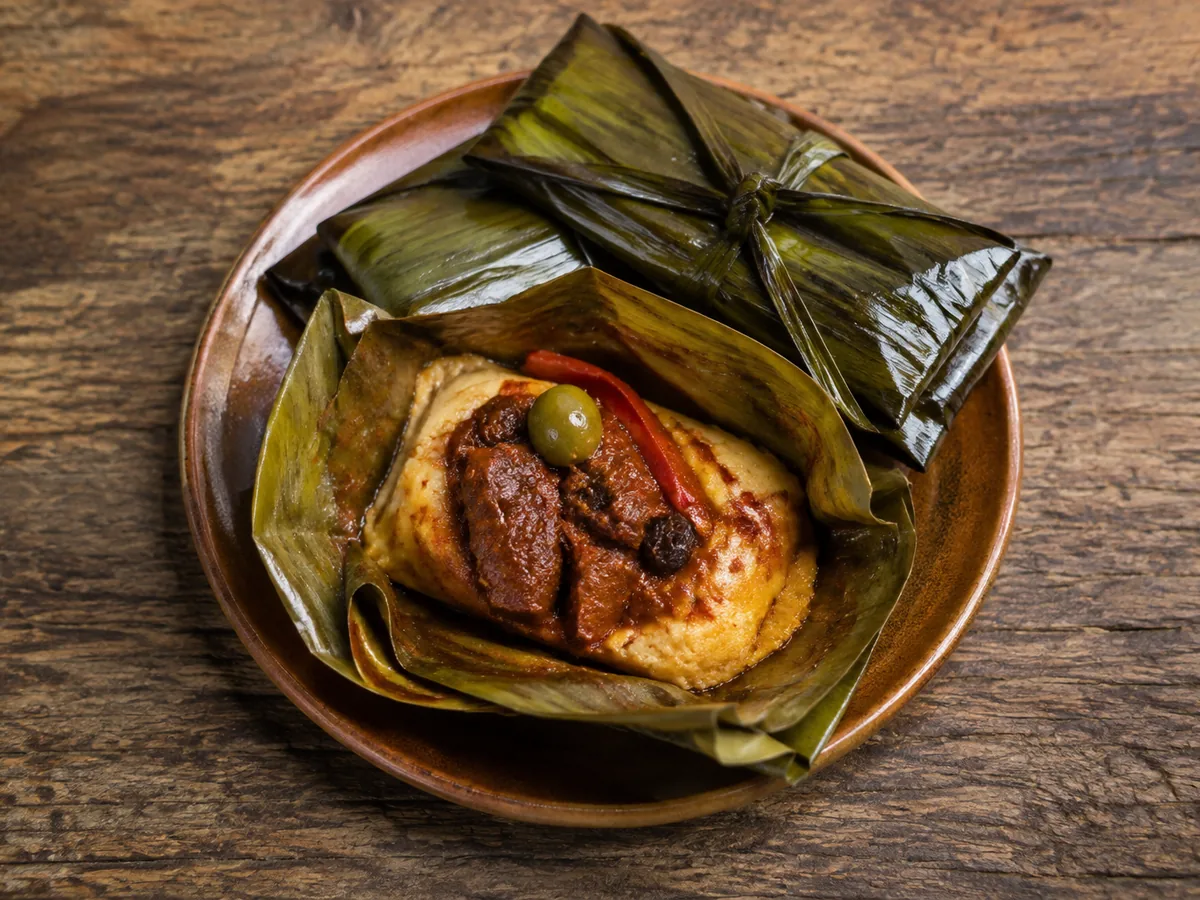
In Guatemala, red lanterns hung outside front doors on a Saturday night mean fresh tamales. Tamales colorados are the crown of holidays and weekend family dinners.
Unlike Mexican tamales, which whip raw corn masa, the Guatemalan version uses masa cocida — pre-cooked, silky and custard-like, worked down with rich broth and rendered lard until glossy. Inside each parcel is a chunk of pork shoulder submerged in a dark recado of toasted pepitoria, sesame, chile guaque, chile pasa and sweet allspice.
Garnished with a green olive, raisins and a strip of red pepper, wrapped in mashán and smoked banana leaves, it steams for hours until it sets into trembling silk.
Masa cocida
- 1 kg2.2 lbFresh nixtamalised corn masa, or 500 g masa harina whisked with 1.2 L rich broth
- 1.5 L6.3 cupsRich seasoned pork or chicken bone broth, warm
- 250 g1.25 cupsHigh-grade rendered pork lard, melted warm
- 20 g1 Tbsp + 1 tspFine sea salt, seasoned boldly into the masa
The red recado
- 4 pieces4 piecesDried chile guaque, stemmed, seeded and toasted
- 3 pieces3 piecesDried chile pasa, stemmed, seeded and toasted
- 800 g5 largeRipe red plum tomatoes, charred on the comal
- 300 g8 mediumGreen miltomates (tomatillos), husked, washed and charred
- 60 g½ cupRaw pepitoria seeds, toasted golden and ground to a fine powder
- 45 g⅓ cupWhite sesame seeds, toasted golden and ground fine
- 1 large1 largeYellow onion, charred on the comal
- 8 cloves8 clovesFresh garlic, charred in the skin and peeled
- 6 whole6 wholeAllspice berries, ground
- 3 whole3 wholeCloves, ground
- 3 g1 in stickCinnamon, ground
Filling and wrap
- 1 kg2.2 lbBoneless pork shoulder, or chicken thigh, cut into 16 uniform 60 g chunks
- 16 whole16 wholePitted green Manzanilla olives
- 32 whole32 wholeDark seedless raisins
- 1 large1 largeRed bell pepper, cut into 16 thin longitudinal strips
- 16 large16 largeFresh mashán leaves, or parchment sheets, as the inner layer
- 16 large16 largeSmoked banana leaves, deveined and cut into 30 × 30 cm squares
- 1 roll1 rollCibaque reed strips, or unbleached kitchen twine
Cook the masa first — this is the whole difference
Raw masa holds unhydrated amylose and amylopectin. Stirred continuously with warm stock and melted lard at 82–88 °C, those starches gelatinise fully *before* wrapping, and the hot lard emulsifies into the swollen gel. Steamed, it sets into a custardy pudding. Wrapped raw, it bakes into a chalky cake.
Do not skimp on the lard
Corn starch needs the fat for a velvety mouthfeel. Too little and the cooked masa is dry, rubbery and crumbly. Beat it in as a steady stream until the mixture is glossy and drops in heavy ribbons.
Two leaves, two jobs
Mashán inside gives the herbal, tea-like perfume and stops the masa sticking; smoked banana leaf outside is the tough, water-resistant structure that keeps condensed steam from diluting the masa.
Pass the leaves through a flame
Three seconds a side until they turn glossy and pliable. Unsoftened leaves crack along the fold and the parcel leaks.
Keep a kettle on the back burner
If the reservoir boils dry during two and a half hours the bottom leaves scorch and the whole batch is ruined. Top up with boiling water so the temperature never drops.
Passive time, counted separately
The chillies soak 15 minutes, the recado cools before assembly, and the steamed tamales rest 20 minutes to firm up before they are opened. None of that is active work.
The five tastes on this plate
Salt is boldly seasoned into the masa and the meat recado. Fat is rendered lard dispersed through the corn starch matrix. Acid is charred miltomate and tomato against the dense lard. Heat is earthy guaque and pasa with sweet allspice. Umami is pork fond, bone stock in the masa, toasted pumpkin seed and green olive.
Equipment
- 8 qt Dutch oven, for the masa
- Long wooden paddle
- Cast-iron comal
- Blender
- 16 to 20 qt stockpot with a steaming rack
- Kitchen twine, and a kettle
Traditionally a large aluminium tamalera with an interior rack lined with corn husks and leaf scraps. A 16-to-20 quart stainless stockpot with an elevated wire rack works in a modern kitchen, with a kettle of boiling water ready to replenish the reservoir without dropping the steam temperature.
Method
Build the red recado30 min
Toast the guaque and pasa 15 seconds a side and soak them in 250 ml hot broth for 15 minutes. Char the tomatoes, miltomates, onion and unpeeled garlic on the comal until blackened.
Grind the toasted pepitoria and sesame to a fine powder, then blend everything with the allspice, cloves, cinnamon and 1 tsp salt for 90 seconds to an ultra-smooth dark-red recado.
Simmer it with 15 ml lard for 8 minutes until glossy and thick, then cool.
Toast guaque and pasa 15 seconds per side; soak in 250 ml hot broth 15 minutes. Char tomatoes, miltomates, onion and unpeeled garlic; peel garlic. Grind toasted seeds. Blend everything with allspice, cloves, cinnamon and 1 tsp salt 90 seconds. Simmer with 15 ml lard 8 minutes until thick and glossy; cool.
Cook the silk masa18 min
Whisk the masa with 1.5 litres warm broth in a heavy pot until completely smooth, and stir in 20 g salt.
Over medium heat, stir continuously in figure-eights. As it nears 75 °C it thickens fast — now pour in the 250 g melted lard in a steady stream, beating hard until fully emulsified and the masa is glossy and drops from the paddle in heavy ribbons. About 15 to 18 minutes. Off the heat.
Whisk masa with 1.5 litres warm broth and 20 g salt until smooth. Stir continuously in figure-eights over medium. Near 75 °C, stream in 250 g melted lard, beating hard. Cook 15–18 minutes to 82–88 °C, until glossy and falling in heavy ribbons; remove from heat.
Prepare leaves and meat20 min
Wipe the banana leaves and pass each over an open flame 3 seconds a side until glossy and pliable, then cut into 30 cm squares. Soften the mashán the same way.
Season the pork chunks lightly and toss them with 4 tablespoons of the red recado.
Wipe the banana leaves and pass each over an open flame 3 seconds a side until glossy and pliable, then cut into 30 cm squares. Soften the mashán the same way.
Season the pork chunks lightly and toss them with 4 tablespoons of the red recado.
Assemble25 min
Lay a banana leaf glossy-side down with a smaller mashán leaf set diagonally in the centre.
Spoon about 150 g of warm masa into the middle and make a shallow hollow. Set one piece of pork in it, spoon over 2 generous tablespoons of recado, and garnish with an olive, two raisins and a strip of red pepper.
Place banana leaf glossy-side down with a smaller mashán leaf diagonally inside. Add 150 g warm masa; hollow the centre. Fill with one pork piece, 2 generous tablespoons recado, one olive, two raisins and a red-pepper strip.
Fold and tie15 min
Bring the two side edges together over the filling and fold them down tightly in a double fold to seal the centre.
Fold the top and bottom flaps firmly underneath into a flat rectangular parcel, and tie in a cross with reed or twine. Repeat for all 16.
Bring side edges together and seal with a tight double fold. Fold top and bottom flaps firmly underneath into a flat rectangle; tie crosswise with reed or twine. Repeat for all 16.
Steam low and slow2 hr 30 min
Set a rack in the stockpot, pour in 1.5 litres boiling water just below the rack, and line it with leaf trimmings.
Stack the tamales flat, alternating directions, cover with more leaf scraps, crimp foil over the rim and clamp the lid on.
Steam over medium-low 2 hours 30 minutes, topping up with boiling water around the sides as needed. Rest 20 minutes before unwrapping.
Add 1.5 litres boiling water just below a leaf-lined rack. Stack tamales flat in alternating directions; cover with leaves, tightly crimped foil and lid. Steam on medium-low 2 hours 30 minutes, topping up with boiling water as needed. Rest 20 minutes before unwrapping.
Sensory cues of doneness
- Visual: unwrapped, a trembling glossy golden-yellow pudding holding a pool of dark red recado with pork, olive and pepper.
- Auditory: a rhythmic bubbling clatter from the bottom of the pot over low heat.
- Olfactory: hot banana leaf, sweet cooked masa, rendered lard, toasted sesame and cinnamon.
Check for glossy, trembling golden masa surrounding dark-red recado, pork, olive and pepper. Maintain rhythmic bubbling on low heat; expect banana leaf, cooked corn, lard, toasted sesame and cinnamon aromas.
Storing it
Keep them wrapped in their leaves, refrigerated up to a week or frozen for 3 months. Reheat by steaming 20 minutes, or 35 from frozen.
Troubleshooting
- A chalky, firm, cake-like tamal.
The masa went in raw, Mexican-style. Guatemalan masa must be cooked on the stove until it ribbons before it is wrapped.
- Dry, rubbery, crumbly masa.
Not enough lard. The corn starch needs it to turn velvety — beat it in fully.
- A scorched, ruined batch.
The steamer boiled dry. Keep a kettle going and top the reservoir up with boiling water.
Substitutions
One-to-one global substitutions, with the technique adjustment each one requires.
Ingredient substitutions
| Ingredient | Replace with | Culinary impact and technique adjustment |
|---|---|---|
| Pork lard | Leaf lard, or refined vegetable shortening | Lard is traditional; shortening gives an authentic texture for a vegetarian version |
| Mashán leaves | Parchment paper under the banana leaves | One-to-one. The banana leaf is the wrap; the parchment is the non-stick shield |
| Fresh masa | Masa harina whisked with rich stock | 500 g masa harina with 1.2 L stock replicates 1 kg of fresh masa |
Scaling
Half, for 8 tamales
Halve everything. The steam drops only slightly, to 2 hours 15 minutes, so the pork cooks through.
Double, for 32 tamales
Double everything, cook the masa in two batches so it heats evenly, and use two steaming pots side by side.
What to serve it with
- Warm pan francés, for swiping up the masa and recado
- Fresh lime squeezed over the hot tamal
- Highland drip coffee, or hot chocolate scented with cinnamon
Questions
Why two kinds of leaf?
Mashán inside gives a delicate herbal, tea-like aroma and keeps the masa from sticking; the outer banana leaf is tough and water-resistant and holds the parcel together.
Can I make them with chicken?
Yes — tamales de pollo are equally authentic. Use boneless thigh cut into chunks and assemble identically.
How do I store and reheat them?
Leave them in their leaves. A week refrigerated or three months frozen; steam 20 minutes to reheat, 35 from frozen.