Rellenitos de Plátano
Guatemala's most loved street sweet, and a genuinely surprising one: black beans cooked down with panela, cinnamon and a grated tablet of drinking chocolate, sealed inside a dough of boiled ripe plantain with no flour in it at all, fried and rolled straight into sugar.
- Prep
- 30 min
- Cook
- 20 min
- Serves
- 12 rellenitos
- Difficulty
- Medium
Researched · Kitchen testing pending
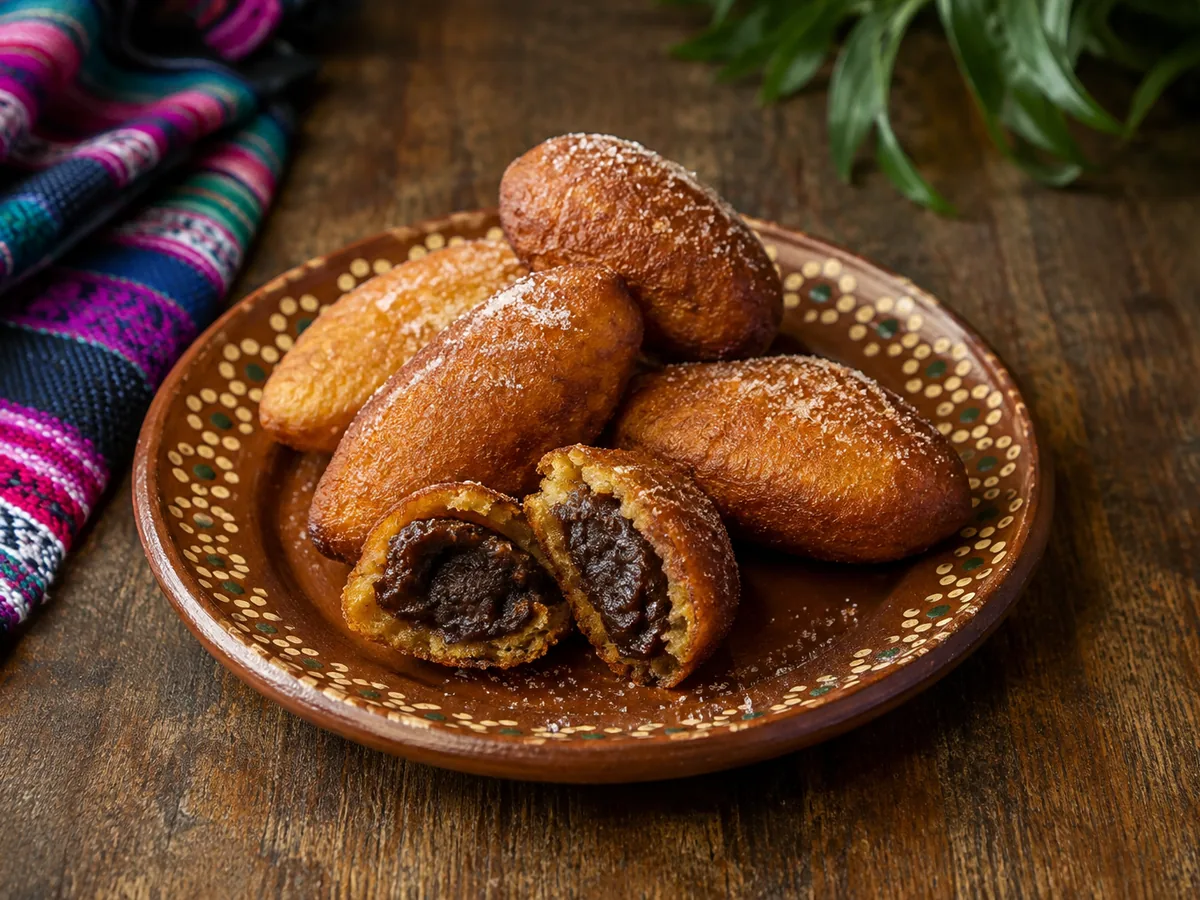
From the plazas of Quetzaltenango to the lanes of Antigua, the sweet perfume of rellenitos fills the afternoon air. They are Guatemala’s most beloved street-food sweet.
Very ripe, black-speckled plantains are boiled whole with a cinnamon stick, then mashed and kneaded into a smooth golden dough with no wheat flour at all. The filling is the revelation: refried black beans cooked down thick and sweetened with grated panela, artisanal drinking chocolate and ground canela.
Shaped by hand into smooth egg-shaped croquettes and dropped into hot oil until crisp and caramelised, they are dusted while still hot with sparkling cane sugar.
Plantain dough
- 1.2 kg4 largeVery ripe sweet plantains, skins heavily mottled black, trimmed and cut crosswise into 5 cm chunks
- 5 g1 stickCeylon cinnamon stick, for the boiling water
- 1 L4.2 cupsCold water
- 2 g½ tspFine sea salt
Chocolate bean filling
- 400 g1.5 cupsCooked black beans, puréed completely smooth
- 60 g⅓ cup packedGrated panela, or dark brown sugar
- 50 g1 tabletGuatemalan drinking chocolate (chocolate de pastilla con canela), finely grated
- 3 g1 tspGround Ceylon cinnamon
- 15 g1 TbspUnsalted European butter
To fry and finish
- 500 ml2.1 cupsNeutral corn or sunflower oil
- 60 g⅓ cupGranulated white cane sugar, for dusting
The skins must be mottled black
As plantains ripen, their amylases convert resistant starch into fructose and sucrose and the pectins soften. Yellow, under-ripe fruit has too much starch and too little sugar, and gives a dry, cracked croquette.
No flour, and none needed
Boiling in the jackets tenderises the cell walls; mashing while warm and kneading three minutes produces a smooth plastic dough bound entirely by gelatinised plantain starch.
The filling must pull away from the pan
Cook the beans with butter, panela and chocolate until the mass rolls away from the floor and sides in one piece — *frijoles volteados*. Any free water left in it turns to steam in the fryer and blows the croquette open.
175 °C, and no hotter
Above about 190 °C the high sugar content of ripe plantain blackens within a minute, leaving a burnt shell around a cold centre.
Check the seams
Roll each one smooth and look for cracks before it goes near the oil. A split seam empties the filling into the pan.
Passive time, counted separately
The mashed plantain cools to room temperature and the bean filling must be completely cold and firm before shaping. That sits outside the times quoted above.
The five tastes on this plate
Salt is a pinch in the plantain dough, sharpening the perception of its sugar. Fat is the frying oil building the caramelised shell and butter enriching the beans. Acid is mellow, with a faint lactic tang from the beans. Heat is the warm woodiness of Ceylon cinnamon in both dough and filling. Umami is slow-simmered black bean and cacao solids against the caramelised plantain.
Equipment
- 3 qt pot
- Potato masher and a wide bowl
- 10 in skillet, for the filling
- Heavy 10 to 12 in cast-iron skillet, for frying
- Slotted spoon and a shallow dish of sugar
Traditionally a clay pot for boiling and a deep iron paila over charcoal. A heavy 10-to-12-inch cast-iron skillet works in a modern kitchen — it holds 175 °C steadily, which is what stops the sugary plantain skin burning before the centre warms through.
Method
Boil and mash the plantains20 min
Put the plantain chunks — skins on — into a pot with the cinnamon stick, ½ tsp salt and 1 litre cold water.
Boil and simmer 15 minutes until the flesh is fork-tender and pulling from the skin. Drain, discard the cinnamon, and peel while hot.
Mash thoroughly, then knead by hand 3 minutes into a smooth, cohesive dough with no lumps. Cool to room temperature.
Boil skin-on plantain with cinnamon, ½ tsp salt and 1 litre cold water; simmer 15 minutes until tender and releasing from skins. Drain, discard cinnamon and peel hot. Mash thoroughly, knead 3 minutes until smooth and cohesive, then cool to room temperature.
Cook the chocolate bean filling10 min
Melt the 15 g butter in a skillet over medium-low and add the puréed beans, grated panela, grated chocolate and ground cinnamon.
Stir constantly 8 to 10 minutes until the sugar and chocolate melt and the beans thicken into a glossy paste that rolls away from the pan in a single mass. Cool completely.
Melt 15 g butter over medium-low. Add puréed beans, grated panela, chocolate and cinnamon; stir constantly 8–10 minutes until melted and thick enough to pull from the pan as one glossy mass. Cool completely until firm.
Shape and stuff15 min
Oil your hands lightly and divide the dough into 12 portions of about 70 g.
Flatten one in your palm into an oval disc 8 mm thick, spoon a generous tablespoon of cold filling into the centre, and bring the edges up and over, pinching tightly to enclose it.
Roll gently between your palms into a smooth egg shape and check the seams for cracks.
Oil hands lightly; divide dough into 12 portions, about 70 g. Flatten into 8 mm ovals, add a generous tablespoon cold filling and pinch closed. Roll into smooth egg shapes; check and seal all cracks before frying.
Fry16 min
Heat the 500 ml oil to 175–180 °C / 350–355 °F, about 2.5 cm deep.
Fry in batches of four without crowding, 3 to 4 minutes a side, rolling them gently, until deep golden-bronze with caramelised dark patches.
Heat the 500 ml oil to 175–180 °C / 350–355 °F, about 2.5 cm deep.
Fry in batches of four without crowding, 3 to 4 minutes a side, rolling them gently, until deep golden-bronze with caramelised dark patches.
Drain and sugar1 min
Lift onto paper towel and drain strictly 30 seconds, then roll immediately in granulated sugar while the surface is still hot enough to grab a sparkling crust.
Serve warm.
Lift onto paper towel and drain strictly 30 seconds, then roll immediately in granulated sugar while the surface is still hot enough to grab a sparkling crust.
Serve warm.
Sensory cues of doneness
- Visual: golden-bronze ovals with brittle caramelised edges under a dusting of sugar crystals, and a dark glossy filling inside.
- Auditory: a gentle lively crackle in the oil, and a crisp yield when bitten.
- Olfactory: caramelised plantain, toasted cinnamon, melted dark chocolate and fried sweet pastry.
Look for golden-bronze ovals with brittle caramelised edges, adhering sugar crystals and glossy dark filling. Expect a gentle frying crackle, a crisp bite, and aromas of caramelised plantain, cinnamon and melted chocolate.
Storing it
Shape and stuff them ahead, lay them on a parchment-lined tray, cover, and refrigerate up to 24 hours. Fry straight from the fridge.
Troubleshooting
- Dry, cracked croquettes.
The plantains were under-ripe. The skins need to be heavily mottled with black.
- Filling leaking into the oil.
The beans were too loose. Cook them down with butter and panela until the paste pulls away from the pan, and seal the seams carefully.
- Blackened outside, cold inside.
The oil was above 190 °C and the plantain sugars burned. Hold 175 °C.
Substitutions
One-to-one global substitutions, with the technique adjustment each one requires.
Ingredient substitutions
| Ingredient | Replace with | Culinary impact and technique adjustment |
|---|---|---|
| Ripe sweet plantains | No substitute — very ripe black-skinned plantains only | Ordinary bananas have too much water and no structural starch |
| Guatemalan chocolate tablet | Mexican drinking chocolate, or 70% dark with a pinch of cinnamon | One-to-one, grated fine |
| Panela | Dark brown sugar | One-to-one. Matches the rich cane molasses flavour |
Scaling
Half, for 6 rellenitos
Halve everything. Frying stays 3 to 4 minutes a side.
Double, for 24 rellenitos
Double everything and fry in batches of four so the oil temperature holds.
What to serve it with
- A drizzle of crema pura chapina — the salty cultured cream cuts the sweetness
- Hot black Antigua highland coffee
- Atol de plátano, spiced with cinnamon and clove
Questions
Can I fill them with custard instead?
Yes. Rellenitos de manjar, filled with a thick vanilla-cinnamon milk custard, are just as beloved.
Can they be air-fried?
You can, at 180 °C for about 12 minutes brushed with oil, but the signature brittle caramelised shell really comes from shallow frying.
Can I shape them ahead?
Yes — shape and stuff them, cover on a parchment-lined tray, and refrigerate up to 24 hours. Fry straight from cold.