Pollo en Crema y Loroco
From the dry cattle hills of Zacapa and Chiquimula, where the cream comes unpasteurised. Cultured crema curdles the moment it boils, so the sauce is held at a strict 80 °C sub-boil — and the loroco flower buds go in only for the last eight minutes, before their volatile terpenes can cook away.
- Prep
- 20 min
- Cook
- 35 min
- Serves
- 6 portions
- Difficulty
- Medium
Researched · Kitchen testing pending
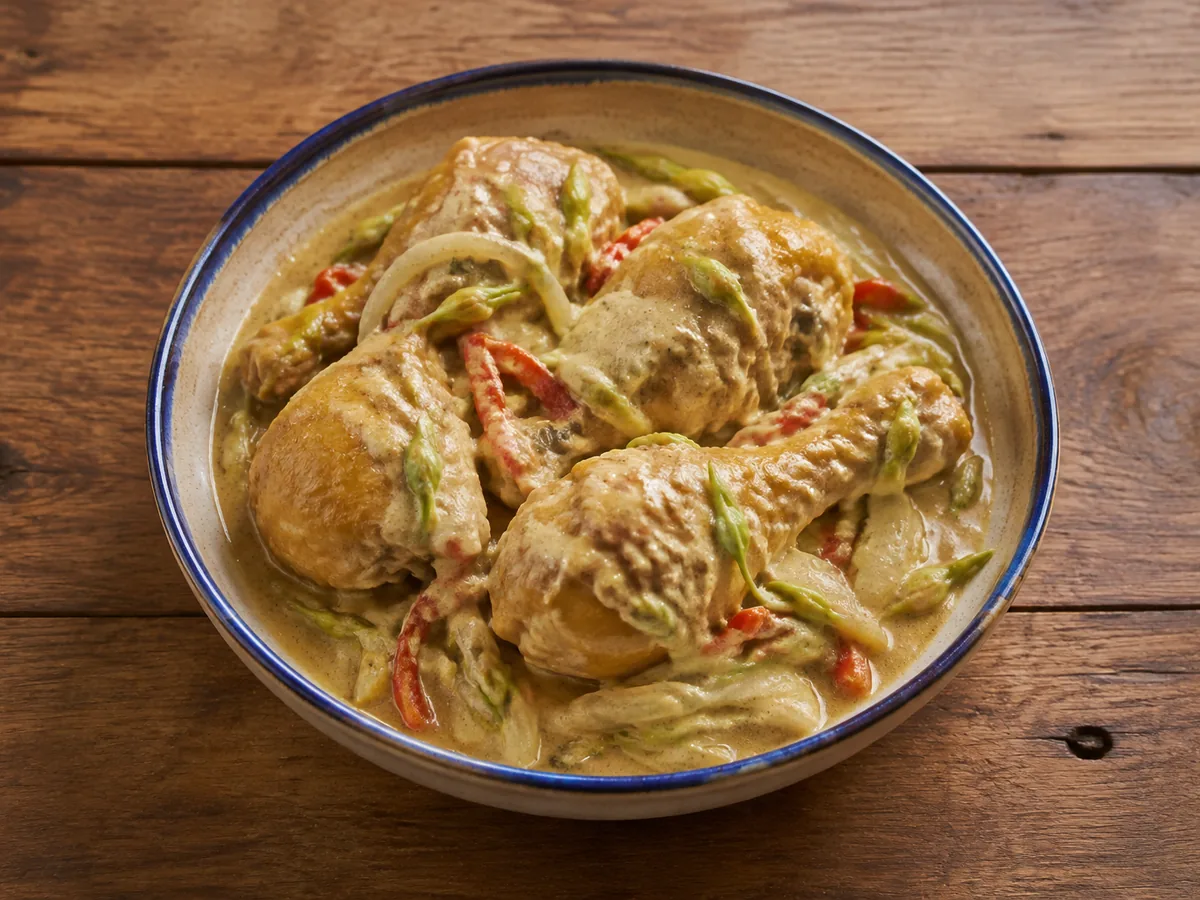
In the sun-baked eastern departments of Zacapa, Chiquimula and Jalapa, cattle graze dry hillsides and produce the rich unpasteurised dairy that defines eastern Guatemalan cooking.
Chicken is seared golden in butter, then simmered slowly in a velvety cream sauce with sweated onion, garlic and sweet red pepper. What lifts it is loroco — the unopened green flower buds of an indigenous Mesoamerican vine.
Tossed into the warm cream at the finish, the buds release an earthy, herbaceous, almost nutty perfume that runs through the whole sauce.
The chicken
- 1.5 kg3.3 lbBone-in, skin-on chicken thighs and drumsticks, trimmed and patted dry
- 45 g3 TbspUnsalted European butter, 82% butterfat
- 15 ml1 TbspExtra-virgin olive oil
- 10 g2 tspFine sea saltseasoned in stages
- 3 g1 tspFreshly ground white pepper
The sauce
- 1 large1 largeYellow onion, peeled and cut into fine 4 mm brunoise
- 4 cloves4 clovesFresh garlic, minced fine
- 1 large1 largeRed bell pepper, seeded and cut into fine 5 mm dice
- 240 ml1 cupRich chicken stock, warm
- 500 ml2.1 cupsCultured sour cream (crema pura), about 25% butterfat, at room temperature
- 1 g¼ tspNutmeg, freshly grated
To finish
- 150 g1.5 cups packedFresh or frozen loroco flower buds, stems trimmed and washed
- 20 g⅓ cupFresh cilantro leaves, chopped fine
Why it curdles, and how not to
Cultured cream is acidified to about pH 4.5–4.8. At a rolling boil the casein micelles clump and expel their serum, and the sauce breaks into white flecks and yellow oil. Temper the room-temperature crema with a little hot pan stock, pour it in slowly, and hold 80–82 °C throughout.
Loroco in the last eight minutes
The buds carry delicate monoterpenes and volatile sulphur compounds that break down under prolonged boiling. Eight minutes keeps them tender-crisp, dark green and perfumed; thirty makes them mush.
Use real crema
Commercial American sour cream is loaded with starch and gelatin and will not melt properly. Latin crema agria, Salvadoran crema or crème fraîche — anything at 25% butterfat or above resists breaking.
Dry skin, then sear
Pat the chicken completely dry and give the skin 6 to 7 undisturbed minutes. That fond is the backbone the stock later dissolves.
Pour off most of the fat
Leave about two tablespoons for the aromatics. More than that and the finished sauce is greasy.
Passive time, counted separately
The finished braiser rests 3 minutes before serving. That sits outside the times quoted above.
The five tastes on this plate
Salt seasons the seared chicken and balances the rich dairy. Fat is butter, chicken drippings and dense cultured cream. Acid is the lactic tang of the crema cutting the poultry fat. Heat is white pepper, sautéed garlic and sweet pepper. Umami is caramelised chicken fond, reduced stock and the nutty, artichoke-like depth of simmered loroco.
Equipment
- Wide 6 qt enamelled cast-iron braiser
- Wooden spoon
- Small bowl and whisk, for tempering
- Instant-read thermometer
Traditionally a clay olla over embers, which moderates the heat naturally and keeps cream from boiling over. A wide 6-quart enamelled braiser works in a modern kitchen — the width lets the chicken sear in one layer and the thick enamelled base spreads heat gently enough to stop the cream curdling.
Method
Sear the chicken10 min
Pat the chicken completely dry and season both sides with 1 tsp salt and the white pepper.
Melt the butter with the olive oil over medium-high and lay the pieces skin-side down. Sear undisturbed 6 to 7 minutes until golden and crisp, then 3 minutes on the flesh side. Onto a plate.
Dry chicken thoroughly; season with 1 tsp salt and white pepper. Melt butter with olive oil over medium-high. Sear skin-down undisturbed 6–7 minutes until crisp and golden, then flesh-side 3 minutes. Transfer to a plate.
Sweat the aromatics8 min
Pour off all but 2 tablespoons of the fat and drop the heat to medium.
Add the onion, garlic and red pepper and cook 6 to 8 minutes, scraping the fond off the bottom, until soft, translucent and sweet.
Pour off all but 2 tablespoons of the fat and drop the heat to medium.
Add the onion, garlic and red pepper and cook 6 to 8 minutes, scraping the fond off the bottom, until soft, translucent and sweet.
Deglaze and braise15 min
Pour in the 240 ml warm stock, stirring hard to dissolve every speck of fond.
Return the chicken with its resting juices, bring to a low simmer, cover, and cook over medium-low 15 minutes to about 70 °C / 158 °F.
Pour in the 240 ml warm stock, stirring hard to dissolve every speck of fond.
Return the chicken with its resting juices, bring to a low simmer, cover, and cook over medium-low 15 minutes to about 70 °C / 158 °F.
Fold in the cream3 min
Turn the burner to low.
Temper the room-temperature crema by whisking 3 tablespoons of hot pan stock into it, then pour it into the braiser in a slow stream, stirring gently in circles.
Season with the nutmeg and remaining salt, and hold strictly at a sub-boil, 80 °C / 176 °F.
Turn heat low. Whisk 3 tablespoons hot pan stock into room-temperature crema; pour in slowly, stirring gently. Add nutmeg and remaining salt. Hold strictly below boiling at 80 °C / 176 °F to prevent splitting.
Add the loroco8 min
Scatter the loroco buds across the sauce and push them gently under the surface around the chicken.
Simmer uncovered on low strictly 6 to 8 minutes, until the buds are tender-crisp and dark green and the chicken reads 77 °C / 170 °F. The sauce should coat a spoon.
Gently submerge loroco buds around chicken. Simmer uncovered on low strictly 6–8 minutes until buds are dark green and tender-crisp, chicken reaches 77 °C / 170 °F, and sauce coats a spoon.
Garnish and serve
Off the heat, rest 3 minutes, then scatter the cilantro over.
Serve straight from the braiser with steamed white rice and warm corn tortillas.
Off the heat, rest 3 minutes, then scatter the cilantro over.
Serve straight from the braiser with steamed white rice and warm corn tortillas.
Sensory cues of doneness
- Visual: a pale ivory velvety sauce flecked with bright green buds and red pepper dice, coating golden-brown chicken.
- Auditory: a quiet murmur of sub-boil bubbles — never an aggressive splattering boil.
- Olfactory: browned butter, sweet cream, cooked chicken, and the herbal, nutty, green-artichoke aroma of loroco.
Check for velvety ivory sauce with green loroco buds and red-pepper dice coating golden chicken. Keep only quiet sub-boil bubbles; expect browned butter, cream, chicken and herbal, nutty loroco aromas.
Troubleshooting
- The sauce breaks into curds and oil.
It boiled. Cultured cream must be tempered in and held at a sub-boil on low heat.
- Mushy, flavourless loroco.
It simmered too long. Add the buds for the final 6 to 8 minutes only.
- A grainy sauce that never comes together.
Commercial sour cream with starch and gelatin was used. Use real high-butterfat Latin crema or crème fraîche.
Substitutions
One-to-one global substitutions, with the technique adjustment each one requires.
Ingredient substitutions
| Ingredient | Replace with | Culinary impact and technique adjustment |
|---|---|---|
| Fresh loroco | Frozen loroco buds | One-to-one. Thaw and drain before they go into the cream |
| Crema pura chapina | Mexican crema agria, Salvadoran crema, or crème fraîche | One-to-one. 25% butterfat or higher is what stops it curdling |
| Bone-in thighs | Boneless skinless thighs, or a cut-up whole chicken | One-to-one, adjusting the braise time to the cut |
Scaling
Half, for 3 portions
Halve everything in a 3.5-quart braiser. Simmering times are unchanged.
Double, for 12 portions
Double everything in an 11-quart wide Dutch oven, searing the chicken in two batches so it browns rather than steams.
What to serve it with
- Arroz blanco chapín, to soak up the cream sauce
- Warm handmade corn tortillas, and frijoles negros parados with epazote
- A cold Gallo, or a crisp mineral Sauvignon Blanc
Questions
What does loroco taste like?
Something between green artichoke heart, asparagus and broccoli rabe, with an edible-floral note and a nutty undertone. There is nothing quite like it.
Where do I find it outside Guatemala?
The freezer section of Latin American grocers — frozen whole loroco buds are widely exported and keep their flavour and texture well.
Can I use chicken breast?
You can, but boneless breast dries out past 68 °C. Cut the braise to 8 minutes before the cream and loroco go in.