Chuchitos
Steam billowing from blanket-wrapped pots in every highland market. The tamal's smaller, firmer sibling — raw masa kneaded with lard rather than pre-cooked, so it sets into something sliceable, tied into a corn-husk pouch like a tiny drawstring sack, and served drowned in tomato sauce and dry salty cheese.
- Prep
- 45 min
- Cook
- 1 hr 15 min
- Serves
- 20 chuchitos
- Difficulty
- Medium
Researched · Kitchen testing pending
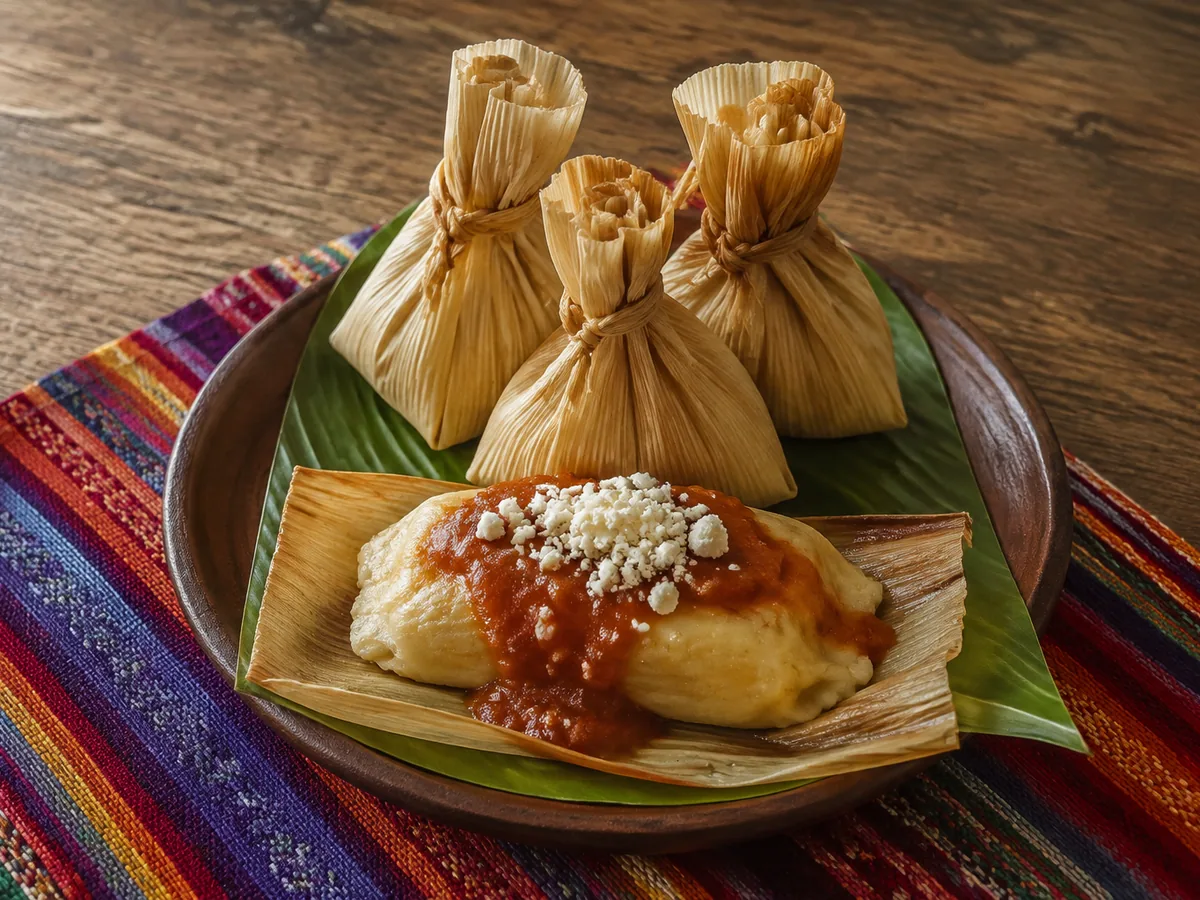
Across highland markets, village fiestas and street corners, steam billows from giant metal pots wrapped in thick blankets: the chuchitos are ready.
A beloved sibling to the festive tamal, they are smaller, firmer, handheld parcels of corn masa enriched with melted lard and savoury broth. Inside each one is a morsel of tender pork shoulder coated in a thick cooked tomato-and-chilli recado.
Wrapped in dried corn husks and tied at the top with a thin strip like a tiny drawstring purse, they steam for an hour until firm and fragrant, then arrive unwrapped under warm tomato sauce and a dusting of salty queso duro de Zacapa.
The masa
- 1 kg2.2 lbFresh nixtamalised corn masa, or 500 g masa harina whisked with 750 ml warm broth
- 180 g¾ cup + 1 TbspRendered pork lard, or vegetable shortening, softened
- 15 g1 TbspFine sea salt, seasoned boldly into the dough
- 60 ml¼ cupRich chicken or pork stock, to adjust the hydration
The filling
- 600 g1.32 lbBoneless pork shoulder, or chicken thigh, cut into 20 uniform 30 g nuggets
The recado
- 600 g4 largeRipe plum tomatoes, charred on the comal
- 150 g4 mediumGreen miltomates (tomatillos), husked, washed and charred
- 2 pieces2 piecesDried chile guaque, stemmed, seeded and toasted
- 1 piece1 pieceDried chile pasa, stemmed, seeded and toasted
- 1 medium1 mediumYellow onion, charred on the comal
- 4 cloves4 clovesFresh garlic, charred in the skin and peeled
- 30 g¼ cupRaw pepitoria seeds, toasted and ground fine
- 30 g2 TbspWhite sesame seeds, toasted and ground fine
- 15 g1 TbspAchiote paste, for the orange-red colour
- 4 whole4 wholeAllspice berries, ground
- 15 ml1 TbspPork lard or oil, for frying the recado
To wrap and serve
- 30 to 4030 to 40Dried corn husks (tuzas), soaked in warm water 30 minutes until pliable
- 1 recipe1 recipeWarm cooked tomato salsa, and finely grated queso duro de Zacapa or Cotija
Raw masa, and firm
This is the opposite of tamales colorados. The dough stays raw and relatively dry — roughly 50% hydration — so that inside the husk the amylose gelatinises in place and knits into a cohesive, sliceable dumpling. Wet dough collapses into mush.
Lard coats the starch
Kneaded in for a full 6 to 8 minutes, softened lard coats each starch granule. The dough should feel supple, smooth and slightly greasy, holding its shape like soft modelling clay without sticking.
Why corn husks and not leaves
Tuzas are water-permeable but steam-resistant. Steam passes through the fibre to cook the pork to 74 °C while excess surface water drains away, so the dumpling never turns soggy.
Tie it tightly
The masa expands as it steams. A loose tie lets water in, and the water washes the recado straight out of the parcel.
Soak the husks properly
Thirty minutes in warm water. Brittle dry husks split along the grain the moment you fold them.
Passive time, counted separately
The husks soak 30 minutes, the recado cools completely before assembly, and the steamed chuchitos rest 10 minutes. None of that is active work.
The five tastes on this plate
Salt is seasoned into the lard-rich masa and the recado. Fat is lard kneaded through the corn and pork juices basting the core. Acid is tart miltomate and plum tomato against the rich corn. Heat is earthy guaque, toasted allspice and charred garlic. Umami is pork fond, toasted pumpkin-seed protein and dry aged cheese.
Equipment
- Cast-iron comal
- Blender
- Saucepan, for frying the recado
- Large mixing bowl
- 12 to 16 qt stockpot with a steamer basket
- Large bowl, for soaking husks
Traditionally a large aluminium tamalera lined with soaked tuzas. A 12-to-16 quart stockpot with a metal steamer basket works in a modern kitchen — line the basket with wet husks so boiling water cannot splash the bottom dumplings.
Method
Cook the recado25 min
Toast the guaque and pasa 15 seconds a side and soak in 200 ml hot water 15 minutes. Char the tomatoes, miltomates, onion and garlic until blackened, and grind the toasted pepitoria and sesame fine.
Blend everything with the achiote, allspice and 1 tsp salt for 90 seconds into a thick red purée.
Fry it in 15 ml lard over medium heat 6 minutes until thick and glossy, and cool completely.
Toast guaque and pasa 15 seconds per side; soak in 200 ml hot water 15 minutes. Char tomatoes, miltomates, onion and garlic; peel garlic. Grind toasted seeds. Blend everything with achiote, allspice and 1 tsp salt 90 seconds. Fry in 15 ml lard over medium 6 minutes until thick and glossy; cool completely.
Knead the masa10 min
Combine the masa, the 180 g softened lard and 15 g salt and knead vigorously by hand 6 to 8 minutes, adding 2 to 4 tablespoons of warm stock only if needed.
It should be supple, smooth and slightly greasy, holding its shape without sticking to your fingers.
If using masa harina, mix 500 g with 750 ml warm broth first. Knead masa, 180 g softened lard and 15 g salt 6–8 minutes. Add 2–4 tablespoons warm stock only if needed; dough should hold its shape, smooth and slightly greasy.
Prepare the husks5 min
Drain the soaked husks and pat them dry. Choose 20 wide, untorn ones, and shred a few narrow husks into 5 mm strips to use as ties.
Soak husks in warm water 30 minutes until pliable. Drain and pat dry; select 20 wide, intact husks. Tear narrower husks into 5 mm strips for tying the parcels.
Stuff and shape20 min
Divide the masa into 20 balls of about 60 g. Cup one in your hand and press a deep hollow with your thumb.
Set a raw seasoned pork nugget inside, spoon over a generous tablespoon of cold recado, then bring the masa up and over and pinch it tightly shut so the meat is completely enclosed.
Divide masa into 20 balls of about 60 g; hollow each with your thumb. Add a raw seasoned pork nugget and a generous tablespoon of cold recado. Bring masa over filling and pinch firmly to enclose meat completely.
Wrap and tie the pouch15 min
Lay a softened husk flat, wide end toward you, and set the ball in the centre.
Fold both sides over it snugly, gather the excess above the ball, twist slightly, and tie tightly with a husk strip like a little drawstring sack. Trim the fibres neatly. Repeat for all 20.
Place a ball centrally on a softened husk, wide end towards you. Fold sides snugly, gather and twist husk above filling, then tie tightly with a husk strip. Trim fibres; repeat for all 20.
Steam1 hr 15 min
Set a rack in the stockpot with 1 litre of boiling water beneath it, and line it with leftover wet husks.
Stand the chuchitos upright, tied ends up, packed snugly. Cover with more wet husks, seal with foil and the lid, and steam over medium-low 1 hour 15 minutes.
Rest 10 minutes off the heat.
Place 1 litre boiling water below the rack; line with wet husks. Pack chuchitos upright, ties up; cover with wet husks, foil and lid. Steam on medium-low 1 hour 15 minutes until meat reaches 74 °C. Rest off heat 10 minutes.
Unwrap and dress
Unwrap onto plates, spoon warm cooked tomato salsa over, and dust with grated queso duro. Serve hot.
Unwrap onto plates, spoon warm cooked tomato salsa over, and dust with grated queso duro. Serve hot.
Sensory cues of doneness
- Visual: a firm pale-yellow dumpling that releases cleanly from the husk with no sticking, and red-glazed pork at the centre.
- Auditory: the rhythmic bubbling of water under the covered pot.
- Olfactory: sweet steamed corn husk, warm pork lard, toasted sesame, allspice and charred tomato.
Check for firm pale-yellow dumplings releasing cleanly from their husks, with red-coated pork inside. Keep rhythmic bubbling below the rack; expect steamed corn husk, lard, sesame, allspice and charred tomato aromas.
Troubleshooting
- The dumpling collapses into mush.
The masa was too wet. Chuchitos need a firm dough, not the soft porridge of a tamal colorado.
- Washed-out, watery parcels.
The ties were loose and water got in. Tie the husk strip tightly — the masa expands as it steams.
- Husks splitting as you fold them.
They were not soaked. Warm water for at least 30 minutes until pliable.
Substitutions
One-to-one global substitutions, with the technique adjustment each one requires.
Ingredient substitutions
| Ingredient | Replace with | Culinary impact and technique adjustment |
|---|---|---|
| Fresh masa | Masa harina whisked with warm broth | 500 g masa harina with 750 ml broth replicates 1 kg fresh masa |
| Queso duro de Zacapa | Cotija, or another dry salty aged cheese | One-to-one, grated fine over the tomato sauce |
| Rendered pork lard | Vegetable shortening | One-to-one, and it gives an authentic texture for a meat-free version |
Scaling
Half, for 10 chuchitos
Halve everything. The steam stays 1 hour 15 minutes.
Double, for 40 chuchitos
Double everything and use two pots, or steam in two batches so the dumplings stand upright and packed rather than tipping.
What to serve it with
- Warm cooked tomato and onion salsa spooned over each unwrapped chuchito
- Grated queso duro de Zacapa, and frijoles negros volteados on the side
- Café de olla with cinnamon, or a cold Cabro Extra
Questions
What is the difference between a tamal and a chuchito?
Tamales colorados are large, soft, custardy parcels of pre-cooked masa in banana leaves. Chuchitos are smaller, firmer handheld dumplings of raw lard-kneaded masa wrapped in dried corn husks and tied like a pouch.
Can I make them with chicken?
Yes. Use boneless thigh cut into 30 g nuggets and assemble exactly the same way.
Can I freeze them?
Yes — steam them fully, cool, and freeze in their husks. Re-steam for about 25 minutes from frozen.