Enchiladas Guatemaltecas
Nothing rolled and nothing baked — these are towering open-faced tostadas. A bone-dry lettuce leaf goes on first as a hydrophobic shield, so the vinegary beet curtido never touches the fried corn and the base stays shattering-crisp down to the last bite.
- Prep
- 45 min
- Cook
- 30 min
- Serves
- 12 large enchiladas
- Difficulty
- Medium
Researched · Kitchen testing pending
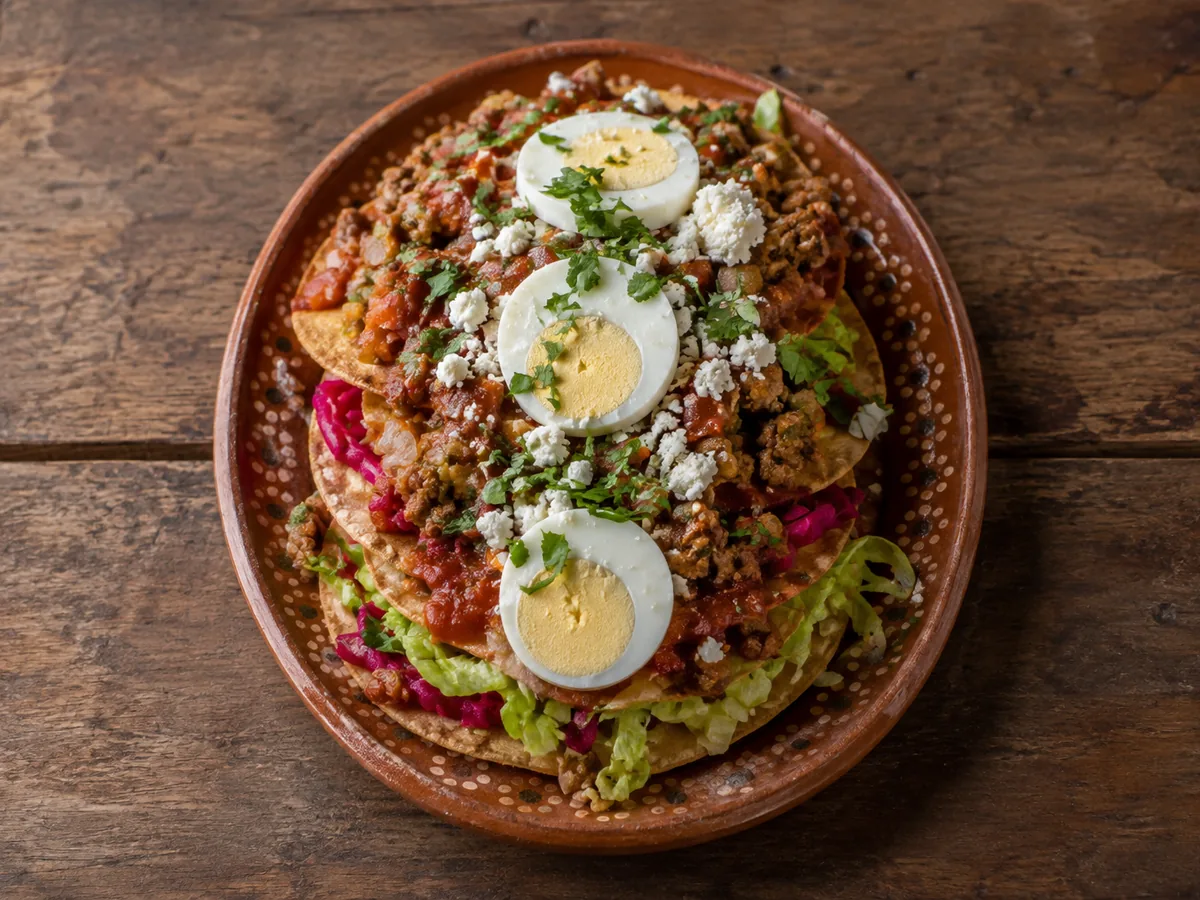
Unlike rolled Mexican enchiladas baked in sauce, the Guatemalan version is a towering open-faced tostada — a street-food and Sunday-family classic across Guatemala City and Quetzaltenango.
The foundation is a thick, ultra-crisp freshly fried corn tostada. A green lettuce leaf acts as a moisture shield. Over it goes curtido de remolacha: cabbage, green beans and carrots steeped in vinegar, bay and roasted beets that stain everything a radiant ruby-magenta. Then warm beef picadillo simmered with potato and carrot, and a ladle of cooked tomato recado.
It is crowned with a slice of hard-boiled egg, raw onion rings, cilantro and a blizzard of dry, salty aged queso duro de Zacapa.
Beet curtido
- 500 g4 mediumFresh red beets, boiled tender in their skins, peeled and cut into 3 mm matchsticks
- 400 g4 cups shreddedGreen cabbage, shredded into 3 mm ribbons and blanched 60 seconds
- 200 g1.5 cupsGreen beans (ejotes), cut into fine matchsticks and blanched tender-crisp
- 200 g1.5 cupsCarrots, peeled, cut into fine matchsticks and blanched tender-crisp
- 180 ml¾ cupCane vinegar, or white wine vinegar
- 60 ml¼ cupBeet boiling water, the concentrated natural dye
- 2 whole2 wholeBay leaves
- 3 g1 TbspDried wild oregano, hand-crushed
Picadillo and salsa
- 500 g1.1 lbLean ground beef chuck, or a half beef and half pork mix
- 1 large1 largeYellow onion, minced into 4 mm brunoisedivided between the picadillo and the salsa
- 4 cloves4 clovesFresh garlic, minced to a paste
- 200 g1.5 cupsPotatoes, peeled and cut into fine 5 mm dice
- 100 g¾ cupSweet green peas, cooked
- 800 g5 largeRipe plum tomatoes, peeled, seeded and puréed
- 20 g1 Tbsp + 1 tspFine sea saltdivided across the curtido, picadillo and salsa
To assemble
- 12 whole12 wholeFresh corn tortillas, to fry into rigid tostadas
- 500 ml2.1 cupsNeutral vegetable oil
- 12 leaves12 leavesCrisp butterhead or romaine lettuce, washed and spun bone-dry
- 3 large3 largeHard-boiled eggs, peeled and sliced into rounds
- 1 large1 largeRed onion, cut into paper-thin rings
- 100 g1 cup packedQueso duro de Zacapa, or Cotija, finely grated
- 20 g⅓ cupFresh flat-leaf parsley, chopped fine
The lettuce leaf is structural
Laid bone-dry directly on the fried tortilla it is a physical, hydrophobic barrier. The wet acidic curtido then rests on the lettuce rather than the corn wafer, and no moisture migrates into the fried starch.
Acid is what fixes the colour
Beet betacyanins glow vivid magenta between about pH 4.0 and 4.5. Pickling the blanched vegetables in cane vinegar with the concentrated beet water stabilises the pigment and stains everything ruby without softening the pectin walls to mush.
Sixty seconds, no more
Cabbage, beans and carrots are blanched only briefly and shocked in ice water, so they stay audibly crisp inside the pickle.
The picadillo must finish dry
Uncover it for the last two minutes and drive off every loose juice. Watery meat defeats the lettuce barrier.
Shake the brine off
Lift the curtido with tongs and let the dripping vinegar fall back into the bowl before it goes on the tostada, or it floods the plate.
Passive time, counted separately
The curtido chills at least 4 hours, and ideally overnight, turning a uniform glowing magenta. That sits outside the times quoted above.
The five tastes on this plate
Salt is the seasoned picadillo and the briny aged cheese. Fat is the fried corn tostada, rendered beef fat and egg yolk. Acid is cane vinegar and beet pickling juice slicing through the fried starch. Heat is raw red onion, garlic, cracked pepper and wild oregano. Umami is caramelised beef fond, cooked tomato recado and dry aged cheese.
Equipment
- Pot, for boiling the beets
- Non-reactive glass or ceramic bowl
- Skillet, for the picadillo
- Saucepan, for the salsa
- 12 in heavy cast-iron skillet, for frying
- Metal spatula and tongs
Traditionally a cast-iron paila for the tostadas and clay bowls for the curtido. A 12-inch cast-iron skillet works in a modern kitchen, and the marinating bowl must be glass or ceramic — acidic beet brine discolours in metal.
Method
Make the ruby curtido — hours ahead45 min
Boil the whole unpeeled beets in 1 litre of salted water 35 to 40 minutes until fork-tender. Reserve 60 ml of the beet water, then peel them under cold running water and cut into 3 mm matchsticks.
Blanch the cabbage, beans and carrots 60 seconds, plunge into ice water and drain bone-dry.
Toss everything in a glass bowl with the vinegar, beet water, bay, oregano and 10 g salt, and chill at least 4 hours, turning twice, until uniformly magenta.
Boil unpeeled beets in 1 litre salted water 35–40 minutes until tender; reserve 60 ml water. Peel under cold water; cut 3 mm matchsticks. Blanch cabbage, beans and carrots 60 seconds, ice-shock and drain thoroughly. Toss in glass with vinegar, beet water, bay, oregano and 10 g salt; chill at least 4 hours, turning twice, until magenta.
Cook the picadillo24 min
Heat 30 ml oil over medium and cook half the onion with half the garlic 4 minutes until translucent.
Add the beef, breaking it into fine crumbs, and brown 8 minutes.
Add the diced potato, peas, 5 g salt and pepper, cover, and cook on low 10 minutes until tender. Uncover and cook 2 minutes more until dry.
Heat 30 ml oil over medium; cook half the onion and garlic 4 minutes until translucent. Crumble in beef; brown 8 minutes. Add potato, peas, 5 g salt and pepper. Cover; cook on low 10 minutes until tender. Uncover 2 minutes until dry.
Simmer the tomato recado18 min
Heat 15 ml oil in a saucepan and sauté the remaining onion and garlic 3 minutes.
Add the puréed tomatoes with oregano, 5 g salt and a pinch of sugar, and simmer uncovered over medium-low 15 minutes until thick and spoonable.
Heat 15 ml oil in a saucepan and sauté the remaining onion and garlic 3 minutes.
Add the puréed tomatoes with oregano, 5 g salt and a pinch of sugar, and simmer uncovered over medium-low 15 minutes until thick and spoonable.
Fry the tostadas20 min
Heat 400 ml oil to 185 °C / 365 °F.
Fry the tortillas one at a time, pressing flat with a spatula so they cannot curl, 90 seconds a side, until rigid, blistered and golden-amber. Drain upright and salt lightly.
Heat 400 ml oil to 185 °C / 365 °F. Fry tortillas individually, pressing flat with a spatula, 90 seconds per side until rigid, blistered and golden-amber. Drain upright and salt lightly.
Assemble, at the last moment
Lay a tostada on each plate and put a dry lettuce leaf directly on it.
With tongs, lift a bundle of curtido, shake off the dripping vinegar, and mound it over the lettuce. Spoon 3 tablespoons of warm picadillo over, then 2 tablespoons of warm tomato recado.
Place a dry lettuce leaf on each tostada. Lift curtido with tongs and shake off vinegar before adding. Top with 3 tablespoons warm picadillo and 2 tablespoons warm tomato recado.
Crown it
Centre a round of hard-boiled egg, lay two paper-thin red onion rings over it, dust heavily with grated queso duro, and scatter parsley across the crest.
Serve immediately.
Centre a round of hard-boiled egg, lay two paper-thin red onion rings over it, dust heavily with grated queso duro, and scatter parsley across the crest.
Serve immediately.
Sensory cues of doneness
- Visual: a stratified tower — golden tostada, green lettuce rim, magenta curtido, brown picadillo, red salsa, white egg with yellow yolk, and a snow of cheese.
- Auditory: a resounding crunch on the first bite, and the crisp snap of the pickled vegetables.
- Olfactory: fried corn, sharp cane vinegar, sweet beet, stewed beef and pungent aged cheese.
Keep distinct layers of golden tostada, green lettuce, magenta curtido, brown beef, red salsa, egg and grated cheese. The shell and vegetables should crunch; expect fried corn, vinegar, beet, stewed beef and aged cheese aromas.
Storing it
The beet curtido keeps refrigerated in a sealed glass jar for up to 2 weeks on its vinegar and salt alone, and improves every day.
Troubleshooting
- A soggy base.
The curtido went straight onto the tortilla without the lettuce barrier, or the plates sat before serving. Assemble immediately before eating.
- Vinegar flooding the plate.
The brine was not shaken off. Lift with tongs and drain each bundle.
- Soft, limp pickled vegetables.
They were boiled rather than blanched. Sixty seconds, then straight into ice water.
Substitutions
One-to-one global substitutions, with the technique adjustment each one requires.
Ingredient substitutions
| Ingredient | Replace with | Culinary impact and technique adjustment |
|---|---|---|
| Queso duro de Zacapa | Cotija, aged Parmigiano-Reggiano, or dry feta | One-to-one. The same dry, crumbly, salty finish |
| Cane vinegar | Distilled white or cider vinegar | One-to-one. Clean, sharp pickling acidity |
| Fresh beets | No substitute — canned beets lack the crisp texture | Always boil fresh beets for the colour and the earthy sweetness |
Scaling
Half, for 6 enchiladas
Halve everything. Frying and cooking times are unchanged.
Double, for 24 enchiladas
Double everything and set up an assembly line — tostadas, lettuce, curtido, picadillo, salsa, garnishes — because they must be built to order.
What to serve it with
- A gravy boat of extra warm tomato recado for anyone who wants more
- Ground chile cobanero, for pungent smoky heat
- Cinnamon horchata to soothe the vinegar, or a cold Gallo
Questions
Why are they called enchiladas if nothing is rolled in chilli sauce?
In Guatemala the word describes an elaborate open-faced toasted corn preparation layered with pickled salad and meat, named for the spiced chilli recado spooned over the top.
Can they be vegetarian?
Yes. Drop the picadillo and use sautéed mushrooms, or potatoes with peas, or simply more curtido.
How long does the beet curtido keep?
Up to two weeks refrigerated in an airtight glass jar, thanks to the vinegar and salt — and it gets better as it goes.