Subanik
The supreme ceremonial offering of Kaqchikel San Martín Jilotepeque, served at weddings, baptisms and cofradía feasts. Beef, pork and chicken are sealed raw with a five-chilli recado inside a bundle of mashán leaves and steamed — the parcel works as a pressure vessel, and nothing escapes it.
- Prep
- 45 min
- Cook
- 1 hr 45 min
- Serves
- 8 ceremonial portions
- Difficulty
- Hard
Researched · Kitchen testing pending
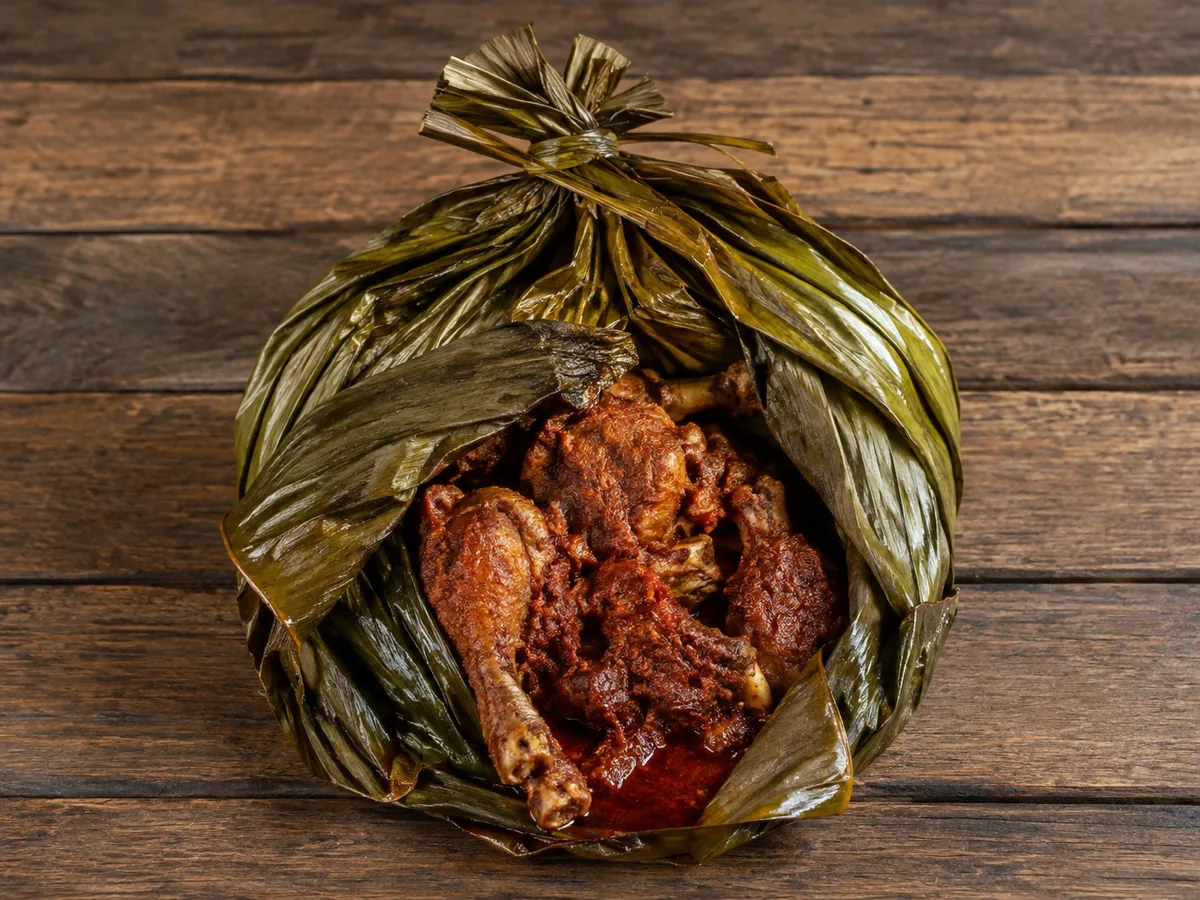
In the ancestral Kaqchikel municipality of San Martín Jilotepeque, subanik is the supreme ceremonial offering — served at weddings, baptisms and cofradía feasts as the union of community and earth.
It combines three meats: beef chuck, pork shoulder and bone-in chicken thigh. What makes it unique is the architecture. The raw meats and a multi-chilli recado are wrapped entirely inside overlapping broad green mashán leaves and tied at the top with cibaque reed into a single botanical package.
Steamed inside a heavy pot over a bed of corn husks, the wrapper works as a pressure vessel — infusing the meat with the leaves’ herbal waxes and trapping every drop of the chilli broth.
The three meats
- 600 g1.32 lbBeef chuck roast, trimmed and cut into 4 cm cubes
- 600 g1.32 lbBoneless pork shoulder, cut into 4 cm cubes
- 600 g1.32 lbBone-in, skin-on chicken thighs, halved
The five chillies
- 3 pieces3 piecesDried chile guaque, stemmed and seeded
- 3 pieces3 piecesDried chile pasa, stemmed and seeded
- 2 pieces2 piecesDried chile zambo, or ancho, stemmed and seeded
- 2 pieces2 piecesFresh red bell pepper (chile pimiento), cored and diced
- 2 pieces2 piecesDried chile cobanero, whole
The recado
- 800 g5 largeRipe plum tomatoes, charred on the comal
- 300 g8 mediumGreen miltomates (tomatillos), husked, washed and charred
- 2 large2 largeYellow onions, chopped coarse
- 8 cloves8 clovesFresh garlic, peeled
- 15 g1 TbspArtisanal achiote paste
- 60 g½ cupRaw pepitoria seeds, toasted pale golden and ground fine
- 40 g2½ TbspFresh corn masa, slaked in 60 ml water
- 6 whole6 wholeAllspice berries, ground
- 3 whole3 wholeCloves, ground
- 20 g1 Tbsp + 1 tspFine sea salt
- 3 g1 tspFreshly ground black peppercorn
The parcel
- 12 large12 largeFresh mashán leaves (Calathea lutea), or smoked banana leaves, cleaned and dried
- 1 roll1 rollCibaque reed fibre strips, or unbleached cotton kitchen twine
- 100 g1 cupDried corn husks (tuzas), to line the pot floor
The parcel is the cooking vessel
Sealed inside overlapping leaves in a closed pot, the interior reaches 98–100 °C under positive steam pressure. Vapour cannot escape; it condenses on the leaf dome above and rains continuously back over the meat, which is why nothing dries and nothing is lost.
Why the leaves matter
Mashán and banana leaves carry cuticular waxes and polyphenols. Under steam those volatile compounds infuse the recado and give the earthy, tea-like aroma that defines subanik. Braised without them the dish is good; it is just not this.
Three meats, three rates
Each tenderises at its own pace inside the same parcel — the chicken stays moist while pork shoulder and beef chuck collagen hydrolyse into gelatin. Using one meat alone turns this into an ordinary pepián.
Five chillies, five jobs
Guaque for sweetness, pasa for dark fruit, pimiento for fresh vegetal aroma, zambo for earthy depth, and cobanero for wood-smoked heat. It is a layered structure, not a quantity of heat.
Do not let the pot boil dry
The water sits just below the top of the corn-husk cushion. If it evaporates the bottom leaves scorch and the whole stew tastes burnt. Keep the burner at its lowest.
Passive time, counted separately
The dried chillies soak 15 minutes before blending. That sits outside the times quoted above.
The five tastes on this plate
Salt seasons the raw meats and the recado. Fat is rendered pork, beef marrow and chicken skin basting the sealed parcel. Acid is charred miltomate and tomato against dense meat. Heat is layered across the five chillies. Umami is the synergy of three collagens dissolving together in leaf steam.
Equipment
- 8 to 10 qt enamelled cast-iron Dutch oven with a heavy lid
- Cast-iron skillet, as the comal
- Blender
- Kitchen twine
- Wide deep serving platter
Traditionally a deep unglazed clay cauldron lined with corn husks under a tight clay lid. An 8-to-10 quart enamelled cast-iron Dutch oven works in a modern kitchen — the heavy lid traps the steam completely, which is what keeps the water reservoir from boiling dry across the 1 hour 45 minute braise.
Method
Toast the chillies, char the aromatics18 min
On a dry skillet over medium heat, toast the guaque, pasa and zambo 15 seconds a side until fragrant, then soak them in 250 ml hot water for 15 minutes.
In the same pan char the tomatoes, miltomates, onions, bell pepper and garlic until blackened in spots, and toast the whole cobaneros for 30 seconds.
Toast guaque, pasa and zambo in a dry skillet over medium 15 seconds per side; soak in 250 ml hot water 15 minutes. Char tomatoes, miltomates, onion, bell pepper and garlic in the same pan. Toast whole cobaneros 30 seconds.
Blend the five-chilli recado5 min
Blend the charred vegetables, the soaked chillies with their water, the cobaneros, achiote, ground pepitoria, masa slurry, allspice, cloves, salt and pepper on high for 90 seconds.
It should be thick, smooth and crimson — complex, savoury and spicy.
Blend charred vegetables, soaked chillies with water, cobaneros, achiote, ground toasted pepitoria, masa slaked in 60 ml water, allspice, cloves, salt and pepper on high 90 seconds until smooth, thick and crimson.
Line the pot, lay the leaves8 min
Spread a 2 cm bed of dried corn husks across the bottom of the Dutch oven and pour in 350 ml water, so the level sits just below the top of the husks.
On the counter, arrange 8 large leaves in a star, overlapping generously in the centre with the ends hanging outward.
Spread a 2 cm bed of dried husks in the pot; add 350 ml water, just below the husk surface. Arrange 8 large leaves in a star on the counter, overlapping centres generously with ends extending outward.
Fill and tie the parcel10 min
Season the cubed beef, pork and chicken lightly and pile them all in the centre of the leaf star.
Pour the entire recado over, turning gently so every piece is submerged.
Fold the flaps up and over, overlapping tightly so nothing can leak, and tie the top firmly with reed fibre or twine like a drawstring bundle. Lower it onto the corn-husk bed.
Lightly season beef, pork and chicken; pile in the leaf centre. Add all recado, turning to coat and submerge meat. Fold leaves tightly over filling without gaps; tie firmly into a bundle. Lower onto the husk bed.
Enclosed steam braise1 hr 45 min
Lay the remaining 4 leaves over the parcel and clamp the heavy lid on.
Bring to a boil over medium — about 8 minutes, until you hear the water working — then drop to the lowest setting and braise 1 hour 45 minutes undisturbed.
Do not lift the lid for the first 90 minutes.
Cover parcel with remaining 4 leaves and a tight lid. Boil over medium about 8 minutes until audible, then cook on lowest heat 1 hour 45 minutes. Keep lid closed for the first 90 minutes; do not let the water bed dry out.
Open it at the table
Lift the parcel onto a wide deep platter, cut the twine and fold the leaves back like petals — the steam billows out.
The beef should read 93 °C / 200 °F and yield like butter. Ladle the meats and crimson sauce into deep bowls with white rice and tamalitos.
Lift parcel to a deep platter. Cut ties and open leaves carefully, avoiding billowing steam. Check beef reaches 93 °C / 200 °F and yields easily. Serve meats and crimson sauce in bowls with rice and tamalitos.
Sensory cues of doneness
- Visual: steam pouring from the opened bundle over glistening fork-tender meats in a thick deep-crimson recado.
- Auditory: muffled bubbling from the water bed beneath, and a sigh of escaping steam when the twine is cut.
- Olfactory: hot banana leaf, wood-smoked cobanero, allspice, roasted pumpkin seed and braised meat.
Check for glistening fork-tender meats in thick crimson sauce as steam escapes the opened parcel. Listen for muffled bubbling beneath; expect hot banana leaf, smoked cobanero, allspice, pumpkin seed and braised meat aromas.
Troubleshooting
- A scorched, burnt-tasting stew.
The water beneath the husks evaporated and the bottom leaves burned. Keep the heat at its lowest and check the level in a light pot.
- The sauce leaks into the water.
There were gaps in the leaf star. Overlap generously and tie the bundle firmly.
- It tastes like an ordinary red stew.
Only one meat was used. The depth comes from beef, pork and poultry collagen dissolving together.
Substitutions
One-to-one global substitutions, with the technique adjustment each one requires.
Ingredient substitutions
| Ingredient | Replace with | Culinary impact and technique adjustment |
|---|---|---|
| Mashán leaves | Smoked banana leaves | One-to-one. Wipe clean and soften over a flame before folding |
| Chile zambo | Mexican ancho | One-to-one. The same sweet, raisin-like earthiness |
| Cibaque reed | Unbleached cotton kitchen twine | One-to-one, tied securely |
Scaling
Half, for 4 portions
Halve everything in a 5-quart Dutch oven. The braise stays 1 hour 45 minutes — the beef chuck needs it.
Double, for 16 portions
Double everything and make two separate parcels in two 8-quart Dutch ovens side by side.
What to serve it with
- Tamalitos blancos de masa, steamed in fresh leaves
- Steamed white rice, and ripe Hass avocado
- Fresco de chilacayote, or aged Guatemalan rum sipped neat
Questions
What are mashán leaves?
*Calathea lutea* — a broad waxy tropical leaf native to Mesoamerica, prized for the sweet, herbal, tea-like fragrance it gives steamed stews and tamales. Smoked banana leaves substitute well.
Why five different chillies?
Kaqchikel cooking layers them: guaque for sweetness, pasa for dark fruit, pimiento for fresh vegetal aroma, zambo for earthy depth, cobanero for wood-smoked heat.
Can I make it without leaves?
You can braise it directly in a tightly sealed Dutch oven, but you lose the botanical aroma the leaves impart, which is much of the point.