Jocón de Pollo
The K'iche' name means roughly "five green ingredients", and keeping it green is the whole discipline. Chlorophyll loses its magnesium to acid and prolonged heat and turns olive-drab, so the herbs go in raw at the end and the sauce simmers strictly eight to ten minutes, never boiling.
- Prep
- 25 min
- Cook
- 45 min
- Serves
- 6 portions
- Difficulty
- Medium
Researched · Kitchen testing pending
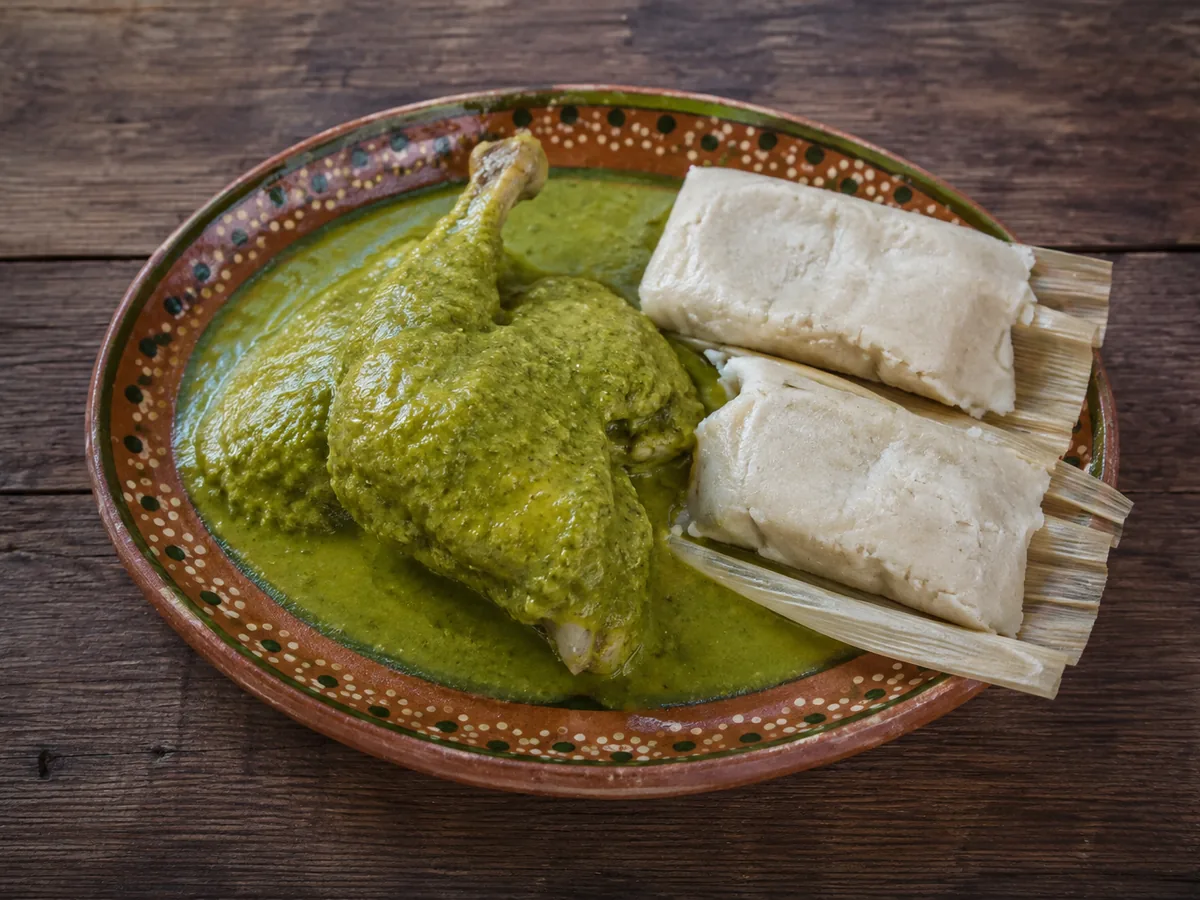
In the cool, mist-covered pine valleys of Huehuetenango and Quetzaltenango, jocón is the ancient Maya green stew. Its name comes from a K’iche’ phrase for “five green ingredients”, celebrating highland abundance.
Unlike the red recados, this one is emerald. Chicken is poached gently, then braised in a sauce of tart miltomates, green bell peppers, mild green chillies, scallions with their dark stalks and bundles of fresh cilantro.
Thickened with toasted pepitoria and ground corn masa, it coats the chicken in a velvety, tangy, herbaceous blanket, served beside piping-hot tamalitos blancos.
Chicken and stock
- 1.5 kg3.3 lbBone-in, skin-on chicken thighs and drumsticks, trimmed of excess fat
- 1.8 L7.5 cupsCold filtered water
- 15 g1 TbspFine sea salt10 g for the poach, 5 g for the recado
The green recado
- 500 g12 mediumFresh green miltomates (tomatillos), husked and washed clean of their sticky residue
- 2 large2 largeGreen bell peppers, cored, seeded and chopped coarse
- 2 medium2 mediumJalapeño or serrano chillies, stemmed and seededleave the seeds in one for more heat
- 80 g1.5 cups choppedScallions with their full green tops, washed and sliced coarse
- 50 g2 cups packedFresh cilantro leaves and tender stems, washed thoroughly
- 20 g½ cup packedFresh flat-leaf parsley leaves
- 6 cloves6 clovesFresh garlic, peeled
- 60 g½ cupRaw hull-less green pumpkin seeds (pepitoria verde)
- 45 g⅓ cupWhite sesame seeds (ajonjolí)
- 40 g2½ TbspFresh corn masa, or masa harina slaked in 60 ml water
- 1 whole1 wholeCorn tortilla, lightly toasted and torn
- 30 ml2 TbspNeutral vegetable oil
- 2 g½ tspFreshly ground white pepper
- 300 g2 mediumYukon Gold potatoes, peeled and cut into 2 cm chunksthe optional highland addition
Chlorophyll is the constraint
The magnesium ion at the centre of chlorophyll is displaced by hydrogen above about 85 °C for more than 15 minutes, or under prolonged acid, and bright green becomes dull pheophytin. So the tomatillos and peppers get a short simmer, the cilantro and parsley go in raw, and the finished sauce cooks 8 to 10 minutes at most.
Six to eight minutes for the miltomates
Just until they turn pale green and soften — never to bursting. Over-boiled tomatillos release bitter seeds into the broth.
Seeds and masa are the body
Toasted pepitoria supplies emulsified vegetable lipid; corn masa starch swells at 75 °C. Together they bind the very watery tomatillo purée into a velvety sauce. Skip either and it stays thin.
Enamel, not bare metal
Acidic tomatillos react with raw metal and dull the colour. The pot matters here as much as the timing.
Passive time, counted separately
The poached chicken waits covered while the recado is built, and the seeds cool before grinding. That sits outside the times quoted above.
The five tastes on this plate
Salt seasons the poach and the recado. Fat is pumpkin-seed oil, toasted sesame lipid and rendered chicken fat. Acid is the electric malic tartness of fresh miltomates. Heat is serrano, scallion allicin and sharp white pepper. Umami is poached chicken collagen, bone broth and toasted pumpkin-seed protein.
Equipment
- 6 qt enamelled cast-iron Dutch oven
- 3 qt saucepan
- Dry skillet, for the seeds
- High-powered blender
- Wide shallow bowls
Traditionally a clay olla and a volcanic stone metate. A 6-quart enamelled Dutch oven and a high-powered blender work in a modern kitchen — the enamel keeps the acidic tomatillos off bare metal, which is what preserves the green.
Method
Poach the chicken35 min
Put the chicken into the Dutch oven with 1.8 litres cold water and 10 g salt, bring to a gentle boil and skim the foam for 10 minutes.
Drop to low, cover partially and simmer 25 minutes to 74 °C / 165 °F. Lift out and cover; strain and keep all the broth.
Bring chicken, 1.8 litres cold water and 10 g salt to a gentle boil; skim 10 minutes. Partially cover; simmer on low 25 minutes to 74 °C / 165 °F. Remove and cover chicken; strain and reserve all broth.
Simmer the green aromatics8 min
In a saucepan, simmer the miltomates, green peppers and chillies with 400 ml of the hot broth strictly 6 to 8 minutes, until the tomatillos turn pale green and soften.
Off the heat at once — do not let the skins burst.
In a saucepan, simmer the miltomates, green peppers and chillies with 400 ml of the hot broth strictly 6 to 8 minutes, until the tomatillos turn pale green and soften.
Off the heat at once — do not let the skins burst.
Toast the seeds4 min
In a dry skillet over medium-low, toast the pepitoria 2 minutes until they puff and pop, then the sesame for 1 minute to pale gold. Cool.
In a dry skillet over medium-low, toast the pepitoria 2 minutes until they puff and pop, then the sesame for 1 minute to pale gold. Cool.
Blend the emerald recado4 min
Pulverise the cooled seeds to a fine meal.
Add the softened tomatillos and peppers with their broth, then the raw scallions, garlic, cilantro, parsley, torn tortilla, masa slurry, white pepper and 5 g salt.
Blend 60 to 90 seconds into a bright, velvety green purée.
Grind cooled seeds finely. Add softened tomatillos and peppers with broth, raw scallions, garlic, cilantro, parsley, torn tortilla, masa slaked in 60 ml water, white pepper and 5 g salt. Blend 60–90 seconds until bright green and velvety.
Cook the recado and finish25 min
Heat 30 ml oil in the Dutch oven over medium and pour in the recado. Simmer 5 minutes, stirring continuously as the masa thickens it.
Add 400 ml broth until it has the consistency of heavy cream, then the potatoes, and simmer 10 minutes until tender.
Lower the chicken in and simmer gently strictly 8 to 10 minutes, to 77–80 °C / 170–175 °F.
Use an enamelled pot. Heat 30 ml oil over medium; stir-fry recado 5 minutes to thicken. Add 400 ml broth to heavy-cream consistency, then potatoes; simmer 10 minutes until tender. Add chicken and simmer gently 8–10 minutes to 77–80 °C / 170–175 °F.
Plate
Ladle into wide shallow bowls, spooning plenty of sauce over the chicken.
Serve at once with white rice and warm tamalitos de masa.
Ladle into wide shallow bowls, spooning plenty of sauce over the chicken.
Serve at once with white rice and warm tamalitos de masa.
Sensory cues of doneness
- Visual: a lustrous jade-green sauce blanketing pale chicken, speckled with dark cilantro and pale sesame.
- Auditory: a quiet gentle bubbling — never a violent boil, which discolours the herbs.
- Olfactory: citrusy tomatillo, fresh scallion, pungent cilantro, toasted pumpkin seed and warm chicken broth.
Look for lustrous jade-green sauce covering pale chicken, with dark cilantro and pale sesame flecks. Keep bubbling gentle, never vigorous, to preserve herb colour; expect tomatillo, scallion, cilantro, toasted pumpkin seeds and chicken broth aromas.
Storing it
Store tightly covered with plastic pressed against the surface of the sauce, and reheat gently over low heat without boiling, or it browns.
Troubleshooting
- A muddy brownish-grey sauce.
It boiled too long. Blend the herbs raw and simmer strictly 8 to 10 minutes at the end.
- A bitter edge.
The tomatillos were over-boiled and released their seeds. Six to eight minutes, never past bursting.
- A thin, watery sauce.
The toasted pumpkin seeds or the masa were skipped. They are what bind the tomatillos' water.
Substitutions
One-to-one global substitutions, with the technique adjustment each one requires.
Ingredient substitutions
| Ingredient | Replace with | Culinary impact and technique adjustment |
|---|---|---|
| Miltomate | Standard green tomatillos | One-to-one. Wash the sticky saponin residue off the skins |
| Pepitoria verde | Raw pumpkin seeds (pepitas) | One-to-one, toasted lightly on a dry pan |
| Potatoes | Chayote squash or zucchini | One-to-one |
Scaling
Half, for 3 portions
Halve everything in a 4-quart pan. Simmering times are unchanged.
Double, for 12 portions
Double everything in a 12-quart pot, blending the recado in two batches so it emulsifies smoothly.
What to serve it with
- Arroz blanco chapín, to soak up the tart green sauce
- Tamalitos blancos de masa, steamed in fresh green leaves
- Fresco de súchiles, or a cold Gallo
Questions
Can I make it with pork?
Yes — jocón de cerdo is traditional in western Guatemala. Use pork shoulder cubes, braise 45 minutes until tender, and finish them in the green recado.
Can it be spicier?
Traditionally it is mild to medium. Blend two raw serranos with their seeds into the herb purée for a fiery green heat.
How do I keep leftovers green?
Cover with plastic pressed directly onto the sauce, and reheat gently over low heat. Do not let it boil.