Hilachas Chapinas
Hilachas means threads, or rags — the long strands flank steak pulls into once seventy-five minutes at a sub-boil have melted its collagen. The shredded beef then braises in a recado of sweet guaque, charred tomato and miltomate, thickened with a spoonful of corn masa rather than flour.
- Prep
- 30 min
- Cook
- 1 hr 30 min
- Serves
- 6 hearty portions
- Difficulty
- Medium
Researched · Kitchen testing pending
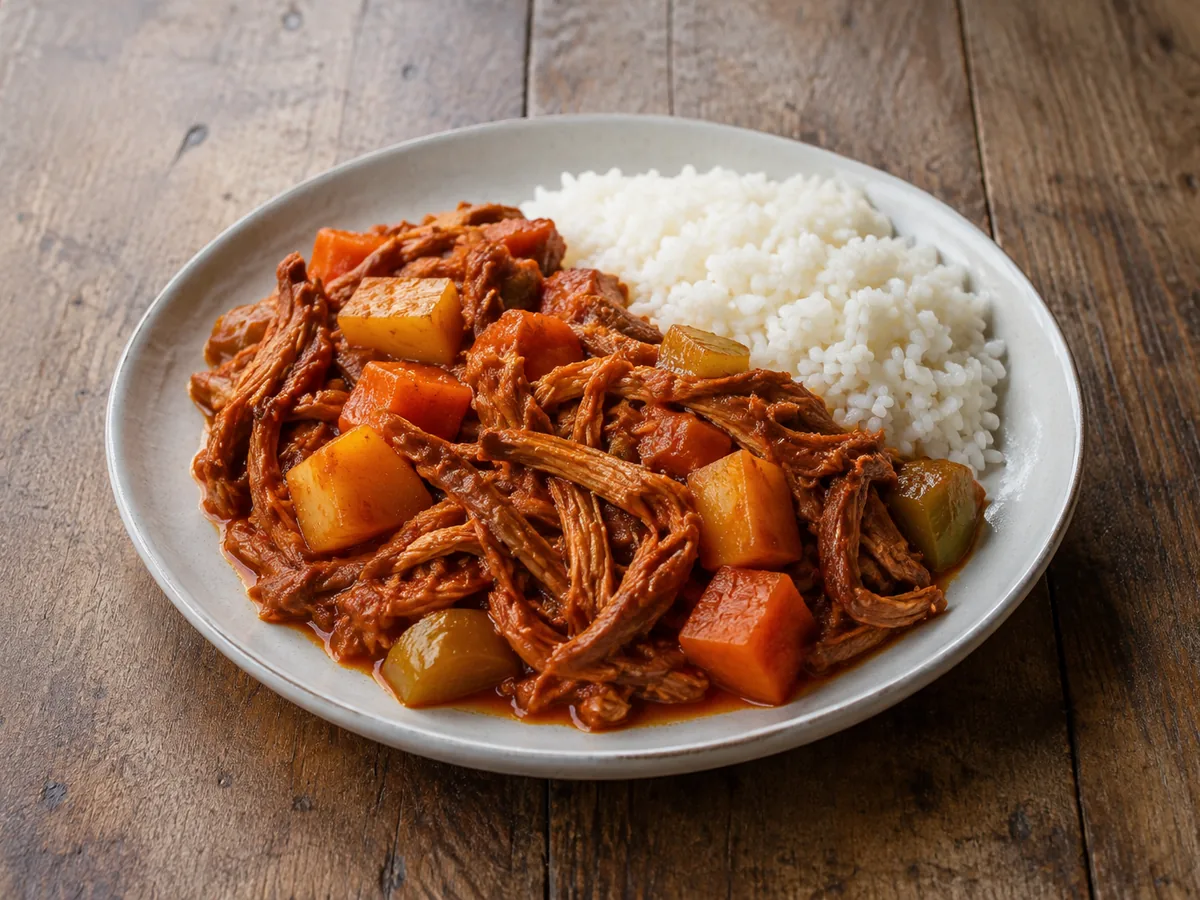
In the highland towns of Salamá and San Pedro Carchá, hilachas has fed working families for generations. The name means threads, or rags, and describes the long tender strands the braised flank pulls into.
The meat simmers gently with aromatics until its longitudinal fibres separate under a fork. Those shreds then braise inside a recado of sun-dried sweet chile guaque, charred plum tomatoes, tart miltomates, garlic and achiote, thickened with corn masa.
Potato, carrot and güisquil cook directly in the red sauce until soft, and the whole thing goes over steaming white rice.
The beef
- 1 kg2.2 lbBeef flank steak (falda de res), silverskin trimmed, cut across the grain into 8 cm slabs
- 1.8 L7.5 cupsCold filtered water
- 1 large1 largeYellow onion, halvedhalf into the braise, half charred for the recado
- 6 cloves6 clovesFresh garlic, peeledthree into the braise, three charred for the recado
- 15 g1 TbspFine sea salt10 g for the braise, 5 g for the recado
The recado
- 3 pieces3 piecesDried chile guaque, stemmed, seeded and wiped clean
- 1 piece1 pieceDried chile pasa, stemmed and seeded
- 600 g4 largeRipe plum tomatoes, charred on the comal
- 200 g5 mediumGreen miltomates (tomatillos), husked, washed and charred
- 15 g1 TbspAchiote paste, dissolved in a little warm broth
- 30 g2 TbspFresh corn masa, or masa harina slaked in 60 ml cold water
- 5 g1½ tspGround cumin seeds, freshly toasted in a skillet
- 3 g1 TbspDried wild oregano, crushed
- 2 g½ tspFreshly ground black peppercorn
- 30 ml2 TbspNeutral vegetable oil, or rendered beef tallow
The vegetables
- 400 g3 mediumRusset or Yukon Gold potatoes, peeled and cut into 2 cm cubes
- 250 g2 mediumCarrots, peeled and cut into 1 cm coins
- 1 medium1 mediumGüisquil (chayote), peeled, cored and cut into 2 cm cubes
- 20 g⅓ cupFresh cilantro leaves, chopped fine
Cut across the grain, shred along it
Flank is long, coarse myofibrillar fibre in tough collagen sheaths. Cut the raw slabs *across* the grain so that when the cooked meat is pulled *along* it, the fibres come away as long 8 cm threads rather than stubby fragments.
90–93 °C for 75 minutes
High heat tightens the proteins violently and the meat goes rubbery. A sub-boil hydrolyses the intramuscular collagen into gelatin so the threads separate cleanly under a fork.
Fry the recado before you thin it
Five minutes of the blended purée in hot oil, stirred constantly, develops Maillard flavour and darkens the colour. Straight into broth and it tastes raw.
Masa is the thickener
Whisked in at about 75 °C, the corn amylose gelatinises and binds the tomato juice and beef broth into a glossy gravy that clings to the shreds. Without it the recado stays thin and watery.
Passive time, counted separately
The chillies steep 15 minutes and the braised beef cools 15 minutes before shredding. Neither is active work and both sit outside the times quoted above.
The five tastes on this plate
Salt seasons the braising broth and the recado. Fat is rendered tallow and frying oil carrying the fat-soluble achiote and chilli carotenoids. Acid is charred miltomate and ripe tomato cutting the beef fat. Heat is earthy guaque, toasted cumin, charred garlic and pepper. Umami is braised flank fond, concentrated broth and charred tomato.
Equipment
- 6 to 7 qt enamelled cast-iron Dutch oven
- Cast-iron skillet, as the comal
- Blender
- Two forks, for shredding
- Wooden spoon
Traditionally a clay comal for the charring and a heavy aluminium or clay olla for the braise. A 6-to-7 quart enamelled Dutch oven works in a modern kitchen — the heavy lid seals the steam through the 75-minute braise so very little liquid is lost.
Method
Braise the flank1 hr 20 min
Put the flank slabs into the Dutch oven with 1.8 litres cold water, half the onion, 3 garlic cloves and 10 g salt.
Bring to a boil, skimming the foam, then drop to low, cover tightly and simmer 1 hour 15 minutes until the meat yields easily — 93–96 °C / 200–205 °F.
Lift onto a board to cool 15 minutes. Strain and keep all the broth.
Combine flank, 1.8 litres cold water, half the onion, 3 garlic cloves and 10 g salt. Boil and skim; cover tightly and simmer on low 1 hour 15 minutes until tender, 93–96 °C / 200–205 °F. Cool meat 15 minutes; strain and save all broth.
Shred into hilachas8 min
With two forks or clean fingers, pull the cooled flank along the grain into long thin threads.
Keep them covered so they do not dry out.
With two forks or clean fingers, pull the cooled flank along the grain into long thin threads.
Keep them covered so they do not dry out.
Char and blend the recado18 min
On a dry skillet over high heat, toast the guaque and pasa 15 seconds a side, then soak them in 250 ml hot beef broth for 15 minutes.
In the same pan, char the tomatoes, miltomates, remaining onion and 3 garlic cloves until blackened in spots.
Blend the charred vegetables, the soaked chillies with their broth, the achiote, cumin, oregano, pepper and 5 g salt for 90 seconds to a smooth red purée.
Toast guaque and pasa in a dry pan over high heat 15 seconds per side; soak in 250 ml hot beef broth 15 minutes. Char tomatoes, miltomates, remaining onion and 3 garlic cloves. Blend vegetables, chillies with broth, achiote, cumin, oregano, pepper and 5 g salt 90 seconds until smooth.
Fry and thicken10 min
Heat 30 ml oil in the Dutch oven over medium and pour in the recado — stand back, it spatters.
Fry 5 minutes, stirring constantly, as it darkens and thickens, then pour in 600 ml hot broth.
Slake the masa in 60 ml cold water, whisk it into the bubbling recado, and simmer 5 minutes until glossy.
Heat 30 ml oil over medium. Carefully add recado; stand back from splashes. Fry, stirring, 5 minutes until darker and thicker. Add 600 ml hot broth; whisk in masa mixed with 60 ml cold water. Simmer 5 minutes until glossy.
Vegetables, then beef27 min
Add the potatoes, carrots and güisquil and cook over medium-low 15 minutes until half-tender.
Fold in all the shredded beef and simmer uncovered 10 to 12 minutes, until the vegetables are fork-tender and the meat has taken up the sauce. Adjust the salt.
Add the potatoes, carrots and güisquil and cook over medium-low 15 minutes until half-tender.
Fold in all the shredded beef and simmer uncovered 10 to 12 minutes, until the vegetables are fork-tender and the meat has taken up the sauce. Adjust the salt.
Finish
Off the heat, scatter the chopped cilantro over.
Serve steaming in shallow bowls over white rice, with warm corn tortillas.
Off the heat, scatter the chopped cilantro over.
Serve steaming in shallow bowls over white rice, with warm corn tortillas.
Sensory cues of doneness
- Visual: a glossy red stew thick with beef threads, tender yellow potato, bright carrot and pale güisquil.
- Auditory: a lively sizzle as the purée hits the hot oil, settling into steady gentle bubbling.
- Olfactory: charred tomato, earthy guaque, toasted cumin, braised beef and corn masa.
Look for glossy red gravy clinging to long beef threads, with tender yellow potato, orange carrot and pale güisquil. After the initial frying sizzle, maintain gentle bubbling; expect charred tomato, guaque, cumin, beef and corn masa aromas.
Troubleshooting
- Stubby fragments instead of threads.
The raw beef was cut parallel to the grain. Cut the slabs across it, then pull the cooked meat along it.
- A thin, watery sauce.
The masa was skipped. It is what binds the tomato and chilli purée into a gravy that coats the meat.
- Tough, chewy shreds.
The beef came out before the collagen melted. It needs the full 75 minutes at a sub-boil.
Substitutions
One-to-one global substitutions, with the technique adjustment each one requires.
Ingredient substitutions
| Ingredient | Replace with | Culinary impact and technique adjustment |
|---|---|---|
| Falda de res | Skirt steak, brisket flat or chuck roast | One-to-one, provided you still shred along the natural grain |
| Chile guaque | Mexican guajillo | One-to-one. Matches the sweet dried pepper profile |
| Güisquil | Chayote squash | One-to-one, and it keeps the same clean crisp texture |
Scaling
Half, for 3 portions
Halve everything in a 4-quart Dutch oven. The flank still braises 75 minutes.
Double, for 12 portions
Double everything in an 11-quart Dutch oven, simmering the vegetables in batches if the pot is crowded so they cook evenly.
What to serve it with
- Arroz blanco con verduras — steamed rice with peas and corn
- Hot handmade corn tortillas, and tamalitos de viaje
- Horchata chapina, made with pumpkin seed and sesame, or a dark Moza bock
Questions
Can I use a pressure cooker?
Yes. Cook the flank on high pressure for 35 minutes with a litre of water and the aromatics, let the pressure release naturally, then shred.
How does this differ from Chilean pino?
Pino is ground or finely diced beef sweated with onion and cumin. Hilachas is long-shredded beef simmered in a complex chilli-tomato recado with potatoes.
Can I use brisket?
Yes — brisket flat or skirt steak both shred beautifully and carry plenty of flavour.