Riz Créole et Haricots Rouges
The daily plate. Soaked red kidney beans simmered with a blanched smoked pork hock, rendered lardons, onion, garlic, cive, thyme and bay until tender, a fifth of them crushed against the pot to thicken the sauce, a whole habanero floated in for the last stretch, and served beside dry long-grain rice steamed on its own.
- Prep
- 20 min
- Cook
- 2 hr
- Serves
- 6 servings
- Difficulty
- Medium
Researched · Kitchen testing pending
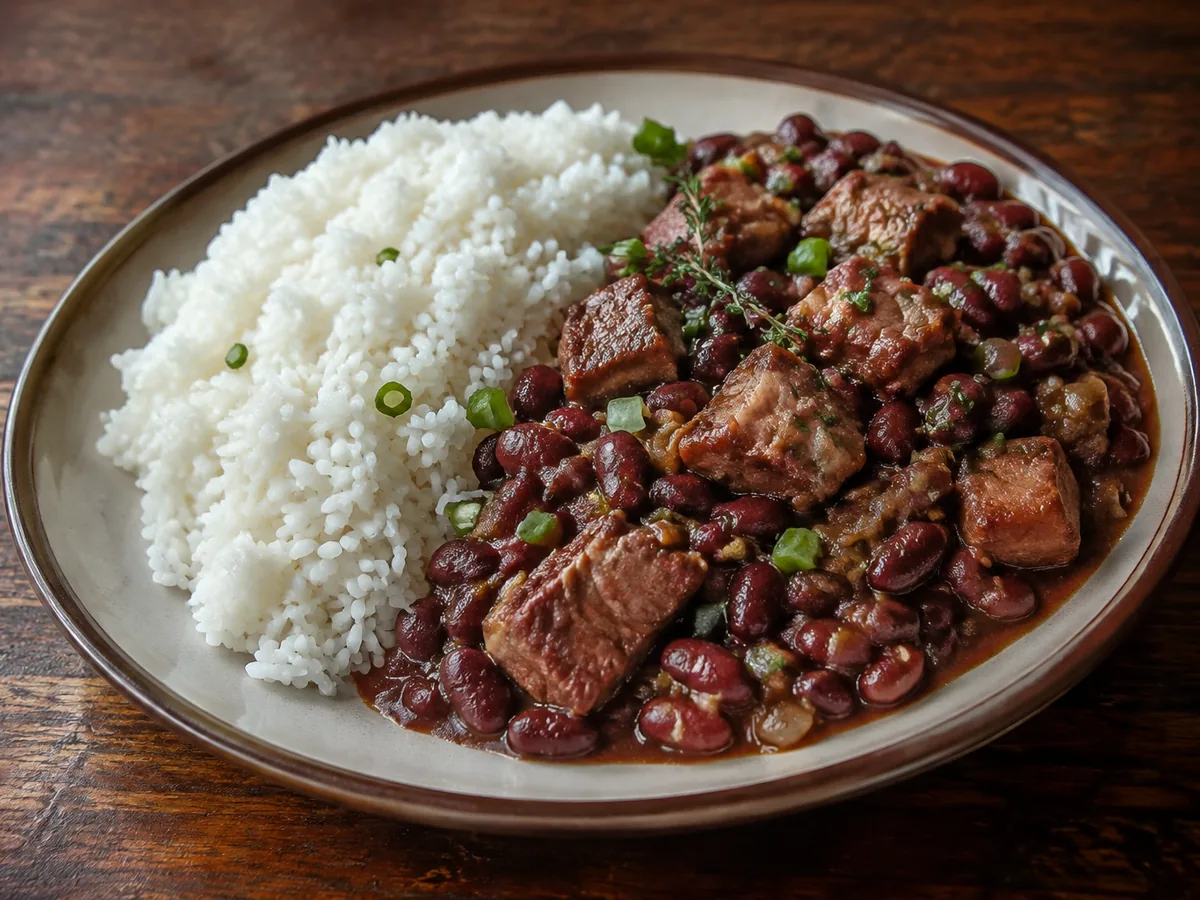
In every family kitchen across French Guiana, from the modest carbets along the river to Creole townhouses in Saint-Laurent and Cayenne, Riz et Haricots Rouges is the foundational daily fuel. It represents the meeting of African legume-stewing techniques with French charcuterie traditions, elevated by tropical aromatics. Unlike Caribbean ‘rice and peas’ where the grain and legumes are boiled together in coconut milk, authentic Guianese Creole practice demands that they be cooked in separate vessels and served side by side. Dried red kidney beans are slow-simmered with smoked pork hock, bacon lardons, garlic, and wild thyme until the starches rupture into a creamy, savory gravy, which is then ladled generously over bone-dry, fluffy steamed white rice.
- 450 g1.0 lb (approx. 2.25 cups)Haricots rouges secs (dried red kidney beans), sorted, soaked overnight
- 500 g1.1 lbsJarret de porc fumé (smoked pork hock/knuckle), bone-in
- 200 g7 ozLardons fumés (smoked bacon lardons), cut into 1/4-inch matchsticks
- 2000 ml8.5 cupsEau filtrée (filtered water) for boiling beans
- 200 g2 mediumOignons jaunes (yellow onions), finely chopped
- 25 g6 clovesGousses d'ail (garlic cloves), finely crushed
- 40 g1/3 cupCiboulette or cive créole, thinly sliced
- 8 g4 sprigsWild Creole thyme (thym frais)
- 2 leaves2 leavesFeuilles de laurier (bay leaves)
- 1 whole1 whole pepperPiment fort (habanero / piment bondamanjak), kept whole
- 30 ml2 tbspHuile végétale (peanut or sunflower oil)
- 12 g2 tsp (to taste)Gros sel marin (coarse sea salt) and black pepper
- 500 g2.5 cups (rinsed until water runs clear)Riz long grain blanc (long-grain white rice)
- 750 ml3.1 cupsEau pour le riz (water for steaming rice)
- 30 ml2 tbspHuile pour le riz (vegetable oil for rice)
Culinary science
The velvety thickness of Guianese stewed red beans is an exercise in colloidal starch gelatinization without artificial thickeners. Dried kidney beans contain approximately 60% complex carbohydrates, predominantly amylose and amylopectin starches encased in insoluble cellulose seed coats. After soaking, gentle simmering at 90°C–95°C (194°F–203°F) softens the middle lamella pectin holding plant cells together. By crushing 20% of the tender beans against the pot wall during the final 20 minutes, free amylose chains dissolve into the water, cross-linking with rendered pork gelatin to form a stable, creamy suspension. The dry steamed Creole rice requires precise water-to-starch stoichiometry. Rinsing long-grain rice removes surface amylose powder that causes clumping. Cooking with a 1:1.5 rice-to-water ratio by volume over high heat until surface water evaporates, then gathering the grains into a central pyramid, trapping steam with a tight lid on the lowest heat setting for 20 minutes, allows internal starch granules to gelatinize fully while surface moisture dries out completely, producing separate, fluffy grains.
Five-taste audit
Salt: Layered salinity from smoked bacon lardons, cured pork hock, and sea salt dissolved into the bean liquor. Fat: Rendered pork belly fat and hock marrow collagen emulsifying with bean starches into a glossy sauce. Acid: Deliberately low; a subtle touch of black pepper and bay leaf balances the rich savory starch profile. Heat / Pungency: Crushed garlic paste, sweet cive onions, black pepper, and radiant aroma from the floating habanero chili. Umami: Intense savory glutamates from wood-smoked pork knuckle, bacon Maillard fond, and slow-braised kidney bean starches.
Equipment
- Two cast-aluminum calderos (one deep canari for beans, one medium caldero for steaming rice to develop concón).
- A heavy 5-to-6-quart Dutch oven for the beans and a 3-quart heavy-bottomed saucepan with a tight lid for the rice.
Method
Soak and blanch
Soak the sorted beans overnight. Drain. Blanch the smoked hock 10 minutes in fresh water, then drain to moderate its salt.
Soak the sorted beans overnight. Drain. Blanch the smoked hock 10 minutes in fresh water, then drain to moderate its salt.
Render the lardons
Heat oil in a Dutch oven over medium. Brown the lardons 5 minutes; add onion and cook 5 minutes more.
Heat oil in a Dutch oven over medium. Brown the lardons 5 minutes; add onion and cook 5 minutes more.
Simmer the beans
Add garlic, cive, thyme, bay, drained beans, hock and 2 litres fresh water. Bring to a rolling boil and maintain it for at least 30 minutes, skimming; then simmer partly covered 60–80 minutes, until the beans are tender.
Add garlic, cive, thyme, bay, drained beans, hock and 2 litres fresh water. Boil vigorously at least 30 minutes, skimming; then simmer partly covered 60–80 minutes until the beans are tender.
Thicken naturally
When the beans are tender, crush about one fifth against the pot wall. Add the whole pepper and simmer uncovered 15–20 minutes until creamy. Remove pepper, bay and thyme; season only now.
When the beans are tender, crush about one fifth against the pot wall. Add the whole pepper and simmer uncovered 15–20 minutes until creamy. Remove pepper, bay and thyme; season only now.
Rinse the rice
Rinse the rice repeatedly until the water is nearly clear. Drain well.
Rinse the rice repeatedly until the water is nearly clear. Drain well.
Steam the rice
Combine rice, 750 ml water, oil and a pinch of salt. Boil uncovered until surface water disappears, gather the rice into a mound, cover tightly and steam over the lowest heat 20 minutes. Rest 10 minutes and fluff.
Combine rice, 750 ml water, oil and a pinch of salt. Boil uncovered until surface water disappears. Mound the rice, cover tightly and steam on lowest heat 20 minutes. Rest 10 minutes; fluff.
Serve separately
Ladle the beans beside or over the dry rice, with pieces of tender smoked pork distributed evenly.
Ladle the beans beside or over the dry rice, with pieces of tender smoked pork distributed evenly.
Storing it
Storage and reheating
Cool rice and beans separately and refrigerate within two hours. Use rice within 1 day and beans within 3 days; reheat both to 74 °C. Freeze beans up to 3 months.
Troubleshooting
- Hard beans
Old beans or acidic additions delay softening. Use fresh dried beans and add no acid while they cook.
- Salty beans
Blanch the cured pork and wait until the end to season.
- Sticky rice
Rinse away surface starch and do not stir during the covered steaming stage.
Substitutions
Ingredient substitutions
| Ingredient | Replace with | Culinary impact and technique adjustment |
|---|---|---|
| Jarret de porc fumé | Smoked ham hock or smoked turkey drumstick: | Smoked turkey supplies smoke with less pork fat; add a spoon of oil if the beans seem lean. |
| Lardons fumés | Thick-cut smoked bacon or pancetta: | Pancetta is less smoky; add it for fat but expect a gentler smoke profile. |
| Haricots rouges secs | Dried pink beans or pinto beans: | Pink or pinto beans become creamy sooner and taste milder; begin checking 15 minutes early. |
Scaling
Half batch
Use a 4-quart bean pot and a 2-quart rice pan; timing stays close to the full batch.
Double batch
Use separate larger pots for beans and rice. Do not double the rice in a narrow saucepan; steam it in two batches.
What to serve it with
- A crisp cucumber and lime salad
- Fried plantain
- A small dish of pepper sauce
Questions
Can canned beans be used?
Yes. Use three drained cans, reduce water to about 500 ml, and simmer with the pork until flavours combine.
Why cook rice separately?
This version depends on the contrast between dry, separate grains and creamy beans.
Can the beans be meatless?
Yes, but they will lose smoke and collagen. Use a little smoked paprika only as a flavour adjustment, not as an equivalent tradition.