Blaff de Poissons et Crevettes
The fisherman's clear broth. Fish steaks and head-on prawns marinated twenty minutes in lime, garlic and salt, then dropped into a boiling broth of allspice leaves, thyme, onion, ginger and cracked pepper with a whole habanero, the heat cut to a poach the moment it returns to the boil, and finished with more lime.
- Prep
- 20 min
- Cook
- 15 min
- Serves
- 4 to 6 servings
- Difficulty
- Medium
Researched · Kitchen testing pending
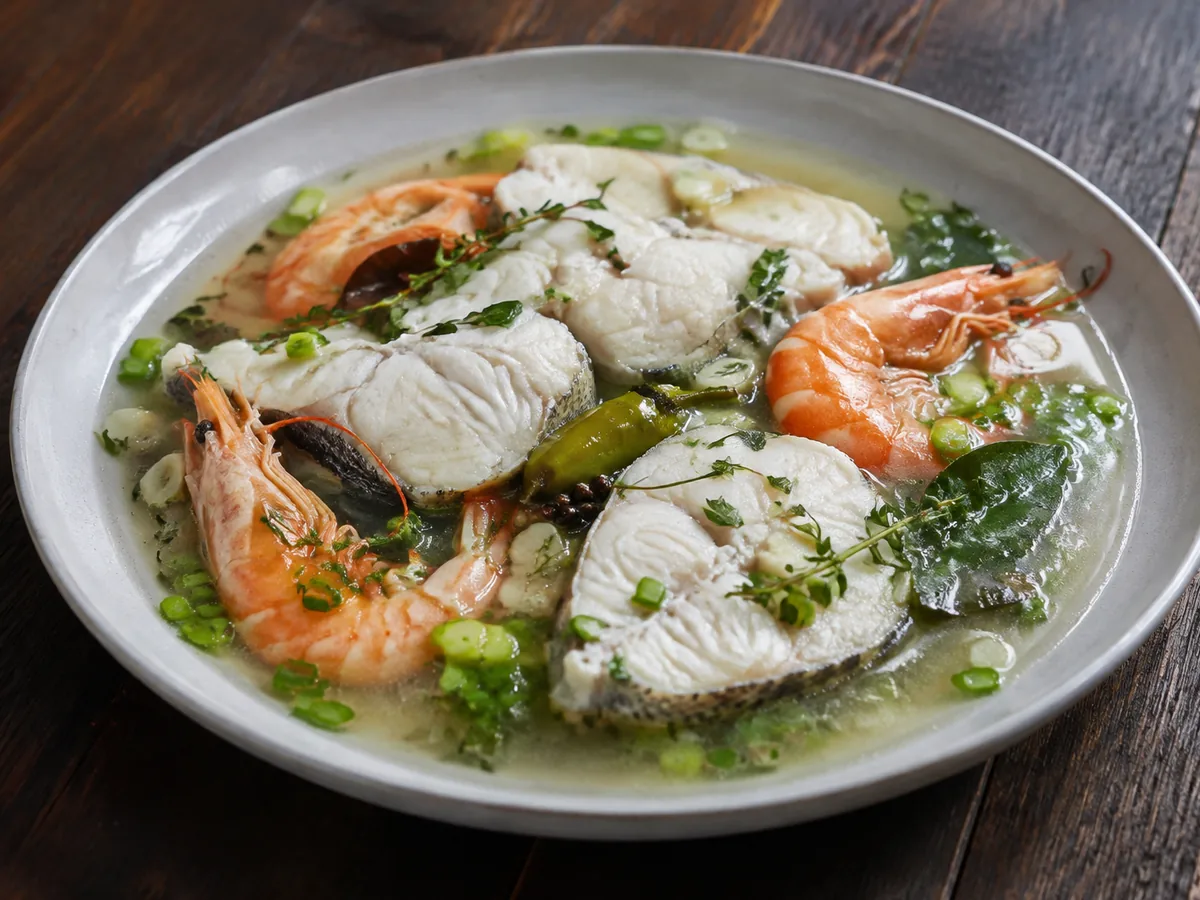
According to Caribbean and Guianese oral tradition, the onomatopoeic name ‘Blaff’ mimics the hollow sound of fresh fish dropped into boiling seasoned broth: blaff! Historically created on fishing boats returning from the equatorial Atlantic mudflats and rivers of French Guiana, the dish was designed to showcase the pristine freshness of the morning catch with absolute purity. Unlike Pimentade, which is red and rich with tomato paste and sautéed onions, Blaff is a clear, pale court-bouillon that uses zero oil or sautéing. Cold fish steaks and sea prawns are marinated heavily in fresh lime juice, crushed garlic, and sea salt, then plunged directly into a vigorously boiling infusion of water, allspice leaves (bois d’Inde), wild thyme, and Scotch bonnet pepper. The rapid poaching locks in moisture, creating an intensely refreshing, restorative broth celebrated as the ultimate island cure.
- 900 g2.0 lbs (cut into 4 to 6 uniform steaks)Fresh firm sea fish steaks (vivaneau, acoupa, or sea bass), skin-on
- 450 g1.0 lbCrevettes sauvages de Guyane (wild sea prawns), whole head-on
- 120 ml1/2 cup (divided)Jus de citron vert (fresh lime juice)
- 30 g8 clovesGousses d'ail (garlic cloves), finely crushed to a paste
- 18 g1 tbsp (divided)Gros sel marin (coarse sea salt)
- 1000 ml4.2 cupsEau filtrée (filtered water)
- 3 leaves3 leavesFeuilles de bois d'Inde (allspice leaves) or 4 whole crushed allspice berries
- 8 g4 sprigsWild Creole thyme (thym frais)
- 40 g1/3 cupCiboulette or cive créole, sliced
- 100 g1 smallOignon jaune (yellow onion), sliced into thin rings
- 1 whole1 whole pepperPiment fort (habanero / piment bondamanjak), kept whole with stem
- 4 g1 tspGraines de poivre noir (black peppercorns), lightly cracked
- 15 g1/2 inch pieceGingembre frais (fresh ginger root), peeled and sliced into thin coins
Culinary science
Blaff represents pure thermal shock poaching. In the first phase, marinating raw fish in lime juice (pH ~2.2) triggers rapid acid denaturation of surface proteins. The acidic bath tightens myofibrils on the cut surface, creating a protective envelope. When the cold marinated fish is plunged into water boiling at 100°C (212°F), the sudden immersion immediately sears the exterior proteins, trapping intracellular juices. The heat is instantly reduced to 85°C (185°F) for gentle sub-boiling poaching. Maintaining this low temperature prevents delicate fish collagen from dissolving too rapidly, keeping the muscle segments firmly attached to the bone. Simultaneously, the head-on prawns release astaxanthin and rich hepatopancreas lipids ('prawn head butter') into the clear court-bouillon, creating a pale golden, shimmering broth without butter or oil.
Five-taste audit
Salt: Clean, bracing ocean salinity from coarse sea salt dissolved in pure water, penetrating delicate fish tissues. Fat: Virtually zero added fat; purely natural marine lipids released by fish skin and prawn head butter. Acid: Dominant, electric citric acid from fresh lime juice added in two stages (marination and final broth finish). Heat / Pungency: Crushed raw garlic, cracked black peppercorns, fresh ginger coins, and volatile floral warmth from whole habanero. Umami: Clean marine nucleotides from fresh red snapper bones, prawn shells, and steeped allspice leaves.
Equipment
- A wide, shallow enamel-coated canari or marmite en fonte that allows fish steaks and prawns to lie in a single, uncrowded layer.
- A wide 12-inch stainless steel sauté pan or straight-sided skillet with a tight-fitting glass lid.
Method
Marinate the seafood
Combine fish and prawns with 75 ml lime juice, half the garlic and 10 g salt. Refrigerate 20 minutes, then drain; reserve none of the raw marinade.
Combine fish and prawns with 75 ml lime juice, half the garlic and 10 g salt. Refrigerate 20 minutes, then drain; reserve none of the raw marinade.
Infuse the broth
Bring water, allspice leaves, thyme, onion, ginger, peppercorns, remaining garlic and the whole pepper to a rolling boil. Boil 8 minutes.
Bring water, allspice leaves, thyme, onion, ginger, peppercorns, remaining garlic and the whole pepper to a rolling boil. Boil 8 minutes.
Poach the fish
Lower the fish steaks into the boiling broth in one layer. As soon as the boil returns, reduce to 85–90 °C, cover and poach 5 minutes.
Lower the fish steaks into the boiling broth in one layer. As soon as the boil returns, reduce to 85–90 °C, cover and poach 5 minutes.
Add the prawns
Add the prawns and cive. Continue the gentle poach 3–5 minutes, until prawns are opaque and the fish reaches 63 °C.
Add the prawns and cive. Continue the gentle poach 3–5 minutes, until prawns are opaque and the fish reaches 63 °C.
Finish the broth
Remove the whole pepper and woody aromatics. Add the remaining lime juice and salt to taste. Serve immediately so the seafood does not continue cooking.
Remove the whole pepper and woody aromatics. Add the remaining lime juice and salt to taste. Serve immediately so the seafood does not continue cooking.
Storing it
Storage and reheating
Blaff is best immediately. Refrigerate leftovers within two hours and use within 1 day; reheat only until steaming, without boiling.
Troubleshooting
- Cloudy, broken fish
After the initial boil, reduce immediately to a gentle poach and avoid stirring.
- Rubbery prawns
Add them after the fish and remove the pan from heat as soon as they turn opaque.
- Flat broth
Boil the aromatics before adding seafood, then finish with fresh lime after poaching.
Substitutions
Ingredient substitutions
| Ingredient | Replace with | Culinary impact and technique adjustment |
|---|---|---|
| Vivaneau / Acoupa | Fresh red snapper, black sea bass, or halibut steaks: | Halibut and sea bass hold firmly; snapper is sweeter. Avoid thin delicate fillets. |
| Feuilles de bois d'Inde | Crushed dried allspice berries or a fresh bay leaf with 1 clove: | Crushed allspice berries are stronger and cloud the broth slightly; tie them in muslin with one bay leaf. |
| Crevettes sauvages | Wild Atlantic sea prawns or Gulf white shrimp: | Gulf shrimp are usually smaller; add them later and begin checking at 2 minutes. |
Scaling
Half batch
Use a 10-inch pan and 600 ml water, enough to surround the seafood without drowning its flavour.
Double batch
Use two wide pans. Stacking seafood makes the lower layer overcook before the upper layer is done.
What to serve it with
- White rice or toasted couac
- Boiled yam, cassava or breadfruit
- Fresh lime and pepper sauce served separately
Questions
What distinguishes blaff from pimentade?
Blaff is a clear, oil-free aromatic court-bouillon; pimentade uses a red tomato base.
Can fillets replace steaks?
Yes, but choose thick skin-on fillets and shorten the poach because they break more easily.
Can I reuse the seafood marinade?
No. Discard raw marinade; the fresh finishing lime supplies the final acidity.