Calou de Guyane
The okra-led calou. Salted beef blanched and simmered with rendered smoked pork belly, onion, cive, garlic, thyme and an allspice leaf until tender, then thin-sliced okra and halved mangrove crabs, and prawns with a whole habanero for the last minutes, finished with lime into a glossy stew bound by the okra's own body.
- Prep
- 30 min
- Cook
- 1 hr 30 min
- Serves
- 6 to 8 servings
- Difficulty
- Medium
Researched · Kitchen testing pending
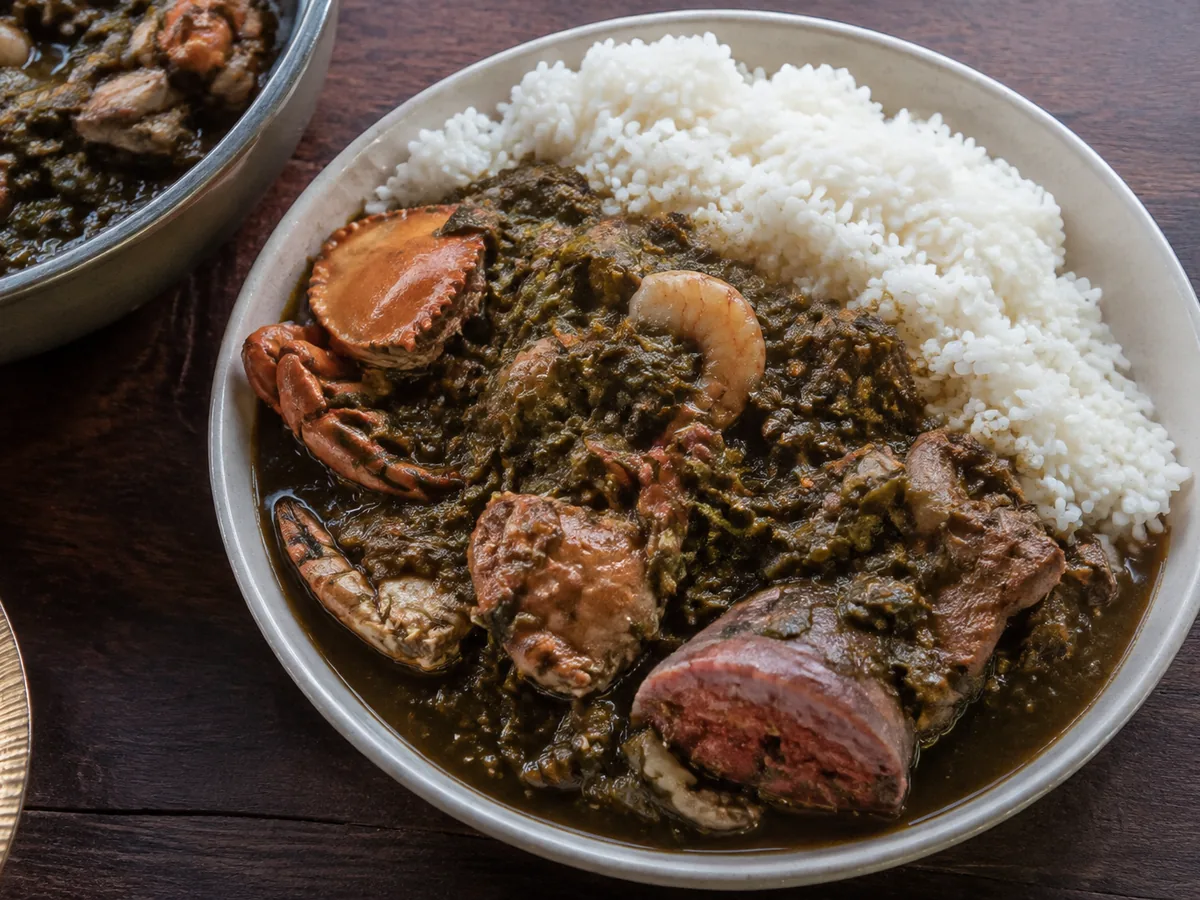
Calou (also spelled Kalou) is one of the oldest African-derived heritage stews of French Guiana, closely related to Brazilian Caruru, West African soupikandia, and Louisiana gumbo. Its name derives from the West African term for okra (calou or quimbombó). For centuries, it has served as the communal comfort food of Afro-descendant Bushinengue and Creole populations. In the Guianese tradition, calou is characterized by its velvety, gelatinous consistency, achieved by simmering mounds of finely sliced fresh okra with cured salted beef, smoked pork belly, and whole mangrove crabs (crabes de palétuvier). The stew is perfumed with fresh cives, wild thyme, and a hint of lime juice, cooked slowly until the okra seeds turn pinkish-amber and the sauce forms an unctuous, spoon-coating emulsion served over steaming white rice.
- 800 g1.75 lbsGombos frais (fresh okra / calou), washed, trimmed, sliced into thin 1/4-inch rounds
- 450 g1.0 lbBœuf salé (cured salted beef brisket or flank), cut into 1-inch cubes, blanched
- 300 g10.5 ozPoitrine de porc fumée (smoked pork belly or bacon), cut into lardons
- 4 whole4 whole crabs (halved, approx. 600 g / 1.3 lbs)Crabes de terre or crabes de palétuvier (mangrove crabs), cleaned and halved
- 250 g9 ozQueues de crevettes fraîches (fresh peeled sea prawns)
- 200 g2 mediumOignons jaunes (yellow onions), finely chopped
- 25 g6 clovesGousses d'ail (garlic cloves), finely minced
- 40 g1/3 cupCiboulette or cive créole, finely chopped
- 8 g4 sprigsWild Creole thyme (thym frais)
- 1 leaf or 1 g1 leaf or 1/4 tspFeuille de bois d'Inde (allspice leaf) or ground allspice
- 1 whole1 whole pepperPiment fort (habanero / piment bondamanjak), kept whole
- 30 ml2 tbspJus de citron vert (fresh lime juice)
- 30 ml2 tbspHuile végétale (peanut or sunflower oil)
- 1200 ml5 cupsEau filtrée (filtered water) or unsalted stock
- To tasteTo tasteGros sel marin (coarse sea salt) and black pepper
Culinary science
The distinctive silky texture of Calou is governed by okra mucilage rheology. Okra pods (Abelmoschus esculentus) contain high concentrations of exocellular mucilage composed of acidic polysaccharides, predominantly galacturonic acid, rhamnose, and galactose. When sliced and heated in aqueous liquid, these polysaccharide polymers unravel and hydrate, forming extensive cross-linked networks that dramatically increase liquid viscosity into an unctuous gel. Managing mucilage viscosity requires precise temperature and pH regulation. High boiling can shear the polysaccharide chains, resulting in a stringy, unappealing texture. Simmering gently at 88°C–92°C (190°F–198°F) allows the mucilage to dissolve smoothly into the braising liquid, where it bonds with gelatin leached from the salted beef and pork collagen. Adding fresh lime juice (citric acid) toward the conclusion of cooking slightly lowers the pH, tightening the polysaccharide matrix into a glossy, velvety sauce that heavily coats a spoon.
Five-taste audit
Salt: Salinity from blanched salted beef and smoked bacon lardons, balanced by the vegetable sweetness of sliced okra. Fat: Rendered pork belly fat and crustacean shell lipids providing body to the viscous vegetable stew. Acid: Measured splash of fresh lime juice added at the finish to brighten the velvety okra mucilage. Heat / Pungency: Whole floating habanero chili, crushed garlic, allicin from scallions, and cracked black pepper. Umami: Layered savory glutamates from cured salted beef, hardwood-smoked pork, and fresh mangrove crab tomalley.
Equipment
- A heavy black cast-iron canari or marmite en fonte, providing uniform radiant heat.
- A heavy 6-to-7-quart enameled cast-iron Dutch oven with a wide surface area.
Method
Desalt the meats
Cover salted beef with cold water, bring to a boil for 10 minutes and drain. Repeat if very salty. Rinse the smoked pork.
Cover salted beef with cold water, bring to a boil for 10 minutes and drain. Repeat if very salty. Rinse the smoked pork.
Render and sweat
Heat oil in a Dutch oven. Brown the pork lardons 5 minutes, then cook onion and cive 5 minutes. Add garlic for 30 seconds.
Heat oil in a Dutch oven. Brown the pork lardons 5 minutes, then cook onion and cive 5 minutes. Add garlic for 30 seconds.
Tenderise the beef
Add salted beef, thyme, allspice leaf and 900 ml water. Cover and simmer gently 45 minutes.
Add salted beef, thyme, allspice leaf and 900 ml water. Cover and simmer gently 45 minutes.
Add crab and okra
Stir in the sliced okra and add the halved crabs. Add enough remaining water to keep the mixture moving, then simmer uncovered 30–35 minutes, stirring slowly from the bottom.
Add sliced okra and halved crabs. Use enough remaining water to keep everything moving; simmer uncovered at 88–92 °C for 30–35 minutes, stirring gently from the bottom. Avoid a hard boil.
Finish with prawns
Add prawns and the whole pepper. Simmer 6–8 minutes until prawns are opaque and the beef is tender. Keep the pepper intact.
Add prawns and the whole pepper. Simmer 6–8 minutes until prawns are opaque and the beef is tender. Keep the pepper intact.
Set the texture
Remove pepper, thyme and allspice. Stir in lime juice, rest 10 minutes and adjust salt. The sauce should be glossy and spoon-coating, not violently stringy.
Remove pepper, thyme and allspice. Stir in lime juice, rest 10 minutes and adjust salt. The sauce should be glossy and spoon-coating, not violently stringy.
Name the version
This is the okra-led calou specified by this collection. Other French Guianese households make a leaf-led calou with country spinach or taro leaves alongside smoked meat and crab.
This version uses okra. Other French Guianese versions use country spinach or taro leaves with smoked meat and crab.
Storing it
Storage and reheating
Remove crab meat from shells before storing if practical. Refrigerate within two hours and use within 2 days. Reheat to a simmer; do not freeze whole crab shells in the stew.
Troubleshooting
- Overwhelming salt
Blanch cured meat first and add no salt until the pot has fully reduced.
- Stringy, broken texture
Maintain a gentle simmer and stir slowly; a hard boil and aggressive whisking shear the okra mucilage.
- Gritty crab
Scrub and rinse crabs carefully, remove gills and stomach sac, and crack cleanly before cooking.
Substitutions
Ingredient substitutions
| Ingredient | Replace with | Culinary impact and technique adjustment |
|---|---|---|
| Crabes de palétuvier | Fresh blue crabs or soft-shell crabs: | Blue crab gives a similar shellfish sweetness; soft-shell crab will break down more and should be added later. |
| Bœuf salé | Corned beef brisket or salted pork belly: | Corned beef carries pickling spice and a different cured flavour; blanch it and season cautiously. |
| Gombos frais | Frozen sliced okra: | Frozen okra thickens well but releases water; add it frozen and reduce uncovered a little longer. |
Scaling
Half batch
Use a 4-quart pot and retain enough liquid for the sliced okra to circulate.
Double batch
Use two Dutch ovens. A crowded pot cools slowly, makes crab awkward to stir and reduces unevenly.
What to serve it with
- Dry steamed white rice
- Boiled cassava or plantain
- Lime wedges
Questions
Is calou always made only with okra?
No. French Guianese calou varies; many versions include country spinach or other leafy greens with okra, smoked meat and crab.
Can frozen okra be used?
Yes. Add it frozen and expect slightly less fresh green flavour but similar thickening.
Why is lime added last?
Late acid brightens the rich cured meat and helps tighten the finished texture without delaying the early softening.