Pastels Guyanais
The aperitif turnover of Cayenne and Kourou. A short dough of flour, cold butter and an egg yolk rolled under two millimetres and cut into 24 rounds, filled with beef cooked down with onion, cive, garlic, thyme, a little habanero, tomato paste and lime, sealed into half-moons and fried at 180 °C until blistered gold.
- Prep
- 45 min
- Cook
- 20 min
- Serves
- 6 to 8 servings (makes 24 pastels)
- Difficulty
- Medium
Researched · Kitchen testing pending
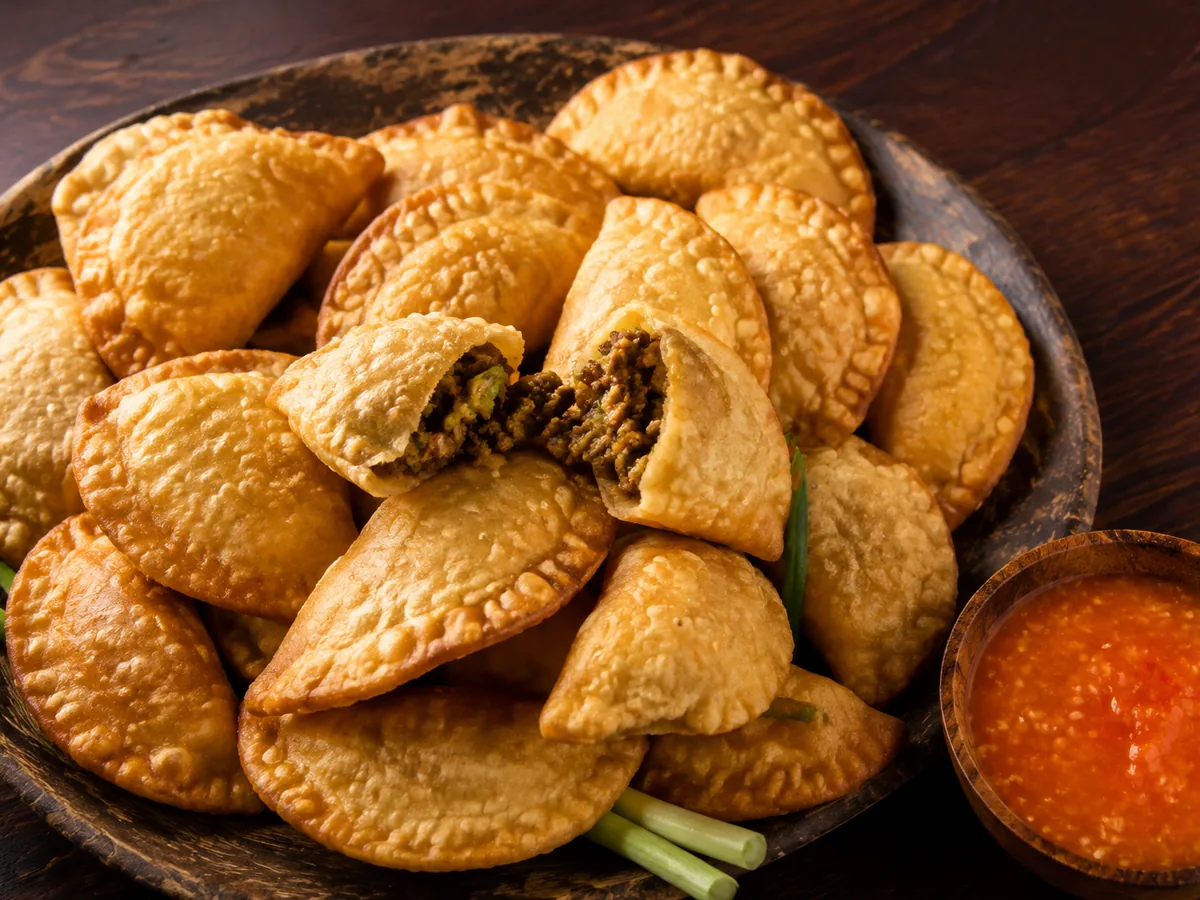
Pastels Guyanais (also called Petits Pâtés Créoles) are the defining celebration finger food of French Guiana, ubiquitous at Sunday family aperitifs, communal festivities, and street-food stalls in Cayenne and Kourou. Rooted in Portuguese and West African pastel traditions, they were adapted by Creole cooks into bite-sized, semi-circular fried hand pies. The hallmark of authentic Guianese pastels lies in the contrast between their delicate, blistered, golden-crisp pastry shell and their spicy, intensely seasoned interior. Two classic fillings dominate: minced beef simmered with garlic, cives, thyme, tomato, and finely minced habanero; or salted codfish (morue) flaked and sautéed with lime juice and sweet peppers. Served piping hot straight from the frying oil, they are dipped into fiery pimentade sauce alongside a glass of chilled rum punch.
- 400 g3.25 cupsFarine de blé T55 (all-purpose flour) for dough
- 100 g7 tbspBeurre doux (unsalted butter), cold, cubed (or lard / saindoux)
- 1 yolk1 yolkJaune d'œuf (egg yolk)
- 150 ml2/3 cupEau glacée (ice-cold water)
- 6 g1 tspSel fin (fine sea salt) for dough
- 400 g14 ozBœuf haché pur (lean ground beef 85/15) for filling
- 120 g1 mediumOignons jaunes (yellow onions), very finely minced
- 30 g1/4 cupCiboulette or cive créole, very finely minced
- 20 g5 clovesGousses d'ail (garlic cloves), crushed to a smooth paste
- 4 g2 tspWild Creole thyme (thym frais), leaves stripped and minced
- 3 g1/2 pepper (to taste)Piment fort (habanero), seeded and finely minced
- 15 ml1 tbspJus de citron vert (fresh lime juice)
- 20 g1.5 tbspConcentré de tomate (tomato paste)
- 15 ml1 tbspHuile végétale for sautéing filling
- 5 g1 tspPoivre noir moulu and fine salt for filling
- 1000 ml4.2 cupsHuile de friture (peanut or sunflower oil for deep-frying)
Culinary science
The crispness of the pastel dough relies on shortcrust fat dispersion. Rubbing cold butter into all-purpose flour coats individual flour proteins (gliadin and glutenin) with a lipid barrier. When ice water is added, gluten formation is physically restricted. Chilling the dough at 4°C for 30 minutes relaxes remaining gluten tension and solidifies butterfat, allowing the pastry to be rolled wafer-thin (1.5 mm) without shrinking back. Moisture control in the filling is critical. If the meat filling contains excess water or free gravy, steam generated during deep-frying at 180°C (356°F) expands rapidly against the sealed pastry, causing the pastels to burst open in the oil. The picadillo must be cooked to complete dryness (*à sec*) on the stovetop and chilled before assembly, ensuring clean seals and a crisp, grease-free fry.
Five-taste audit
Salt: Fine sea salt seasoning the butter-larded pastry dough and savory beef picadillo. Fat: Crisp, flaky pastry shortened with cold butter; clean frying oil creating a micro-blistered exterior. Acid: Fresh lime juice folded into the spiced meat filling, cutting through the rich fried crust. Heat / Pungency: Finely minced habanero pepper, raw garlic paste, fresh scallions, and cracked black pepper. Umami: Seared ground beef, tomato paste reduction, and savory Maillard crust on fried pastry.
Equipment
- A wide, deep cast-aluminum caldero or iron skillet filled with hot frying oil.
- A deep heavy-bottomed Dutch oven or commercial countertop deep fryer with digital temperature control.
Method
Make the short dough
Whisk flour and salt. Rub in cold butter until the mixture resembles coarse crumbs. Add yolk and just enough ice water to form a firm dough; do not knead smooth.
Whisk flour and salt. Rub in cold butter until the mixture resembles coarse crumbs. Add yolk and just enough ice water to form a firm dough; do not knead smooth.
Rest
Flatten into a disc, wrap and chill 30 minutes.
Flatten into a disc, wrap and chill 30 minutes.
Cook the filling
Heat 15 ml oil. Cook onion and cive 4 minutes, add garlic and thyme, then beef. Break it finely and cook to 74 °C. Stir in tomato paste, pepper and lime; continue until completely dry. Cool fully.
Heat 15 ml oil; cook onion and cive 4 minutes. Add garlic, thyme, then beef; break up finely and cook to 74 °C. Stir in tomato paste, pepper and lime. Cook completely dry and cool fully before filling.
Roll and cut
Roll the chilled dough 1.5–2 mm thick. Cut twenty-four 9–10 cm rounds, rerolling scraps only once.
Roll the chilled dough 1.5–2 mm thick. Cut twenty-four 9–10 cm rounds, rerolling scraps only once.
Fill and seal
Place 1 heaped teaspoon cold filling off-centre. Moisten the edge lightly, fold into a half-moon, press out air and crimp firmly with a fork.
Place 1 heaped teaspoon cold filling off-centre. Moisten the edge lightly, fold into a half-moon, press out air and crimp firmly with a fork.
Fry in batches
Heat oil to 180 °C. Fry 4–6 pastels at a time for 2–3 minutes, turning once, until blistered and golden. Let the oil return to temperature between batches.
Heat oil to 180 °C. Fry 4–6 pastels at a time for 2–3 minutes, turning once, until blistered and golden. Let the oil return to temperature between batches.
Drain and serve
Drain on a rack rather than stacked paper towels. Serve hot after the steam has settled for 2 minutes.
Drain on a rack rather than stacked paper towels. Serve hot after the steam has settled for 2 minutes.
Storing it
Storage and reheating
Refrigerate cooked pastels up to 2 days. Re-crisp for 8–10 minutes at 190 °C. Freeze uncooked pastels in one layer, then bag for up to 2 months.
Troubleshooting
- Pastels burst
The filling was wet, warm or overfilled. Reduce it dry, cool completely and leave a clean sealing border.
- Greasy pastry
Oil below 175 °C saturates the dough. Fry small batches and restore 180 °C between them.
- Tough shells
Too much water or kneading developed gluten. Add water gradually and handle only until the dough holds.
Substitutions
Ingredient substitutions
| Ingredient | Replace with | Culinary impact and technique adjustment |
|---|---|---|
| Bœuf haché | Flaked salted codfish (morue) or spiced minced chicken: | Salt cod makes the established fish version; desalt thoroughly and keep the filling equally dry. |
| Beurre doux | Lard (saindoux) or vegetable shortening: | Lard makes a crisper, more savoury shell; shortening is neutral and slightly less flavourful. |
| Cive créole | Scallions or spring onions: | Scallions are a direct aromatic substitute; use both white and green parts. |
Scaling
Half batch
Make 12 pastels. Use the same oil depth so temperature remains stable.
Double batch
Mix two dough batches separately and fry in the same small batches; doubling food in the oil causes greasiness.
What to serve it with
- Pimentade or fresh chile sauce
- Lime wedges
- A small ti’ punch or chilled fruit drink
Questions
Can salted cod replace beef?
Yes. Desalt, poach and flake it, then sauté it dry with the same aromatics before cooling.
Can pastels be assembled ahead?
Yes. Refrigerate in one layer for up to 8 hours, or freeze raw and fry from frozen with about 1 extra minute.
Can they be baked?
They can, but baking produces a different, less blistered shell. Brush with egg and bake at 200 °C until golden.