Fricassée de Biche
Forest meat, bronze-red. Venison or wild boar marinated overnight in lime, aged rum and garlic, seared in roucou oil with a little caramelised cane sugar, built up with red onion, sweet seasoning peppers and tomato paste, deglazed with more rum and braised under a whole habanero until fork-tender, then reduced to a glossy coat.
- Prep
- 12 hr 30 min
- Cook
- 1 hr 45 min
- Serves
- 6 servings
- Difficulty
- Hard
Researched · Kitchen testing pending
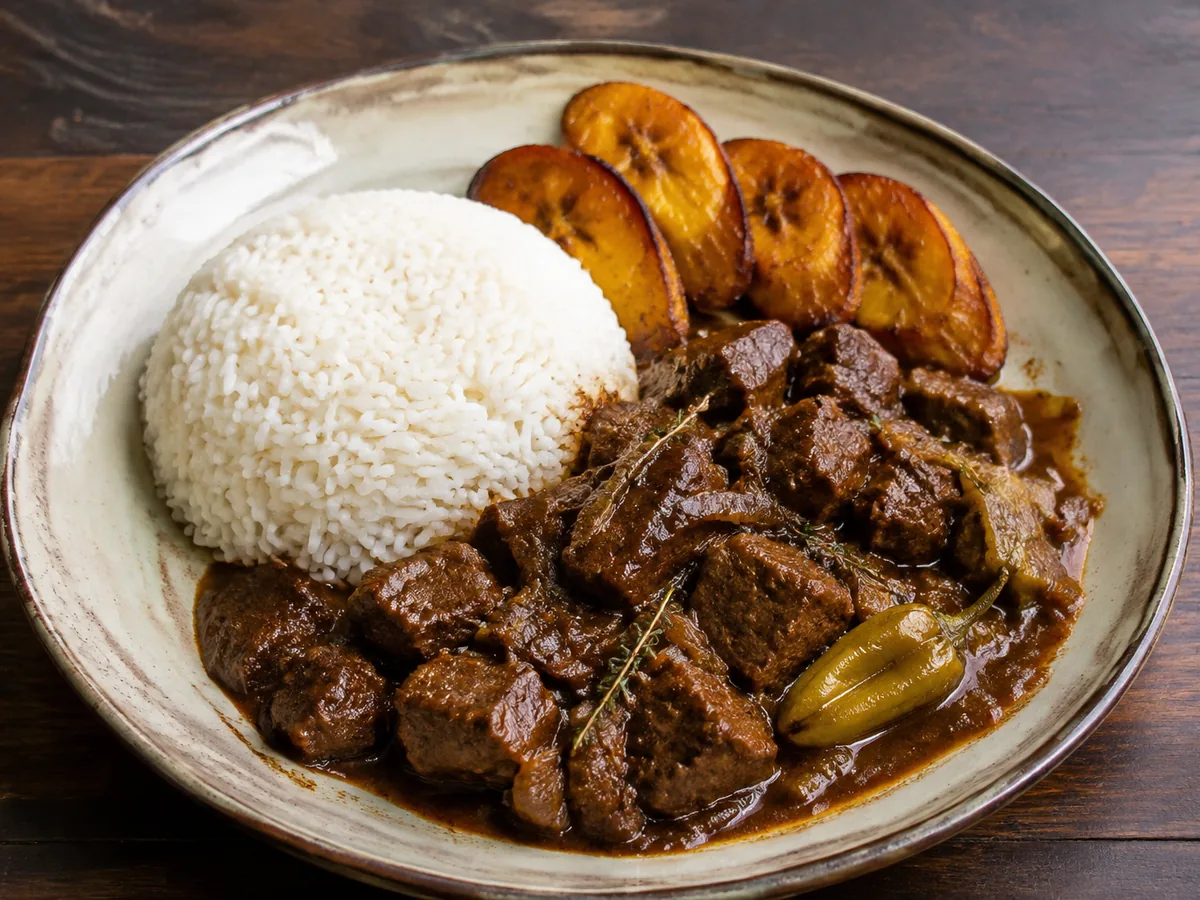
In the deep equatorial rainforest of French Guiana, hunting traditions form an unbroken link between Amerindian forest stewardship (Wayana, Teko, Kali’na) and Bushinengue maroons. Known locally as ‘viande des bois’ (forest meat), traditional game includes biche (red brocket deer / Mazama americana), pak (paca / Cuniculus paca), and cochon-bois (collared peccary). The meat is prepared as a fricassée—a deep, bronze-red stew slow-simmered with forest aromatics. Because wild forest game is extremely lean and dense, authentic Guianese technique requires three foundational steps: a prolonged marinade in fresh lime juice, crushed garlic, and dark agricultural rum to neutralize gamy notes; searing in smoking oil with raw cane sugar to build rich Maillard browning; and simmering with roucou (achiote / annatto seeds extracted in oil), sweet vegetarian peppers, and wild Creole thyme into an earthy, mahogany ragout.
- 1400 g3.0 lbsViande de gibier (venison shoulder, wild boar, or lean beef chuck/lamb), cut into 1.5-inch chunks
- 90 ml6 tbsp (divided)Jus de citron vert (fresh lime juice)
- 60 ml4 tbsp (divided)Rhum vieux agricole de Guyane (aged dark Guianese rum)
- 30 g8 clovesGousses d'ail (garlic cloves), finely crushed to a paste
- 8 g4 sprigsWild Creole thyme (thym frais)
- 20 g1.5 tbspPâte de roucou (annatto seed paste) or roucou oil
- 20 g1.5 tbspSucre de canne roux (unrefined cane sugar)
- 45 ml3 tbspHuile végétale (peanut or sunflower oil)
- 200 g2 mediumOignons rouges (red onions), finely chopped
- 40 g1/3 cupCiboulette or cive créole, finely chopped
- 30 g6 small peppersPiments végétariens (sweet aromatic Guianese seasoning peppers), seeded and minced
- 1 whole1 whole pepperPiment fort (habanero), kept whole with stem
- 30 g2 tbspConcentré de tomate (tomato paste)
- 1 leaf1 leafFeuille de bois d'Inde (allspice leaf) or 2 crushed allspice berries
- 700 ml3 cupsEau filtrée (filtered water) or rich game/beef stock
- 15 g1 tbsp (to taste)Gros sel marin (coarse sea salt)
- 4 g1 tspPoivre noir concassé (cracked black pepper)
Culinary science
Wild game muscle (such as venison or wild boar) differs substantially from domestic livestock. Free-ranging animals have virtually no intramuscular marbling, higher myoglobin counts, and denser bundles of connective tissue with heat-stable cross-linked collagen. Marinating in lime juice (pH 2.0–2.4) and aged rum (40% ABV) serves two chemical functions: the citric acid denatures tough surface collagen sheaths, increasing water-holding capacity, while ethanol dissolves hydrophobic gamy scent compounds (such as skatole and volatile fatty acids), flushing them away during the sear. Roucou (Bixa orellana) delivers natural color chemistry. The seeds contain high concentrations of the apocarotenoid bixin, a lipid-soluble orange-red pigment. Blooming roucou in hot cooking oil dissolves the bixin, creating a vivid red oil that acts as a heat-transfer medium. When combined with the sugar-caramelized fond and deglazed with dark rum, the bixin undergoes thermal polymerization, yielding the characteristic deep reddish-mahogany lacquer that defines Amazonian fricassées.
Five-taste audit
Salt: Coarse sea salt seasoned deeply into game fibers during marination, balancing the natural sweetness of cane sugar and rum. Fat: Neutral oil bloomed with red roucou, carrying fat-soluble bixin carotenoids and coating lean wild game muscle. Acid: High citric acidity from fresh lime juice in the marinade, breaking down strong wild game musk. Heat / Pungency: Intense garlic paste, cracked black pepper, aromatic sweet piments végétariens, and radiant warmth from the floating habanero. Umami: Caramelized game protein, tomato concentrate, pan fond deglazed with dark rum, and rich reduced bone/muscle stock.
Equipment
- A heavy black cast-iron canari or marmite en fonte, seasoned from decades of wild game stews over wood fires.
- A heavy 6-quart enameled cast-iron Dutch oven with a dense, flat base to ensure rapid heat recovery during searing.
Method
Marinate the game
Combine meat with 60 ml lime juice, 30 ml rum, half the garlic, thyme, salt and pepper. Refrigerate 4–12 hours; drain and pat very dry.
Combine meat with 60 ml lime juice, 30 ml rum, half the garlic, thyme, salt and pepper. Refrigerate 4–12 hours; drain and pat very dry.
Make roucou oil
Warm the oil with roucou paste over medium-low heat until brick-red and fragrant, about 2 minutes; do not scorch it.
Warm the oil with roucou paste over medium-low heat until brick-red and fragrant, about 2 minutes; do not scorch it.
Caramelise and sear
Add cane sugar and let it turn deep amber. Brown the meat in small batches, reserving each batch so the pot stays hot.
Add cane sugar and let it turn deep amber. Brown the meat in small batches, reserving each batch so the pot stays hot.
Build the fricassee
Cook onions and cive 5 minutes. Add remaining garlic, sweet peppers and tomato paste; cook until the paste darkens.
Cook onions and cive 5 minutes. Add remaining garlic, sweet peppers and tomato paste; cook until the paste darkens.
Deglaze
Return the meat. Remove the pot briefly from direct flame, add the remaining rum, then return to heat and scrape the fond. Add stock, allspice leaf and whole pepper.
Return the meat. Remove the pot briefly from direct flame, add the remaining rum, then return to heat and scrape the fond. Add stock, allspice leaf and whole pepper.
Braise
Cover and simmer at 88–92 °C for 75–100 minutes, until the chosen meat is fork-tender and about 85–90 °C internally. Add hot water only as needed.
Cover and simmer at 88–92 °C for 75–100 minutes, until the chosen meat is fork-tender and about 85–90 °C internally. Add hot water only as needed.
Reduce and finish
Remove the lid, pepper and allspice leaf. Reduce to a glossy coating sauce, add the remaining lime juice, and rest 10 minutes.
Remove the lid, pepper and allspice leaf. Reduce to a glossy coating sauce, add the remaining lime juice, and rest 10 minutes.
Storing it
Storage and reheating
Refrigerate up to 3 days; the flavour improves overnight. Reheat covered to 74 °C with a splash of stock. Freeze up to 3 months.
Troubleshooting
- The meat steams grey
Dry it thoroughly and brown in batches with space between pieces.
- A harsh bitter crust
The sugar or roucou burned. Keep roucou below smoking and stop caramel at deep amber.
- Lean meat dries out
Use shoulder or another collagen-rich cut and maintain a bare simmer with enough liquid.
Substitutions
Ingredient substitutions
| Ingredient | Replace with | Culinary impact and technique adjustment |
|---|---|---|
| Viande de gibier | Venison shoulder, wild boar, or lean beef chuck/shin: | Venison is leanest; wild boar is fattier and beef chuck milder. All need a collagen-rich cut rather than loin. |
| Pâte de roucou | Achiote paste or ground annatto powder mixed with oil: | Ground annatto has less body than paste; dissolve it in the measured oil before heating. |
| Piments végétariens | Sweet mini bell peppers or Cubanelle peppers: | Cubanelle or mini peppers supply sweetness but less floral perfume; do not replace them with extra hot chile. |
Scaling
Half batch
Use a 4-quart pot. Browning still requires at least two batches.
Double batch
Use two pots or sear in many batches. Double liquid only to the level needed for a braise, not automatically.
What to serve it with
- Dry white rice
- Fried ripe plantain
- Steamed cassava or breadfruit
Questions
Which meat should a home cook use?
Legally sourced venison shoulder is closest. Wild boar or lean beef chuck are practical alternatives.
Must the rum be flambéed?
No. Add it off direct flame and simmer to deglaze; flambéing is unnecessary.
Why marinate so long?
The lime, garlic, herbs and rum season dense lean meat, but tenderness still comes from the slow braise.