Colombo Guyanais
Tamil curry in a Creole pot. Pork shoulder marinated in toasted colombo powder, lime and garlic, browned, then braised with mustard seed under a whole habanero, with potato, chayote and green mango going in first and eggplant and zucchini last, so the mango's acid hurries the meat along and the sauce stays loose.
- Prep
- 1 hr 30 min
- Cook
- 1 hr 15 min
- Serves
- 6 servings
- Difficulty
- Medium
Researched · Kitchen testing pending
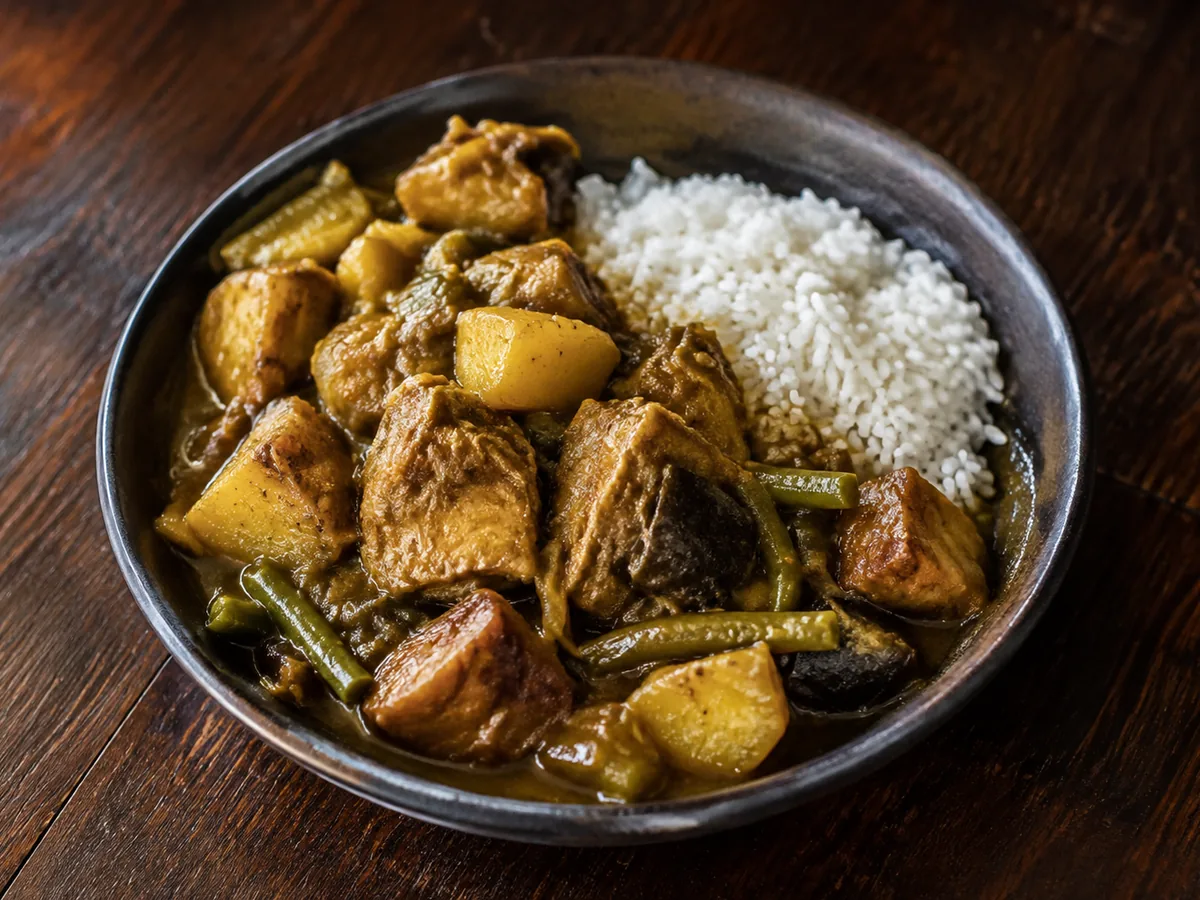
Following the abolition of slavery in 1848, thousands of indentured workers from southern India (Pondicherry and Tamil Nadu) arrived in French Guiana and the French Antilles, carrying with them their ancestral spice-roasting techniques. In the melting pot of Guianese kitchens, Indian curry traditions hybridized with Creole braising methods to birth Colombo Guyanais. Guianese colombo differs from Indian curries through its specific roasted spice blend: raw coriander seeds, cumin, yellow mustard seeds, fenugreek, and black pepper are toasted in a dry skillet with raw white rice, which serves as a natural toasted thickener, before being ground with vibrant yellow turmeric. Furthermore, the stew incorporates native tropical vegetables—chayote (christophine), eggplant, and critically, green unripe mango (mangue verte)—whose crisp, sour flesh melts into the sauce, lending a fruity tartness that balances rich pork or poultry.
- 1200 g2.6 lbsÉpaule de porc (pork shoulder), trimmed, cut into 1.5-inch chunks (or bone-in chicken thighs)
- 40 g4 tbsp (divided)Poudre de colombo guyanais (toasted Colombo curry powder)
- 60 ml4 tbsp (divided)Jus de citron vert (fresh lime juice)
- 30 g8 clovesGousses d'ail (garlic cloves), finely grated
- 8 g4 sprigsWild Creole thyme (thym frais)
- 250 g1 mediumMangue verte (firm unripe green mango), peeled, pitted, cut into large wedges
- 300 g1 largeChristophine / Chayote, peeled, cored, cut into 1-inch cubes
- 250 g1 mediumAubergine (eggplant), cut into 1.5-inch chunks
- 200 g1 mediumCourgette (zucchini), cut into thick rounds
- 300 g2 mediumPommes de terre (waxy potatoes), peeled, cut into 1-inch cubes
- 200 g2 mediumOignons jaunes (yellow onions), chopped
- 40 g1/3 cupCiboulette or cive créole, finely chopped
- 45 ml3 tbspHuile végétale (peanut or sunflower oil)
- 700 ml3 cupsEau filtrée (filtered water) or light stock
- 1 whole1 whole pepperPiment fort (habanero / scotch bonnet), kept whole
- 15 g1 tbsp (to taste)Gros sel marin (coarse sea salt)
- 5 g1 tspGraines de moutarde jaune (yellow mustard seeds), whole
Culinary science
The distinctive texture of Guianese Colombo stems from toasted starch suspension and fruit acid tenderization. Traditional Colombo powder incorporates raw white rice grains toasted until golden alongside coriander, cumin, and mustard seeds before milling. When bloomed in hot oil and simmered with stock, the toasted rice starches release partially dextrinized amylose, producing a naturally velvet, grain-free thickening effect that coats meat without masking bright flavors. The green unripe mango plays a biochemical role beyond flavor. High in unripe pectin and organic fruit acids (malic and citric), the green mango holds its structural integrity during the first 30 minutes of braising while steadily lowering the broth pH. This slight acidification accelerates the conversion of tough pork collagen into tender gelatin while balancing the earthy, bitter undertones of roasted turmeric and mustard.
Five-taste audit
Salt: Coarse sea salt massaged into meat and dissolved in the spiced braising liquid. Fat: Rendered pork shoulder lipids and cooking oil carrying fat-soluble curcumin and spice terpenes. Acid: Dual-source acidity: astringent malic/citric acid from unripe green mango simmering into the sauce, brightened with fresh lime juice at finish. Heat / Pungency: Mustard seed pungency, toasted black pepper, raw garlic, and warm aromatic heat from the floating habanero. Umami: Seared pork proteins, vegetable glutamates from slowly melting eggplants, and earthy toasted coriander.
Equipment
- A heavy cast-iron canari or cocotte en fonte, distributing low heat uniformly over charcoal embers.
- A heavy 6-to-7-quart enameled cast-iron Dutch oven with a tight-fitting lid to retain moisture during the slow braise.
Method
Marinate
Toss the pork with half the colombo powder, half the lime juice, garlic, thyme and salt. Refrigerate 1 hour, then blot the surface lightly.
Toss the pork with half the colombo powder, half the lime juice, garlic, thyme and salt. Refrigerate 1 hour, then blot the surface lightly.
Brown the meat
Heat oil in a Dutch oven over medium-high. Brown the pork in batches, 3–4 minutes per side, and reserve.
Heat oil in a Dutch oven over medium-high. Brown the pork in batches, 3–4 minutes per side, and reserve.
Bloom the spices
Lower to medium. Cook onion and cive 5 minutes, then stir in mustard seeds and the remaining colombo powder for 45 seconds.
Lower to medium. Cook onion and cive 5 minutes, then stir in mustard seeds and the remaining colombo powder for 45 seconds.
Start the braise
Return the pork, add water or stock and the whole pepper, and scrape up the fond. Cover and simmer gently 35 minutes.
Return the pork, add water or stock and the whole pepper, and scrape up the fond. Cover and simmer gently 35 minutes.
Stagger the vegetables
Add potatoes, chayote and green mango; simmer 20 minutes. Add eggplant and zucchini and continue 15–20 minutes until the pork reaches about 85 °C and is fork-tender.
Add potatoes, chayote and green mango; simmer 20 minutes. Add eggplant and zucchini and continue 15–20 minutes until the pork reaches about 85 °C and is fork-tender.
Finish
Remove the pepper and thyme stems. Add the remaining lime juice, adjust salt, and rest 10 minutes so the toasted-rice starch in the colombo thickens the sauce.
Remove pepper and thyme stems. Stir in the remaining lime juice and adjust salt. Rest 10 minutes to let the sauce thicken before serving.
Storing it
Storage and reheating
Refrigerate up to 3 days. Reheat slowly with a spoonful of water; the sauce thickens markedly when cold. Freeze without zucchini for up to 2 months.
Troubleshooting
- A dusty, gritty sauce
Bloom the powder briefly in oil and give its ground rice enough simmering time to hydrate.
- Mushy vegetables
Add dense potato and chayote before eggplant and zucchini.
- Tough pork
Keep a low simmer and cook to tenderness, not merely to the minimum safe temperature.
Substitutions
Ingredient substitutions
| Ingredient | Replace with | Culinary impact and technique adjustment |
|---|---|---|
| Poudre de colombo | Blend of 2 parts mild curry powder, 1 part toasted ground coriander, and 1/2 part toasted rice flour: | The blend mimics the toasted coriander and rice thickening, but standard curry powder may be hotter; add gradually. |
| Mangue verte | Green tart Granny Smith apple or peeled green papaya: | Green apple gives acidity but softens faster; add it with the eggplant. Green papaya is firmer but less tart, so add lime. |
| Christophine | Chayote squash or peeled zucchini chunks: | Zucchini releases more water and softens sooner; cut it large and add during the final 15 minutes. |
Scaling
Half batch
Use a 4-quart pot and reduce stock only enough to keep the meat half submerged.
Double batch
Use two Dutch ovens. A deep double batch steams instead of browning and crushes the vegetables.
What to serve it with
- Dry steamed white rice
- Simply cooked green beans
- Cucumber salad dressed with lime
Questions
Can I use chicken instead of pork?
Yes. Use bone-in thighs and add the vegetables earlier; cook the chicken to 74 °C without the prolonged pork braise.
Why green mango?
It supplies the tart fruit note characteristic of many Guianese versions and helps balance the toasted spices.
Should colombo powder be hot?
It is aromatic rather than primarily hot. Control chile heat with the whole pepper.