Pimentade de Poisson
Cayenne's fiery court-bouillon. Sea fish steaks marinated in lime and garlic, then poached below the boil in a sauce of sweated onion and cive, double tomato paste, ripe tomato, thyme and an allspice leaf, with a pin-pricked habanero floated whole and lifted out before the last squeeze of lime goes in.
- Prep
- 25 min
- Cook
- 30 min
- Serves
- 4 to 6 servings
- Difficulty
- Medium
Researched · Kitchen testing pending
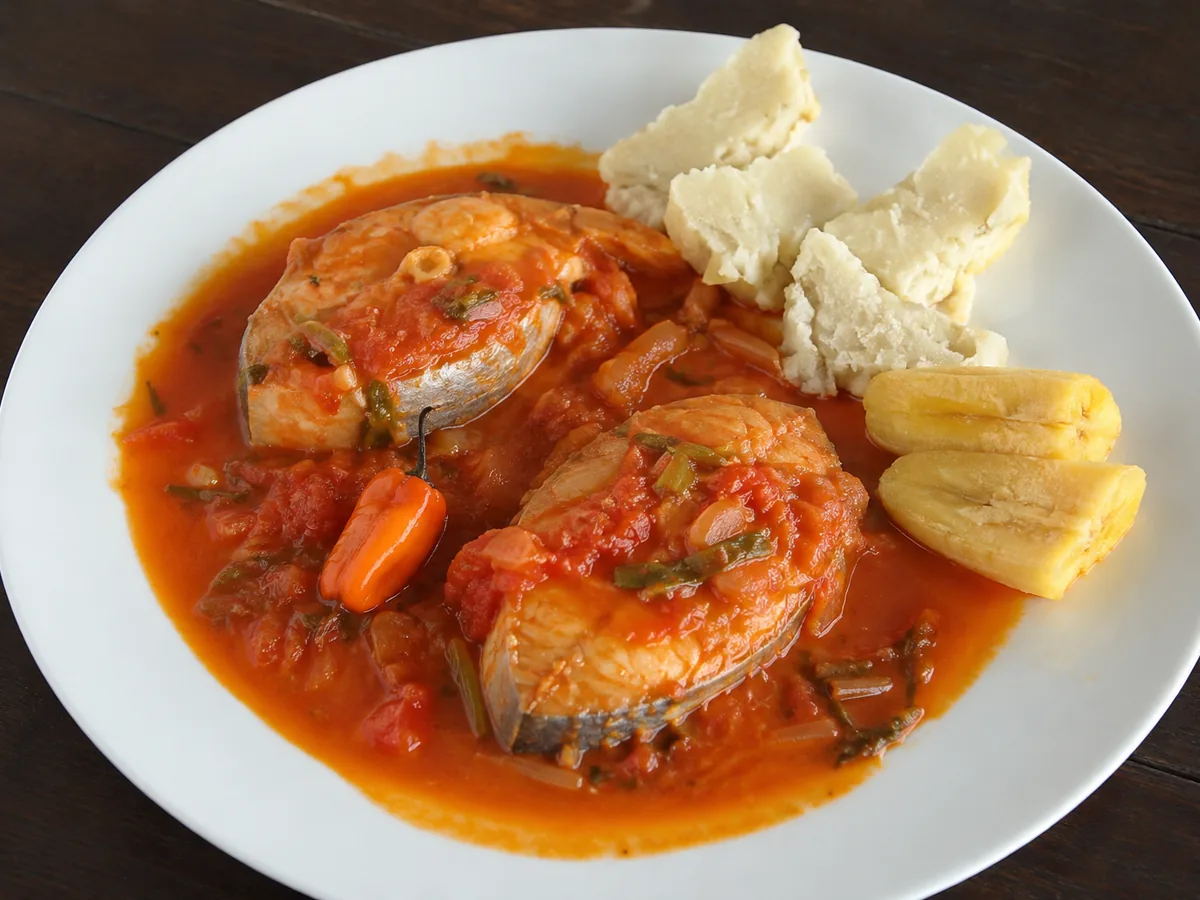
Pimentade de Poisson represents the daily coastal culinary soul of French Guiana, served from the colorful harbor markets of Cayenne to the riverbank villages along the Maroni. Unlike European bouillabaisse, which relies on complex saffron-leek reductions, the Guianese pimentade is a fiery, acid-forward court-bouillon where fresh Atlantic sea fish poaches gently in a broth spiked with lime juice, dark tomato concentrate, raw garlic, and aromatic habanero chili. Traditionally prepared with wild estuary fish such as machoiran (sea catfish), acoupa de roche (weakfish/croaker), or vivaneau (red snapper), the fish is first marinated in sour citrus to firm its muscular fibers. The sauce is cooked rapidly, balancing intense acid and capsaicin heat with the sweet, delicate flakes of local seafood, finished with toasted couac sprinkled tableside.
- 1000 g2.2 lbs (cut into 6 uniform portions)Steaks or thick fillets of sea fish (acoupa, red snapper, or sea bass), skin-on
- 90 ml6 tbsp (divided)Jus de citron vert (fresh lime juice)
- 25 g6 clovesGousses d'ail (garlic cloves), finely minced
- 1 whole1 whole pepperPiment fort (habanero / scotch bonnet), pricked with a pin
- 6 g3 sprigsWild Creole thyme (thym frais)
- 45 ml3 tbspHuile végétale (sunflower or peanut oil)
- 200 g1 largeOignons jaunes (yellow onions), finely diced
- 40 g1/3 cupCiboulette or cive créole, thinly sliced
- 60 g4 tbspConcentré de tomate (double-concentrated tomato paste)
- 300 g2 mediumTomates fraîches bien mûres (ripe tomatoes), seeded and chopped
- 1 leaf or 1 g1 leaf or 1/4 tspFeuille de bois d'Inde (allspice leaf) or ground allspice
- 600 ml2.5 cupsEau filtrée (filtered water) or light fish stock
- 10 g2 tsp (to taste)Gros sel marin (coarse sea salt)
- 3 g1/2 tspPoivre noir fraîchement moulu
Culinary science
The pimentade relies on acid-assisted protein firming. Raw fish muscle has short myotome fibers bound by fragile connective tissue (myocommata). Marinating the fish in fresh lime juice (pH ~2.2) for 15 minutes before cooking causes surface proteins to partially denature and cross-link, tightening the exterior. This prevents the delicate fish steaks from flaking apart and disintegrating when submerged into the hot court-bouillon. Managing heat extraction from the habanero pepper is a critical physical control. Capsaicin is a hydrophobic alkaloid concentrated in the pepper's inner placental ribs. By keeping the chili completely intact with its stem and gently floating it in the simmering broth, fat-soluble volatile terpenes infuse into the surface oils, imparting floral tropical aroma while restricting capsaicin release to an appetizing, invigorating warmth. If the chili bursts, capsaicin floods the aqueous phase, overwhelming the dish.
Five-taste audit
Salt: Clean sea salt dissolved into the court-bouillon, seasoning the fresh fish flakes from the exterior inward. Fat: Modest vegetable oil sautéing the aromatics; overall a lean, clean, mineral-rich broth. Acid: High, bright citric acidity from lime juice combined with tomato malic and citric acids, defining the pimentade profile. Heat / Pungency: Intense but controlled capsaicin heat from whole habanero simmered in broth, reinforced by raw garlic and cracked pepper. Umami: Glutamates from concentrated tomato paste and gelatin-rich fish bones and skin dissolving during poaching.
Equipment
- A wide, shallow enamelled cast-iron sauteuse or canari permettant to lay fish steaks in a single flat layer.
- A 12-inch heavy stainless steel skillet with high straight sides and a tight-fitting glass lid.
Method
Season the fish
Pat the fish dry. Coat it with half the lime juice, half the garlic, 4 g salt and black pepper; refrigerate 15 minutes, then drain without rinsing.
Pat the fish dry. Coat it with half the lime juice, half the garlic, 4 g salt and black pepper; refrigerate 15 minutes, then drain without rinsing.
Sweat the aromatics
Heat the oil in a wide skillet over medium. Cook onion and cive 4 minutes without browning; add the remaining garlic and cook 30 seconds.
Heat the oil in a wide skillet over medium. Cook onion and cive 4 minutes without browning; add the remaining garlic and cook 30 seconds.
Cook the tomato base
Stir in tomato paste for 1 minute, then add chopped tomatoes, thyme and allspice leaf. Cook 5–7 minutes until glossy and reduced.
Stir in tomato paste for 1 minute, then add chopped tomatoes, thyme and allspice leaf. Cook 5–7 minutes until glossy and reduced.
Form the court-bouillon
Add water or fish stock and the whole pepper. Simmer uncovered 10 minutes, keeping the pepper intact.
Add water or fish stock and the whole pepper. Simmer uncovered 10 minutes, keeping the pepper intact.
Poach gently
Lay the fish in one layer, cover, and hold the liquid below a boil. Poach 8–12 minutes, depending on thickness, to 63 °C; turn only once if the liquid does not cover the steaks.
Lay the fish in one layer, cover, and hold the liquid below a boil. Poach 8–12 minutes, depending on thickness, to 63 °C; turn only once if the liquid does not cover the steaks.
Finish
Remove the pepper and allspice leaf. Add the remaining lime juice, taste for salt, and spoon the sauce over the fish without breaking the steaks.
Remove the pepper and allspice leaf. Add the remaining lime juice, taste for salt, and spoon the sauce over the fish without breaking the steaks.
Storing it
Storage and reheating
Refrigerate fish and sauce within two hours and use within 2 days. Reheat gently only once; vigorous boiling dries the fish.
Troubleshooting
- Fish breaks apart
Use thick, firm steaks, keep the poach below a boil and move them only once.
- The broth is painfully hot
The pepper split. Keep it whole and lift it out before serving.
- A thin, raw-tasting sauce
Reduce the tomato base before adding water; the paste should darken and the fresh tomato should collapse.
Substitutions
Ingredient substitutions
| Ingredient | Replace with | Culinary impact and technique adjustment |
|---|---|---|
| Acoupa / Vivaneau | Red snapper, black sea bass, or cod fillets: | Cod is softer than snapper; cut thick steaks and shorten the poach. Sea bass and halibut hold more firmly. |
| Cive créole | Scallions or spring onions: | Scallion is slightly less pungent; use both white and green parts. |
| Feuille de bois d'Inde | Ground allspice or a fresh bay leaf: | Bay plus a clove approximates the warm aroma but tastes less distinctly of allspice; remove both before serving. |
Scaling
Half batch
Use a 10-inch skillet and keep the fish in one layer. Sauce timing is nearly unchanged.
Double batch
Use two skillets. Crowding or stacking the steaks makes them break and cook unevenly.
What to serve it with
- Dry white rice
- Boiled cassava, plantain or sweet potato
- Toasted couac sprinkled at the table
Questions
What fish works best?
Firm skin-on steaks of snapper, croaker, sea bass or halibut hold together best.
Is the lime marinade a safety step?
No. Lime seasons and firms the surface; only controlled heat cooks the fish.
Can I prepare the sauce ahead?
Yes. Refrigerate the tomato base up to 2 days, then reheat and poach the fish only when ready to serve.