Bouillon d’Awara
The Easter stew of French Guiana. Awara palm paste opened into a quiet simmer, then twice-desalted pig tails, smoked hock and belly for two hours, free-range chicken for one, cabbage, yardlong beans and cassava leaves, and last the smoked fish, cracked mangrove crabs and prawns under two whole habaneros, rested and brightened with lime.
- Prep
- 1 hr 30 min
- Cook
- 4 hr 30 min
- Serves
- 10 to 12 ceremonial servings
- Difficulty
- Hard
Researched · Kitchen testing pending
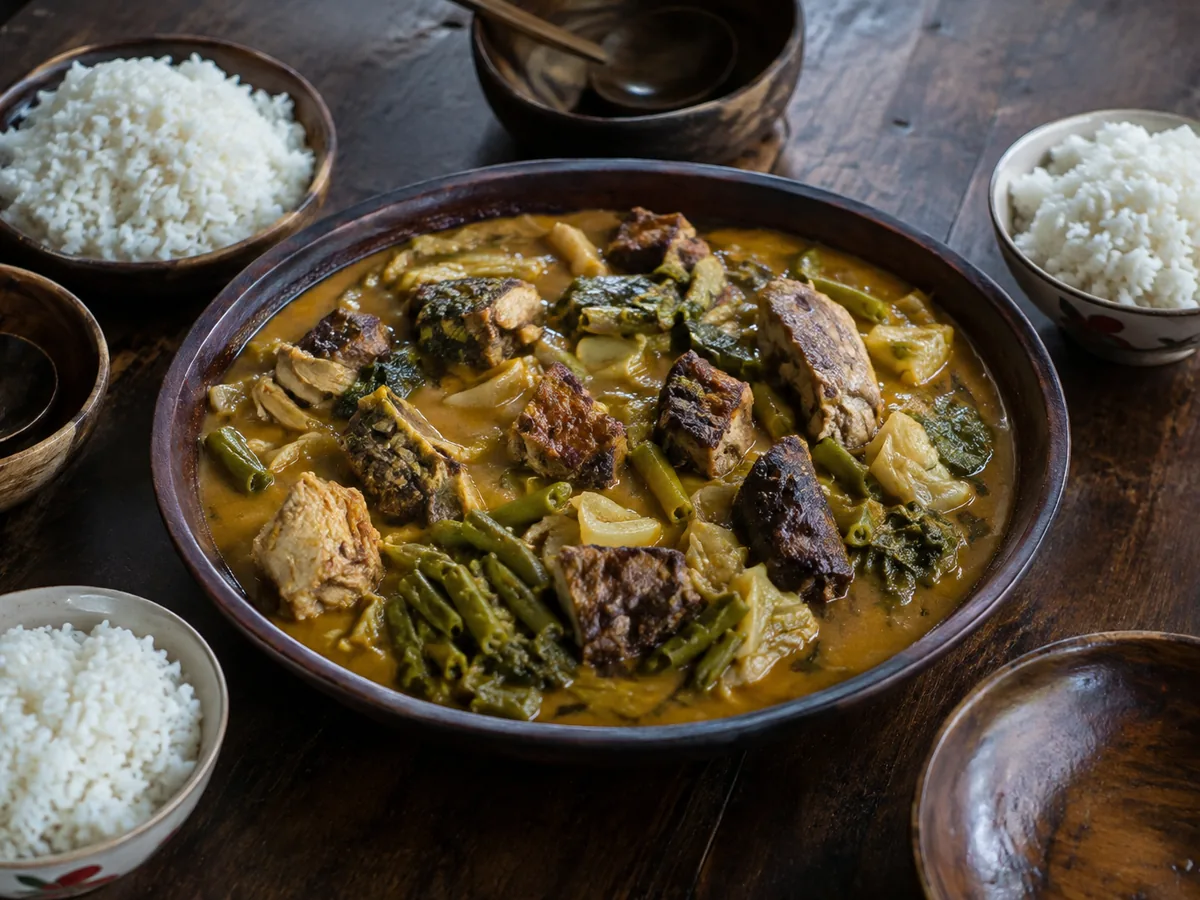
In French Guiana, an old Creole proverb declares: ‘Si tu manges du bouillon d’awara, en Guyane tu reviendras’ (If you eat awara broth, to Guiana you will return). Prepared ceremonially for Easter Sunday and Pentecost, Bouillon d’Awara represents the sacred culinary summit of Guianese identity. It unites the three foundational heritages of the territory: the Amerindian extraction of native forest palm fruits, the African Bushinengue mastery of smoked game and river fish, and the European Creole salt-curing and vegetable braising traditions. The soul of the dish resides in the bright orange paste extracted from the fruit of the awara palm (Astrocaryum vulgare). The hard orange drupes are boiled, pounded in wooden mortars, and pressed to yield a thick, vitamin-rich, fatty pulp. In this unctuous orange nectar, a multitude of cured, smoked, and fresh proteins simmer sequentially alongside tropical greens: smoked pork knuckle, salted pigtails, country chicken, smoked river fish, sea crabs, and wild prawns, bound together by cabbage, yardlong beans, and spinach.
- 1500 g3.3 lbs (approx. 6 cups)Pâte d'awara (pure palm fruit pulp, unsweetened)
- 2000 ml8.5 cupsWater or light unsalted poultry stock
- 500 g1.1 lbsQueue de cochon salée (salted pig tails), cut into 2-inch segments, blanched
- 300 g10.5 ozLardons fumés or smoked pork belly, cut into thick lardons
- 600 g1.3 lbsJarret de porc fumé (smoked pork knuckle/hock), bone-in, sliced
- 1200 g2.6 lbsPoulet fermier (free-range chicken), cut into 8 bone-in pieces
- 400 g14 ozPoisson fumé (smoked sea catfish/machoiran or smoked cod), flaked large
- 6 whole6 whole crabs (approx. 800 g / 1.75 lbs)Crabes de palétuvier (mangrove crabs), cleaned, cracked, top shell removed
- 450 g1.0 lbCrevettes de mer de Guyane (wild sea prawns), whole head-on
- 400 g14 ozChou blanc (white cabbage), cored, cut into large wedges
- 250 g9 ozHaricots verts or haricots kilomètre (yardlong beans), trimmed, cut into 2-inch lengths
- 200 g7 ozÉpinards pays or young cassava leaves, washed thoroughly
- 200 g7 ozConcombre piquant (West Indian gherkin / ti-concombre), halved
- 250 g9 ozAubergines (eggplants), cut into large 1.5-inch cubes
- 300 g2 mediumOignons jaunes (yellow onions), peeled and finely chopped
- 30 g8 clovesGousses d'ail (garlic cloves), peeled, finely grated
- 10 g4 sprigsThym frais pays (fresh broadleaf thyme)
- 3 leaves3 leavesFeuilles de laurier (bay leaves)
- 50 g1/2 cupCiboulette or cive créole (scallions), finely chopped
- 2 whole2 whole chilies (unbroken)Piment habanero (piment fort / piment bondamanjak), kept whole
- 45 ml3 tbspJus de citron vert (fresh lime juice)
- To tasteTo tasteGros sel marin (coarse sea salt) and black pepper
Culinary science
The scientific core of Bouillon d'Awara lies in stabilizing a massive carotenoid-lipid-protein emulsion. Awara palm fruit pulp (Astrocaryum vulgare) is extraordinarily rich in beta-carotene, palmitic acid, and oleic acid. Unlike water-based stews, the awara paste acts as a continuous lipid phase suspended in stock. When gently simmered at 88°C to 92°C (190°F–198°F), the collagen from salted pigtails and pork hocks hydrolyzes into soluble gelatin peptides, which seat themselves along the lipid-water interface, stabilizing the rich orange broth without separating into greasy oil slicks. Protein staggering is thermodynamically essential. Tough connective tissues in pork hocks require over three hours of moist heat to tenderize. Adding delicate sea prawns, mangrove crabs, and smoked fish at the beginning would denature actin and myosin into chalky rubber. Prawns and crabs enter during the final 20 minutes, allowing crustacean shell astaxanthin to extract into the warm lipid phase while preserving sweet, juicy flesh.
Five-taste audit
Salt: Layered salinity delivered by desalted pigtails, cured pork knuckle, and smoked sea fish, tempered by sweet root starch and cabbage water. Fat: Dense red-orange palm oil lipids from pure awara pulp and rendered smoked pork, creating an opaque colloidal emulsion. Acid: Finishing squeeze of fresh lime juice and natural vegetable malic acid, cutting the heavy lipid density of the palm broth. Heat / Pungency: Whole unbroken habanero peppers releasing floral capsicum notes without burning the palate, complemented by fresh garlic and allicin from cives. Umami: Profound multi-protein glutamates derived from smoked pork collagen, marine nucleotides in crabs and prawns, and cured fish.
Equipment
- A massive black cast-iron cauldron (canari en fonte) set over hardwood embers in an outdoor kitchen (carbet), allowing radiant heat to envelop the thick stew.
- A heavy 10-to-12-quart enameled cast-iron Dutch oven or thick tri-ply stainless steel stockpot. Heat diffusers are recommended on gas burners to prevent bottom scorching.
Method
Desalt the cured meats
Cover the pigtails and smoked pork hock with cold water, bring to a boil for 10 minutes, drain, rinse, and repeat if the water remains aggressively salty.
Cover the pigtails and smoked pork hock with cold water, bring to a boil for 10 minutes, drain, rinse, and repeat if the water remains aggressively salty.
Open the awara base
Whisk the awara paste with the water or stock in the largest heavy pot. Bring it only to a quiet simmer, 88–92 °C; scrape the base often so the dense palm pulp cannot catch.
Whisk the awara paste with the water or stock in the largest heavy pot. Bring it only to a quiet simmer, 88–92 °C; scrape the base often so the dense palm pulp cannot catch.
Tenderise the pork
Add the pigtails, pork belly and hock. Simmer partly covered for 2 hours, stirring the bottom every 15 minutes and adding hot water whenever the solids cease to move freely.
Add the pigtails, pork belly and hock. Simmer partly covered for 2 hours, stirring the bottom every 15 minutes and adding hot water whenever the solids cease to move freely.
Add the chicken
Nestle in the chicken and simmer 60 minutes more, until the dark meat reaches at least 74 °C and the pork is approaching fork-tender.
Nestle in the chicken and simmer 60 minutes more, until the dark meat reaches at least 74 °C and the pork is approaching fork-tender.
Build the vegetable layer
Add cabbage, yardlong beans and the remaining firm vegetables from the ingredient list. Simmer 35–45 minutes. Add country spinach only for the final 15 minutes. If using cassava leaves, never add them raw at this late stage: use commercially prepared leaves or boil them separately according to the supplier's safety directions until fully cooked, then stir them into the pot.
Add cabbage, yardlong beans and remaining firm vegetables; simmer 35–45 minutes, adding country spinach for the last 15. Never add raw cassava leaves here: use commercially prepared leaves or separately boil following supplier safety directions until fully cooked before adding.
Stagger the seafood
Fold in the smoked fish, then add the cracked crabs. After 10 minutes, add the prawns and the whole unbroken pepper. Simmer 8–10 minutes, just until the prawns are opaque and the crab is hot through.
Fold in the smoked fish, then add the cracked crabs. After 10 minutes, add the prawns and the whole unbroken pepper. Simmer 8–10 minutes, just until the prawns are opaque and the crab is hot through.
Balance and rest
Remove the pepper. Taste before adding salt, brighten with the measured lime, and rest off heat for 20 minutes. The broth should remain thick and glossy, never split or scorched.
Remove the pepper. Taste before adding salt, brighten with the measured lime, and rest off heat for 20 minutes. The broth should remain thick and glossy, never split or scorched.
Storing it
Storage and reheating
Cool in shallow containers within two hours. Refrigerate up to 3 days or freeze up to 2 months. Reheat to a full simmer, stirring from the base, and do not repeatedly cool and reheat seafood portions.
Troubleshooting
- A scorched, bitter base
Awara paste settles quickly. Use low heat, a heavy pot and a flat wooden spoon that reaches every part of the base.
- Seafood that turns rubbery
Add crab and prawns only near the end; the cured meats need hours, but the seafood needs minutes.
- A stew that is too salty
Blanch cured meats first and postpone final salt until all smoked and salted proteins have simmered.
Substitutions
Ingredient substitutions
| Ingredient | Replace with | Culinary impact and technique adjustment |
|---|---|---|
| Pâte d'awara | Brazilian pupunha paste or tinned Moqueca palm pulp base: | The substitute is milder and less fatty; add it gradually and expect a lighter, less distinctly awara broth. |
| Queue de cochon salée | Salt pork or corned beef brisket: | Salt pork keeps salinity but contributes less skin collagen; brisket adds body but changes the cured-pork character. |
| Poisson fumé (machoiran) | Hot-smoked haddock or smoked cod: | Smoked haddock or cod is saltier and more assertive; rinse if necessary and add late so it does not shred away. |
Scaling
Half batch
Use a 6-to-7-quart pot. Keep the same blanching and seafood timings; begin checking the pork 30 minutes early.
Double batch
Use two large pots rather than one overfilled vessel. Divide every ingredient evenly and cook both batches on separate burners.
What to serve it with
- Dry steamed white rice
- Fresh couac offered at the table
- Lime wedges and a restrained hot-pepper condiment
Questions
Can bouillon d’awara be made in one day?
Yes. This professional-kitchen version concentrates the traditional long communal cook into about four and a half hours, but it still needs staged additions and frequent stirring.
Can I omit one of the meats?
Yes. Keep a balance of smoked or salted meat, poultry and seafood rather than replacing every protein with the same type.
How do I know the awara paste is cooked?
It loses its raw palm edge, turns glossy and coats the spoon while the pork collagen becomes tender. It must not smell scorched.