Falklands Lamb Pasties
The shearing-shed lunch, carried to the gangs in a tin. Cold butter rubbed into flour and brought together with cold water, chilled, rolled into circles and filled raw with small dice of lamb shoulder, potato, swede and onion, seasoned and dotted with butter. Crimped, brushed with egg, vented, and baked until the pastry is deep gold and the filling piping hot.
- Prep
- 1 hr
- Cook
- 45 min
- Serves
- 8 pasties
- Difficulty
- Hard
Researched · Kitchen testing pending
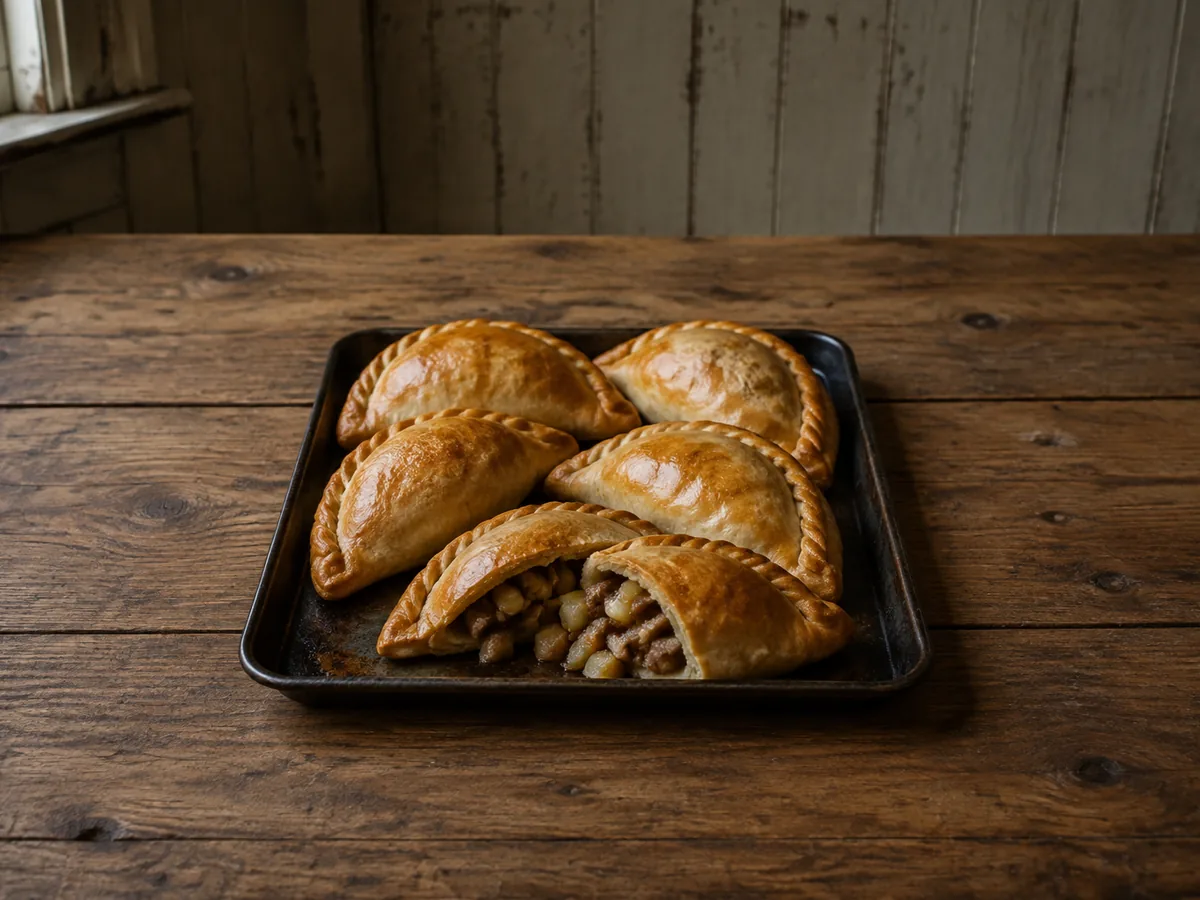
Shearing season on the Falklands means gangs of shearers moving from farm to farm, and the farm’s kitchen sends the lunch out to the shed. Pasties travel: a butter pastry sealed around raw lamb, potato, swede and onion, baked until the filling makes its own gravy, and eaten cold from the hand.
They are the Cornish pasty a long way from home, with the islands’ lamb instead of beef, and the crimp is still the test of the cook.
Pastry
- 500 g4 cupsAll-purpose flour
- 6 g1 tspFine salt
- 250 g1 cup plus 2 TbspButter, cold, in cubes
- 180 ml¾ cupCold water
- 11Egg, beaten
Filling
- 600 g1⅓ lbLamb shoulder, in 1 cm dice
- 400 g14 ozPotatoes, peeled, in 1 cm dice
- 250 g9 ozSwede, peeled, in 1 cm dice
- 1 medium1 mediumOnion, finely chopped
- 8 g1¼ tspFine salt
- 3 g¾ tspBlack pepper
- 30 g2 TbspButter, in 8 small pieces
Raw filling
Everything goes into the pastry raw and cooks in its own steam, which is why the dice must be small and even and the seasoning generous. The butter dotted on top melts into the gravy.
A firm crimp
The crimp is not decoration. A pasty that opens in the oven loses its gravy; fold the edge over on itself and press hard, then vent the top so steam has somewhere better to go.
The five tastes on this plate
Salt is in the pastry and the filling. Fat is butter, in both. Acid is the pickle or brown sauce beside. Heat is black pepper, more than you think. Umami is lamb cooked in its own juices.
Equipment
- Large bowl
- Rolling pin and a 20 cm plate, for cutting circles
- Two baking trays lined with parchment
- Pastry brush
- Instant-read thermometer
A cold kitchen and cold hands make good pastry. On a warm day, chill the bowl and the flour too.
Method
Make the pastry10 min
Whisk the flour and salt, rub in the cold butter until the mixture is sandy with some pea-sized pieces, add the cold water and bring together without kneading. Wrap and chill 30 minutes.
Whisk the flour and salt, rub in the cold butter until the mixture is sandy with some pea-sized pieces, add the cold water and bring together without kneading. Wrap and chill 30 minutes.
Dice the filling20 min
Cut the lamb, potato and swede into even 1 cm dice and mix with the onion, salt and pepper in a bowl.
Cut the lamb, potato and swede into even 1 cm dice and mix with the onion, salt and pepper in a bowl.
Roll and cut10 min
Heat the oven to 200 °C. Roll the pastry 3 mm thick and cut 8 circles of 20 cm around the plate, re-rolling once.
Heat the oven to 200 °C. Roll the pastry 3 mm thick and cut 8 circles of 20 cm around the plate, re-rolling once.
Fill and seal15 min
Pile an eighth of the filling on one half of each circle, leaving a 2 cm edge, and set a piece of butter on top. Brush the edge with egg, fold the pastry over, and crimp firmly by folding the edge over itself in a rope. Set on the trays, brush with egg, and cut a small vent in the top of each.
Place one-eighth of filling on half of each circle, leaving a 2 cm border; top with butter. Egg-wash edges, fold over and firmly crimp the edge over itself. Transfer to trays, brush with egg and cut a small steam vent.
Bake45 min
Bake 15 minutes at 200 °C, then lower to 180 °C and bake 25 to 30 minutes more until deep gold and the filling reads at least 75 °C through the vent.
Bake 15 minutes at 200 °C, then lower to 180 °C and bake 25 to 30 minutes more until deep gold and the filling reads at least 75 °C through the vent.
Rest10 min
Rest 10 minutes on the trays; the filling is scalding.
Rest 10 minutes on the trays; the filling is scalding.
Sensory cues of doneness
- Visual: a glossy, deep gold shell with a browned crimp; a cut pasty shows tender lamb and potato in a little gravy.
- Auditory: a soft bubbling through the vent in the last minutes.
- Olfactory: baked butter pastry and roasting lamb.
Look for a glossy, deep gold shell and browned crimp; the filling should show tender lamb and potato with gravy. Expect gentle bubbling through the vent near the end and butter-pastry and lamb aromas.
Storing it
Keep 3 days refrigerated and reheat at 180 °C for 15 minutes, to 74 °C inside. They freeze baked or unbaked for 2 months; bake unbaked ones from frozen with 15 minutes more.
Troubleshooting
- Filling still firm.
Dice too big, or pulled too early. One centimetre, and 75 °C through the vent.
- Soggy base.
Wet filling, or a cool tray. Drain the diced potato and bake on the middle shelf.
- Crimp opened.
Egg on the edge, fold and press hard, and always a vent.
Substitutions
One-to-one swaps, with the technique change each one needs.
Ingredient substitutions
| Ingredient | Replace with | Culinary impact and technique adjustment |
|---|---|---|
| Lamb shoulder | Beef skirt, the Cornish way, or mutton | Beef needs the same dice; mutton wants 10 minutes more |
| Swede | Turnip or carrot | Carrot is sweeter; keep the dice small |
| Butter pastry | Half butter, half lard | Flakier and the older shearing-shed recipe |
Scaling
Half
Four pasties from half the pastry; the same oven times.
Double
Make the pastry in two batches to keep it cold; bake in two rounds.
What to serve it with
- Brown sauce or a pickle
- A mug of tea in the shed
- Baked beans, for the full working lunch
Questions
Is this a Cornish pasty?
Its descendant. British settlers brought the pasty south, and the islands filled it with what they had, which was lamb and swede.
Why raw meat?
The whole point of a pasty: the filling cooks inside the pastry and makes its own gravy. Cooked filling turns dry.
Can they be eaten cold?
That is how the shearing gangs get them. Cold, in the hand, out of a tin.