Camp Mutton Stew
The winter pot of the settlements. Mutton shoulder browned in batches until the pan carries a dark fond, onions softened in the fat and dusted with flour, the meat returned with stock and bay for two hours at the gentlest simmer, then carrots, swede and potatoes added and cooked until everything is tender at once. Rested, skimmed and seasoned before it meets bread.
- Prep
- 35 min
- Cook
- 3 hr
- Serves
- 6
- Difficulty
- Easy
Researched · Kitchen testing pending
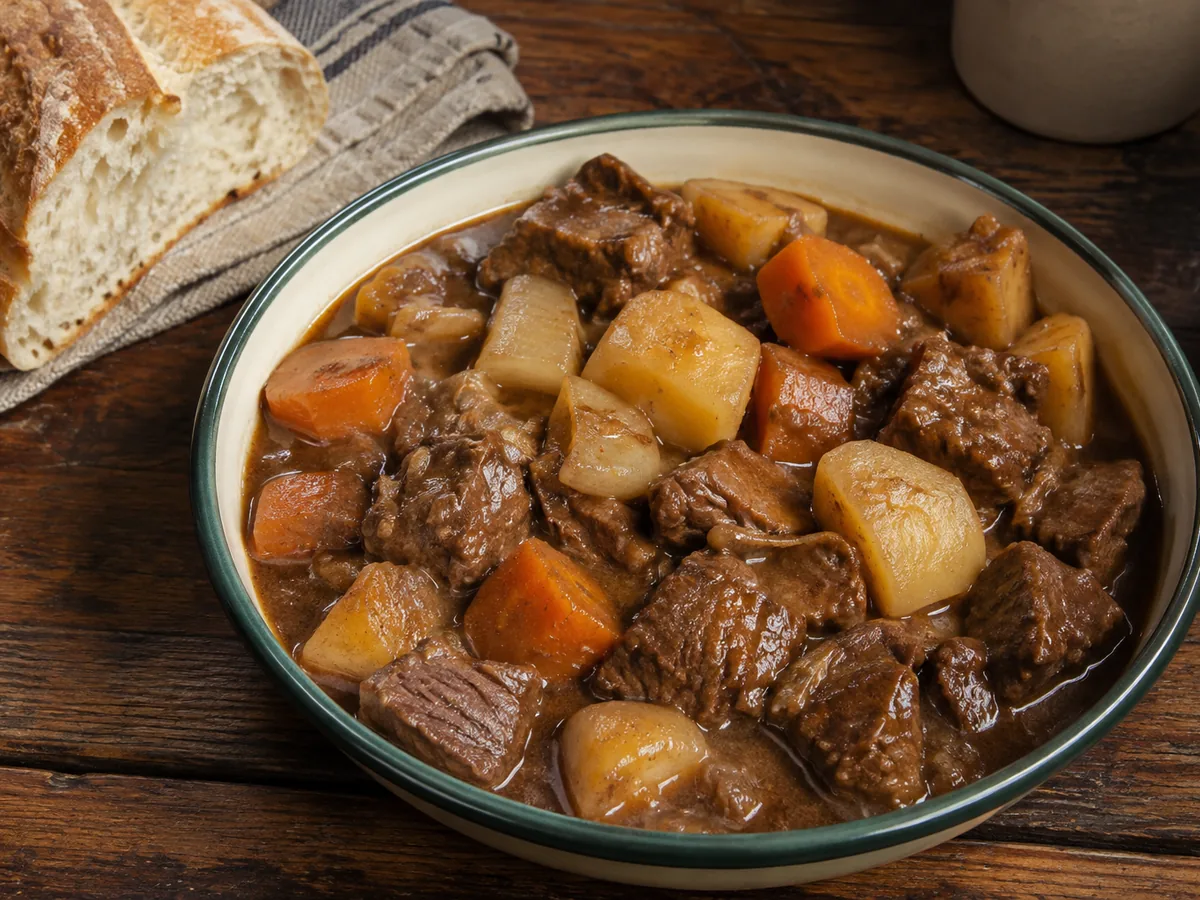
In camp, the settlements and farms outside Stanley, a stew goes on the range in the morning and is eaten when the day’s work is done. Mutton is the meat, because sheep are the islands, and the pot is filled out with the roots that grow in the cold ground: carrots, potatoes and swede.
The rule is patience. Two hours before the vegetables go in, at a simmer so slow it barely moves, and the mutton gives up everything it has.
- 1.5 kg3⅓ lbMutton shoulder, in 4 cm cubes
- 10 g1½ tspFine saltdivided
- 3 g¾ tspBlack pepper
- 30 ml2 TbspOil or dripping
- 2 medium2 mediumOnions, sliced
- 30 g¼ cupFlour
- 750 ml3 cupsLamb or beef stock
- 22Bay leaves
- 500 g1 lb 2 ozCarrots, in thick chunks
- 300 g10 ozSwede, peeled, in 3 cm chunks
- 500 g1 lb 2 ozPotatoes, peeled, in 4 cm chunks
Mutton, and time
Mutton is sheep past its first year, and on the Falklands it is what most stews are made of. It has more flavour than lamb and more connective tissue, which two hours at a bare simmer turns to gelatin. Lamb shoulder works with half an hour less.
Roots by cooking time
The vegetables go in only after the meat has had its two hours, so they cook through without collapsing into the gravy. Carrot and swede first, potatoes with them; all are done together at 45 minutes.
The five tastes on this plate
Salt is added twice, at the browning and at the end. Fat is mutton fat and dripping. Acid is a spoon of Worcestershire or a pickle beside it. Heat is black pepper. Umami is the browned meat and the reduced stock.
Equipment
- 6-quart enamelled Dutch oven with a lid
- Tongs
- Wooden spoon
- Wide spoon, for skimming
A heavy lidded pot on the lowest ring, or in a 150 °C oven, holds the gentle simmer that mutton needs without watching.
Method
Brown the mutton20 min
Pat the meat dry and season with half the salt and the pepper. Heat the oil in the pot over medium-high and brown the mutton in three batches, 5 minutes each, until dark at the edges. Set aside.
Dry the mutton; season with half the salt and the pepper. Heat oil over medium-high and brown in three batches, 5 minutes each, until dark-edged. Set aside.
Onions and flour8 min
Lower the heat, add the onions to the fat and cook 6 minutes until soft. Dust with the flour and stir 2 minutes until the raw smell goes.
Lower the heat, add the onions to the fat and cook 6 minutes until soft. Dust with the flour and stir 2 minutes until the raw smell goes.
The long simmer2 hr
Return the meat and its juices, add the stock and bay leaves, and bring to a boil, scraping the base. Lower to the gentlest simmer, cover, and cook 2 hours, stirring once or twice.
Return the meat and its juices, add the stock and bay leaves, and bring to a boil, scraping the base. Lower to the gentlest simmer, cover, and cook 2 hours, stirring once or twice.
The roots45 min
Add the carrots, swede and potatoes, pushing them under the liquid. Cover and simmer 40 to 45 minutes until the meat falls apart under a spoon and the roots are tender.
Add the carrots, swede and potatoes, pushing them under the liquid. Cover and simmer 40 to 45 minutes until the meat falls apart under a spoon and the roots are tender.
Rest, skim, season15 min
Take the pot off the heat and rest 15 minutes. Skim the fat from the surface, remove the bay leaves, and season with the remaining salt to taste.
Take the pot off the heat and rest 15 minutes. Skim the fat from the surface, remove the bay leaves, and season with the remaining salt to taste.
Serve
In deep bowls, with bread to wipe them.
In deep bowls, with bread to wipe them.
Sensory cues of doneness
- Visual: meat shredding at the edges, a gravy that clings to the vegetables, swede gone translucent.
- Auditory: a bubble every few seconds, no more.
- Olfactory: roasted mutton and bay, then sweet carrot.
Look for meat shredding at the edges, gravy clinging to tender vegetables and translucent swede. Keep the simmer to a bubble every few seconds; expect mutton, bay and sweet carrot aromas.
Storing it
Better on the second day. Keeps 3 days refrigerated and freezes for 3 months; reheat to a full simmer, 74 °C through.
Troubleshooting
- Tough meat after three hours.
It boiled. A hard boil tightens mutton; keep it at a bare simmer or in a 150 °C oven.
- Gravy thin.
Too much stock, or the lid was tight the whole way. Uncover for the last 20 minutes.
- Vegetables collapsed.
In too early. After the two hours, and cut large.
Substitutions
One-to-one swaps, with the technique change each one needs.
Ingredient substitutions
| Ingredient | Replace with | Culinary impact and technique adjustment |
|---|---|---|
| Mutton shoulder | Lamb shoulder or neck | Milder; 1 hour 30 minutes before the roots |
| Swede | Turnip or parsnip | Parsnip is sweeter and softens faster; add 10 minutes later |
| Stock | Water with a spoon of Marmite or a stock cube | The camp-kitchen way; check the salt |
Scaling
Half
A 4-quart pot, the same times; brown in two batches.
Double
A 10-quart pot or two. Brown in five batches so the pan stays hot.
What to serve it with
- Crusty bread, or boiled potatoes if the stew has none
- Pickled beetroot or a spoon of chutney
- A pot of tea, in camp
Questions
What does camp mean?
Everything on the Falklands outside Stanley: the farms, the settlements and the land between. Camp cooking is farmhouse cooking.
Can I make it in the oven?
Yes; 150 °C with the lid on for the two hours, then the roots and 45 minutes more.
Why brown in batches?
A crowded pan steams instead of browning, and the browning is where the gravy's colour and depth come from.