Slow-Roasted Falkland Lamb
The Sunday joint of the islands. A bone-in leg rubbed with oil, garlic, rosemary, salt and pepper, set over potatoes and carrots in a hot oven for twenty minutes to colour, then roasted slowly at 165 °C with stock in the pan to 63 °C for pink or 71 °C for well done. Rested twenty-five minutes, the tin deglazed for gravy, and carved across the grain.
- Prep
- 40 min
- Cook
- 2 hr 30 min
- Serves
- 6
- Difficulty
- Medium
Researched · Kitchen testing pending
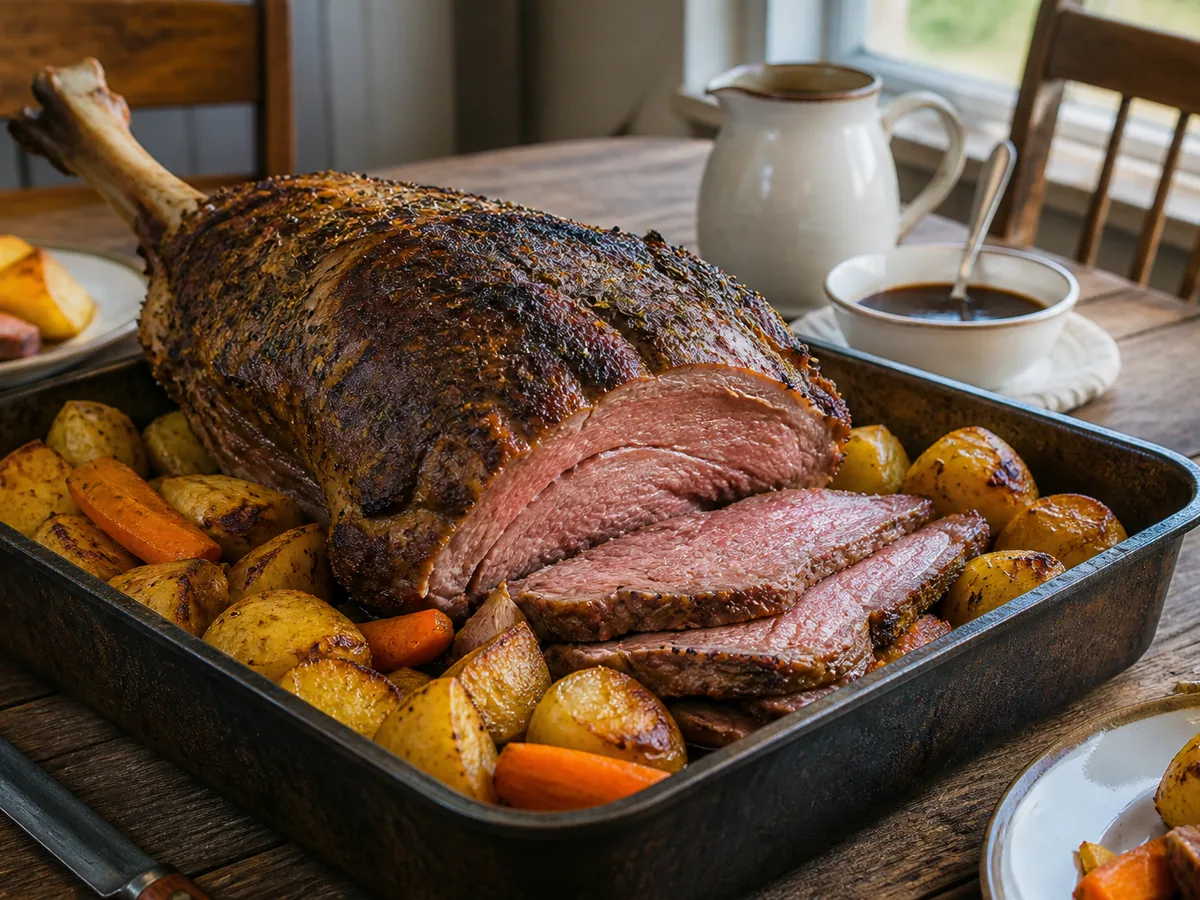
Sheep outnumber people on the Falklands by a few hundred to one, and the Sunday roast is a leg of lamb from the farm down the road. It is rubbed with garlic and rosemary, started hot and finished slow over potatoes and carrots, and carved at the table with a gravy made in the tin.
Camp tables cook it through; Stanley tables have taken to pink. Either way it rests under foil while the gravy is made, and the bone goes into the next day’s stew.
- 1.8 kg4 lbBone-in leg of lamb
- 30 ml2 TbspOil
- 6 cloves6 clovesGarlic, 4 crushed and 2 slivered
- 4 sprigs4 sprigsRosemary, leaves chopped
- 12 g2 tspFine salt
- 3 g¾ tspBlack pepper, freshly ground
- 1 kg2¼ lbPotatoes, peeled and halved
- 500 g1 lb 2 ozCarrots, in thick batons
- 500 ml2 cupsLamb or chicken stock
- 15 g2 TbspFlour, for the gravy
Two temperatures
Twenty minutes at 220 °C browns the fat and the vegetables; the rest of the roast at 165 °C cooks the leg evenly without drying the outside before the inside is done. Count on about 25 minutes per 500 g at the lower heat, and trust the thermometer over the clock.
Falkland lamb
Raised on tussock and heath with the wind off the South Atlantic, and slow-grown; it carries more flavour than a spring lamb and takes well to the long roast. Any grass-fed leg stands in.
The five tastes on this plate
Salt is in the rub and the gravy. Fat is the leg's own. Acid is a little redcurrant or diddle-dee jelly beside it. Heat is black pepper. Umami is the roasted fat, the fond and the stock.
Equipment
- Large roasting tin
- Small sharp knife, for slivering garlic into the meat
- Instant-read or probe thermometer
- Carving board with a groove, and foil
- Small saucepan or the tin itself, for the gravy
A probe thermometer left in the thickest part of the leg, clear of the bone, is the one piece of kit that matters here.
Method
Temper30 min
Take the lamb out of the fridge 30 minutes before roasting. Heat the oven to 220 °C. Make small slits in the meat with the knife and push in the garlic slivers.
Take the lamb out of the fridge 30 minutes before roasting. Heat the oven to 220 °C. Make small slits in the meat with the knife and push in the garlic slivers.
Rub5 min
Mix the oil, crushed garlic, rosemary, salt and pepper and rub it all over the leg. Toss the potatoes and carrots in the tin with a spoon of the rub and set the lamb on top of them.
Mix the oil, crushed garlic, rosemary, salt and pepper and rub it all over the leg. Toss the potatoes and carrots in the tin with a spoon of the rub and set the lamb on top of them.
The hot start20 min
Roast 20 minutes at 220 °C until the fat starts to colour.
Roast 20 minutes at 220 °C until the fat starts to colour.
The slow roast1 hr 40 min
Lower the oven to 165 °C and pour the stock into the tin. Roast about 1 hour 30 to 1 hour 45 minutes, until the thickest part reads 63 °C for pink lamb or 71 °C for well done. Baste twice with the pan juices.
Lower oven to 165 °C and add stock to the tin. Roast 1 hour 30–45 minutes, basting twice, until the thickest part reaches 63 °C for pink or 71 °C for well done; trust the thermometer over time.
Rest25 min
Move the lamb to the board, cover loosely with foil and rest 25 minutes; the temperature rises a few degrees more. Keep the vegetables warm in the tin, in the switched-off oven.
Move the lamb to the board, cover loosely with foil and rest 25 minutes; the temperature rises a few degrees more. Keep the vegetables warm in the tin, in the switched-off oven.
Gravy8 min
Lift the vegetables out. Set the tin over medium heat, whisk the flour into the juices and cook 1 minute, then add 250 ml water or more stock and simmer, scraping, until it thickens. Strain, season, and add the resting juices from the board.
Remove vegetables. Over medium heat, whisk flour into pan juices; cook 1 minute. Add 250 ml water or more stock; simmer, scraping, until thickened. Strain, season and add the lamb’s resting juices.
Carve
Carve across the grain in thick slices. Serve with the potatoes, carrots and gravy.
Carve across the grain in thick slices. Serve with the potatoes, carrots and gravy.
Sensory cues of doneness
- Visual: a mahogany crust; slices rosy at the centre for pink, pale grey-brown for well done; potatoes crisp-edged.
- Auditory: the fat spitting in the hot start, then a quiet sizzle at the lower heat.
- Olfactory: rosemary and garlic in roasting lamb fat.
Look for a mahogany crust and crisp potato edges; slices are rosy for pink lamb or pale grey-brown for well done. Fat spits at 220 °C, then sizzles quietly; expect rosemary, garlic and roasted lamb aromas.
Storing it
Cold roast lamb keeps 3 days refrigerated and is the next day's sandwiches. Reheat slices briefly in the gravy to 74 °C. The bone makes a stock for camp mutton stew.
Troubleshooting
- Grey and dry all through.
Cooked by time, not temperature. A probe in the thickest part, out at 63 °C for pink.
- Raw at the bone, done outside.
Roasted from cold. Thirty minutes on the counter first, and the slow second stage.
- Thin gravy.
Not reduced. Simmer until it coats a spoon, and add the board juices last.
Substitutions
One-to-one swaps, with the technique change each one needs.
Ingredient substitutions
| Ingredient | Replace with | Culinary impact and technique adjustment |
|---|---|---|
| Bone-in leg | Boneless rolled leg, or a shoulder | Boneless cooks 20 percent faster; shoulder wants 80 °C and falls apart |
| Rosemary | Thyme, or dried mint in the English way | Thyme is gentler; mint goes with the older island tables |
| Potatoes and carrots | Parsnips, swede or onion wedges | The same tin, the same time |
Scaling
Half
A 1 kg half leg: 15 minutes hot, then about 50 minutes at 165 °C.
Double
Two legs in two tins, oven shelves swapped halfway. The rest and the gravy are the same.
What to serve it with
- Redcurrant or diddle-dee jelly
- Peas, and buttered swede
- A bottle of Chilean red, the islands' nearest wine
Questions
What is Falkland lamb like?
Grass-fed, slow-grown and lean, with a deeper flavour than spring lamb; the islands export it and eat a great deal of it.
Pink or well done?
Camp tradition is well done. Sixty-three degrees gives pink lamb that most visitors prefer; both are safe once rested.
Can I roast it the day before?
Yes, cool, wrap and chill; reheat thick slices in gravy. A roast served cold with pickles is also a Falklands lunch.