Tamales de Gallina
Where a Mexican tamal whips raw masa with cold lard, the Salvadoran one cooks its dough on the stove first. Lard poured in at 75 °C coats each swelling starch granule in a lipid film that stops it cross-linking into a rubbery cake — which is why this sets into a custard that trembles on the fork.
- Prep
- 1 hr 30 min
- Cook
- 2 hr
- Serves
- 16 large ceremonial tamales
- Difficulty
- Hard
Researched · Kitchen testing pending
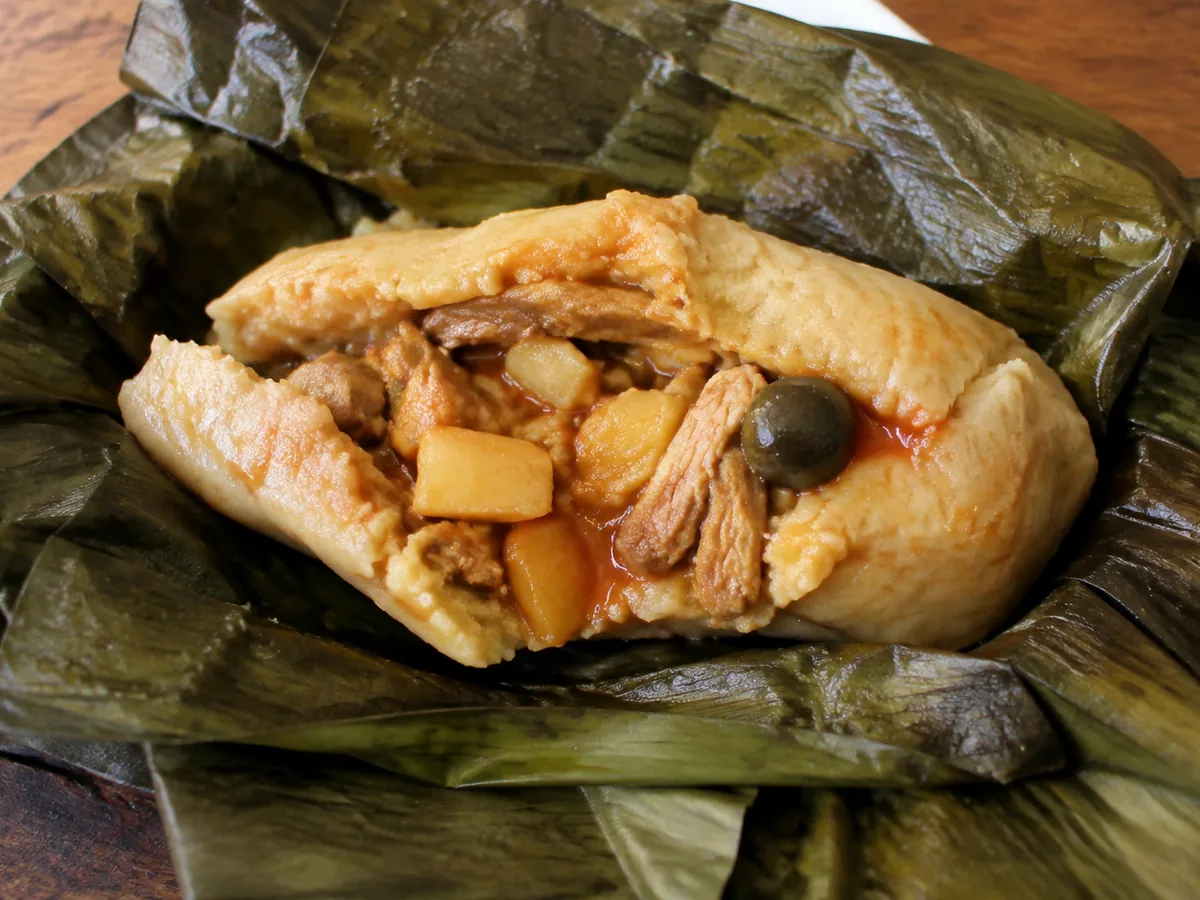
In El Salvador, Sunday mornings and Christmas belong to tamales de gallina.
Unlike the firm raw-whipped masa of Mexico, the Salvadoran tamal uses masa cocida — corn dough cooked down with rich chicken broth, rendered lard and sweet peppers until it turns into a velvety pudding. Inside sits a chunk of braised hen in spiced red recado, with potato slices, chickpeas, a green olive and a strip of sweet pepper.
Wrapped tightly in smoked banana leaves and steamed for two hours, the masa sets into a custard that trembles on the fork.
The chicken
- 1 kg2.2 lbBone-in chicken thighs and breasts, cut into 16 uniform 60 g chunks
The masa
- 600 g4 cupsPrecooked white corn flour for tamales
- 1.8 L7.5 cupsRich chicken bone broth, hot1.5 L into the masa, 250 ml into the recado
- 200 g1 cupRendered pure pork lard, or European butter
- 60 ml4 TbspAchiote oil15 ml into the recado, the rest into the masa
- 20 g1 Tbsp + 1 tspFine sea salt15 g into the masa, 5 g into the recado
- 4 g1 tspCumin seeds, freshly toasted and ground
The recado
- 600 g4 largeRipe plum tomatoes, charred on the comal
- 2 large2 largeYellow onions — one quartered for the broth, one charred for the recado
- 8 cloves8 clovesFresh garlic, minced to a pastefour of them charred for the recado
- 1 large1 largeGreen bell pepper, cored and charred
- 45 g⅓ cupRaw pepitoria, toasted and ground fine
- 30 g2 TbspWhite sesame seeds, toasted and ground fine
- 2 pieces2 piecesDried chile guaque, toasted and soaked in hot water
The filling
- 2 medium2 mediumYukon Gold potatoes, peeled, cut into 16 rounds and parboiled 5 minutes
- 150 g1 cupCooked chickpeas, skins slipped off
- 16 whole16 wholePitted green Manzanilla olives
- 1 large1 largeRed bell pepper, cut into 16 long thin strips
To wrap
- 2 kg4.4 lbSmoked banana leaves, cleaned, ribs trimmed, cut into 30 × 30 cm sheets
- 1 roll1 rollKitchen twine, or banana leaf fibre strips
Cook the masa on the stove
Whisked with hot broth at 80–85 °C, the amylose and amylopectin swell and absorb liquid before anything is wrapped. Raw masa gives a grainy chalky tamal instead of a custard.
Lard at 75 °C, in a stream
Poured in while beating hard, it films each starch granule and stops the chains cross-linking into a rubbery cake. The masa should end up glossy and falling in heavy ribbons.
Banana leaves, not husks
Their natural oils and moisture keep a pre-cooked masa custardy, and their cuticular waxes and polyphenols perfume the dough with a herbal-tea aroma that corn husks cannot give.
Follow the ratios
600 g corn flour, 1.5 L broth, 200 g lard. Under-hydrated or under-fatted, the tamal comes out dry and crumbly.
Check the water every 45 minutes
A dry steamer scorches the bottom leaves and bitter smoke goes through every tamal in the pot.
Passive time, counted separately
The chillies soak, the potatoes parboil, and the steamed tamales rest 15 minutes before unwrapping. None of that is active work.
The five tastes on this plate
Salt is the seasoned bone broth, the lard-rich masa and the briny olives. Fat is pork lard and achiote oil dispersed through the corn starch matrix. Acid is charred tomato and sweet pepper against the lard. Heat is toasted cumin, fruity guaque and sweet garlic. Umami is concentrated broth, braised poultry fond, toasted pumpkin seed and olives.
Equipment
- Comal or cast-iron skillet, for toasting and charring
- Blender
- 8 qt pot and a wooden paddle, for the masa
- 16 to 20 qt stockpot with an elevated rack
- Kitchen twine
Traditionally a large aluminium tamalera over wood embers. A 16-to-20 quart stockpot with a raised rack works in a modern kitchen — bed the bottom with extra leaves so boiling water never touches the lowest parcels.
Method
Cook the red recado25 min
Toast the pumpkin and sesame seeds and the soaked guaque, and char the tomatoes, onion, bell pepper and 4 garlic cloves.
Blend the lot with 250 ml broth until smooth, then sauté in 15 ml achiote oil 8 minutes until thick and glossy and season with 5 g salt. Toss the raw chicken chunks in 4 Tbsp of it.
Toast pumpkin seeds, sesame and soaked guaque; char tomatoes, onion, pepper and 4 garlic cloves. Blend with 250 ml broth until smooth. Sauté in 15 ml achiote oil 8 minutes until thick and glossy; add 5 g salt. Coat raw chicken with 4 Tbsp recado.
Cook the silky masa20 min
Whisk the corn flour with 1.5 L warm broth, the cumin and 15 g salt until lump-free, and cook over medium heat, stirring continuously.
At 75 °C pour in the melted lard and remaining achiote oil in a steady stream, beating hard, and cook 12 to 15 minutes until glossy and falling in heavy ribbons.
Whisk corn flour, 1.5 L warm broth, cumin and 15 g salt until smooth. Cook over medium, stirring constantly. At 75 °C stream in melted lard and remaining achiote oil, beating hard. Cook 12–15 minutes, reaching 80–85 °C, until glossy and falling in heavy ribbons.
Prepare the leaves15 min
Pass each leaf briefly over a flame, about 3 seconds a side, until pliable and dark green, and cut into 30 × 30 cm squares.
Cut parchment squares to line any leaf that tears.
Pass each leaf briefly over a flame, about 3 seconds a side, until pliable and dark green, and cut into 30 × 30 cm squares.
Cut parchment squares to line any leaf that tears.
Assemble30 min
Spoon 120 g of warm masa into the centre of a leaf square and set a piece of seasoned chicken on it.
Spoon a tablespoon of recado over the meat and add a potato round, three chickpeas, an olive and a strip of red pepper.
Place 120 g warm masa on a leaf; add seasoned chicken, 1 tablespoon recado, a potato round parboiled 5 minutes, three cooked peeled chickpeas, an olive and a red-pepper strip.
Fold and tie20 min
Bring the leaf edges together over the filling in a tight double fold, then fold the top and bottom flaps underneath into a flat rectangle.
Tie securely with twine in a cross.
Bring the leaf edges together over the filling in a tight double fold, then fold the top and bottom flaps underneath into a flat rectangle.
Tie securely with twine in a cross.
Steam2 hr
Line the rack with leaf scraps, pour in 1.5 L boiling water below rack level, and stack the tamales flat.
Cover with more leaves and foil, seal with the lid, and steam over medium-low 2 hours, topping up the water as needed. Rest 15 minutes before unwrapping.
Line rack with leaf scraps; add 1.5 L boiling water below rack and stack tamales flat. Cover with leaves, foil and lid; steam on medium-low 2 hours. Check water every 45 minutes and replenish as needed. Rest 15 minutes before opening.
Sensory cues of doneness
- Visual: a trembling silky golden-yellow block holding red-glazed chicken, potato and chickpea, releasing cleanly from the leaf.
- Auditory: steady rhythmic bubbling from the steamer and the gentle clink of parcels.
- Olfactory: steamed banana leaf, sweet corn, chicken broth, pork lard, toasted sesame and cumin.
Check for silky golden masa holding red-glazed chicken, potato and chickpea and releasing cleanly from the leaf. Keep steady bubbling in the steamer; expect banana leaf, corn, chicken broth, lard, sesame and cumin aromas.
Storing it
Wrapped tamales keep a week refrigerated or 6 months frozen. Reheat by steaming 20 minutes.
Troubleshooting
- A grainy, chalky tamal.
The masa was wrapped raw. It has to be cooked on the stove first.
- Dry and crumbly.
Too little lard or broth. Follow the ratios exactly.
- A bitter scorched note through the whole batch.
The steamer ran dry and the bottom leaves burned. Check the water every 45 minutes.
Substitutions
One-to-one global substitutions, with the technique adjustment each one requires.
Ingredient substitutions
| Ingredient | Replace with | Culinary impact and technique adjustment |
|---|---|---|
| Tamal masa flour | Fine white masa harina | One-to-one, still pre-cooked on the stovetop as directed |
| Pork lard | Unsalted European butter, or vegetable shortening | One-to-one. Butter brings a rich dairy note |
| Smoked banana leaves | Parchment inside heavy-duty foil | A mechanical wrapper only — the leaf aroma is lost |
Scaling
Half, for 8 tamales
Halve everything and steam 1 hour 45 minutes in an 8-quart pot.
Double, for 32 tamales
Double everything across two 16-quart pots so the steam circulates freely.
What to serve it with
- Hot pan francés, wrapped around the soft tamal — a beloved Salvadoran habit
- Spicy habanero sauce on the side
- Santa Ana mountain coffee, or hot spiced chocolate
Questions
Can I use pork?
Yes — tamales de cerdo use shoulder or ribs braised in the same red recado.
How long do they keep?
A week refrigerated in their leaves, 6 months frozen. Steam 20 minutes to reheat.
Why banana leaves rather than corn husks?
Their oils and moisture keep pre-cooked masa custardy, and they add a rich herbal-tea aroma.